Carve a hollow into one end of a block of explosive and there is less explosive left. Yet when that block goes off on a steel plate, the crater gets deeper, not shallower. This surprising result, confirmed in several experiments in the 1880s, is where the shaped charge begins. In the United States and Britain the effect is called the Munroe effect.
Shaped charges are best known as warheads for anti-tank weapons. But a 1998 article from Lawrence Livermore National Laboratory (LLNL) says their widest use was in the oil and gas industry. Why would less explosive dig deeper? The answer lies in the empty space and the metal lining placed inside it.
A hollow charge digs deeper
An explosion releases hot gases, known as detonation products. Leave a hollow in a cylinder of explosive, at the end away from where it is set off, and that hollow gathers the detonation products together. A smaller amount of explosive can then dig a deeper crater in a steel plate.
A 2008 report by Walters of the U.S. Army Research Laboratory (ARL) gives his own definition. A shaped charge is "a cylinder of explosive with a hollow cavity at the end opposite the initiation train." If nothing lines the cavity, it is a hollow charge.
If the cavity has a lining, or liner, made of metal, an alloy, glass, ceramic, wood or another material, it is a shaped charge in the narrower sense. The former Soviet Union called it a cumulative charge, and Germany called it a Hohlladung.
Liners come in several shapes, such as cones, hemispheres and parabolas. A liner bent shallowly like a bow gives an explosively formed penetrator (EFP), which is also a kind of shaped charge. Different shapes collapse in different ways, so the jet or slug they produce also looks different.
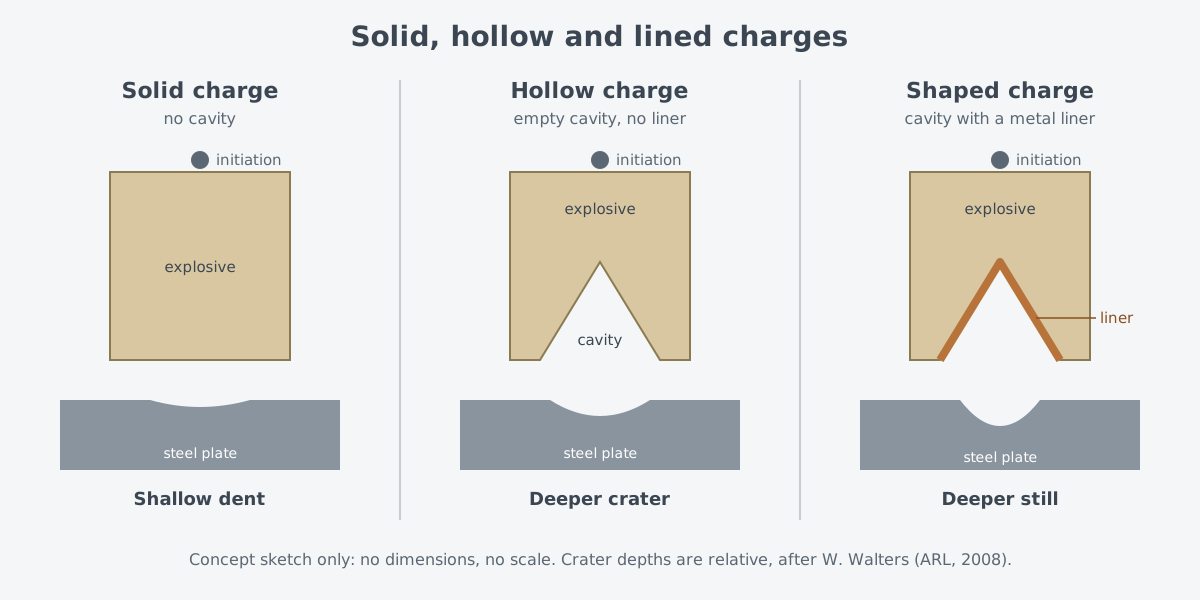
The names have a history of their own. The term "hollow charge" appears to have been coined by A. Marshall in 1920, and "shaped charge" came into use in the United States during World War II.
The letters Munroe saw
In 1888, Charles Munroe of the Naval Torpedo Station in Newport, Rhode Island, set off blocks of explosive resting against a steel plate. The face of the charge opposite the firing point carried the letters USN, for United States Navy. After the blast, the same letters were stamped into the steel. This is called explosive engraving.
Munroe went a step further. When he hollowed out the end of an explosive cylinder opposite the firing point, the crater in the steel grew deeper. There was less explosive, but the hole went further in. Walters puts the gain down to the hollow focusing the detonation products.
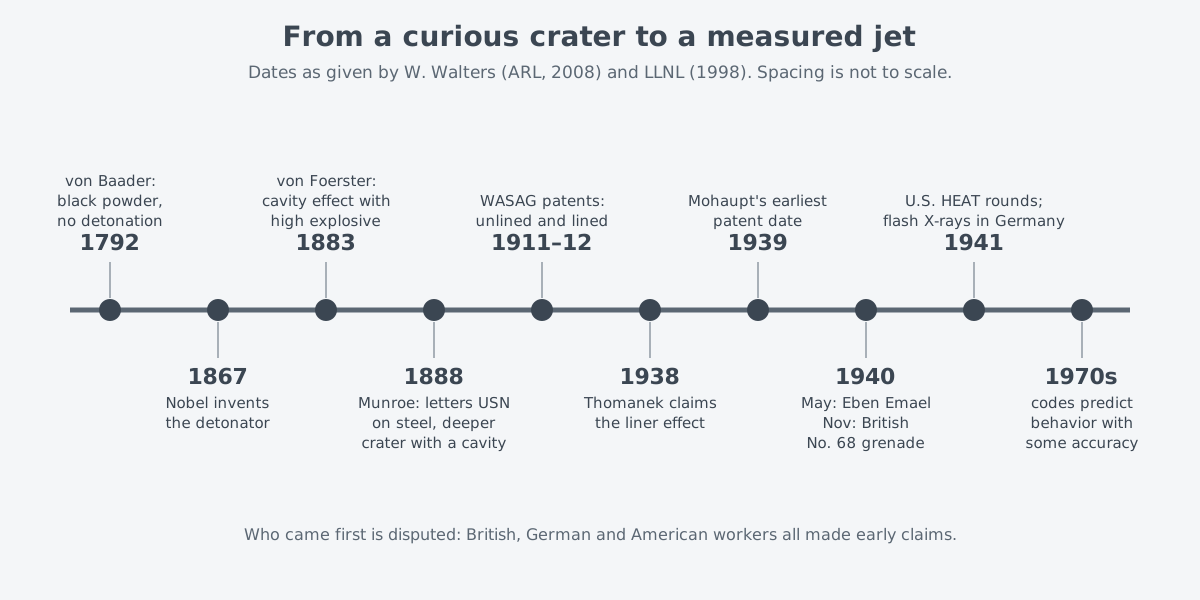
Munroe was not the first to see it. The earliest cited case of focusing a blast with a hollow belongs to Franz von Baader in 1792. But he used black powder, which cannot detonate, so Walters starts the story after Alfred Nobel invented the detonator in 1867.
The first to show the cavity effect with high explosives was von Foerster, in 1883. He also ran engraving experiments much like Munroe's. That is why Walters calls Munroe's 1888 work a "rediscovery" of the unlined shaped charge.
The same effect has a second name. Patents filed in Britain and Germany in 1911–12 by the German company WASAG showed both the unlined effect and the lined effect.
M. Neumann (1911) and E. Neumann (1914) also showed the unlined effect. The way a hollow boosts penetration is known as the Munroe effect in the United States and Britain, and as the Neumann effect in Germany.
When the metal liner becomes a jet
LLNL describes a shaped charge as a concave metal hemisphere or cone, the liner, with high explosive packed behind it, all inside a steel or aluminum case. When the explosive goes off, the liner is crushed and pushed forward into a long, thin stream of metal: the jet. The tip of this jet can move as fast as 10 km/s (10 kilometers per second).
Squeeze a toothpaste tube hard from both sides at once, and the paste crowds toward the opening and shoots out in a single line. A liner turning into a jet looks a little like that at first glance. In reality it is very different. An explosion does the squeezing, not a hand, the thing that shoots out is metal, and a typical jet-formation experiment is over in less than 30 µs.
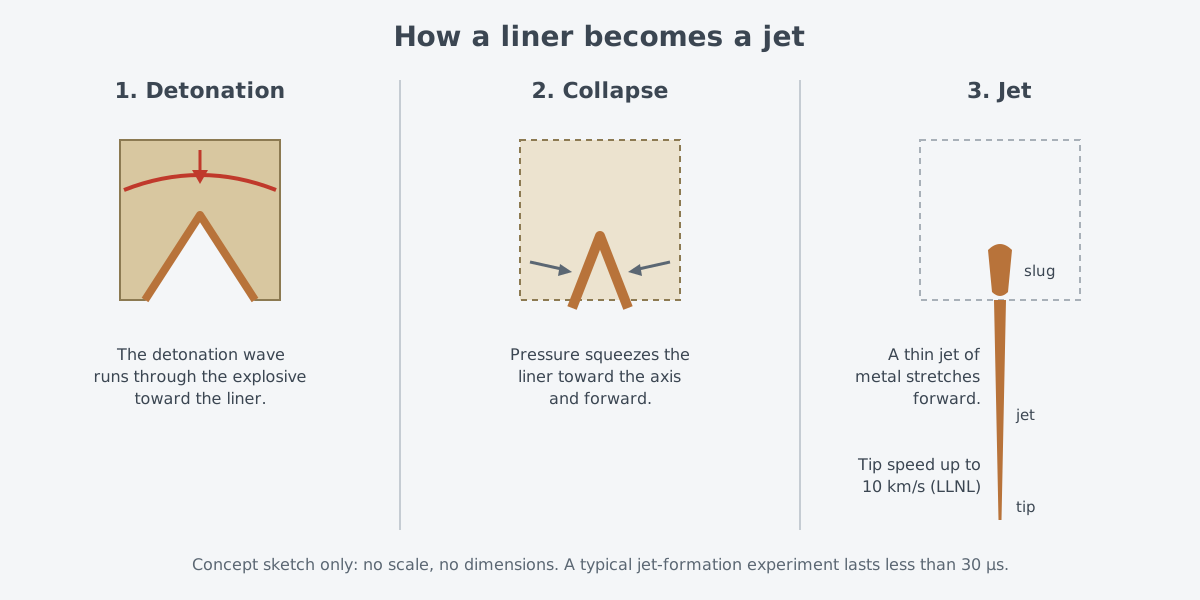
The idea of a metal surface being pushed forward sounds simple enough. Yet LLNL wrote in 1998 that the physics behind it is highly complex and, even then, not fully understood. The same article notes that a shaped charge, by design, puts all its energy on a single line, which makes it very accurate and controllable.
Who was first: the early twentieth century
Research on lined shaped charges sped up enormously between 1935 and 1950, mainly because of World War II. The British, Germans and Americans have all claimed early development, so the question of who came first is somewhat unclear.
Two names stand out for the modern shaped charge. Franz Rudolf Thomanek in Germany and Henry Hans Mohaupt, working for Britain and the United States, each perfected the idea independently. Thomanek claimed he discovered the liner effect on February 4, 1938. Mohaupt's earliest patent claimed a date of November 9, 1939.
Records of use as a weapon start around this time. On May 10, 1940, hollow charges were used at Eben Emael in Belgium.
After seeing Mohaupt's demonstration, the British took a second look at the shaped charge. About a year of work later, in November 1940, they brought the No. 68 rifle grenade into service. Walters counts it as the first anti-tank rifle grenade anywhere to use a hollow charge.
In 1941 the United States produced a 2.36-in high explosive anti-tank (HEAT) grenade and 75 mm and 105 mm HEAT artillery rounds. Adding a rocket motor and a shoulder launcher to that grenade gave the bazooka. To see how today's anti-tank guided missile (ATGM) came about, continue with the article on anti-tank guided missiles.
Every new spear brings a new shield. Reactive armor, mounted on the outside of a vehicle, was developed mainly to stop shaped-charge warheads. The article on composite and reactive armor tells that story.
X-rays that saw through the smoke
What happens if you photograph an explosion with an ordinary camera? You see smoke and flame and little else. That is why, Walters explains, flash radiographs were needed. X-rays pass through the smoke and show the metal inside as a shadow.
The shaped-charge principle came to be understood through pioneering flash X-ray pictures taken in the United States by Seely and others, and in Britain by Tuck. In Germany, Schumann and Schardin obtained similar pictures in 1941. Opinions differ on who took the first flash radiograph.
From the 1950s and 1960s, high-speed photography and flash radiography matured, and large computer codes appeared that could simulate the liner collapsing and the jet forming and growing. Both brought major progress. Looking back in 1998, LLNL notes that early work relied largely on trial and error. Only in the 1970s could codes predict a shaped charge's behavior with any accuracy.
LLNL's X-ray shadow pictures reveal the jet's speed, density and mass distribution. Lasers helped with this work too. An image-converter camera developed at the laboratory lit the charge with a pulsed ruby laser and took the first truly sharp, high-resolution pictures of a jet taking shape. Without the laser light and the camera's filter, the picture would show only a blinding, glowing sheath of hot gas around the jet.
Shaped charges away from the battlefield
According to the 1998 LLNL article, work on shaped charges for piercing tanks and other armored equipment began after World War I. The same paragraph names the oil and gas industry as their most extensive use at the time. There they break open the rock around wells that have been drilled.
They work under the sea too. The 2010 Deepwater Horizon accident caused the biggest marine oil spill the United States has seen. Afterward, LLNL researchers designed an explosives-based emergency severance tool, to be fired if a well's blowout preventer fails.
The tool uses linear-shaped charges, a kind often used in construction and demolition. The detonation wave quickly crushes a copper liner, and the jet shoots out at very high speed and slices through the drill pipe. In this tool the jet takes the form of a copper sheet.
Cones and spheres are routinely used to pierce heavy material. For cutting steel drill pipe, LLNL explains, a linear sheet that acts like a blade proved the best fit.
Where this meets lasers: putting energy on one line
The point of a shaped charge is not to use more explosive. It is to gather the same blast onto one line, using a hollow and a liner.
Gathering matters for lasers too. Light of the same power reaches a higher intensity when it is squeezed onto a smaller area. The difference between power and intensity is explained with light bulbs and sunlight in the article on power, energy and intensity.
The differences are just as clear. A shaped charge throws a jet of metal, and once it fires, it is spent. A laser sends light, not matter. And as the earlier section showed, a laser was also the light behind the first truly high-resolution pictures of this metal jet forming.
What to read next
- Anti-tank guided missiles: how missiles carrying shaped-charge warheads came about.
- Composite and reactive armor: how armor changed to stop shaped-charge warheads.
- Power, energy and intensity: what gathering energy into a small spot means in laser units.