Some photos of armored vehicles show a fence of steel bars around the hull. Recent photos from the battlefield also show grids or wire mesh on top of tank roofs. The vehicle already has thick armor plate, so why stand an open frame of metal outside it?
The fence and the roof grid came from different eras, but they share one idea. Instead of making the armor thicker, you place something in front of the main armor with a gap between them. The idea was used once on the Stryker in Iraq and again in the drone-era grids on vehicles.
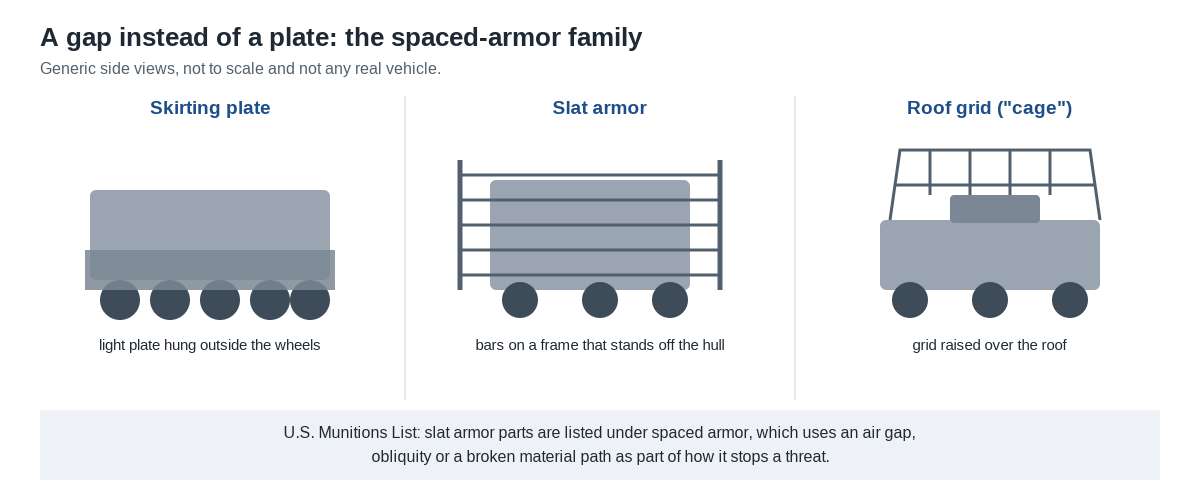
Where slat armor sits among armor types
Slat armor is not a standalone invention but a branch of armor. The U.S. Munitions List (22 CFR 121.1) lists slat armor parts under spaced armor components. The same list has an interpretive clause. It defines spaced armor as armor that uses an air gap, obliquity or a broken material path as part of how it stops a threat.
Slat armor shows two of those at a glance. It stands off the hull, so there is an air gap, and the spaces between bars break up the material. That is also why it weighs far less than a plate.
What the gap does
The armor monograph from DSIAC, an information center under the Defense Technical Information Center, gives a short reason why spacing works. After a penetrator hits one element, the time and space before it reaches the next allow disturbances to grow. By the time it reaches the main armor, it is no longer in its original shape.
The tank skirting plate is an older example. It is a light curtain of armor hung outside the road wheels. According to the monograph, it made shaped-charge and high-explosive plastic (HEP) rounds detonate far from the hull-side armor, which reduced their effect.
Moving the point of detonation outside the main armor is one approach in this branch. The MBT 70, jointly developed in the early 1970s, already had skirting plates, and in tests spaced armor proved very efficient for its weight.
Strykers in Iraq and 5,000 pounds
Slat armor became widely known during the Iraq War. A 2008 U.S. Army article describes a work site in Kuwait. Each night, contract workers were stripping slat armor from more than 280 Stryker vehicles of the 4th Stryker Brigade Combat Team, 2nd Infantry Division.
The brigade had fitted the armor to each vehicle about 15 months earlier as it prepared to push north into Iraq, and it weighed 5,000 pounds per vehicle. That is about 2.3 t. Even if it is lighter than plate armor, it is not a small load to add to one vehicle.
The article's wording is worth noticing too: the armor was "retro-fitted," added later rather than designed in. When the threat on the battlefield changes, vehicles change shape outside the factory as well.
The price: weight and bulk
Armor with gaps carries an unavoidable cost. The DSIAC monograph points out that mass spread over a large volume has a larger moment of inertia. The farther mass sits from the center, the harder it is to turn.
On a tank, this cost shows up in the turret. A larger moment of inertia means more power is needed to turn the turret at the desired rate. The suspension also needs extra weight to keep the vehicle from pitching hard over rough ground. The farther slats and skirts spread around the hull, the bigger this problem gets.
Grids return in the drone era
Lately the grids have moved to the top of vehicles. Drones are the background. A March 2025 report from the Congressional Research Service (CRS) sums up reports that Russia and Ukraine have built growing numbers of battlefield drones.
Both sides have also handed front-line troops explosive-laden first-person view (FPV) drones that fly one way into their targets. The U.S. Defense Department has called uncrewed systems an "urgent and enduring threat."
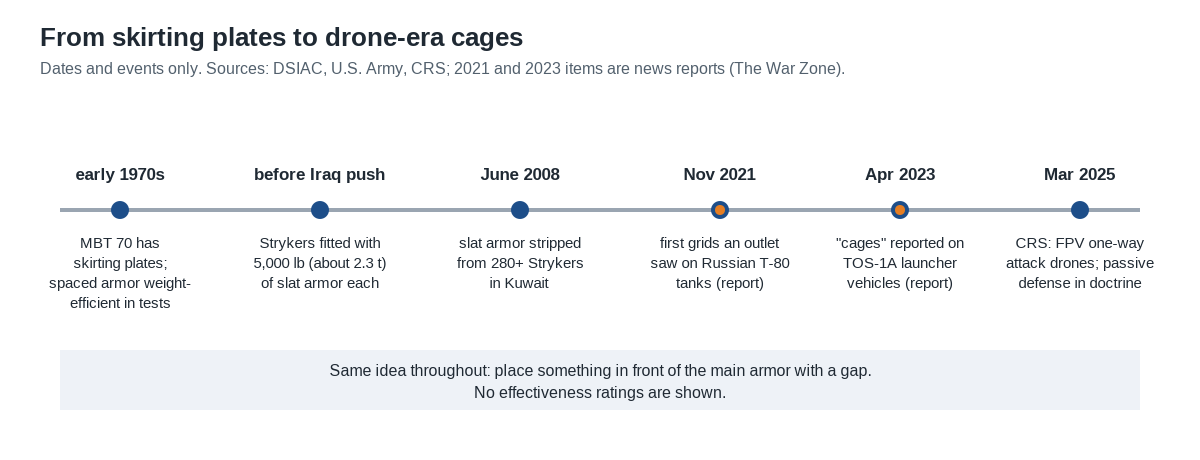
Official government documents on the roof grids themselves are hard to find, and the record comes mostly from news reports. The U.S. military news site The War Zone reported that Russia had been adding metal grids atop vehicles against drones and anti-tank guided missiles even before the war began. The first case the outlet saw was improvised armor on T-80 tanks in November 2021. In April 2023 it reported such "cages" on TOS-1A multiple rocket launcher vehicles as well.
The Defense Department says that in the near term it will stress detection and both active and passive defense. In principle, a grid over a vehicle is the same spacing idea as the skirting plate. The difference is that it has moved to face a threat arriving from above.
What to read next
- Tank Armor Types at a Glance: Rolled, Spaced, Composite, Reactive, Active: where spaced armor sits in the armor family
- Active protection systems: defending beyond the armor: defending from outside with sensors and countermeasures instead of grids
- FPV Drones in Ukraine: How Production and Organisation Changed: the drones behind the roof grids
- IEDs and the MRAP: How a Roadside Threat Reshaped Vehicles: another way vehicles changed in Iraq at the same time