Beep, beep, beep. On the night of 4 October 1957, a small ball circling the Earth sent out that sound at steady intervals. It was Sputnik 1, the first artificial satellite, launched by the Soviet Union.
The sound left a bigger mark on the United States than anyone expected. Before a year had passed, the country had a new research agency inside the Defense Department, a civilian space agency and a law aimed at students and classrooms. Today's DARPA and NASA were both born in those twelve months.
How could one satellite reshape research agencies and even schools? This article goes through the dates from fall 1957 to fall 1958 and explains what each of the three new institutions was meant to do.
News at an embassy reception
On the evening of Friday, 4 October, the Soviet embassy in Washington held a reception. It closed a week-long conference on rockets and satellites for the International Geophysical Year (IGY). The IGY was an international science effort in which many countries studied the Earth together over 18 months, from 1 July 1957 to 31 December 1958. The United States and the Soviet Union were each preparing a satellite for it.
The American satellite project was called Vanguard. It was running late and costing more than planned. A little before 6 p.m., a New York Times reporter at the party took an urgent call from his bureau chief. Tass, the Soviet news agency, had just reported the launch of Sputnik 1, the first artificial satellite to circle the Earth.
An 83 kg ball and a second satellite
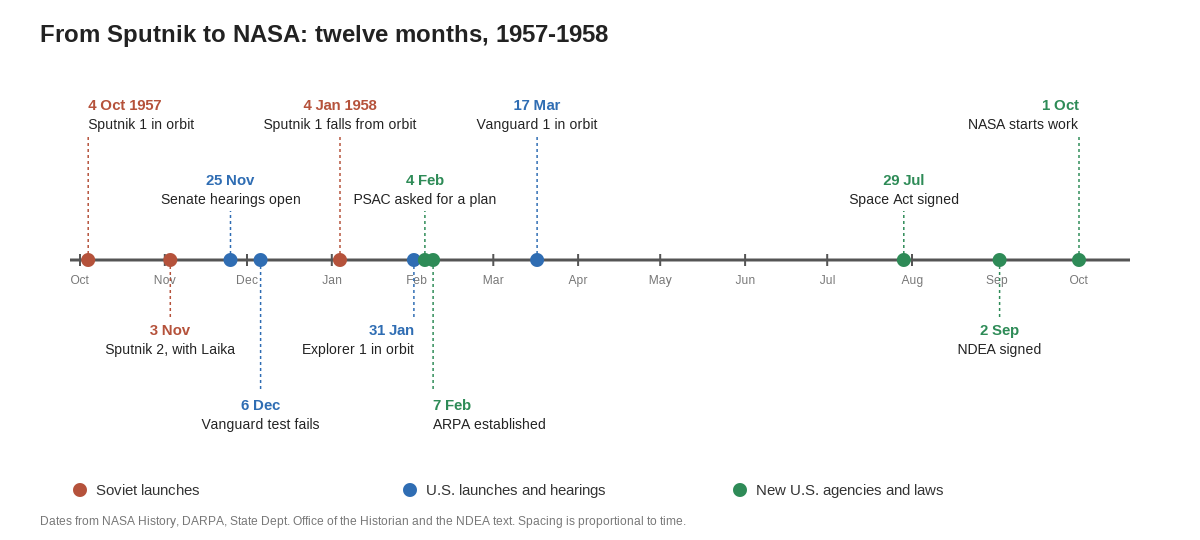
Sputnik 1 rose from a test site in the desert near Tyuratam, in what was then the Kazakh Republic. It was an aluminum ball 22 inches (about 56 cm) across with four flexible antennas, and it went around the Earth on a stretched, elliptical orbit once every 96 minutes. Inside was a small radio beacon that sent signals at regular intervals. The satellite fell out of orbit three months later, on 4 January 1958.
Sources give slightly different weights. The NASA History article says 183 pounds, and the State Department's Office of the Historian says 184 pounds. Either way, that is about 83 kg. The first Vanguard satellite was planned at 3.5 pounds (about 1.6 kg), so the gap was wide even on weight alone.
Less than a month later, on 3 November, Sputnik 2 went up carrying a dog named Laika. It weighed 1,120 pounds (about 508 kg) and stayed in orbit for almost 200 days. In the same year the Soviet Union also tested its first intercontinental ballistic missile (ICBM). How a rocket that puts a satellite in orbit relates to a missile that crosses continents is covered in the ICBM article.
Hearings, and flames on the launch pad
The American reaction came fast. The NASA History article says Sputnik 1 had a "Pearl Harbor" effect on public opinion. Ordinary citizens met the space age for the first time as a crisis.
Congress moved first. On 25 November 1957, Senate Majority Leader Lyndon Johnson opened hearings in a subcommittee of the Senate Armed Services Committee. The panel looked at the whole range of defense and space programs. It concluded that space work was badly short of money and poorly organized.
The government wanted a visible answer. On 6 December, with reporters invited to watch, it test-launched a Vanguard rocket. The rocket lifted about three feet off the pad, shook, and broke apart in flames. In the next test, on 5 February 1958, Vanguard climbed four miles and then exploded.
The first success came from the Army. At 10:55 p.m. on 31 January 1958, a Juno 1 rocket lifted Explorer 1 from Cape Canaveral, Florida. Explorer was lighter than Sputnik but went higher, and data from a small radiation counter on board led to the discovery of the Van Allen radiation belts around the Earth. Vanguard 1 did not reach orbit until 17 March.
A small agency inside the Pentagon: ARPA
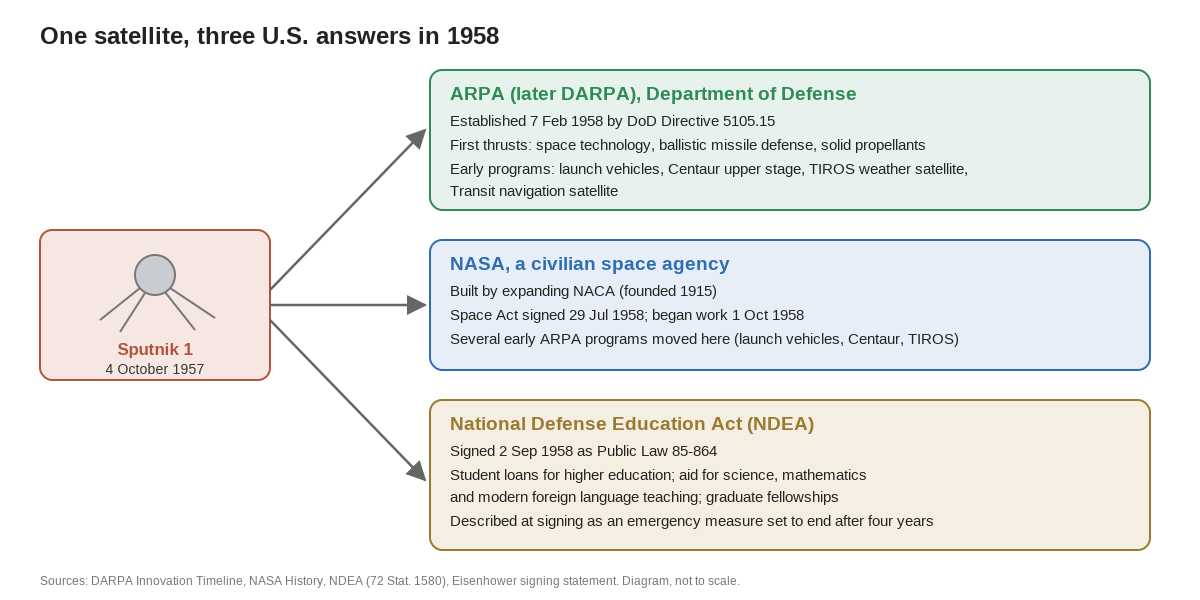
On 7 February 1958, Defense Secretary Neil McElroy signed DoD Directive 5105.15. It created the Advanced Research Projects Agency (ARPA). Later the word "Defense" was added to the front of its name, which made it today's DARPA. DARPA still describes itself as a response to the Sputnik launch, and as a pledge that the nation will not again be caught by a strategic technical surprise.
Its first jobs centered on space and missiles: the first three research thrusts were space technology, ballistic missile defense and solid propellants. In its first months, ARPA funded and ran rocket development work. That included a launch vehicle program under Wernher von Braun's team and Centaur, an upper-stage rocket burning liquid oxygen and hydrogen. Both soon moved to the new NASA, and the von Braun team's Juno V led to the Saturn V Moon rocket.
Satellite projects began then too. ARPA started the TIROS weather satellite in 1958 and handed it to NASA in 1959, and TIROS 1 reached orbit on 1 April 1960. Transit, a navigation satellite ARPA funded from 1958, saw its first launch in 1960, moved to the Navy in the mid-1960s and served until GPS replaced it in 1996. How the agency farms out research today is explained in the defense research agencies article.
An aviation advisory body becomes a space agency
All winter, people argued over who should run space work outside the military, and one plan even called for a new Department of Science and Technology. President Eisenhower did not like that plan, and he pushed back on smaller ones as well. The turning point came on 4 February 1958. The president asked his science adviser, James Killian, to convene the President's Science Advisory Committee (PSAC) and come up with a plan for a new space organization.
The committee's answer was to grow an existing body. The National Advisory Committee for Aeronautics (NACA) had handled aviation research since 1915. The plan was to strengthen it, rename it, and put all nonmilitary space work under it. The new agency's job was to plan, direct and carry out aeronautical and space activities.
Congress passed the National Aeronautics and Space Act that summer, and the president signed it on 29 July 1958. The National Aeronautics and Space Administration (NASA) began work on 1 October. Less than a year had passed since Sputnik 1 went up.
Sputnik goes to school
Research agencies were not the only thing that changed. On 2 September 1958, Eisenhower signed the National Defense Education Act (NDEA), Public Law 85-864. Section 101 of the law declares that national security depends on developing the mental resources and technical skills of young people as fully as possible.
That section aimed at two things. One was to keep able students from losing a chance at college because they could not pay. The other was to fix an imbalance in education, in which too few people studied science, mathematics and modern foreign languages. The law's table of contents lists college loans, support for science, math and language teaching, graduate awards called National Defense Fellowships, student guidance and testing, and language research.
The law also had an end date. In his signing statement, Eisenhower called it an emergency measure that would end after four years. He regretted that Congress had left out the National Defense scholarships he had recommended, but he still called the act sound and constructive.
What the twelve months left behind
In the State Department historians' account, the fear of falling behind pushed the United States to speed up its space and weapons programs. With both countries racing on new technology, talk of a nuclear test ban treaty faded for several years. Sputnik fed both the space race and the arms race. Fear of a "missile gap" between the two nuclear arsenals was then used in the 1960 presidential election.
Whether the gap was real is another question. The NASA History article says Sputnik created an "illusion" of a technological gap. The missile gap debate, and what later reconnaissance showed, continue in the Cold War arms race article and the 1960 U-2 incident article.
Whether the fear was real or not, the institutions it left were real. A high-risk research agency in the Defense Department, a civilian space agency and a law tying science and language education to national security all appeared in a single year, 1958.
Where this meets lasers
The agency Sputnik produced later reached into laser weapon research. According to DARPA's timeline, in the mid-1970s high-energy lasers (HEL) looked promising for air defense, and especially for ballistic missile defense, and DARPA backed many technologies and early system concepts.
One result was MIRACL, a huge megawatt-class device that used combustion much like a rocket engine. It first produced laser light in 1980. The same line of support produced the chemical oxygen-iodine laser (COIL), which became the basis of the U.S. Air Force's Airborne Laser (ABL). Ballistic missile defense had been one of ARPA's three original research thrusts in 1958.
What to read next
- Defense Research Agencies: What DARPA and ADD Do: how ARPA's successor runs research today
- The Cold War Arms Race: From Bombers to Missiles to Satellites: the bigger picture around Sputnik
- The 1960 U-2 Incident: The Day Flying High Stopped Being Safe: the missile gap debate and reconnaissance
- 1997: The MIRACL Satellite Test and the Debate Over Lasers in Space: the later story of a laser born from DARPA support