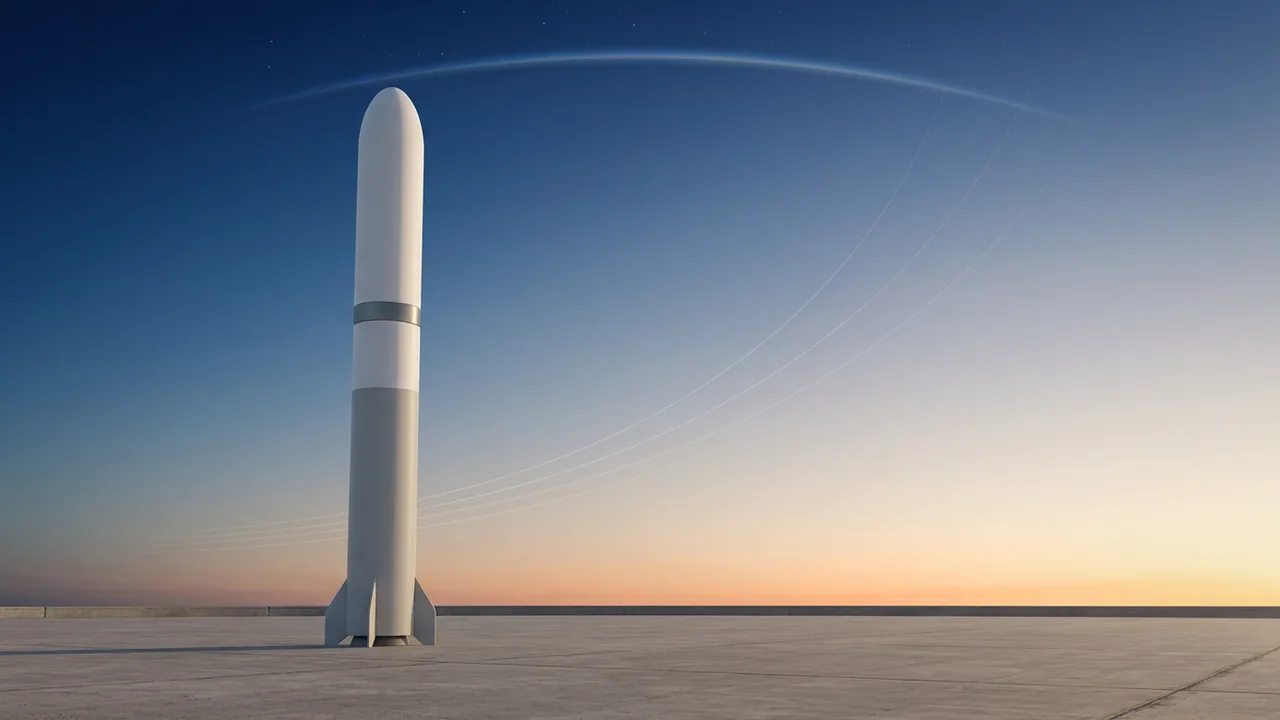
On January 3, 1962, NASA's Manned Spacecraft Center drew up a statement of work to obtain Titan II rockets as Gemini launchers. The plan was to use the missile's form and basic systems almost as they were. In March of that year, the U.S. Air Force test-fired the same Titan II type as an intercontinental ballistic missile.
So a rocket meant to carry people into space and a missile built to cross continents could share almost the same body. How is that possible? The clue is that the rocket technology itself overlaps. They part ways on whether the cargo is raised to orbital speed and placed in orbit, or stays out of orbit and returns to the atmosphere.
What counts as an ICBM
Ballistic missiles differ in where they are launched from, how far they go and what they carry. A common way to sort them is by range. The basic primer from the Congressional Research Service (CRS) uses these bands.
| Class | Distance to target |
|---|---|
| Short-range ballistic missile (SRBM) | 300–1,000 km |
| Medium-range ballistic missile (MRBM) | 1,000–5,500 km |
| Intercontinental ballistic missile (ICBM) | more than 5,500 km |
The ICBM is the class that reaches farthest. The same primer says missiles with shorter reach are usually treated as tactical tools in regional wars. ICBMs, by contrast, count as strategic deterrent forces, kept to discourage a strategic attack. The name says "intercontinental," but the class is set by the distance band.
Why a ballistic missile climbs high and then comes down is the subject of a separate article in this series, "Ballistic missiles: why they climb high and come back down." This article looks only at the longest-range branch.
Up, coasting, and back down
The U.S. Missile Defense Agency (MDA) explains that ballistic missile paths are commonly split into three phases of flight: boost, midcourse and terminal. First, the rocket engines burn and push the missile upward. That is the boost phase.
The midcourse phase begins when the booster burns out. The missile then coasts through space toward its target with no engine running. MDA notes this phase can last as long as 20 minutes. The final terminal phase starts when the missile reenters the atmosphere, and it is very short.
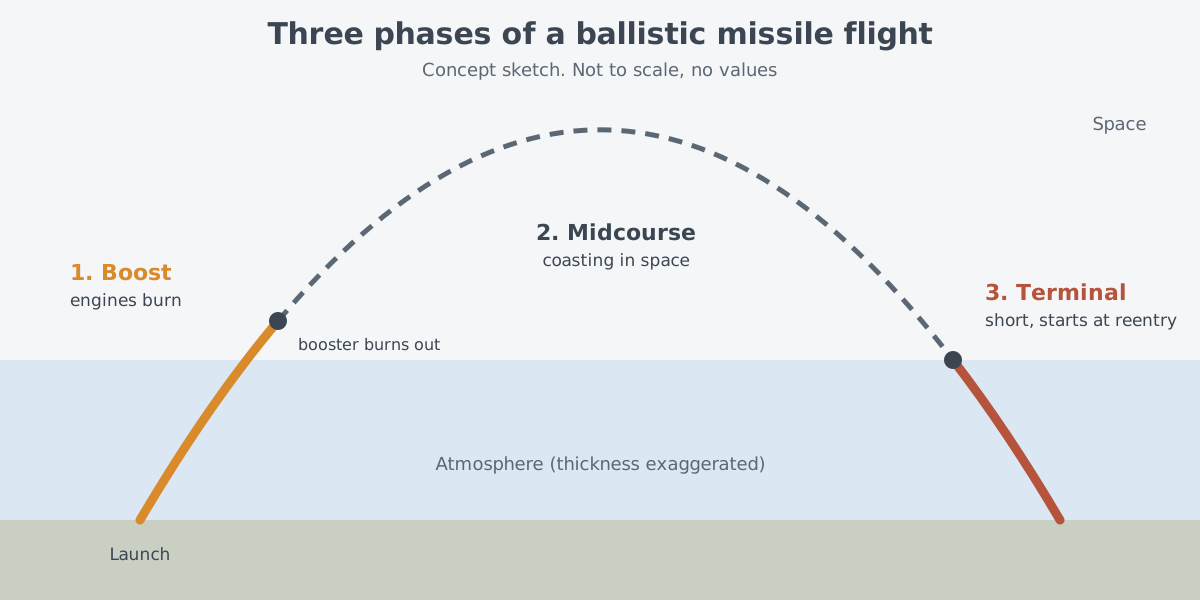
The CRS primer sometimes adds a "post-boost" phase between boost and midcourse, which makes four. Sources differ in how many boxes they draw. The overall flow is the same: a part with engines burning, a part spent coasting, and a part coming back into the air.
Think of a thrown ball and the shape looks similar. Once it leaves your hand, nothing pushes it, and it falls along a curve. A missile is different. Its engines keep pushing through the whole boost phase, and it spends the midcourse phase in space, above the atmosphere.
Rockets that get lighter by dropping stages
A rocket uses the thrust from its propulsion system to overcome its own weight. NASA Glenn Research Center's teaching material points out that, on a full-size satellite launcher, the payload makes up just a small share of the weight at liftoff. Most of the weight is propellant.
The trouble comes as that propellant burns away. The tanks and structure that were needed to hold a full load stay behind, nearly empty, and they make up a growing share of the vehicle's weight. So most launchers throw away part of the vehicle to get light enough to reach orbital speed. This is called staging.
Of the two ways to do it, serial staging stacks a smaller second stage above a bigger first stage. The first stage is lit at launch and burns until its propellant is gone. Once it shuts down, the second stage comes away from the first and lights its own engine. The Saturn V moon rocket had three stages and split off stages twice before reaching Earth orbit.
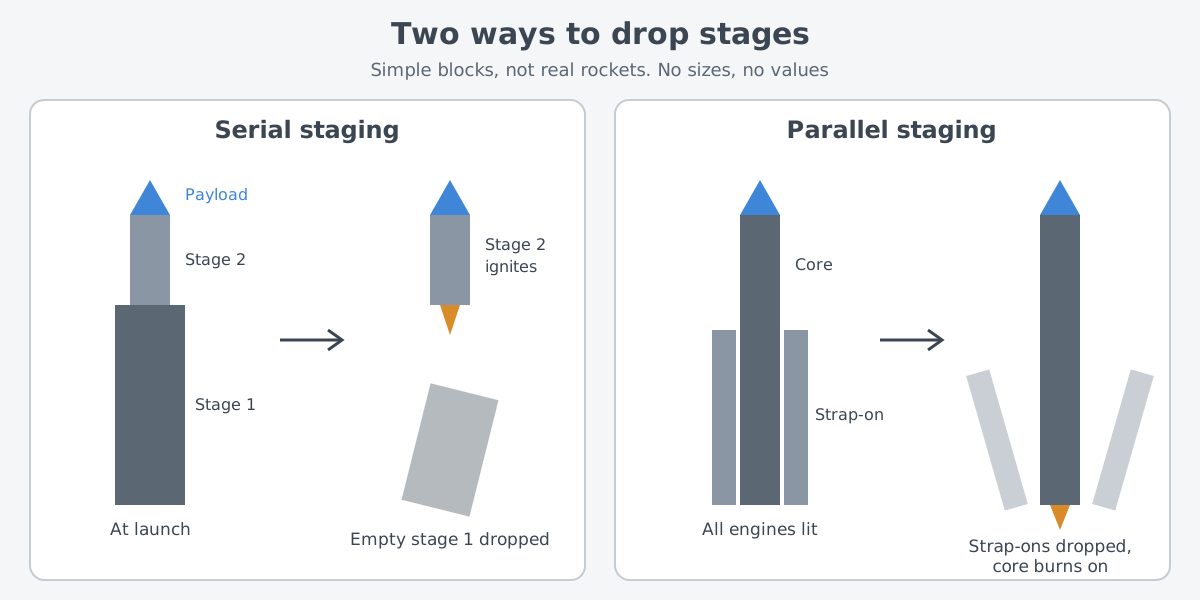
In parallel staging, a few smaller first stages are attached beside a central rocket. All the engines are lit together at launch, and the strap-ons are dropped when their propellant runs out. The central rocket keeps burning and carries the payload to orbit. The Space Shuttle used this method.
Some launchers use both. The Titan III had a liquid-fueled, two-stage Titan II at its center, with two solid rockets strapped on for launch. Here the Titan II name shows up again.
Same rocket, different cargo: where launchers part ways
An orbit is the steady path an object in space traces again and again around another body. NASA describes it as a tug-of-war between forward motion and gravity.
Without gravity, a satellite would fly off in a straight line. With too much sideways motion, it goes past and never settles into orbit. With too little, it is pulled down and falls.
In balance, the object keeps dropping toward Earth all the time, but it moves sideways fast enough that it never reaches the ground. That speed is orbital velocity. According to NASA, at a height of 242 km (150 miles) above Earth it comes to about 17,000 mph.
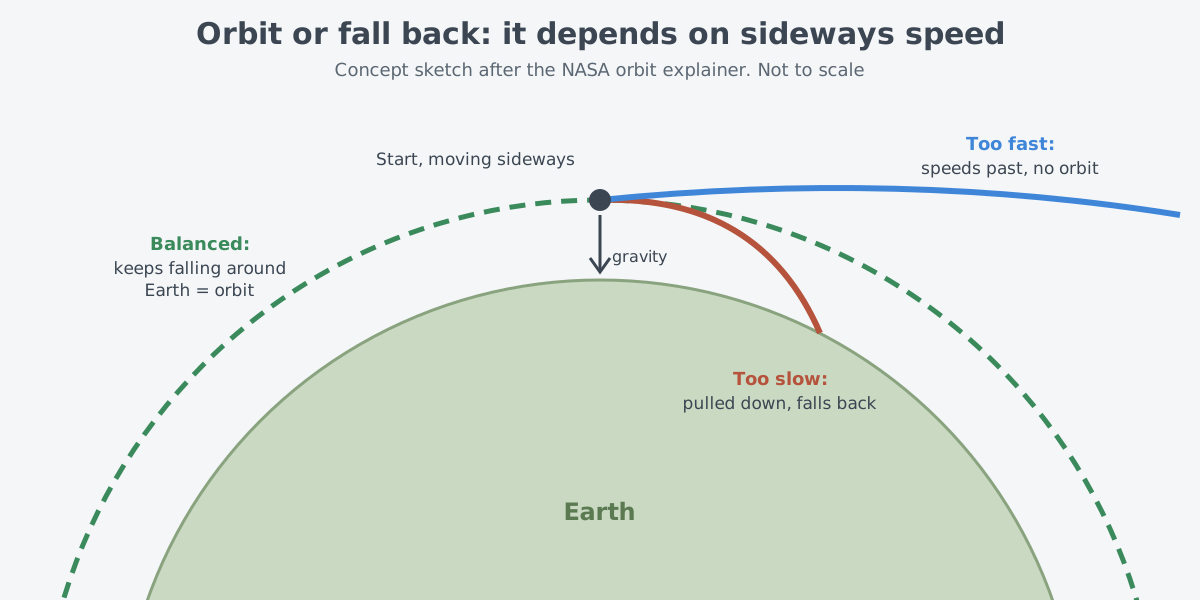
Now the cargo of the two rockets can be compared. A satellite launcher places the payload riding on its last stage into orbit. A ballistic missile never enters orbit: after its booster burns out, it coasts through space and then comes back into the atmosphere. In terms of the tug-of-war, it takes the path that is pulled back down, not the one that stays in orbit.
When a missile became a space launcher
The Gemini program from the opening is that case. According to the Gemini chronology in NASA's history series, that statement of work had the launcher keep the missile's aerodynamic form, core systems and propulsion approach. Only minimal changes would be made, mostly for crew safety.
So what did change? The same chronology says the main change in flight control, going from missile to Gemini launcher, was guidance. The Titan II's inertial guidance system was replaced with a radio guidance system and the three-axis reference system from the Titan I. On February 22, 1962, the company Martin-Baltimore sent its first proposal for redundant systems for flight control and hydraulics on the Gemini launcher.
In the meantime, on March 16, 1962, the Air Force flew a Titan II intercontinental ballistic missile with success. The chronology records it as the vehicle's first test at full scale. The missile's first test and the work to turn it into a launcher moved forward side by side in the same year.
Why international rules look at both together
The Missile Technology Control Regime, or MTCR, is a loose political agreement between countries that want to limit the spread of missiles and missile technology. The G-7 industrial countries set it up in 1987, and its website lists 35 member countries. Its annex sorts controlled items into Category I and Category II.
Category I, where the greatest restraint applies, covers complete rocket systems that exceed a range of 300 km with a payload of 500 kg. The MTCR places ballistic missiles in this group side by side with space launch vehicles and sounding rockets. Major subsystems are in it too, such as rocket stages and engines, re-entry vehicles, guidance systems and warhead mechanisms, along with the facilities that make them. Exports of Category I items face a strong presumption of denial whatever their purpose, and are approved only rarely.
That does not mean space programs are blocked. The MTCR Guidelines say the regime is not meant to hold back national space programs or cooperation in them, if those programs cannot help deliver weapons of mass destruction. Even so, the MTCR explains why its members handle space launch vehicle equipment and technology with care. The technology in a space launch vehicle is virtually the same as in a ballistic missile, which creates a real risk of missile proliferation.
A United Nations Security Council resolution also brings up space use and ballistic missile technology together. Resolution 2087 of 2013 recognizes that every state may explore outer space and make use of it under international law, including limits set by relevant Security Council resolutions. It also condemned North Korea's launch of December 12, 2012, as one that used ballistic missile technology and broke the earlier resolution 1718 (2006) and resolution 1874 (2009).
The two documents speak at different levels. The MTCR states, as a general point, that space launcher technology is virtually the same as ballistic missile technology. Resolution 2087 recognizes the freedom to use space within the limits of Security Council resolutions, while finding that one particular launch used ballistic missile technology.
What to read next
- Ballistic missiles: why they climb high and come back down: the flight principle behind all ballistic missiles, ICBMs included.
- Layered missile defense: why defense comes in layers: how the defending side splits up the three flight phases in this article.
- Hypersonic glide vehicles: a different flight path: a way of flying that does not follow a ballistic path, for comparison.
- A history of laser weapons: from chemical to electric lasers: includes the airborne laser program aimed at ballistic missiles in the boost phase.