In 1957 the Soviet Union put the first Sputnik satellite into orbit. The next year the United States set up a small agency inside its Department of Defense. Today it comes up in almost every story about the internet and GPS: the Defense Advanced Research Projects Agency (DARPA).
South Korea has an agency whose name comes up just as often. The Agency for Defense Development (ADD) was founded in 1970. Both are defense research agencies, but they work in quite different ways. This article looks at why each was created, how each runs its research, and what difficulties the public record notes.
An agency left behind by Sputnik
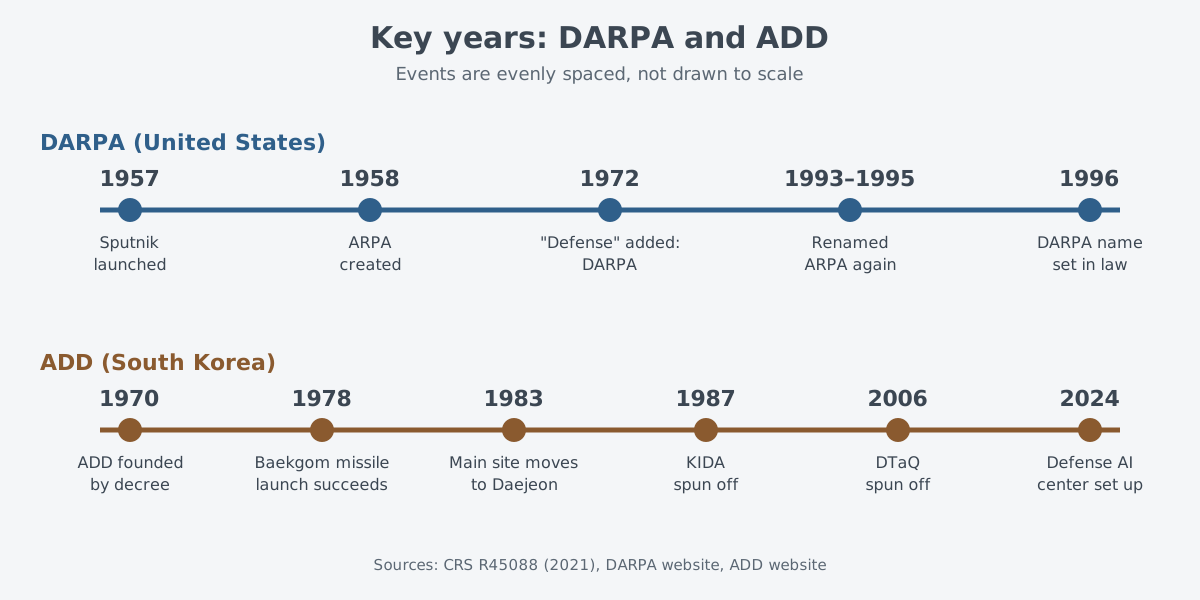
A Congressional Research Service (CRS) report says the Department of Defense created the agency in 1958 under the name Advanced Research Projects Agency (ARPA). Two reasons are given. One was the response to Sputnik. The other was a sense that promising ideas needing a long development time also deserved resources.
The name changed a few times. In 1972 "Defense" was added to stress a mission of "pivotal investments" in breakthrough technologies for national security. Between 1993 and 1995, under President Clinton, it went back to the name ARPA, and the White House tried to widen its mission to dual-use technology. In 1996 Congress fixed the name DARPA in law.
DARPA describes its own mission as creating and preventing "technological surprise" for national security. The idea is that the surest way to avoid being surprised is to make the surprise first. CRS notes that DARPA-funded work led to military technology such as precision-guided munitions (PGM), stealth, unmanned aircraft and infrared night vision. It also fed into civilian technology such as the internet, GPS and automated voice recognition.
An agency that funds research without labs
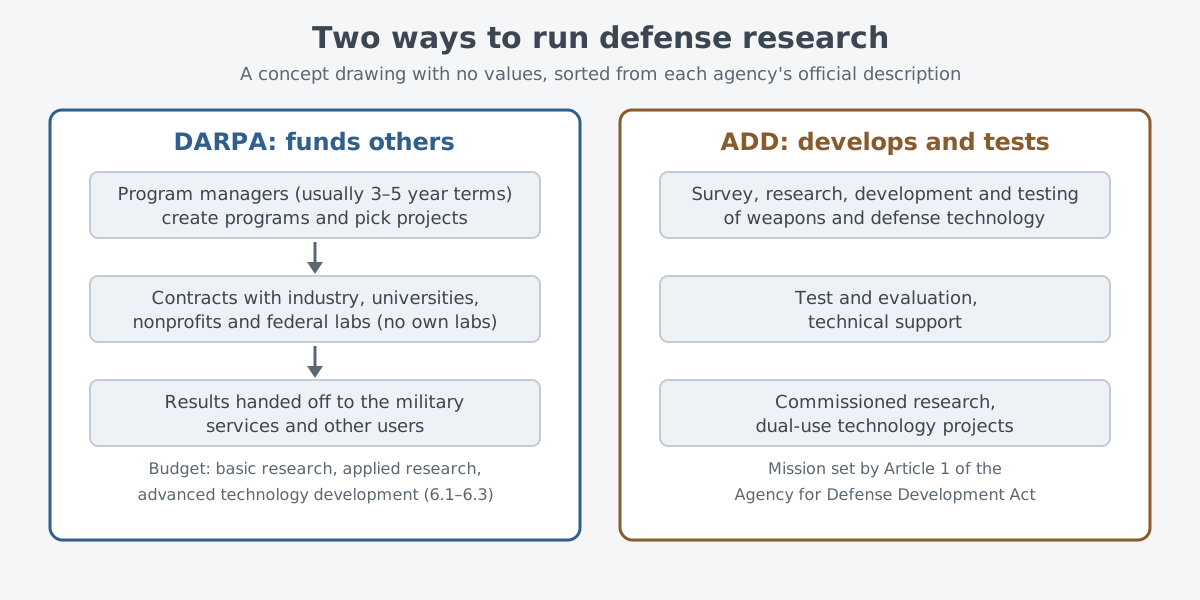
DARPA has no laboratories of its own. In the 2021 CRS report it had a little over 200 government employees. About 100 of them were program managers in charge of a yearly budget of about $3 billion. The research itself is mostly contracted out to industry, universities, nonprofits and federal labs.
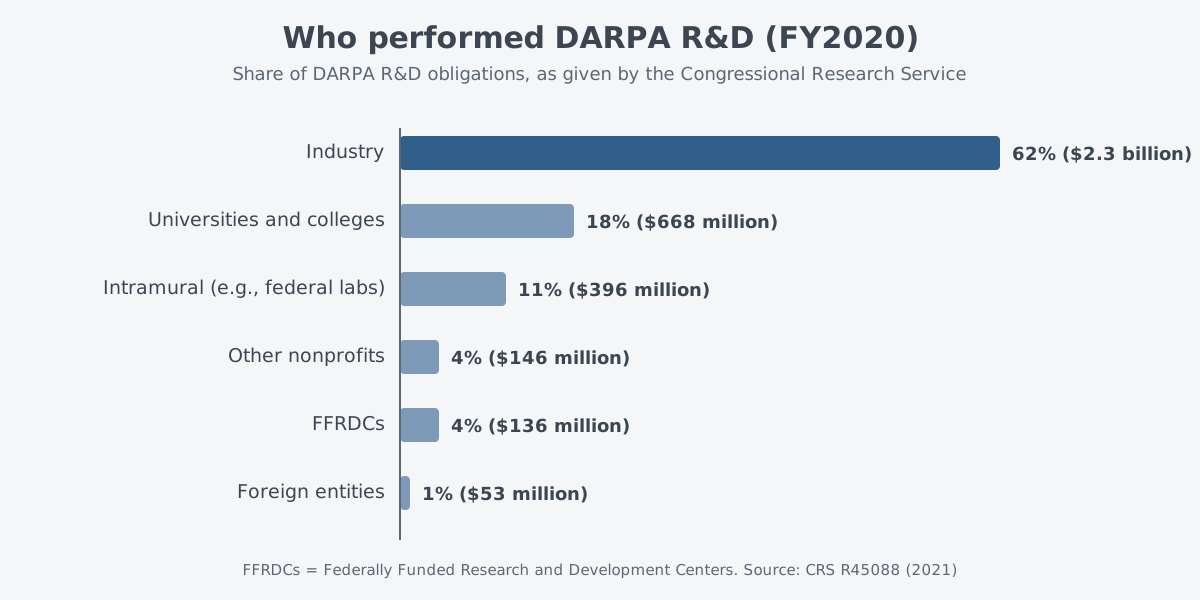
So where does the money go? In FY2020, industry performed 62% of DARPA R&D ($2.3 billion). Universities did 18%, and intramural performers such as federal labs did 11%. Other nonprofits and Federally Funded Research and Development Centers (FFRDCs) each did 4%, and foreign entities did 1%.
The type of work is also fixed. Nearly all DARPA funding sits in three budget categories: basic research (6.1), applied research (6.2) and advanced technology development (6.3). In FY2021 the split was 15% basic research, 39% applied research and 44% advanced technology development. For recent figures, the DARPA website lists an FY2026 enacted budget of $4.322 billion and an FY2027 presidential request of $5.039 billion.
Program managers on a clock
The person who comes up most when people describe the DARPA approach is the program manager. DARPA credits its record to trust and autonomy, the urgency of limited tenure, a sense of mission, and a tolerance for risk and failure. Unlike most federal research agencies, its program managers create new programs themselves and fund new ideas quickly. Peer review is optional, so in practice they pick projects and, when needed, end them.
The job has a time limit. Program managers usually serve three to five years, and DARPA estimates that 25% of them turn over each year. In 1998 Congress set up a trial program that let DARPA hire outside science and engineering experts directly for terms of up to six years. The FY2017 National Defense Authorization Act made that authority permanent.
Funding for a single project is short as well. DARPA usually pays just long enough to test whether an idea is feasible, typically three to five years. Milestones set before the program starts decide whether funding continues. Frequent turnover has critics, too: a thin institutional memory can lead to repeated work.
Failure and the handoff problem
Aiming for high risk and high reward brings failures. The Falcon Hypersonic Technology Vehicle 2 (HTV-2) fell short of expectations in 2011, and the program ended that year. In 2020 DARPA closed its Launch Challenge without a winner. Even so, DARPA is often held up as a model, and two later agencies copied it: IARPA in the intelligence community and ARPA-E in the energy department.
An older problem is handing results over. CRS says Congress has long recognized the challenge of moving DARPA-funded technology into the military services' acquisition programs or to other users. Technology that challenges the way things are done can meet resistance. The Government Accountability Office (GAO) gives the example of the Air Force, which at first resisted investing in stealth technology for aircraft.
The budget categories sit right in this gap. DARPA funding stops at 6.3 and does not cover 6.4 and 6.5, where prototypes are built and systems are demonstrated. GAO lists four factors behind successful handoffs. They are military or commercial demand, a link to an area of steady DARPA interest, active work with the receiving partner, and clear technical goals that are met.
Think of a relay race in which DARPA runs the first leg fast. The real situation differs in one way: often nobody is lined up to take the baton, and sometimes the next runner does not want it.
ADD, founded for self-reliant defense
ADD was founded on August 6, 1970, by presidential decree. The agency's own history calls the 1970s its "beginning period" and names two main threads: making basic weapons at home and starting work on guided weapons. On September 26, 1978, it launched the Baekgom missile successfully.
Its job is set in law. Article 1 of the Agency for Defense Development Act gives it the technical survey, research, development and testing of weapons and defense technology. The aim is stronger, self-reliant national defense. Its functions include R&D and test and evaluation of weapon systems and related technology, technical support, commissioned research on military supplies, research assistance and dual-use technology projects.
The history also shows where parts of the organization branched off, and in 1983 the main site moved from Seoul to Daejeon. In 1987 an attached defense management institute became the Korea Institute for Defense Analyses (KIDA). In 2006 an attached quality office became the Defense Agency for Technology and Quality (DTaQ). A defense AI center opened in 2024 and was reorganized into an AI institute in 2025.
ADD splits its history into four periods. After the beginning period (1970–1979) came a period of growth (1980–1999), when it built up weapon development skills and upgraded advanced weapons. Then came entry into the advanced group (2000–2019), with precision weapons, and leadership in advanced defense technology from 2020.
Its list of "50 R&D achievements" is split into 40 weapon systems and 10 core technologies. ADD says systems it developed have been exported, such as the KT-1 basic trainer, the K9 self-propelled howitzer, the Haeseong ship-to-ship missile and Bigung. Turkey, India and Poland are among the K9 buyers.
The two agencies side by side
The biggest difference is who does the research. DARPA has no labs, contracts work out, and funds only the stages before prototypes. ADD, as its law says, carries out weapon research, development and testing itself, and commissions outside research when needed.
Their starting positions differ too. According to CRS, DARPA was created from the start as an independent agency clearly separate from the military services' R&D organizations. That freed it to back work outside formal military requirements and outside the roles of any one service. ADD began with making basic weapons at home and has carried on developing weapon systems.
These two countries are not the only ones with such agencies. The United Kingdom has the Defence Science and Technology Laboratory (Dstl), an executive agency backed by the Ministry of Defence. Ranking the two approaches is not the point. One agency's first task was the technological surprise after Sputnik, and the other's was making weapons at home.
Where this meets lasers
These agencies also turn up in laser weapon stories. ADD's list for 2020 onward includes high-power lasers and a laser anti-aircraft weapon, and directed energy is one of the eleven focus areas it names. How Korea's laser anti-aircraft weapon was developed and fielded is covered in Laser weapon programs that have been made public.
In the United Kingdom, Dstl leads the DragonFire laser weapon program on behalf of the Ministry of Defence and works with industry partners.
DARPA's laser work is not only about weapons. Its now-completed PULSE program (Program in Ultrafast Laser Science and Engineering) sought better radiation sources by carefully shaping the spectrum of light. It moved from proof of principle in Phase 1 to component integration and lab demonstrations in Phase 2, then to a relevant defense operating environment in Phase 3. The order runs from the lab toward real-world conditions.
High-energy laser (HEL) weapons also went through many stages between research agency demonstrations and military fielding. That long history is traced in A history of laser weapons: from chemical to electric lasers.
What to read next
- A map of Korean defense technology: where ADD stands in the acquisition steps and which fields it covers.
- Laser weapon programs that have been made public: the laser anti-aircraft weapon ADD led, alongside cases from other countries.
- Stealth aircraft: truly invisible?: the principles behind stealth, a technology often listed among DARPA's results.