On 4 October 1957, the Soviet Union launched the world's first artificial satellite, Sputnik 1. Experts and ordinary citizens in the United States were shocked. One record even compares its effect on American public opinion to "Pearl Harbor." But was the United States really that far behind?
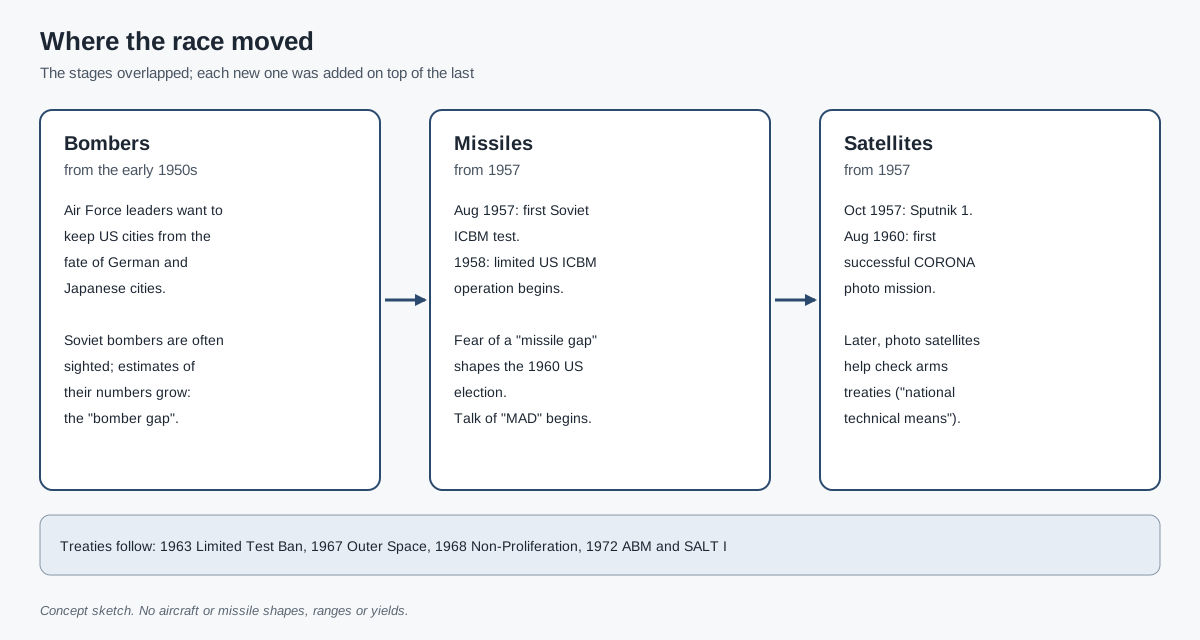
The Cold War arms race fed on fears and guesses like these. First the stage was bombers, then missiles, then satellites. This article uses US government and United Nations records to follow how the race moved from 1949 to 1991. It looks at where the word "gap" came from, how it went away, and which treaties came after the crises.
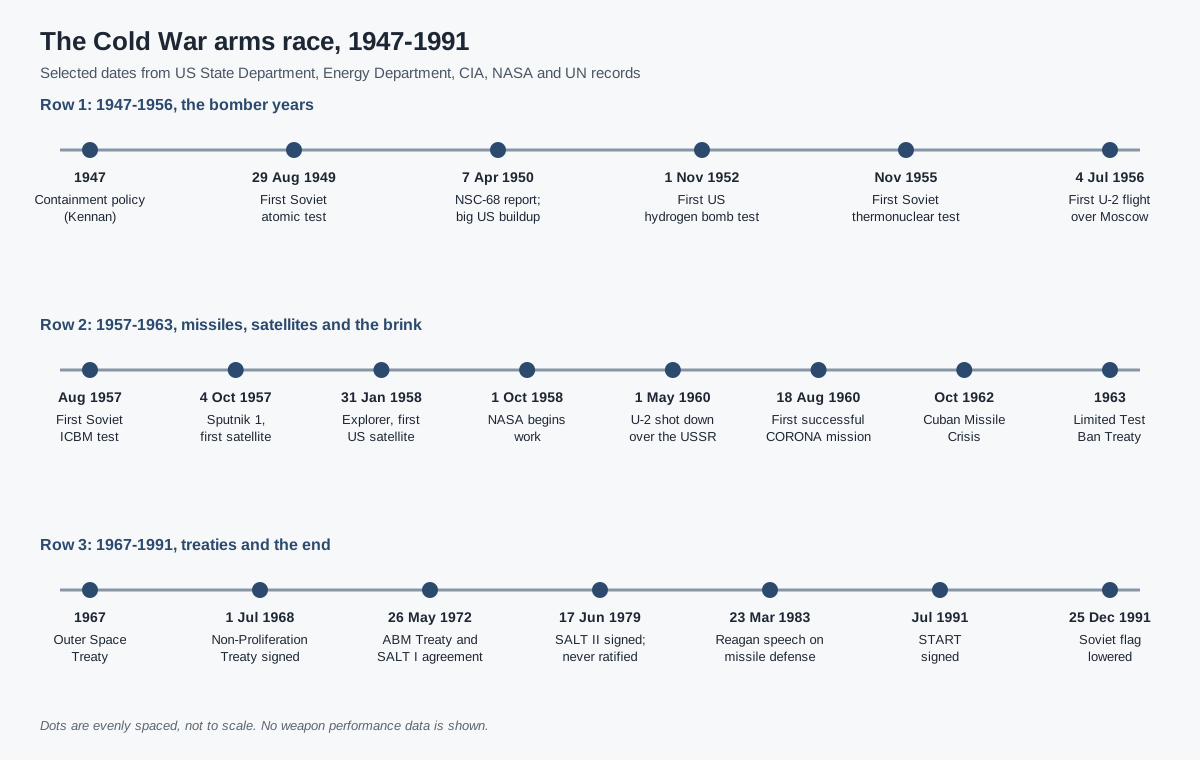
The year the monopoly ended
The United States and the Soviet Union were at odds well before the Second World War. The US Department of Energy (DOE) history traces the roots back to the Russian revolution of 1917. The two were allies during the war, but the suspicion never went away.
After the war, the question was how to put nuclear weapons under international control. The United States saw the Soviet army as a threat to Western Europe, and its own non-nuclear forces had shrunk fast. So it would not give up its nuclear monopoly without proper controls.
The monopoly ended sooner than expected. The Soviet Union carried out its first nuclear test on 29 August 1949. The American intelligence community had generally expected a Soviet bomb in 1952 or even later.
By then the broad US approach was already set. It was "containment," which the diplomat George F. Kennan put forward in an anonymous article in 1947. He wrote that Soviet expansion had to be held back in a long-term, patient but firm way.
The State Department's historians describe containment as the basic US strategy for the whole Cold War.
The bomber years and the big buildup
On 7 April 1950, the State Department's Policy Planning Staff finished a top-secret report called NSC-68. It concluded that only a large buildup of both conventional and nuclear arms could deter the Soviet Union.
There was strong pushback. Secretary of Defense Louis Johnson and the Soviet experts Kennan and Bohlen said America was already well ahead militarily. The North Korean invasion of South Korea in June 1950 settled the argument. Between 1950 and 1953, the Truman administration raised defense spending from 5% to 14.2% of GDP, close to three times as much.
In those years, bombers were the way to deliver nuclear weapons. The US Air Force generals who had overseen the bombing of German and Japanese cities were set on keeping American cities from the same fate. The bombs changed too: the United States tested its first hydrogen bomb on 1 November 1952. The Soviet Union tested a "boosted fission" weapon in August 1953 and its first true thermonuclear weapon in November 1955.
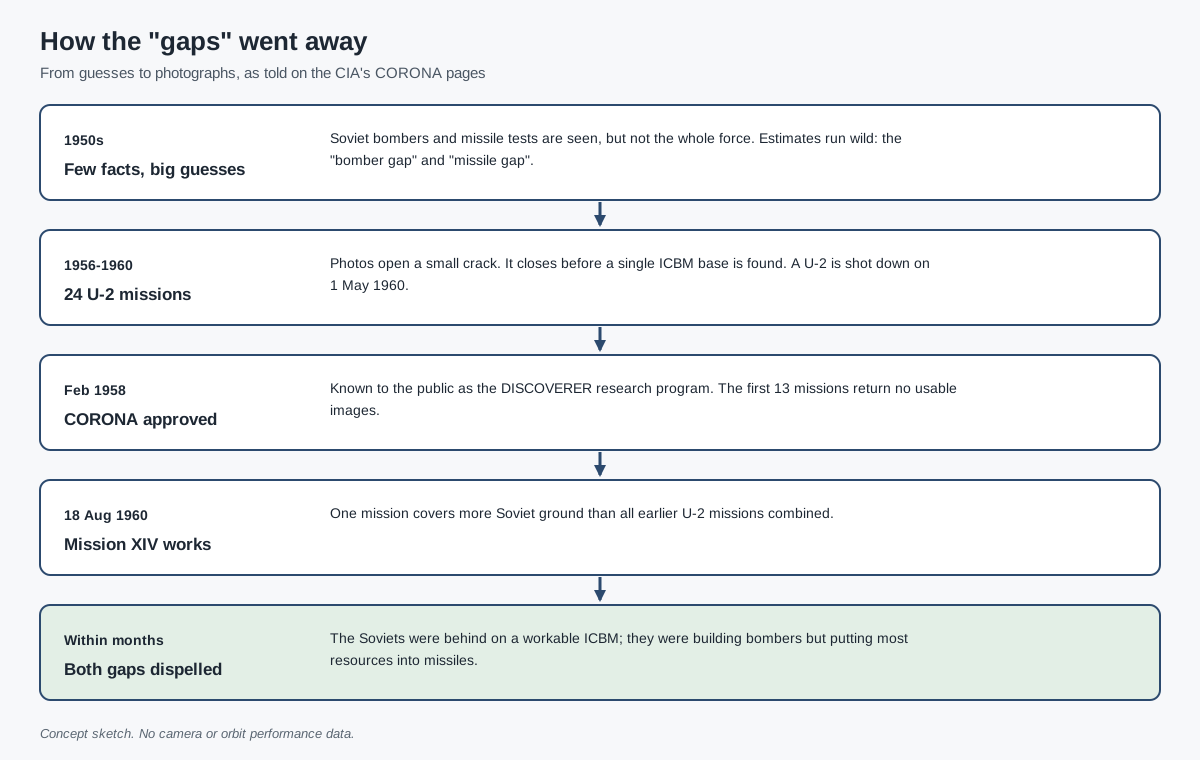
How many bombers did the other side have? In the 1950s the United States often sighted Soviet strategic bombers but had no way to see the whole force. The CIA writes that the intelligence community wildly overestimated Soviet bomber and missile production, and that this was the so-called "bomber gap" and "missile gap."
Missiles and Sputnik
The Soviet Union ran the first-ever test of an intercontinental ballistic missile (ICBM) in August 1957. Two months later, Sputnik 1 showed that feat to the whole world. The next year the United States began limited operation of its own ICBM. Why the same rocket can be a space launcher or a missile is covered in the ICBM article.
The United States hurried, but its first steps went badly. In December 1957 its first satellite, Vanguard, exploded on the launch pad, and only on 31 January 1958 did Explorer reach orbit. NASA started work on 1 October 1958. The NASA history essay judges that Sputnik created "an illusion of a technological gap," and that the illusion drove new spending on aerospace, science education and new federal agencies.
In the late 1950s, Khrushchev boasted of growing Soviet ICBM stockpiles. In the United States, the "missile gap" became an issue in the 1960 presidential election, and Kennedy campaigned on it. Yet soon after he took office, the Kennedy administration decided that the nuclear balance still favored the United States.
What made the missile age frightening was that nothing could stop a missile once it was launched. Only the promise that the other side would surely strike back was thought to keep the balance. This was the age of "mutual assured destruction," or MAD.
Eyes overhead: from the U-2 to CORONA
To count the other side's weapons, you have to see its land. At Geneva in 1955, Eisenhower proposed "open skies," with each side flying over the other to inspect nuclear sites and launchpads. Khrushchev refused. When Khrushchev claimed the Soviet Union had built many ICBMs, the United States looked even harder for new ways to check Soviet nuclear progress.
The U-2 spy plane, run by the CIA, first flew over Moscow and Leningrad on 4 July 1956. Photos from 24 U-2 missions over the Soviet Union between 1956 and 1960 opened a small crack. But the crack closed before a single ICBM base was found. On 1 May 1960 a U-2 was shot down over the Soviet Union, and the Paris summit was cancelled.
The next set of eyes was in space. Eisenhower approved the CORONA reconnaissance satellite program in February 1958. To the public it was known as a science program called DISCOVERER. The first 13 missions did not return a single usable image.
On 18 August 1960, the 14th mission finally worked from start to finish. That one mission covered more Soviet ground than all earlier U-2 missions combined.
Within a few months, CIA photo interpreters had cleared away both gaps, for missiles and for bombers. The Soviets were in fact well behind the United States on a workable ICBM, and while they were building bombers, they were putting most of their resources into missiles. The reconnaissance satellite article picks up how orbiting cameras gather information.
From the brink to treaties
The State Department's historians call October 1962 the moment the two superpowers came nearest to a nuclear war. On 14 October a U-2 photographed missile sites being built in Cuba. On 22 October Kennedy ordered a naval "quarantine" of Cuba. On 28 October Khrushchev announced that the missiles would be taken apart and removed, and US Jupiter missiles left Turkey the following April.
The crisis left two things behind. One was a direct line between the White House and the Kremlin, the "Hotline," so each side could understand the other more clearly. The other was treaties.
The 1963 Limited Test Ban Treaty ruled out every nuclear test in the air, in space and under water. It came after worldwide concern grew about what fallout from atmospheric tests could do to people.
This treaty did little in practice to stop the development and spread of nuclear weapons. Still, it set a precedent for the treaties that followed. The Outer Space Treaty opened for signature in January 1967 and entered into force that October; it kept nuclear weapons from being placed in space as satellites. On 1 July 1968, the United States, Britain, the Soviet Union and 59 other nations signed the Nuclear Non-Proliferation Treaty (NPT), which took effect in March 1970.
On 26 May 1972 in Moscow, Nixon and Brezhnev signed the ABM Treaty and the interim SALT I agreement. For the first time in the Cold War, the two countries agreed to cap how many nuclear missiles they held. The ABM Treaty held each side's missile defenses to 200 interceptors and two defense sites. Earlier, Secretary of Defense McNamara had called the path of answering each buildup with another "an insane road to follow."
The talks also carried a US concern that the Soviets kept building more submarine-launched ballistic missiles (SLBMs). How a missile starts from under the sea is covered in the SLBM article.
A treaty only works if you can check it. In the SALT II talks, the two sides agreed to verify with "national technical means," including collecting electronic signals called telemetry and using photo-reconnaissance satellites. The satellites that once watched in secret now helped hold treaties up. SALT II was signed in Vienna on 17 June 1979 but never ratified, and both countries later pledged to keep to its terms anyway.
The 1980s and the end of the race
On 23 March 1983, President Reagan used an address to the nation to call for a program that would meet the Soviet missile threat with defensive measures. It aimed at ballistic missile defense (BMD), which would stop strategic ballistic missiles in flight. He ordered a long-term research and development plan in line with the ABM Treaty and said it would take years, probably decades. Reagan argued that this Strategic Defense Initiative (SDI) research kept to the 1972 ABM Treaty.
A later attempt to stop ballistic missiles with a laser, the Airborne Laser (ABL), is told in A history of laser weapons.
In July 1991, at the Moscow summit, President Bush signed the START treaty. On 25 December 1991, the Soviet flag was lowered over the Kremlin for the last time.
The weapons left behind became a new worry. In November 1991, the Nunn-Lugar Act set up the Cooperative Threat Reduction Program to pay for taking apart weapons in the former Soviet Union.
What it left, and split verdicts
On 17 January 1961, the departing President Eisenhower warned of the "military-industrial complex" in his farewell address. He admitted that the United States had been "compelled to create a permanent armaments industry of vast proportions." He said the country must guard against that industry gaining unwarranted influence in government. People who expected a nostalgic "old soldier" goodbye from the hero of the Second World War were surprised by such a strong warning.
The race never turned into a world war. Instead the two superpowers faced off in proxy wars in places such as Korea, Vietnam and Afghanistan. The DOE history says this "victory" did not come cheap, that millions died in those wars, and that the outcome was never certain. The same source reads the Soviet economic collapse of the 1980s as the end of four decades of a very costly arms race.
People also disagreed on how to contain the Soviet Union. Nitze saw the Soviet threat mainly in military terms, while Kennan saw it as mainly political and put economic aid first. In 1950, Nitze's view won. From another side, some critics said Kennan's containment was too defensive.
The race also left an unexpected record: CORONA gathered more than 800,000 images over its working life, and they were released by Executive Order 12951, announced on 24 February 1995. At that event, Vice President Gore said watching from orbit made US leaders confident enough to seek arms control deals. He also said the satellites captured far more than the terrain of the Cold War. He added that they had kept the environmental history of the Earth for future generations.
People living near the missile fields carried the weight of the race too. The Minuteman Missile National Historic Site in western South Dakota says families there had to get used to nuclear weapons sitting, quite literally, in their backyards. In the National Park Service's words, the Cold War was a nuclear arms race that could have destroyed both sides, yet it held an uneasy peace.
What to read next
- ICBMs: what they share with space launch vehicles: why Sputnik and the first ICBM came in the same year, seen through rocket basics.
- Reconnaissance satellites: information from orbit: how the spy satellites that followed CORONA work.
- A history of laser weapons: from chemical to electric lasers: where missile defense research and lasers meet.
- Arms Control Treaties: What INF and New START Limited: the treaties that came after this story.
- MIRVs: A Cold War Idea and the Treaties Around It: the MIRVs that the SALT II talks tried to pin down.