May 1, 1960, was May Day, a holiday in the Soviet Union. That day, in the sky near Sverdlovsk in the Ural Mountains, a missile fired from the ground brought down an American reconnaissance plane. The pilot came down by parachute and was captured.
The plane, a U-2, flew at 70,000 feet. The United States believed that at such a height it could cross the Soviet Union unseen. On the day that belief broke, a U.S.-Soviet summit planned for two weeks later broke with it. How did a secret program that relied on height alone come apart?
"Open skies," proposed and refused
By the mid-1950s, Washington and Moscow were both worried about each other's nuclear strength. Knowing how far ahead the other side was became central to security. At a 1955 conference in Geneva, President Eisenhower put forward an "open skies" plan. Each country would be allowed to inspect the other's nuclear sites and launch pads from the air.
Khrushchev turned the plan down. The Office of the Historian writes that this followed the Soviet policy of refusing international inspection in any form. With no agreement to show each other, the United States looked for a way to see in secret. The arms race of those years is covered in The Cold War Arms Race: From Bombers to Missiles to Satellites.
A spy plane above 70,000 feet
Built for extreme height, the U-2 flew at around 70,000 feet. That height was thought to be out of range of Soviet air defenses. Its camera was designed for sharp, detailed photos taken near the top of the stratosphere.
Why did height matter so much? Entering another country's airspace without permission was normally seen as an act of war. Staying unseen was therefore vital, and the United States expected that at such a height ground radar would not pick the plane up. The first flight, run by the CIA, passed over Moscow and Leningrad on July 4, 1956.
It did not work out that way. It later came out that the Soviets had been tracking the flights on radar. So why did Moscow stay quiet? Without firm proof that Washington was behind the flights, a public protest would mostly have shown that Soviet forces could not bring the planes down.
May 1, Sverdlovsk
On May 1, 1960, during the May Day holiday and just before the Paris summit, Francis Gary Powers, a CIA pilot, left a base in Pakistan. His destination was a base in Norway, and the planned route ran for 2,900 miles through Soviet airspace. Near Sverdlovsk, a Soviet surface-to-air missile struck his plane.
Powers ejected, landed safely by parachute, and was taken by the Soviet security service, the KGB, for questioning. Born in Kentucky in 1929, he had joined the CIA in January 1956 and by 1960 had already flown many secret reconnaissance missions. Classified documents released in 1998 showed that the CIA and the U.S. Air Force had run the flight together. The aircraft came down, and pieces of it later went on show in Moscow.
The weather-plane story falls apart
Before learning that Powers was alive, Washington put out a different account. The U-2, they said, had been on a routine weather flight when its oxygen system failed, the pilot passed out, and the plane drifted into Soviet airspace.
On May 7, Khrushchev revealed the twist. Powers was alive and unhurt, and he had not passed out from lack of oxygen. The Soviets also had most of the aircraft, camera system and all. It became obvious at once that the weather story was a cover for a spy program.
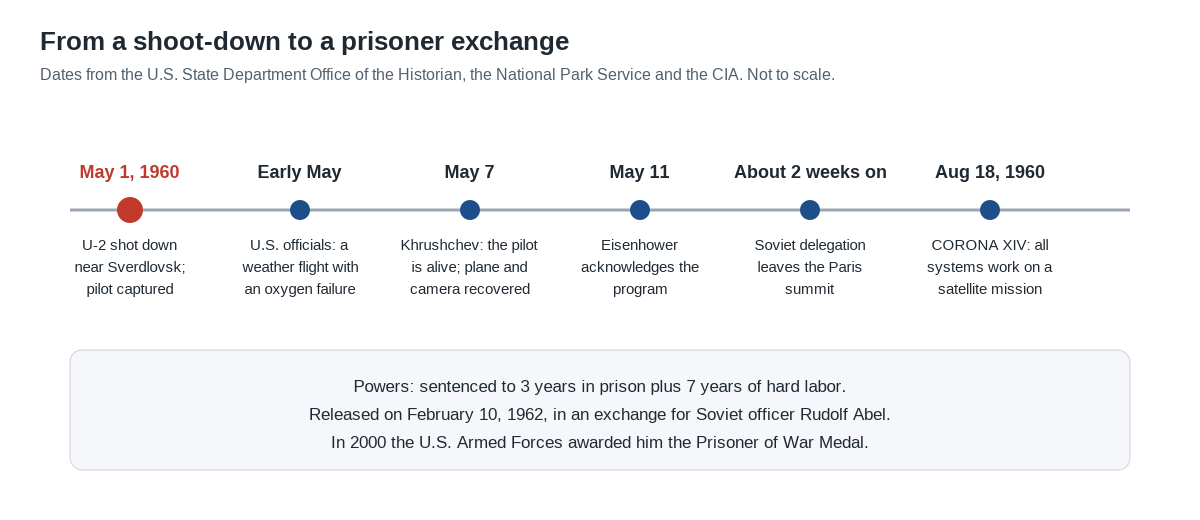
Eisenhower would not make a formal apology. He had taken a close interest in the program and had approved each flight himself. On May 11, he admitted that he knew about the whole program and about Powers's flight. He added that, without an open skies agreement, such flights were needed to defend the country and would continue.
A collapsed summit, and after
Now in a difficult position, Khrushchev demanded an apology for past flights and a promise to stop them before any talks could begin. When Eisenhower refused, the Soviet delegation left Paris on the eve of the talks. Khrushchev then gave up on working with Eisenhower and chose to wait for John F. Kennedy, elected in November 1960, to take office.
A Soviet court found Powers guilty of espionage and gave him 3 years in prison plus 7 years of hard labor. On February 10, 1962, he and a detained American student went free in a swap for a Soviet spy held by the United States, Rudolf Abel. In 2000, the U.S. Armed Forces awarded him the Prisoner of War Medal and the Distinguished Flying Cross. Powers never saw them; he died in 1977 when the TV news helicopter he was flying crashed in Los Angeles.
From the sky to space
Sources differ a little on what happened to the U-2 flights next. The Office of the Historian says Eisenhower would not shut the U-2 program down, yet it was soon overtaken as satellite images replaced aerial photos. The CIA says that after the shoot-down Eisenhower stopped all U-2 flights over the Soviet Union.
The CIA's own verdict is blunt. Photos from 24 U-2 missions over the Soviet Union in 1956–1960 opened only a small crack. That crack closed before a single intercontinental ballistic missile (ICBM) base was found. Then, a little over three months later, on August 18, 1960, all systems finally worked on the fourteenth mission of the CORONA reconnaissance satellite.
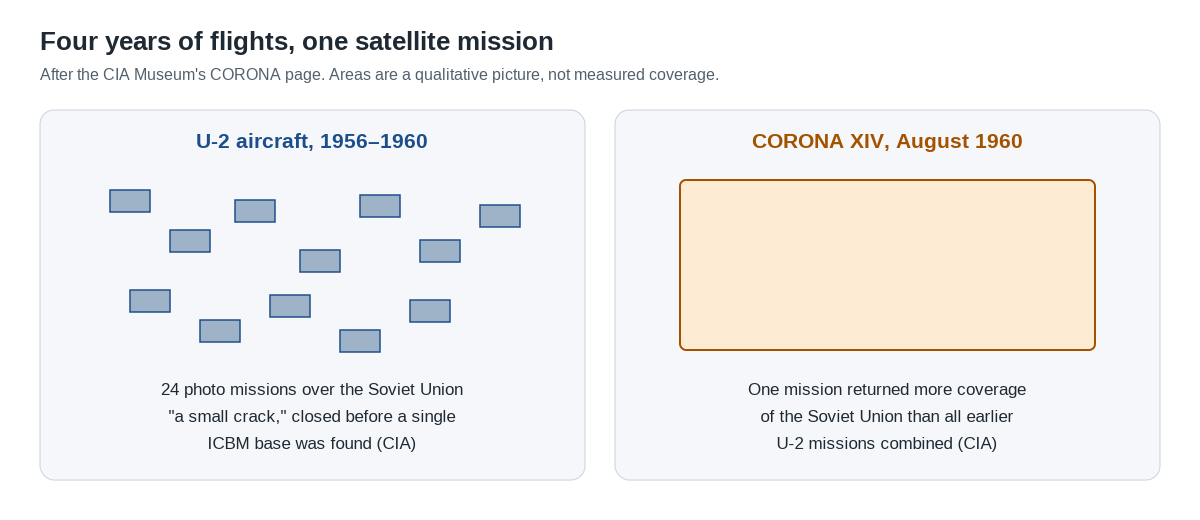
According to the CIA, that one mission brought back from space more photo coverage of the Soviet Union than every earlier U-2 mission put together. CORONA's images were made public on February 24, 1995, under Executive Order 12951. In the year that the idea of safety through height fell apart, reconnaissance began moving higher than any plane could fly. The story continues in Reconnaissance satellites: information from orbit.
What to read next
- Reconnaissance satellites: information from orbit: the eyes in space that followed the U-2
- Surface-to-air missiles: ground systems that guard the sky: how equipment on the ground defends against high-flying aircraft
- The Cuban Missile Crisis: Thirteen Days of Nuclear Danger: two years later, when reconnaissance photos changed history again