When a headline says "50 kW-class laser," can you tell right away whether that is a lot? Kilowatts appear on household electric bills, yet the same unit feels strange in a weapons story.
Line up everything from one light bulb to one nuclear reactor and you can see where laser weapons sit. A 40 W bulb, a house, published laser powers and a gigawatt-scale reactor all fit on one scale. Along the way comes the difference between power and energy, which news readers often mix up.
The watt and the prefixes above it
A watt is a rate: 1 J of energy per second. In the International System of Units, the watt is the unit of power and radiant flux, equal to J/s. Light output and electrical power are both measured in watts.
The prefixes in front of the watt are powers of ten. Kilo (k) means 1,000 times, mega (M) a million times, and giga (G) a billion times. The U.S. Energy Information Administration (EIA) calls 1 W "a very small amount of power." Larger devices are measured in kilowatts, and very large amounts, such as the output of power plants, in megawatts and gigawatts.
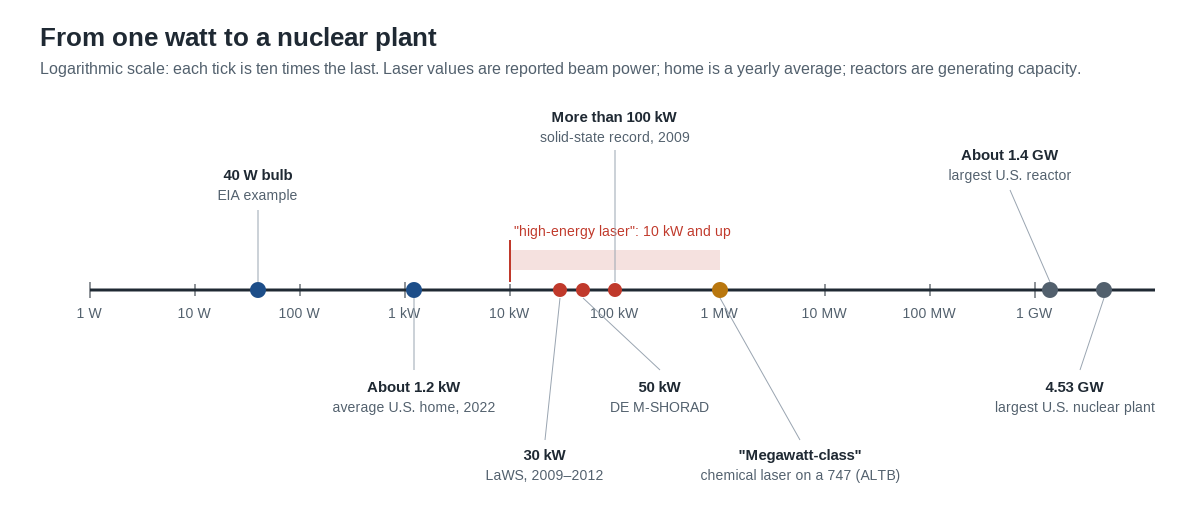
Everyday rungs: a bulb and a house
The bulb in the EIA's example draws 40 W. Many devices around us need anywhere from a few watts to a few dozen.
What about a whole house? According to the EIA, the average U.S. residential customer bought 10,791 kWh of electricity in 2022. A year has 8,760 hours, so if that use were spread evenly, it would be a steady draw of about 1.2 kW. Real use swings a lot between night and day and between summer and winter, but the figure is useful for a sense of scale.
Laser weapon rungs: from 10 kW to megawatt-class
Military laser talk starts around 10 kW. A CRS report says that in discussions of Navy shipboard lasers, a laser whose beam carries 10 kW or more is generally considered a high-energy laser (HEL). That is a single beam of light several times the average power of a whole house.
Here are some published figures. LaWS, the prototype laser the U.S. Navy tested on land and at sea in 2009–2012, was reported to put out a 30 kW beam. The U.S. Army's DE M-SHORAD program puts a 50 kW laser on a Stryker vehicle. Using the household average above, 50 kW is the power of about 40 homes.
Research records go higher. A U.S. Army article reports a 2009 milestone in the Joint High Power Solid State Laser (JHPSSL) program. Northrop Grumman ran a solid-state laser at more than 100 kW for several minutes. That equals 2,500 of the 40 W bulbs.
Above that sat chemical lasers. A Missile Defense Agency (MDA) fact sheet says the airborne test bed, a modified Boeing 747 freighter, carried a "megawatt-class" chemical oxygen-iodine laser. "Megawatt-class" describes a scale, not an exact value.
Power plant rungs: megawatts and gigawatts
The very large amounts of electricity made by power plants are measured in megawatts and gigawatts. Take real numbers. The largest U.S. nuclear reactor, at the Grand Gulf station in Mississippi, has a net summer capacity of about 1,400 MW (1.4 GW), according to the EIA. Vogtle, the largest U.S. nuclear plant, has four reactors totaling 4,530 MW.
One 1,400 MW reactor is 14,000 times the 100 kW solid-state laser record of 2009. That is why more than four steps separate the laser rungs from the reactor rungs in the figure.
Power and energy are not the same
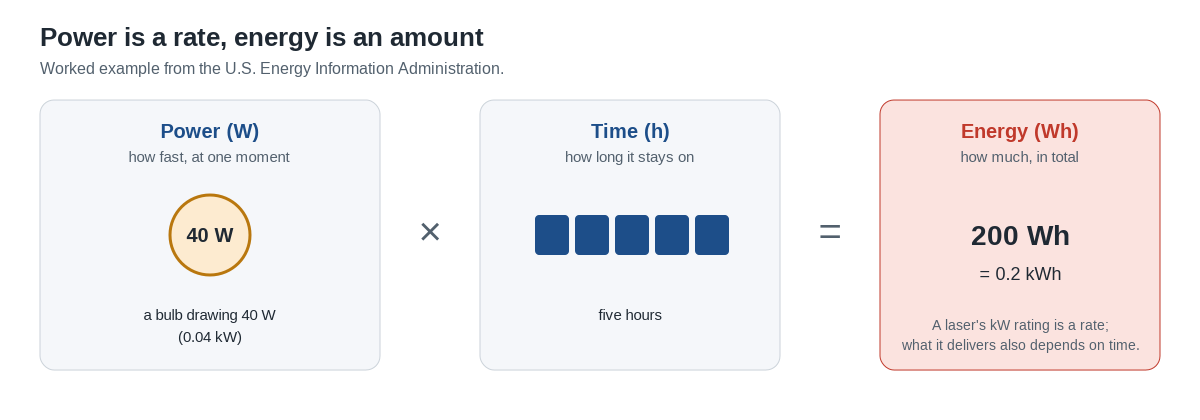
The pair most often mixed up in news is power and energy. The EIA explains that watts measure power at one moment, while the amount of electricity used over time is measured in watt-hours (Wh). A 40 W bulb left on for five hours uses 200 Wh, or 0.2 kWh.
Think of a faucet: power is how hard the water flows, and energy is how much water collects in the bucket. In reality laser light does not collect in a bucket; at the target surface it is absorbed, reflected or scattered.
The shared point holds, though: "how many kW" alone does not tell you how much energy reached a target. You also need to know how long the light stayed on and how small an area it covered. The difference is covered in more detail in Power, energy and intensity: W, J and W/cm².
Light out versus electricity in
One more point is worth remembering. The "kW" in laser news usually means beam power, the light that leaves the laser. A laser turns only part of its electrical input into light, so a laser with 50 kW of beam power draws more than 50 kW of electricity. The share of input electricity that becomes light is called wall-plug efficiency.
A CRS report notes that many current U.S. programs are electrically powered solid-state lasers. So the cost per shot would equal the cost of the electricity needed to fire it.
That cost is counted on the electricity going in, not the beam coming out. Electrical input is often not published for each system, so this article's ladder shows beam power only. How efficiency sets the size of a system is covered in Power and efficiency.
Further reading
- How to read laser weapon news: "kW-class", "range" and "cost per shot": the order for reading numbers in a story
- Power, energy and intensity: W, J and W/cm²: how the three units differ
- Laser weapon programs that have been made public: background on the lasers on this ladder