Laser news is full of numbers. One story says "a 50 kW laser." Another says "2.05 MJ." A third puts "2.08 MJ" and "456 TW" in the same sentence.
They all sound big and strong, yet the three numbers measure different things.
This article is a quiz. The seven numbers below come from sentences actually written by the U.S. Congress's research service, a national laboratory, NASA and an energy statistics agency. For each one, decide whether it is power, energy or intensity. Multiplication and division are all the math you need.
Before you start, look at how the unit ends
The International Bureau of Weights and Measures (BIPM) looks after the International System of Units (SI). In its unit tables, the unit of energy is the joule (J), the unit of power is the watt (W), and the watt is spelled out as J/s. So 1 J flowing every second is 1 W.
A watt is how fast energy flows, and a joule is how much has flowed. Think of a car: the watt is like "60 km per hour" on the speedometer, and the joule is like "60 km" on the trip counter. Drive at the same speed for longer and the distance grows; shine the same power for longer and the energy piles up. The difference is that the distance a car covers stays on the counter, while laser energy hits a target and is absorbed, reflected or scattered.
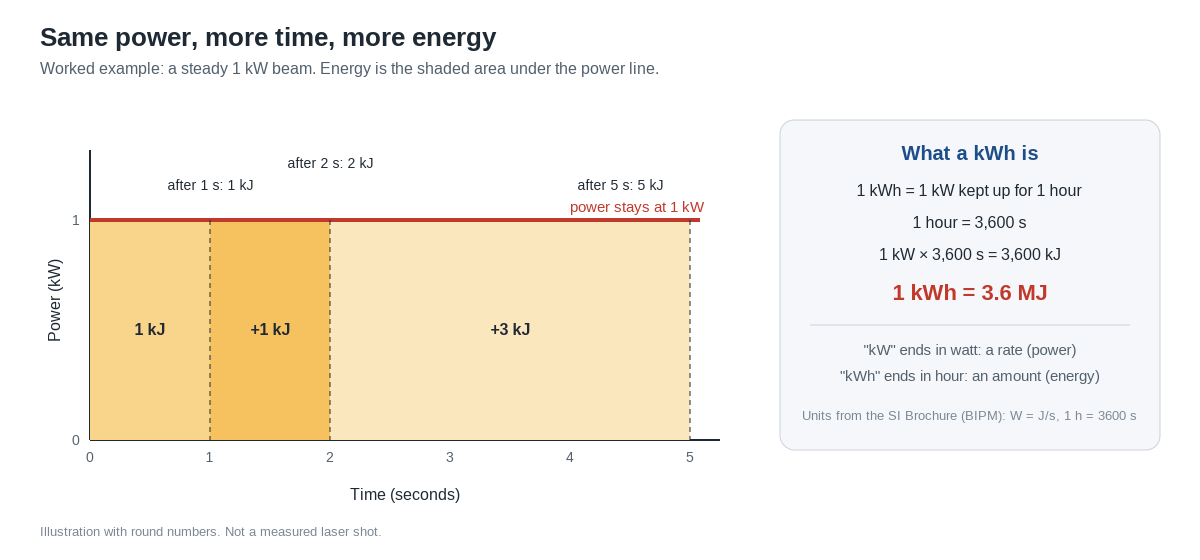
So 1 kW for 1 second gives 1 kJ, and 1 kW for 2 seconds gives 2 kJ. The prefix in front, k (kilo, a thousand), M (mega, a million) or T (tera, a trillion), only changes the size. You decide what kind of number it is by how the unit ends.
Questions 1–3: sentences with kilowatts
Question 1. The Congressional Research Service (CRS) wrote a directed energy weapons report in 2024. It describes the Army's DE M-SHORAD program as one that would put "a 50 kW laser" on a Stryker combat vehicle. What is 50 kW?
The answer is power. Kilowatts and megawatts are both units of power. The number tells you how much energy the beam sends out each second. It does not tell you how many joules leave in one shot.
Question 2. Quoting Army budget documents, CRS says the IFPC-HEL program, meant to protect fixed and semi-fixed sites, includes a "300 kW class [>250 kW]" laser subsystem. What does "class" mean here?
It is a rough grouping of power. In the brackets, the document itself spells out "300 kW class" as more than 250 kW. When a story says "a ○○ kW-class laser," keep in mind that it may point to a range rather than an exact value.
Question 3. A high-energy laser (HEL) has "energy" in its name. Is it defined by energy or by power?
This one is a trap. The CRS report on Navy shipboard lasers says that, in Navy discussions, a high-energy laser generally means one whose beam puts out 10 kW or more. The name says energy, but the yardstick is power.
Questions 4 and 5: units with time, and joules
Question 4. The U.S. Energy Information Administration (EIA) reports that in 2022 the average U.S. home bought 10,791 kWh of electricity over the year. Is a kilowatt-hour (kWh) power?
No. It is energy, because the unit ends in "hour," not "watt." 1 kWh is 1 kW kept up for an hour. An hour is 3,600 seconds, so that comes to 3,600 kJ, or 3.6 MJ.
You can also run it backward. A year has 8,760 hours, so 10,791 kWh divided by 8,760 hours means the home drew about 1.2 kW on average. The same fact is 10,791 kWh as energy and about 1.2 kW as average power.
Question 5. Lawrence Livermore National Laboratory runs the National Ignition Facility (NIF). In its account of a December 5, 2022 experiment, the lasers put 2.05 MJ into the target and the shot released 3.15 MJ of fusion energy. Is 2.05 MJ power?
It is energy, since a megajoule (MJ) ends in joule. This experiment was fusion research, not a weapon test, but it is a clear example of stating in joules how much one laser shot handed to a target. The comparison that more fusion energy came out than laser energy went in works only because both numbers use the same unit.
Question 6: when both appear in one sentence
Question 6. The laboratory says that in an April 7, 2025 experiment, NIF's lasers delivered 2.08 MJ to the target in a single pulse with a peak power of 456 terawatts. What is each number?
2.08 MJ is energy and 456 TW is power. More precisely, it is peak power. That means the highest power reached at one instant inside a short pulse. A terawatt is a trillion watts, so it sounds enormous, while the energy number looks far more modest.
Dividing one by the other shows why. 2.08 MJ divided by 456 TW gives about 0.0000000046 seconds, or 4.6 nanoseconds. If the beam had stayed at its peak the whole time, it would have delivered all that energy in that tiny span.
The real pulse length and shape are not given on that page, so 4.6 nanoseconds should not be read as the pulse length. Still, when a very large power and a modest energy show up together, it is a sign that the time involved is very short.
Question 7: units with an area
Question 7. NASA's Goddard Space Flight Center gives total solar irradiance, all the sunlight arriving at Earth added up, as about 1361 W/m². Is W/m² power or energy?
Neither. The watt now has "per square meter" after it, so it is power on each bit of area, which is intensity. Since 1 m² is 10,000 cm², 1361 W/m² can also be written as about 0.136 W/cm².
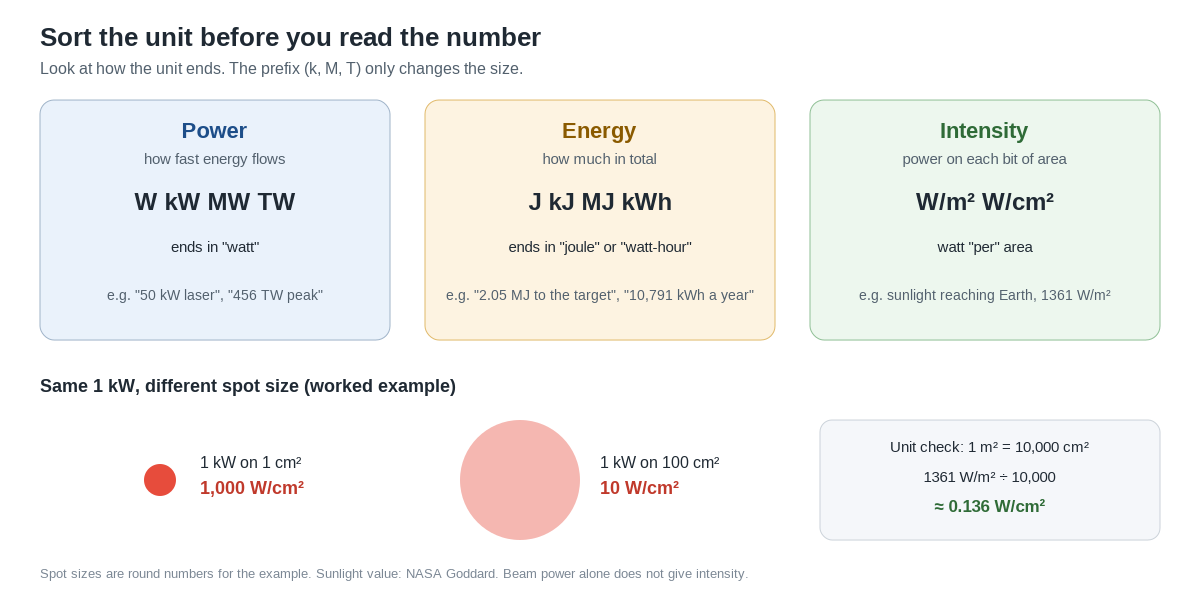
Intensity changes a great deal with how tightly the same power is gathered. Put 1 kW on 1 cm² and you get 1,000 W/cm²; spread it over 100 cm² and you get 10 W/cm². That is why "how many kW" in a story cannot tell you the intensity at the target surface. You also need to know how large a spot the beam makes there.
What one number cannot tell you
After seven questions, the numbers in a story start to look different. "50 kW" is a rate, and how many joules that beam left on a target depends on time. As an assumed example, 50 kW held for 10 seconds sends out 500 kJ. Those 10 seconds were picked to show the math; they are not a real engagement time.
Not all of the energy that leaves is used on the target, either. Light weakens and spreads as it crosses the air, and part of it reflects off the target. Why a laser weapon needs time to damage a target is covered in a separate article.
When you meet a number in a story, ask three questions: does the unit end in watts, does it end in joules or hours, or is there an area attached? Depending on the answer, the same "big number" tells a completely different story.
What to read next
- Power, energy and intensity: W, J and W/cm²: the three units from the start, with a light bulb and sunlight
- Units and dB notes: reading W, dBm and ratios: prefixes and dB for rewriting numbers
- A Feel for Power: From a Light Bulb to a Power Plant, W, kW, MW and GW: how big the kW in the news is in daily life
- Why a laser weapon does not finish "the instant it fires": why power has to be multiplied by time
- How to read laser weapon news: "kW-class", "range" and "cost per shot": the order for reading numbers in a story