A laser pointer on a desk and a processing machine on a factory floor are both lasers. Yet the material that amplifies the light is not the same. It can be a gas in a tube, a clear crystal, a thin optical fiber or a piece of semiconductor.
That material is called the gain medium. Change the medium and three other things change with it: the pumping, which is how energy is put into the medium, the typical wavelength, and the uses. The sections below take gas, solid-state, fiber and semiconductor lasers in turn and end with one table.
How lasers are grouped: by gain medium
A laser needs a gain medium, an energy source, and an optical resonator that feeds light back. Of the three, the gain medium comes in a wide range of materials. Solids such as a ruby crystal, gases, plasmas, and liquids such as organic dyes all serve.
Lasers are usually named by their gain medium, too. A technical note from the manufacturer Newport (MKS) uses four names: gas, liquid, semiconductor and solid-state.
The four branches in this article differ a little from those. Liquids (dyes) are left out and fiber lasers get a branch of their own, because sources disagree on whether fiber and semiconductor lasers count as solid-state lasers.
The RP Photonics Encyclopedia calls fiber lasers a special kind of solid-state laser. It adds that semiconductor lasers are solid-state lasers too, though the term is not always meant to include them. Newport usually treats fiber lasers separately from bulk solid-state lasers. Here, fiber and semiconductor lasers each get their own branch, though a fiber laser is also a form of solid-state laser.
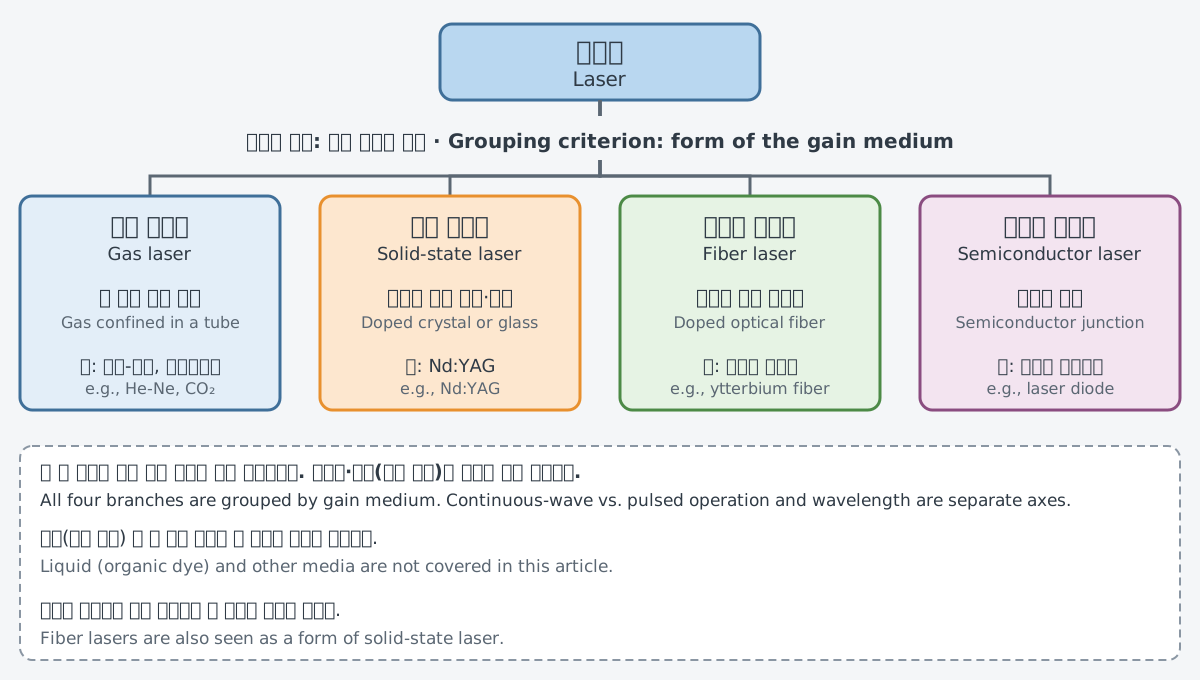
The only grouping criterion is the form of the gain medium. The operating mode, continuous-wave (CW) or pulsed, and the wavelength are separate axes.
Gas lasers
The helium-neon (He-Ne) laser, with its red light, is a typical gas laser. In a gas laser, the gain medium is a gas confined in a tube. In most of them an electric current passes through the tube and excites the atoms. This is an electric discharge.
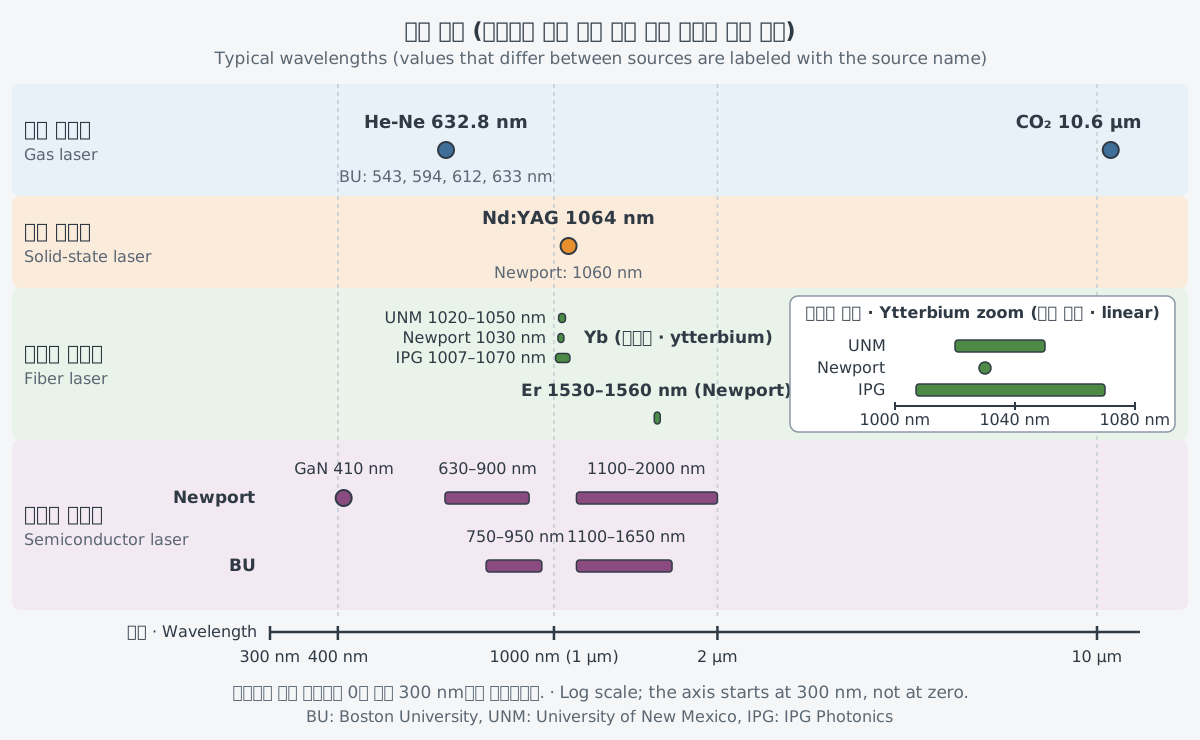
Helium-neon lasers often emit red light at 632.8 nm but can also be made for other wavelengths such as 543.5 nm. Some wavelength tables list only 632.8 nm, while others list four lines side by side: 543, 594, 612 and 633 nm. The other typical example, the carbon dioxide (CO₂) laser, has a wavelength of about 10.6 μm.
According to Newport, gas lasers were once widely used but, except for specialized uses, have largely been replaced by laser diodes (LD) and other sources. Newport names carbon dioxide and excimer lasers as the exceptions to this trend, saying they still play significant roles in the laser processing and eye surgery markets.
Solid-state lasers
A solid-state laser uses a transparent crystal or glass with active ions introduced as impurities as its gain medium. The crystal or glass is called the host. The ions are rare-earth or transition-metal ions.
A typical example is Nd:YAG. It is a crystal called YAG doped with neodymium ions, and its most common wavelength is 1064 nm. The Newport wavelength table lists it as 1060 nm.
It is pumped by flash tubes or laser diodes. Laser diodes are now the most common pump source.
Fiber lasers
Take a solid-state gain medium and draw it out into a long, thin strand instead of a bulk piece, and the result is a fiber laser. The optical fiber itself becomes the gain medium. The fiber is doped with rare-earth ions, and the most common are ytterbium (Yb), erbium (Er) and thulium (Tm).
Being thin is not its only feature. A fiber guides light with strong confinement over long distances, so fiber lasers are usually treated separately from bulk solid-state lasers. Virtually all fiber lasers are pumped with light from laser diodes or other fiber lasers.
A search for the wavelength of ytterbium fiber lasers turns up several numbers, because each source is describing a different thing. The 1030 nm in the Newport table is a nominal value for ytterbium glass. The 1020–1050 nm in the University of New Mexico slides is for lasers pumped by 940–980 nm diodes, and IPG Photonics lists 1007–1070 nm for its high-power continuous-wave product line. Erbium fiber appears in the Newport table at 1530–1560 nm.
Semiconductor lasers (laser diodes)
The laser used in a laser pointer is a semiconductor laser. Its gain medium is a semiconductor. It works like a diode with current flowing forward through a junction, which is why it is often called a laser diode.
The junction is the region where two different semiconductors, n-doped and p-doped, meet. Most semiconductor lasers are laser diodes, pumped with an electric current in this region.
The wavelength depends on the semiconductor material, and sources group the materials differently. The Boston University safety document names two families. GaAlAs (gallium, aluminum, arsenic) types span 750–950 nm, and InGaAsP (indium, gallium, arsenic, phosphorus) types span 1100–1650 nm. The Newport table groups the materials in three sets and lists 410 nm, 630–900 nm and 1100–2000 nm, where 410 nm is the value for the material GaN.
Comparison at a glance
The chart below places the typical wavelengths from the earlier sections on one axis. The horizontal axis is logarithmic, so equal spacing means equal multiples, and it starts at 300 nm, not at zero. Where sources give different values, the point carries the source name.
| Type | Typical example | Gain medium | Pumping | Typical wavelength | Typical uses |
|---|---|---|---|---|---|
| Gas | Helium-neon | Gas in a tube | Electric discharge | 632.8 nm (Boston University table: 543, 594, 612, 633 nm) | Interferometry, holography, barcode scanning |
| Gas | Carbon dioxide | Gas in a tube | Electric discharge | 10.6 μm | Material processing, surgery, dental use |
| Solid-state | Nd:YAG | Active ions in a crystal or glass host | Flash tube or laser diode | 1064 nm (the Newport table gives 1060 nm) | Material processing, rangefinding, surgery, pumping other solid-state lasers |
| Fiber | Ytterbium fiber | Optical fiber doped with ions | Laser diode (usually) | Near 1030 nm (1007–1070 nm, depending on source) | Material processing, ultrashort-pulse research, LIDAR |
| Semiconductor | Laser diode | Semiconductor junction | Electric current (mostly) | Depends on the material (Newport table: 410 nm, 630–900 nm, 1100–2000 nm) | CDs, DVDs and Blu-ray Discs, laser pointers, optical fiber communications, pumping solid-state lasers |
Efficiency figures are hard to read as a ranking. The University of New Mexico slides give below 0.1% for helium-neon, below 10% for Nd:YAG, below 20% for carbon dioxide and below 40% for GaAlAs diodes, with no measurement conditions. The RP Photonics Encyclopedia puts the electrical-to-optical efficiency of laser diodes typically on the order of 50%. The pages do not show whether the two values use the same basis, so "below 40%" and "about 50%" should not be compared directly.
What to read next
- "Why wavelength matters: visible and invisible light": what the wavelength values mean.
- "Continuous-wave and pulsed lasers": the operating mode, which is a separate axis from the medium.
The official websites of manufacturers are gathered on the Manufacturers page.