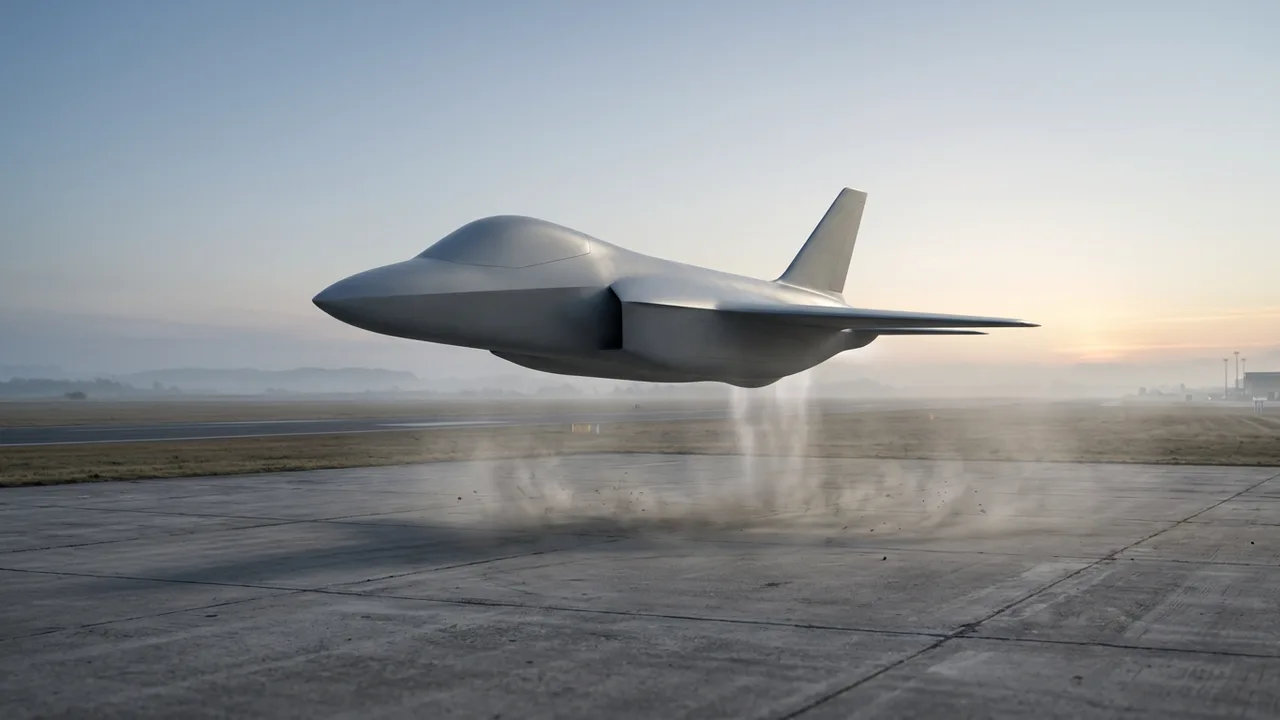
To get into the air, a fighter jet usually has to race down a long runway. Yet some aircraft take off from a ship's deck or a grass field, and some rise straight up from one spot like a helicopter. They are all airplanes, so what is different?
The answer is in what holds the weight up. This article starts with the separate jobs of the wings and the engines. It then explains what the labels vertical takeoff and short takeoff mean. After that come three ways to turn engine power downward and the weight problem that follows, all from public sources.
Why airplanes need runways
An airplane in flight is under four forces. Weight pulls it down, lift pushes against the weight, thrust drives it forward, and drag holds it back.
Lift comes from the airplane moving through the air, and the wings make most of it. So what do the engines do? NASA Glenn Research Center's introductory aeronautics guide points out that the engine's job is to overcome drag, not to lift the airplane. The lifting is done by the wings.
That is also why airplanes run down a runway. The wings only make lift while they move through the air, so the airplane has to speed up on the ground first. U.S. federal aviation rules define an airplane the same way: a fixed-wing aircraft held up by the reaction of the air pushing against its wings.
It is a bit like running into the wind to launch a kite. The real thing is different. A kite is held by a string and needs the wind to blow, while an airplane pushes itself forward with engine thrust and sends air over its own wings.
Four labels: CTOL, STOVL, V/STOL, VTOL
The ordinary way, using the whole runway, is called conventional takeoff and landing (CTOL). Taking off after a short run and then landing straight down is short takeoff and vertical landing (STOVL). An aircraft that can take off and land either vertically or after a short run is called vertical/short takeoff and landing (V/STOL, also written VSTOL).
Rising and landing straight up and down from one spot is vertical takeoff and landing (VTOL). U.S. federal rules have a separate category for winged aircraft like this, called powered-lift.
This category covers aircraft that can take off vertically, land vertically and fly slowly. During those phases they are held up mostly by engine thrust or engine-driven lift devices, and in level flight they rely on non-rotating wings. A rotorcraft, such as a helicopter, is held up mainly by the lift from one or more rotors and belongs to a different category.
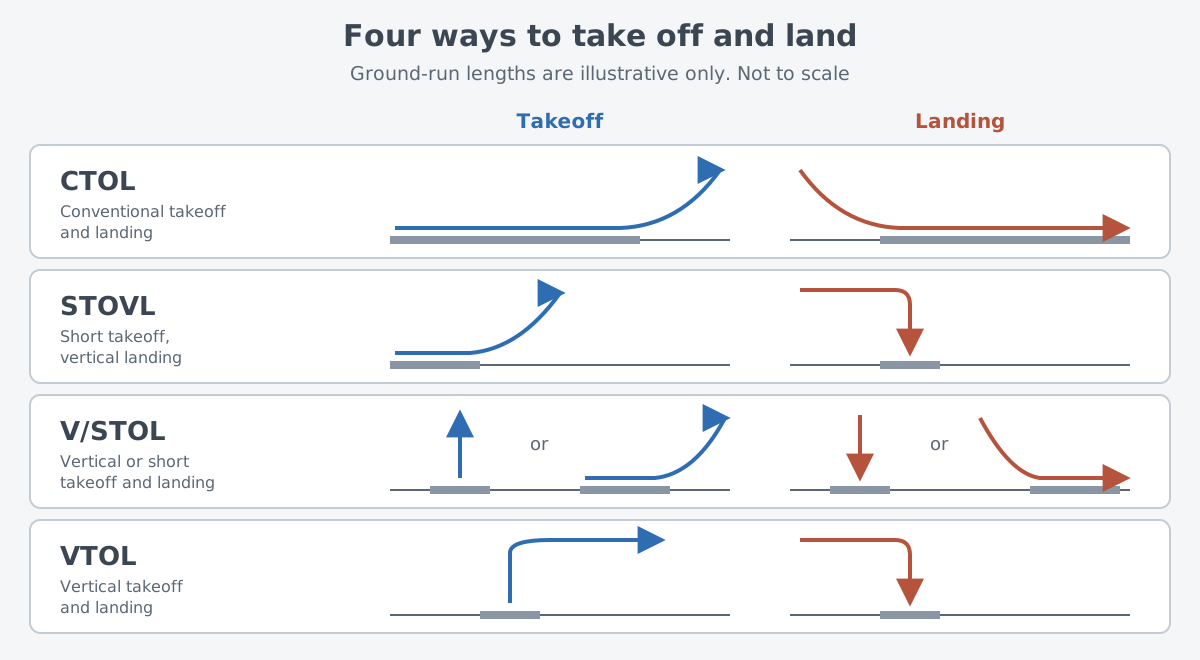
These labels describe how an aircraft takes off and lands, not what model it is. The F-35 is a good example.
A report by the Congressional Research Service (CRS) lists three versions. The Air Force F-35A is CTOL, the Marine Corps F-35B is STOVL, and the Navy F-35C is a CTOL version built for aircraft carriers. The differences among the three include how they take off and land, how much fuel they hold, and whether they suit carriers.
Holding the weight up with engines
In forward flight, the wings carry the weight. So what carries it when the aircraft is nearly standing still in the air? The wings are not moving fast enough to help much, which leaves the engines. In its section on the F-35B, CRS notes that at low or zero airspeed, how well the aircraft performs rests directly on its engine thrust compared with its weight.
That ratio is called the thrust-to-weight ratio. It is the thrust divided by the weight, and the higher it is, the faster the aircraft can accelerate. When the ratio tops one and drag stays low, the aircraft can speed straight up like a rocket. A rocket, too, needs more thrust than its own weight to lift off.
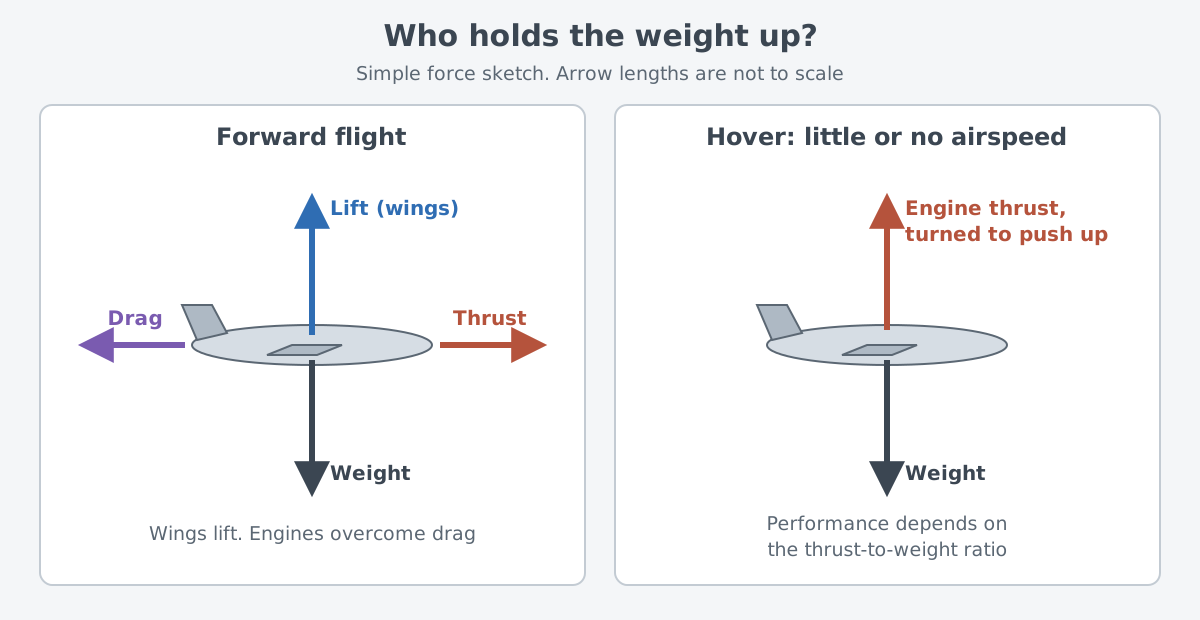
That leaves the question of direction. In a normal airplane, thrust points forward along the body. To hold the weight up with the engines, that push has to be turned so it lifts the aircraft. The Harrier is one aircraft built to do exactly this, changing the direction of thrust to get off the ground in a very short distance.
Three approaches: nozzles, a lift fan, tilting rotors
The first approach swivels the exhaust nozzles. The Kestrel, a British-built prototype, had four adjustable exhaust nozzles under its wing. Turning them gave the thrust needed for vertical flight, flying backward, hovering, and ordinary forward flight. The Harrier grew out of the Kestrel.
The second approach adds a lift fan. On the F-35B, the engine's rear exhaust nozzle can swing downward, and a lift fan in the middle of the body is connected to the engine. The fan blows air downward to help hold up the front of the aircraft. The rear nozzle and the front fan hold the aircraft up together.
The third approach tilts the rotors, an aircraft type known as a tiltrotor. The V-22 Osprey carries a rotor and a nacelle holding the engine and transmission at each wing tip. It acts like a helicopter when it takes off and lands vertically, and once in the air it turns the nacelles 90 degrees forward to fly level.
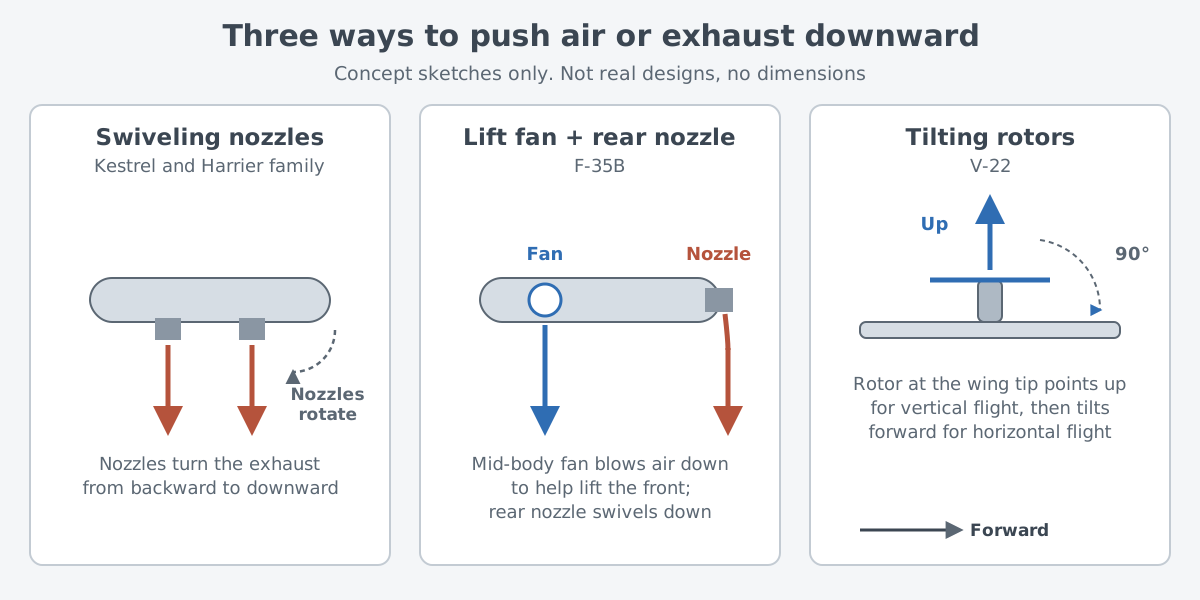
The Navy describes the V-22 as doing vertical takeoff and landing missions as well as a regular helicopter while also cruising long distances like a twin-engine turboprop. All three approaches do the same job. They turn engine power downward to carry the weight while the wings are not yet doing their work.
A short history through public examples
Follow the dates and a pattern appears. According to the National Museum of the U.S. Air Force, the first Kestrel began flight trials in Britain in 1961. The following year, the United Kingdom, the United States and West Germany ordered nine aircraft for joint testing. In 1965, a joint evaluation squadron that included U.S. Air Force pilots put the Kestrel through trials.
The Kestrel could work from grass, partly prepared ground, or ship decks. An improved version, the Harrier, joined the Royal Air Force in 1969 and became the world's first operational V/STOL fighter. The U.S. Air Force did not order it, but the U.S. Marine Corps and the Royal Air Force flew the Harrier for decades.
- 1989: The V-22, the world's first production tiltrotor aircraft, made its first flight.
- 1994: Congress told the Marine Corps to merge its effort to replace the Harrier with the Air Force and Navy program. That program became the Joint Strike Fighter (JSF), the F-35.
- March 17, 2010: The F-35B showed it could hover for the first time, after a demonstration that had been planned for November 2009. The first vertical landing came the next day.
The Marine Corps' choice to wait for the F-35B instead of buying another new fighter fits this history. Part of the reason was that the F/A-18E/F it passed over is a CTOL aircraft, while the Marine Corps favors aircraft able to operate vertically.
The price: weight matters most
Carrying the weight on engine power means that even a little extra weight becomes a burden right away. Weight is an especially critical factor for the F-35B, since it takes off and lands close to vertically. The thrust-to-weight ratio from earlier shows up again here.
It also left a mark on the order of development. Normally the simplest version is developed first, and its lessons are applied to the more complex ones. But the Marine Corps' Harriers were reaching the end of their lives first, so the most complex version, the F-35B, had to come first. CRS concludes that technical problems found only in STOVL aircraft held up all three versions.
The public numbers show the price too. The Navy's V-22 specifications list three maximum gross weights: 52,600 pounds for vertical takeoff, 57,000 pounds for short takeoff, and 60,500 pounds for self-deployment. Self-deployment means flying itself to another location.
On the same page, the CMV-22B specifications give 60,500 pounds as the maximum weight for a rolling takeoff. The limit is lowest for a vertical takeoff, so the way it takes off changes how heavy it is allowed to be.
Where this meets lasers: weight and space
On a vertical takeoff aircraft, a single chunk of extra weight turns straight into a performance problem. The same question of what can be carried, and how much, applies to other equipment as well. People who fit equipment onto platforms weigh this as size, weight and power (SWaP).
Laser weapons face the same wall. A laser has to bring its power and cooling equipment along with it. Weight and platforms: fitting on a vehicle, ship or aircraft looks at what each platform demands.
What to read next
- Thrust vectoring: steering with the engine. It looks at turning engine thrust from the side of maneuvering in flight.
- Helicopter rotors: how coaxial helicopters fly without a tail rotor. It looks at rotorcraft, which stay up on their rotors.
- Weight and platforms: fitting on a vehicle, ship or aircraft. It looks at the limits that weight and space put on laser weapons.