A helicopter rises and lands straight up and down, with no runway at all. It is weak at going fast and far, though. An airplane is the opposite: fast and long-ranged, but it needs a long runway to get into the air. Could one aircraft do both?
NASA's history of its XV-15 research program calls this wish, which took shape by the middle of the 20th century, "a new dream." The goal was an aircraft that lifts off and hovers like a helicopter but cruises as fast and as far as a fixed-wing plane. The tiltrotor gets closer to that dream by changing the direction its rotors point. This article follows the idea and the long run of tests behind it, from first attempts in the 1920s to today's Army program.
Why helicopters struggle to fly fast
A helicopter's rotor blades sweep a circle overhead. When the aircraft flies forward, one blade moves into the wind while the blade on the other side moves away from it. The advancing blade meets air at its rotation speed plus the flight speed. The retreating blade meets air at its rotation speed minus the flight speed.
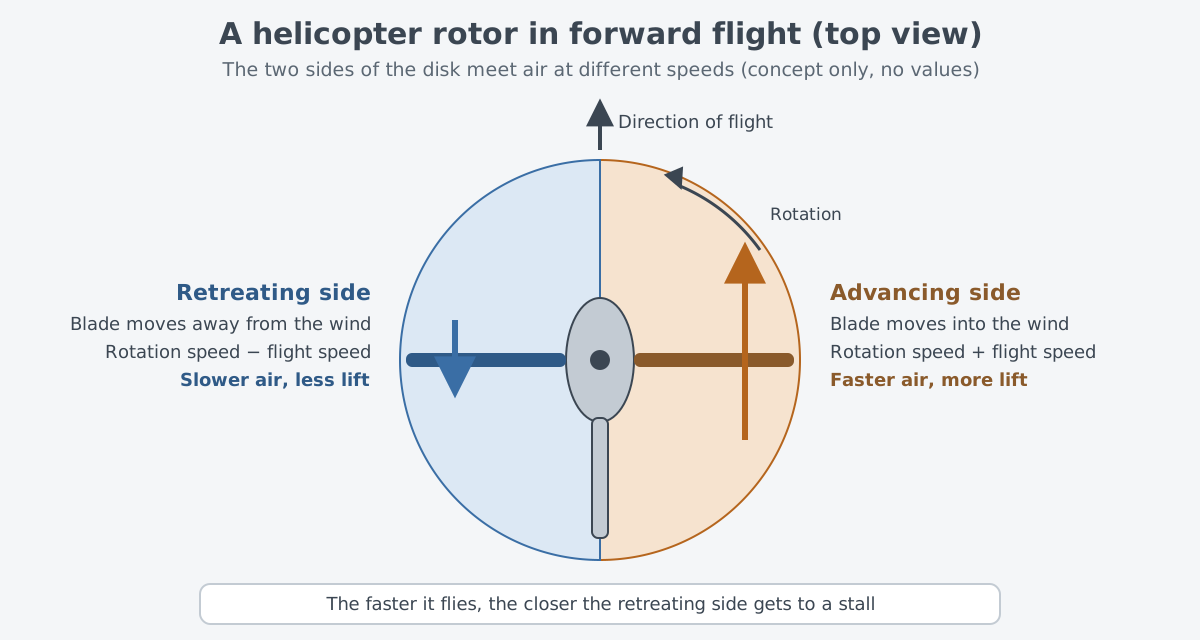
The advancing side, with faster air, can make more lift. This unequal lift between the two halves of the disk is called dissymmetry of lift. A helicopter evens it out by letting the advancing blade flap up and the retreating blade flap down. Flapping down makes the retreating blade meet the air at a larger angle of attack.
Trouble comes with speed. At high forward speed, the large angle of attack and slow air on the retreating blade push it into a stall. The Federal Aviation Administration (FAA) helicopter handbook calls this retreating blade stall, and lists a nose pitch-up, vibration and a tendency to roll as its signs. Blade flapping and slow air on the retreating blade together normally cap a helicopter's top speed.
Adding a wing did not remove this wall. In cruise, a helicopter rotor slices through the air edgewise, and each blade speeds up and slows down in the airflow on every turn. The NASA history notes that the compound helicopter, which let a fixed wing carry the lift, still suffered from this shaking and was not the answer people were looking for.
Tilting the rotor forward
The tiltrotor idea is simple. Take a large rotor and tilt its shaft from vertical to horizontal. For takeoff the rotor points up and carries the weight. For forward flight it points ahead and pushes the aircraft like a propeller, while the wing holds the aircraft up.
A rotor tilted forward works like a propeller, so it does not have to slice edgewise through the air the way a cruising helicopter rotor does. The Smithsonian National Air and Space Museum describes how the XV-15 swings its rotor pylons from upright to level. That tilt removes the speed barriers that retreating blade stall puts on conventional helicopters.
Why keep such a large rotor? The answer is a quantity called disc loading: the thrust divided by the area that produces it.
A helicopter rotor pushes air over a wide area, so it is a low disc loading device. Such a device delivers much more thrust per horsepower than one that pushes through a small area, like a jet nozzle. For an aircraft that must hover for long periods or save fuel in a hover, the big rotor is the better choice.
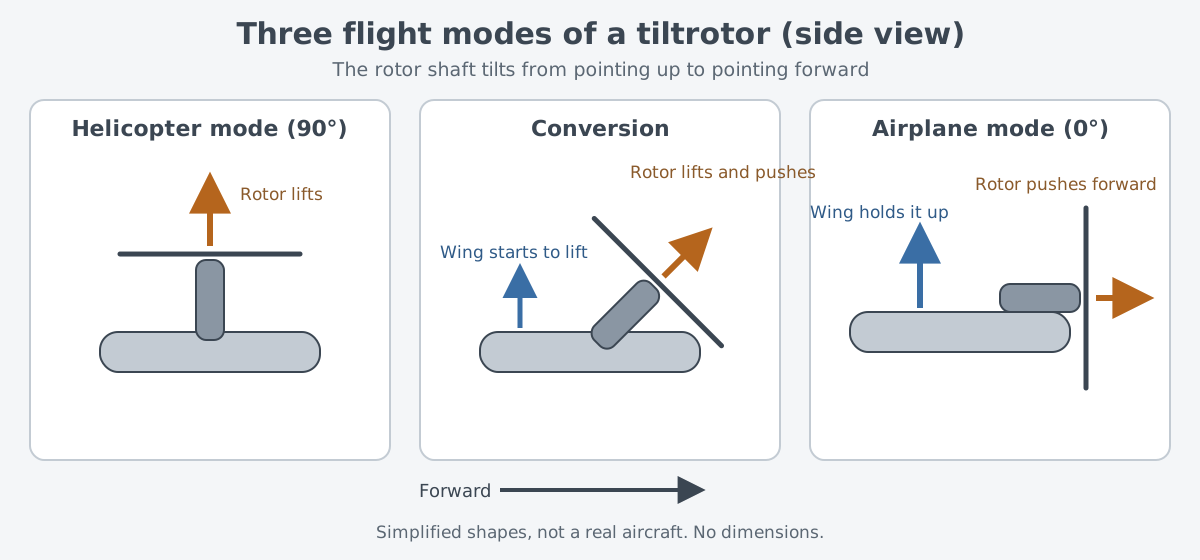
The XV-15 project called the helicopter mode, with the rotor shaft pointing up, 90 degrees, and the airplane mode, with the shaft pointing forward, 0 degrees. Moving between them is conversion. Conversion could be flown inside a corridor that allowed a wide range of airspeeds, shaft angles and body attitudes. The wing's control surfaces, such as the ailerons and elevator, work in every mode, and the rotor controls fade out automatically as the nacelles tilt forward.
Picture slowly turning the head of a desk fan from facing the ceiling to facing the room. The real thing is different because a heavy nacelle holding the engine and rotor tilts as one piece, which shifts the aircraft's balance. The pilot's main task during conversion was a fore-and-aft input to hold the aircraft's attitude.
U.S. federal aviation rules also treat this kind of aircraft separately, defining a helicopter as a rotorcraft held up mainly by lift from its rotors. Powered-lift is different: when it takes off or lands vertically or flies slowly, it depends mainly on lift devices driven by engines, or on engine thrust. In level flight it depends on wings that do not rotate. Read word by word, that definition matches a tiltrotor, which leans on its rotors for vertical takeoff and landing (VTOL) and on its wing in cruise.
One rotor, two jobs
A tiltrotor's rotor has to be both a helicopter rotor and an airplane propeller, which is why it is often called a proprotor. Giving one part two jobs makes it hard to get either job perfect.
Bell's XV-3 test aircraft showed this difficulty clearly. According to the NASA history, its rotor had poor propulsive efficiency in airplane mode and poor hover performance as well. Later tiltrotor designers were able to give proprotor blades a lot of twist, like airplane propeller blades. They were freer than helicopter blades, which must cope with edgewise flight.
The size compromise remains. A big proprotor that lets the aircraft hover on low, helicopter-like power is much larger than the size that works best in airplane mode. The forces on the blades and the way air flows into the rotor also differ widely between hover and cruise. Finding an aircraft that meets both hover and cruise performance goals was the major task facing the developers of vertical takeoff aircraft.
Early attempts and the XV-3
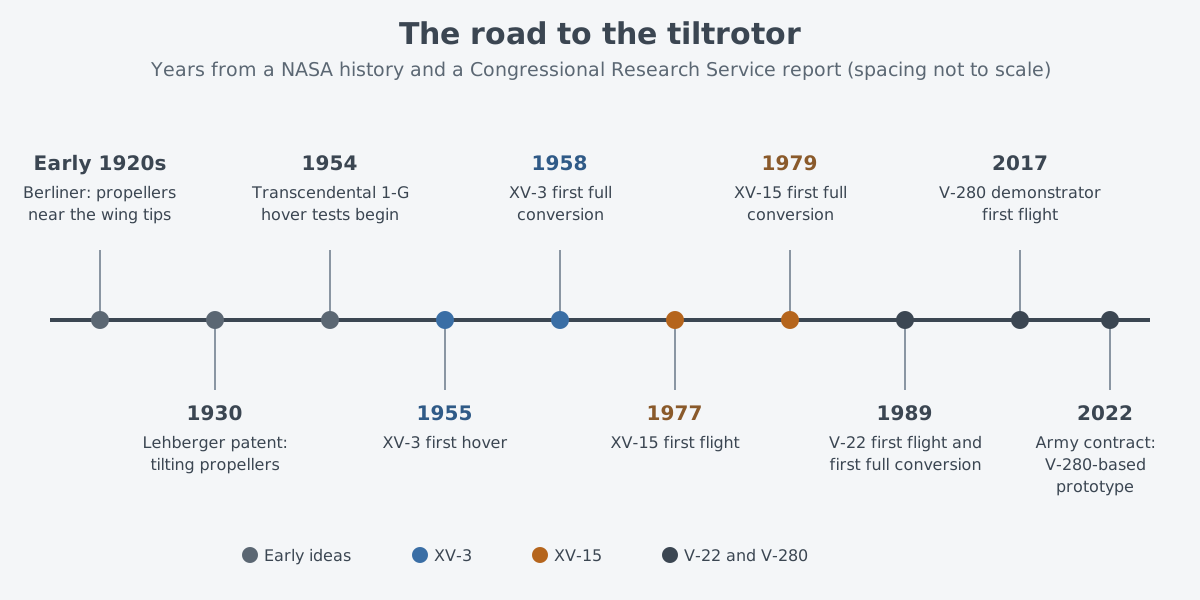
Tilting rotors is an old idea. In the early 1920s, Henry Berliner in the United States built a machine that looked like a biplane of the time. It had a propeller on a vertical shaft near each wing tip, and for forward flight the shafts tilted forward. It never fully converted to an airplane, yet its side-by-side rotors already resembled the layout of today's tiltrotors.
In September 1930, George Lehberger received a patent for a flying machine with propellers that tilt from vertical to horizontal.
On June 15, 1954, the small Transcendental Model 1-G began hover tests. It made more than 100 flights in just over a year, and tilted its rotors partway, getting as close as 10 degrees to the airplane position. Then, on July 20, 1955, it went down in Chesapeake Bay. The 1-G is widely recognized as the first aircraft to successfully explore tiltrotor conversion flight.
The military was interested too. In August 1950, the U.S. Army and Air Force started a joint program for a vertical takeoff aircraft with more speed and range than the helicopters of the day. Bell proposed a tiltrotor in 1951, and it became the XV-3. It made its first hover on August 11, 1955, but a week later a rotor dynamic instability returned and caused a hard landing.
Worse came on October 25, 1956. As the pilot moved the rotor shafts 17 degrees ahead of vertical, a severe rotor instability shook the cockpit so violently that he blacked out. The first XV-3 crashed and the pilot was seriously injured. The NASA history describes this as a crisis for the whole XV-3 effort.
The team replaced the three-bladed rotor with a two-bladed one and ran repeated tests in the large NACA Ames wind tunnel. On December 18, 1958, the XV-3 finally converted all the way to airplane mode while staying dynamically stable. A government flight evaluation at Edwards Air Force Base from May to July of the next year listed many shortcomings in performance and flying qualities. It still concluded that the tiltrotor principle was feasible and deserved serious consideration in future design competitions.
The XV-3's 13 years were not all bright. The aircraft was badly underpowered, which limited its hover and cruise performance.
The history even calls it fortunate that its airplane-mode speed was held so low. Faster flight would likely have destroyed it through a shaking instability involving the rotor, pylon and wing together. Even so, 10 pilots flew 110 full conversions in 125 hours and showed that the aircraft could move from helicopter to airplane and back again safely.
The XV-15: the research aircraft that proved the idea
NASA and the U.S. Army took the next step together. Their project plan for a tiltrotor research aircraft came out in April 1972, and the Bell-built XV-15 lifted off for the first time on May 3, 1977. On July 24, 1979, it converted completely from helicopter mode to airplane mode in flight for the first time.
Within just over two years, enough data had been gathered to judge that the main proof-of-concept goals were met. The checks covered the dynamic stability of the rotor and wing that had troubled the XV-3, along with performance and noise. The NASA history counts this as a first for the government, meaning the Army and NASA. They had set the requirements for a whole new kind of aircraft and helped bring that kind into American aviation.
Testing brought surprises as well. On one flight the right engine stopped suddenly, and an automatic clutch disconnected it from the drive system. The left engine kept running and fed power across to the right side through a cross-shaft, so both rotors kept turning, and the aircraft landed on one engine.
The XV-15 took part in the Paris Air Show in June 1981, which the history counts as a key nontechnical moment. One of the two aircraft was lost in an accident in August 1992. The other served from 1979 through 2003, logged 700 hours of testing and is now on display at the Smithsonian's Udvar-Hazy Center. The museum says its success encouraged development of the MV-22 for the Marines, and that Bell drew on it with Agusta to develop the civil Model 609 tiltrotor.
From the V-22 to the V-280
From February to May 1982, government engineers and military specialists met at Ames Research Center to study whether one aircraft could handle the vertical lift missions of several services. The study judged the tiltrotor best suited to missions as varied as Marine assault, Navy rescue, Air Force special operations and Army medical evacuation. By then the XV-15 program had already shown something important. Engineers could predict how a military tiltrotor transport would perform, what loads it would carry and how its structure would behave, all with high confidence.
Former competitors Bell and Boeing teamed up, and the new V-22 Osprey first flew on March 19, 1989, in Arlington, Texas. That was the same site where the XV-15 had first flown twelve years earlier. On September 14 of that year it tilted all the way into airplane mode for the first time.
The road was rough. When a new administration's defense secretary picked major purchases to cancel in order to cut spending, this program was on the list.
Six full-scale development aircraft were planned for flight tests and five were completed. Two of them crashed and were destroyed, and one of those crashes killed all 7 people on board. The accidents were judged not to come from the inherent nature of this aircraft type, and the program survived.
The first production V-22 handed over to the Marines touched down at the Pentagon on September 8, 1999. In late 1999 the V-22 was in operational testing with the Navy. A June 2025 report from the Congressional Research Service (CRS) lists the Marines, the Navy and the Air Force as V-22 operators.
The next tiltrotor came from the Army, whose new long-range assault aircraft program, called FLRAA, carries the designation MV-75. The Army plans for it to take over, in time, from the UH-60 Black Hawk, a helicopter whose design dates back over half a century. Bell's V-280 Valor demonstrator first flew in December 2017, and in 2022 the Army gave Bell a contract for a digital prototype based on the V-280. The competing Sikorsky and Boeing design was a compound helicopter with coaxial rotors stacked on one shaft and a pusher propeller.
CRS, citing an industry official, says Bell took a more conventional path with the newer design. On the V-22 the whole engine tilts, while on the V-280 only the proprotors and gearbox swing forward. The newer aircraft uses an unswept, straight wing and so avoids the gearbox that sits in the middle of the V-22 wing. The Osprey also carries a V-shaped tail.
The same report lists a plan for a first prototype flight in 2026, low-rate initial production in 2028 and first fielding in 2030. It also records concerns. Some members of Congress questioned the choice of a tiltrotor, pointing to fatal V-22 accidents. The Senate Appropriations Committee encouraged Army aviation officials to share tiltrotor development and operating lessons with the Navy.
Where this meets lasers: the price of doing two jobs
The tiltrotor's history is also a history of the price paid for giving one part two jobs. A proprotor sized for hover is too big for cruise. The aircraft also needs extra parts, such as the conversion system that moves between modes and the cross-shaft that lets one engine turn both rotors. In return it gains a way to take off without a runway and still get past the helicopter's speed barrier.
Putting a laser weapon on a vehicle, ship or aircraft involves a similar kind of accounting. A platform can only give up so much weight, space and power, and any new equipment has to share that budget with the jobs the platform already does. Weight and platforms: fitting on a vehicle, ship or aircraft walks through that accounting.
What to read next
- Helicopter rotors: how coaxial helicopters fly without a tail rotor: the force that tries to spin a helicopter's body, and the ways to cancel it.
- VTOL and STOVL: flying from short runways: swiveling nozzles, lift fans and tilting rotors side by side.
- Weight and platforms: fitting on a vehicle, ship or aircraft: what a platform can spare, seen from the laser weapon side.