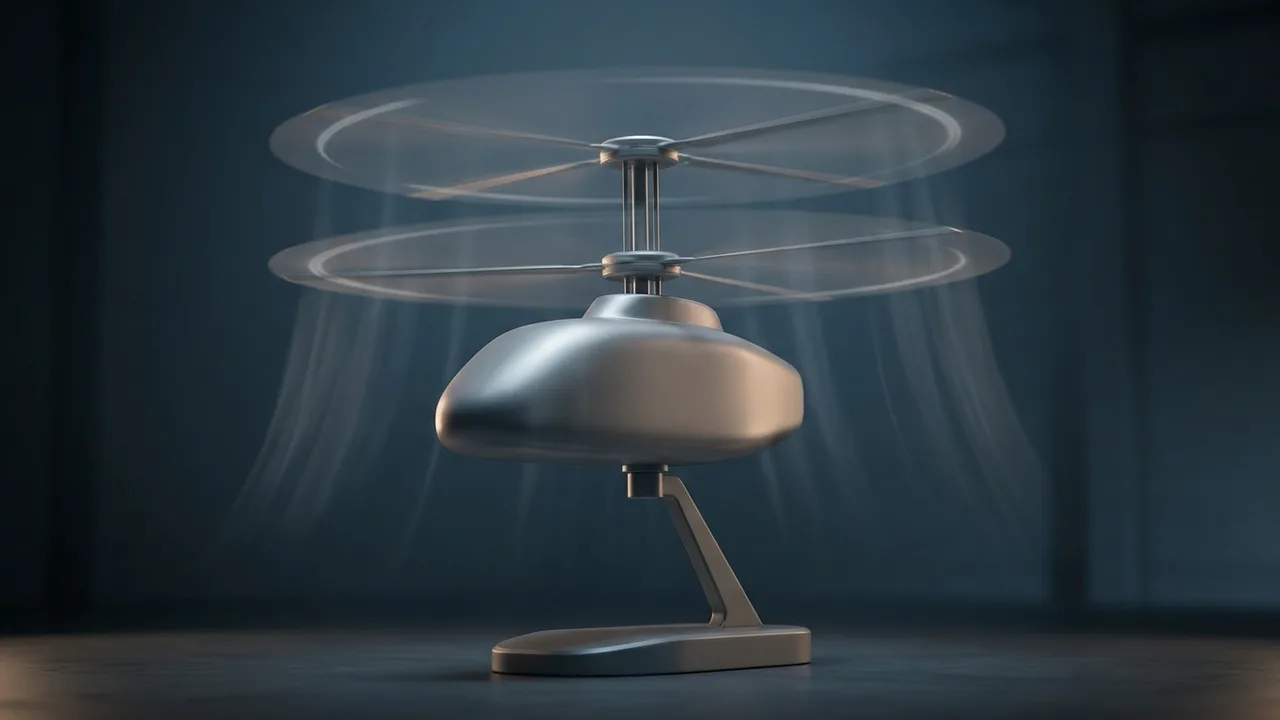
Look closely at a toy helicopter and you will see a small propeller standing sideways at the tip of the tail. The big rotor on top lifts the aircraft, but the little one at the tail blows air to the side. Yet some helicopters, with two large rotors stacked one above the other, have no tail rotor at all.
So what is the tail rotor doing? And how do helicopters without one get the same job done? The answer starts with action and reaction from high school physics.
Spin the rotor and the body spins the other way
A swimmer pushes backward on the pool wall to move forward. When one body pushes on another, it feels a push of the same size in the opposite direction. That is Newton's third law.
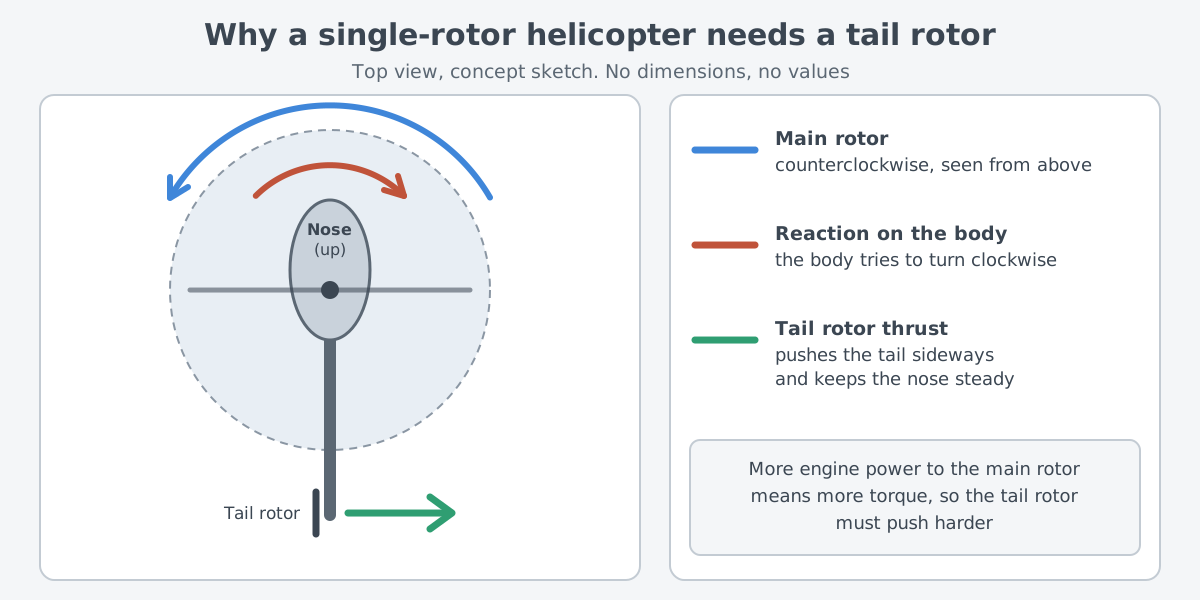
A helicopter works the same way. When a helicopter has only one main rotor, the engine turns the rotor and the body tries to turn the opposite way. This turning or twisting force is called torque. If the rotor turns counterclockwise as seen from above, the body tries to turn clockwise.
Think of sitting on a swivel chair and spinning a heavy bicycle wheel hard with your hands: the chair turns the other way. In a real helicopter, the engine does the spinning instead of your arms, and the size of the effect follows the engine power going into the rotor. When the power changes, the torque changes too.
The tail rotor: a small rotor that pushes sideways
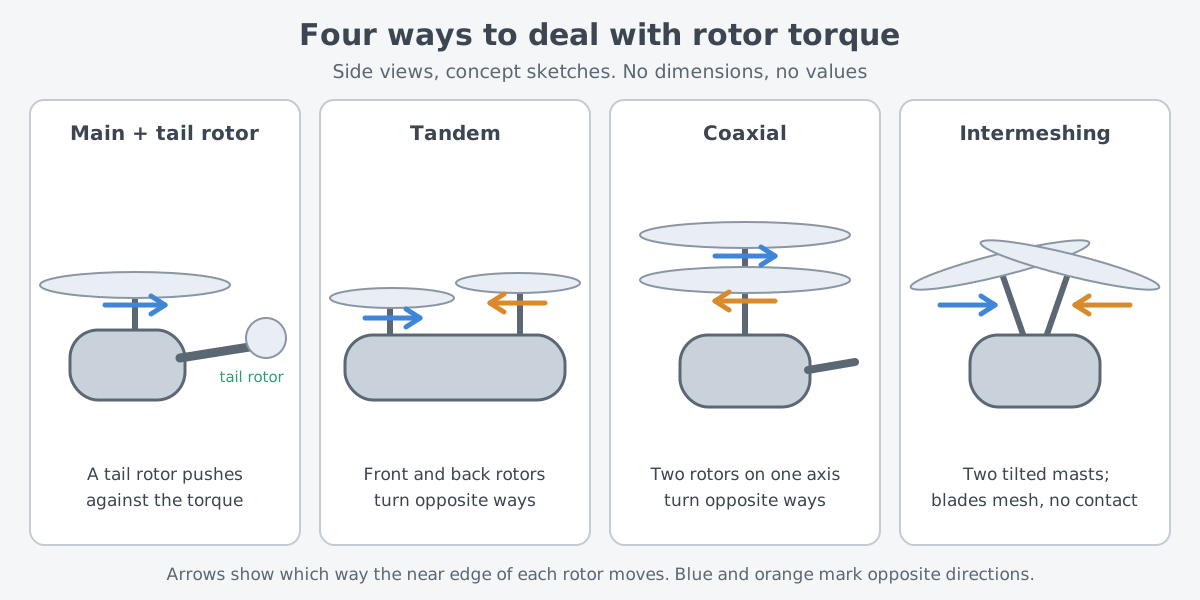
Most helicopters have one main rotor and add a separate small rotor to overcome the torque. This is the tail rotor. Igor Sikorsky settled on this design for his VS-300. The FAA handbook notes that a single main rotor with a tail rotor became the layout the world came to know as "the helicopter."
The tail rotor pushes or pulls the tail sideways to counter the torque. By pushing the tail against the way the body wants to turn, it holds the direction of the nose, or yaw. When the engine feeds the main rotor harder, the torque grows, so the tail rotor has to push harder too.
This approach has costs. Part of the engine power goes into fighting torque instead of lifting. Getting power to the tail rotor takes a drive shaft running along the tail and a gearbox at its end. And in a hover, the push of the tail rotor makes the aircraft tend to drift sideways in that same direction, an effect called translating tendency.
Other ways to do the tail rotor's job
The FAA handbook lists the three most common antitorque designs in use today: the traditional tail rotor, the Fenestron, also known as a fantail, and NOTAR. All three make a sideways force at the tail to resist torque. They differ in how they make that force.
The Fenestron spins a set of blades enclosed inside the vertical tail. With the blades housed in a round duct, people and objects are less likely to be hit by them.
NOTAR uses an enclosed fan instead of an exposed tail rotor. The fan blows outside air into the tail boom, the long beam that reaches back from the body. The air leaves through two long slots along the right side of the boom. This airflow sets up the Coanda effect, a form of boundary-layer control.
In a hover, the tail boom then acts like a wing in the downwash of the main rotor and produces a sideways force. A rotating jet thruster handles the rest of the directional control. In forward flight, the vertical stabilizers supply most of the antitorque, while the jet thruster still handles directional control. The design removes some of the mechanical drawbacks of a tail rotor, such as long drive shafts.
Turning two rotors in opposite directions
There is another path. Fit two rotors and turn them in opposite directions, and the twist one rotor puts on the body is canceled by the other. There is no longer any need for a separate sideways force at the tail.
Tandem rotors place two large rotors at the front and back. Because the two turn opposite ways and cancel each other's torque, all the engine power can go into lifting. With two sets of blades, shorter blades can also lift more weight.
Intermeshing rotors mount the masts of two opposite-turning rotors at a slight angle to each other. The blades then mesh as they turn without hitting each other. With no antitorque system, more power is left for lift, but neither rotor lifts straight up, which lowers the efficiency of each rotor.
Coaxial rotors: two rotors on one axis
A coaxial layout puts two rotors on the same axis, one stacked above the other, and turns them in opposite directions. The FAA handbook describes this layout as a noted feature of helicopters from the Russian Kamov design bureau, and it says Sikorsky's experimental X2 also uses coaxial rotors.
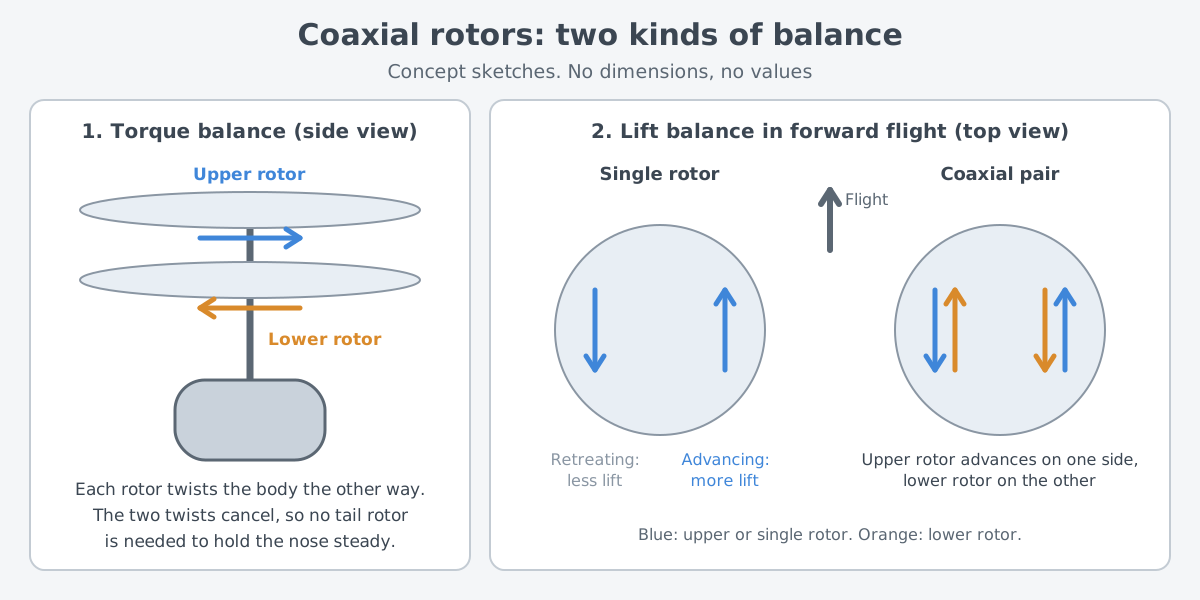
The first benefit is about torque. The upper and lower rotors twist the body in opposite directions, so no tail rotor or other antitorque device is needed.
The second benefit shows up in forward flight. On one side of the rotor disk the blades move forward, in the direction of flight, and on the other side they move backward.
The advancing blades meet stronger wind, increased by the flight speed, and the retreating blades meet weaker wind by the same amount. The FAA handbook gives an example: a helicopter with a blade tip speed of about 400 knots flies forward at 100 knots. The advancing side then meets 500 knots of wind, and the retreating side only 300 knots.
The side with stronger wind can make more lift, so lift on the two sides becomes uneven. This is called dissymmetry of lift. On a single-rotor helicopter, the blades flap up and down and change their angle on their own to even out the lift.
In a coaxial pair the rotors turn opposite ways, so where the upper rotor advances, the lower rotor retreats, and the reverse is true on the other side. That keeps coaxial rotors clear of the uneven-lift problem.
There is a price. The main drawback is that the rotor system becomes more mechanically complex.
A coaxial helicopter that flew on Mars
One unexpected example of coaxial rotors is on Mars. A paper by researchers at NASA Ames Research Center tells the story.
Work on Ingenuity began in 2015 at NASA's Jet Propulsion Laboratory (JPL), together with the Ames and Langley research centers and the company AeroVironment. It is a small coaxial helicopter built to fly in the unusual Martian atmosphere. Ingenuity was released from the underside of the Perseverance rover and then flew on Mars.
Ingenuity's mass is 1.8 kg, and its two coaxial rotors, turning in opposite directions, measure 1.21 m across. The paper lists four benefits of this design. The rotor system is compact, it gives more thrust for the same power than non-coaxial rotors, the opposite-turning rotors balance torque, and lift stays even in forward flight. Both kinds of balance described above are there.
So how does it change the direction of its nose without a tail rotor? The same paper points out that directional stability is a key challenge in controlling coaxial counter-rotating rotors.
To hold the nose in one direction, the torques of the two rotors must add up to zero. Suppose the blade angle of the upper rotor goes down slightly and that of the lower rotor goes up by the same amount. The total thrust stays nearly the same, but the turning force on the aircraft changes. The balance that cancels torque is tipped on purpose, just a little, to turn.
What to read next
- Thrust vectoring: steering with the engine: another way to turn an aircraft by changing the direction of a force.
- Weight and platforms: fitting on a vehicle, ship or aircraft: what has to be weighed when a laser weapon goes onto a vehicle such as an aircraft.
- ISR drones: why endurance matters: what aircraft without people on board are used for.