Look up at military aircraft passing overhead and the wings come in many shapes. Some stick straight out from the body, some lean back like an arrowhead, and some aircraft look like one big triangle. There were even aircraft that spread and folded their wings in flight.
None of these shapes were picked for looks. As an aircraft gets close to the speed of sound, the air behaves very differently, and wings changed to keep up. This article follows what problem swept, delta and swing wings were each meant to solve, and what each one cost. It draws on records published by NASA and the agency that came before it, the NACA.
Looking at a wing from above
A few words come first. The front edge of a wing is the leading edge and the back edge is the trailing edge. How far it is from front edge to back edge is the chord, and how far it is from tip to tip is the span.
The outline of a wing seen from above is called its planform. On a rectangular wing the chord stays the same from root to tip. Most modern aircraft are different: the chord changes from root to tip, and both edges may lean back. The whole aircraft industry uses these words today, and the Wright brothers knew most of them in 1900.
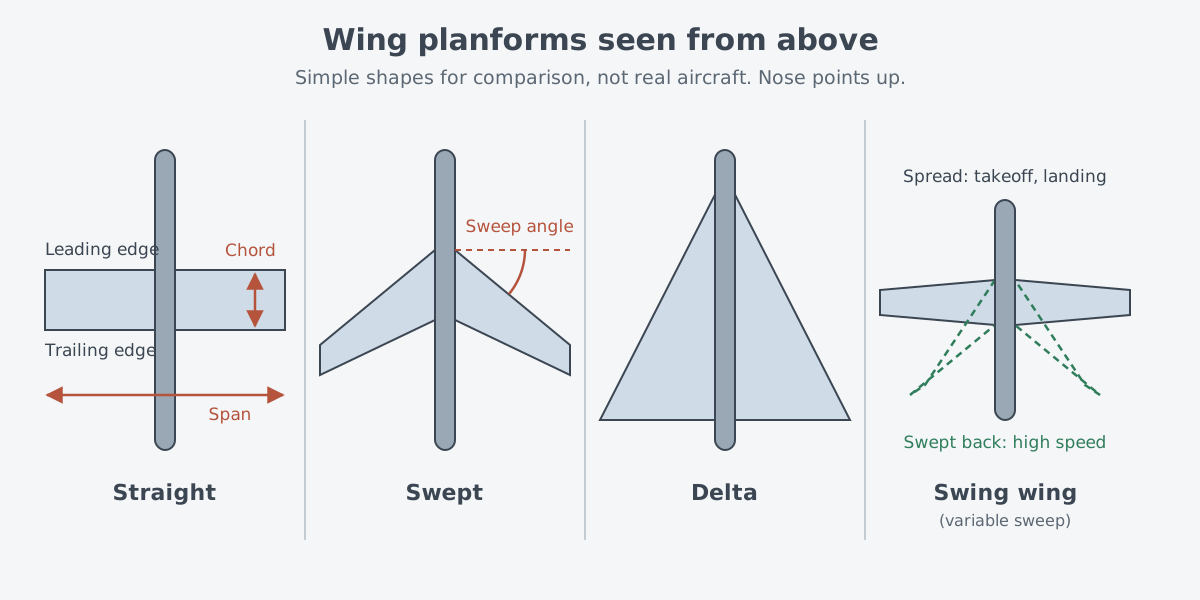
The aspect ratio tells how long and thin a wing is. Long-span wings, like a high-performance glider's, have a high aspect ratio. Wings with a short span or a thick chord, like the Space Shuttle's, have a low one. A higher aspect ratio means lower drag and a better glide, which is why glider wings are long and narrow.
So should a fast aircraft also get long, straight wings? Near the speed of sound, the answer changes.
What happens near the speed of sound
Around a slow aircraft, the density of the air stays the same. NASA's teaching material puts that range at typically less than 250 mph. At higher speeds, some of the aircraft's energy goes into squeezing the air, and the local density changes. The force the air puts on the aircraft depends on density, so this compressibility effect changes the force itself, and it matters more as speed rises.
How close a speed is to the speed of sound is measured by the Mach number. It is the aircraft's speed divided by the speed of sound. At sea level, the speed of sound is about 330 m/s.
When the Mach number is nearly one, the flow is called transonic. Over parts of the aircraft's surface, the air is already moving faster than sound. Sharp disturbances form shock waves, and shock waves change both lift and drag.
People once believed in a "sound barrier" that made flying faster than sound impossible. In fact, the barrier was a rise in drag near the speed of sound caused by compressibility. That high drag is still the reason aircraft avoid cruising close to Mach 1.
By the late 1930s, one thing was clear. Traditional straight wings and fairly thick wing sections were not suited to flight close to the speed of sound. New swept-back wing shapes began to be proposed to reduce the high drag and other problems that appeared at transonic speeds.
Swept wings: why lean the wing back
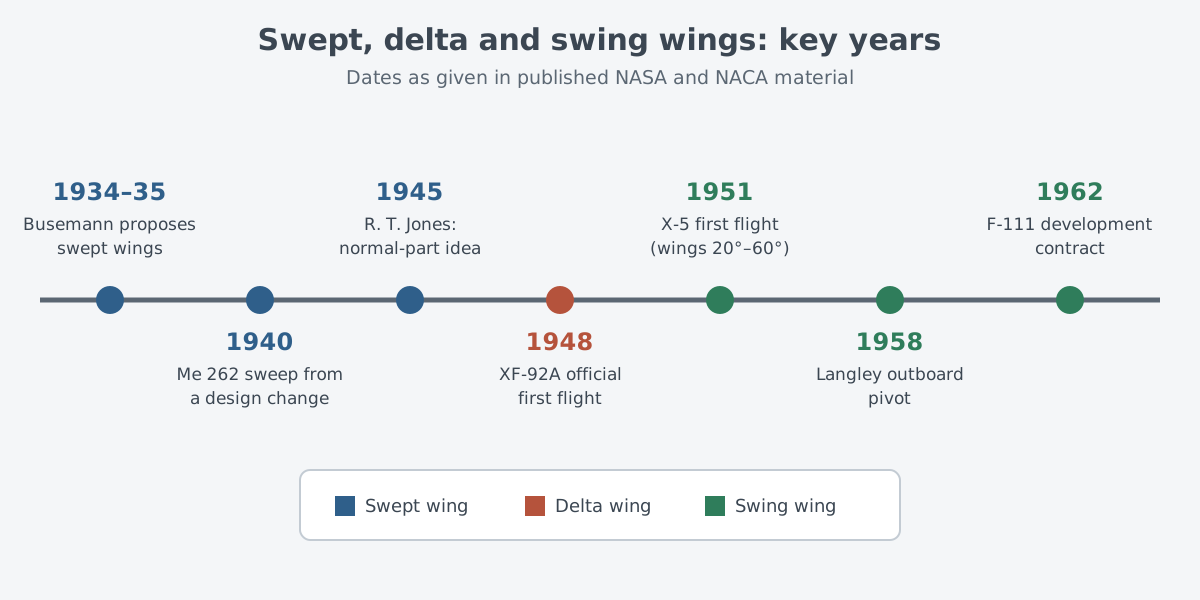
The idea of sweeping the wing back came first from Germany. The German aerodynamics researcher Adolf Busemann was the first to suggest sweeping wings to cut wave drag at supersonic speeds. Wave drag is the drag caused by shock waves. NASA's Hall of Honor places this at an international meeting in 1934, while another NASA Langley paper refers to "Busemann's 1935" theory.
Leading NACA figures were at that meeting. Even so, nobody at the agency grasped how important the theory was.
In the United States, Robert Jones at Langley reached the same answer on his own. His theoretical study, finished in January 1945, showed that the pressures on a wing are set only by the "component of motion in a direction normal to the leading edge." He got this result independently of Busemann's work.
A picture makes the meaning clear. Imagine air blowing straight at a swept wing, and split that air into a part normal to the leading edge and a part flowing along the leading edge. The normal part is what sets the pressures on the wing. The more the wing is swept, the smaller that normal part becomes compared with the actual flight speed.
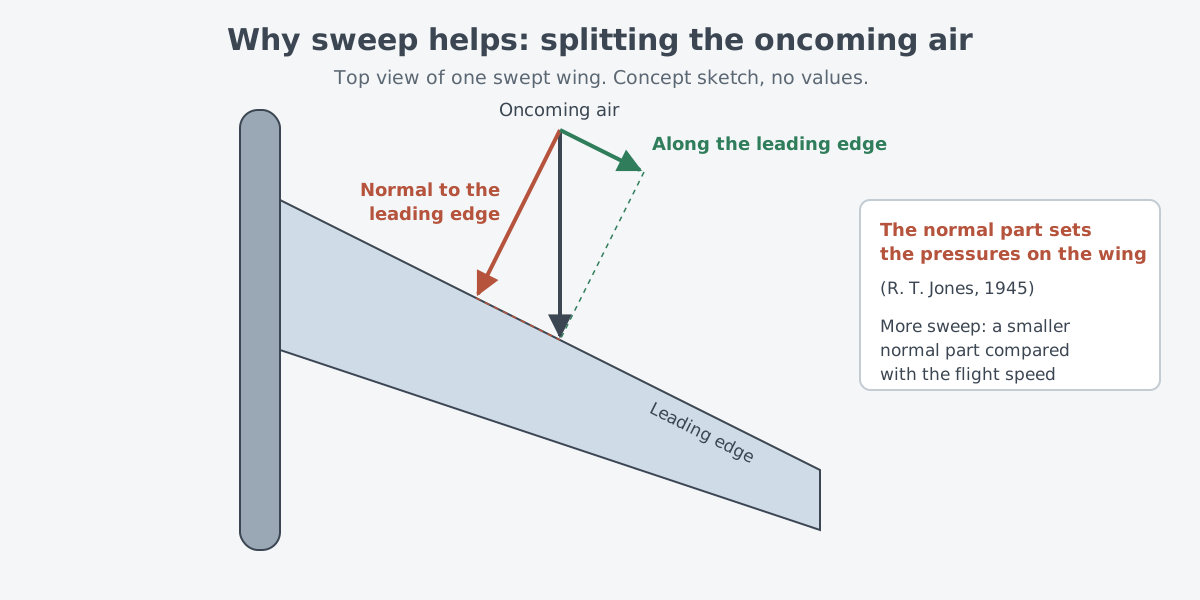
It is a little like walking up a slope at an angle instead of straight up, so the ground under your feet feels less steep. The real case differs. On a slope you pay by walking farther, but on a wing what shrinks is the part of the airspeed that sets the wing pressures.
Jones also pointed out that for efficient supersonic flight, the wing should be swept behind the Mach cone. The Mach cone is the cone-shaped region in a supersonic flow within which small disturbances travel. Sweeping the front edge behind that cone keeps the flow there below the speed of sound and cuts wave drag.
Jones's report did not come out easily. An editorial committee inside Langley recommended against publishing it. After months of deadlock, in-flight free-fall tests and supersonic wind tunnel experiments confirmed his results. On the very day it was cleared, the agency's headquarters reported that German experts had been studying swept wings for several years.
Germany already had swept wings on a real aircraft. The most surprising feature of the Me 262 jet fighter was its swept-back wing, which gave it a speed advantage by delaying the onset of compressibility drag. As the Polhamus paper from NASA notes, the Allied nations did not understand this benefit at the time.
There is a twist. The sweep on the Me 262 was the chance result of a design change made in 1940. That same year, German researchers showed in a wind tunnel that Busemann's supersonic swept-wing theory also applied to compressibility effects below the speed of sound.
Jones's theory and the German swept-wing data obtained after the war led to wide swept-wing research at the Langley and Ames laboratories. They also led to aircraft programs in the Air Force and industry. Swept wings had their own quirk. Aircraft with swept wings tended to raise their nose on their own when flying slowly or turning, and devices such as wing fences were used to tame it.
Delta wings: the triangle
One of the new swept shapes came from German scientist Alexander M. Lippisch. It was a triangular wing, named the delta wing because it looks like the Greek letter delta (Δ). During the Second World War, Lippisch built a glider with this wing to see how the shape handled at low speed.
A delta wing packs two strengths into one shape. Its sharp angle lowers drag, and its large area adds lift. The wing could also be made very thin and still be very strong.
When the war ended, both Lippisch and his glider came into Allied hands. NACA wind tunnel research separately confirmed the delta wing's promise at high speed. The American company Consolidated-Vultee built a flying mock-up to study how a delta wing behaves at slow and fast subsonic speeds. It made its official first flight on September 18, 1948.
The Air Force designation for this aircraft was XF-92A. The name was that of a prototype fighter, but its job was research.
The XF-92A proved that an aircraft with a delta wing could work. It also exposed flaws in the aircraft itself. It suffered severe pitch-up, where the nose rises sharply, and NASA records that these often went past 6 g and once went past 8 g.
Convair, as Consolidated-Vultee was later renamed, fixed the problems. It then drew on the XF-92A work for the B-58 strategic bomber, the F-102 and F-106 interceptors, and the XF2Y-1 Sea Dart, a jet fighter that took off from water. In France, the Mirage also had delta wings, and in Europe today the Typhoon keeps the delta wing in service this century.
Swing wings: changing shape in flight
Swept and delta wings solved the problems of high speed. But aircraft do not always fly fast. They must fly slowly to take off and land. So why not change the wing to suit the moment?
The aircraft that tested this idea was the American Bell X-5. A combat aircraft could take off with its wings spread wide, needing less speed and runway, then sweep them back in the air to cut drag and fly faster. It also suited research. Each swept-wing test aircraft of the time gave data for one wing angle only, so a single aircraft that changed its angle could stand in for several.
The X-5 grew out of a German experimental aircraft, the Messerschmitt P.1101. Its wings could be set on the ground to three angles between 35 and 45°, and U.S. troops captured it in April 1945 before it had flown. The NACA was also running its own wind tunnel tests of wings with changing sweep that year.
The X-5 could change its angle in flight, not just on the ground. It first flew on June 20, 1951, and its wings swung from 20° to 60° in flight.
The price was a complex mechanism. Sweeping the wings back moves the center of gravity and the center of pressure. To make up for this, the X-5 slid its whole wing unit forward along rails in the body as the wings swept back. It could land safely only with a sweep angle of 40° or less.
Its handling had problems too. NACA pilot Scott Crossfield later recalled that the X-5 was a terrible airplane in a spin and took a long time to recover. On October 13, 1953, Major Raymond Popson died when an Air Force X-5 crashed in a spin, with the wings set at 60°.
The need to slide the wing back and forth was solved at Langley late in 1958. Researchers found an arrangement that kept the aircraft stable over a wide range of sweep angles without moving the wing fore and aft. A Langley paper calls it the outboard pivot. This work began the program that led to the F-111.
The Department of Defense placed the first development contract for the F-111 on November 24, 1962. A 1966 NASA Langley working paper describes the F-111 as the first aircraft in the world to fly faster than sound with variable sweep. With its wings spread as wide as they go, the paper explains, the aircraft is well suited to efficient subsonic flight. The earlier X-5 and Grumman XF-10F were subsonic aircraft, and their structures were complicated by the need to slide the wing.
There was one more way to change a wing. The oblique wing, first put forward in 1942 by the German engineer Richard Vogt, pivots a single straight wing as a whole about one point on the fuselage. One side then sweeps back and the other sweeps forward, like an open pair of scissors. Jones went back to Ames in 1970 and took up this design.
No single shape fits every speed
Put the four wings side by side and they share a pattern. Whatever one shape gains at one speed, it gives up somewhere else.
A long, straight wing has a high aspect ratio, so it has low drag and glides well, but it was not suited to flight near the speed of sound. A swept wing delayed the onset of compressibility drag, but its tendency to raise the nose at low speed had to be controlled. A delta wing was thin yet strong, but the first research aircraft showed severe pitch-up. A swing wing tried to have both the spread and the swept wing, and accepted a complex mechanism as the price.
This comparison is not a ranking of which wing is better. It means the right wing depends on the speeds an aircraft mostly flies at and the work it does.
Every aircraft is a choice made between speed and shape like this. Why the conditions differ for vehicles, ships and aircraft when new equipment such as a laser weapon is added continues in Weight and platforms.
What to read next
- Thrust vectoring: steering with the engine: how an engine can turn the aircraft at high angles of attack, where the wing loses its grip.
- Supersonic Flight and Shock Waves: What Happens Past the Speed of Sound: a closer look at the shock waves touched on here.
- Weight and platforms: fitting on a vehicle, ship or aircraft: what has to be weighed when a laser weapon goes on an aircraft.
- Stealth aircraft: truly invisible?: what it takes to make an aircraft hard to find.