Can a weapon keep hurting people after the war is over? Laos is one answer. During the 1960s and 1970s, U.S. forces dropped large numbers of cluster munitions across Southeast Asia.
A Congressional Research Service (CRS) report cites an estimate by the International Committee of the Red Cross (ICRC). Between 9 million and 27 million submunitions were left unexploded in Laos alone, and more than 10,000 civilians there have been killed or injured.
This article first looks at what a cluster munition is and why the duds remain a problem for so long. It then turns to the Convention on Cluster Munitions (CCM), adopted in 2008: what it bans, what it requires, and where the states that stayed out of it stand. The sources are the treaty text and official records.
One weapon, many small bombs
A cluster munition opens in mid-air and scatters many small bombs over an area. Those small bombs are called submunitions. Aircraft can drop them, and artillery, rocket launchers and missiles on the ground can fire them. Their first use came in World War II.
How many submunitions are inside one? The ICRC says it depends on the model, from several dozen to more than 600. Most are small explosives with no guidance.
The convention gives the legal definition. A cluster munition is a conventional munition built to scatter or release explosive submunitions that each weigh under 20 kg, and the term covers those submunitions too. Munitions that spread flares, smoke or chaff, munitions built only for air defense, and munitions that produce electrical or electronic effects are not included.
One more kind of munition falls outside the definition. It must meet all five conditions.
It holds fewer than ten submunitions, and each one weighs more than 4 kg. Each one is built to sense one target object and hit it. Each also carries an electronic self-destruct mechanism and an electronic self-deactivating feature. These conditions are meant to prevent wide, indiscriminate effects and to limit the danger of duds.
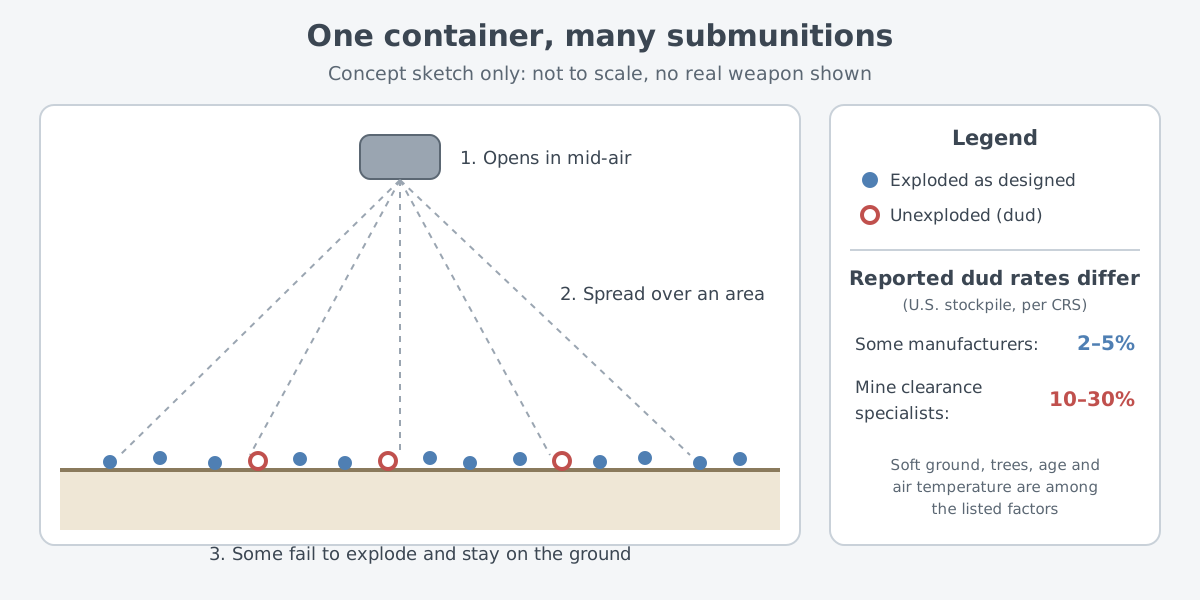
Picture a farmer scattering a handful of seed across a field. The spreading pattern looks similar. The reality is very different. What lands is explosive, and no one can know exactly where each piece came down.
What the duds leave behind
The CRS report lists three main criticisms. Cluster munitions spread many submunitions over a wide area without much precision. Many of those submunitions fail to explode and are hard to find. And they can stay dangerous for decades.
How many fail? Even that number is disputed. For the U.S. stockpile, some manufacturers claim a submunition dud rate of 2–5%, while mine clearance specialists have often reported 10–30%.
Listed factors include how the weapon is delivered, the age of the submunition and air temperature. Soft or muddy ground, trees and plants, and damage after scattering also play a part.
Is a self-destruct feature the fix? Submunitions without one are a special concern because they can stay dangerous for decades. Experts, however, say self-destruct features shrink the dud problem but do not remove it.
Harm comes both during and after the fighting. Because submunitions usually have no guidance, wind and other factors can carry them far outside the target area. Leftover submunitions make farming and other daily work dangerous.
They also slow the work of rebuilding roads, rail lines and power stations. Children drawn to their shape and color often pick them up.
The preamble of the treaty starts from the same worry. It says the remnants kill or injure civilians, including women and children. They take away livelihoods, hold back economic and social development, and delay the return of refugees and displaced people. The harm can last for many years after use.
How the convention came about
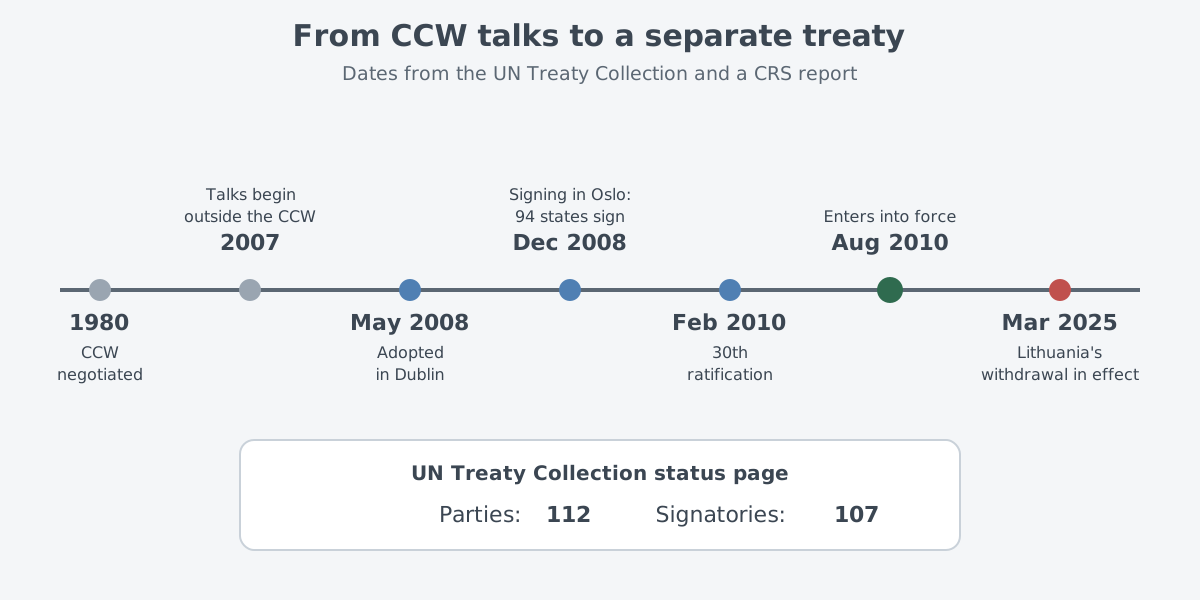
Cluster munitions were first taken up under the Convention on Certain Conventional Weapons (CCW). Fifty-one states drew up the CCW in 1980, and it took effect at the end of 1983. In 2007 its parties agreed to negotiate a proposal on the humanitarian impact of cluster munitions. Talks in 2008 and 2009 ended without agreement, and the November 2011 review conference also failed to agree on a protocol.
Meanwhile, another path opened. In 2007 a group of CCW members, with Norway in the lead, began separate talks on a ban outside the CCW framework. The ICRC calls this the "Oslo Process," a Norwegian plan to finish a treaty before 2008 was over.
The talks moved fast. The convention was adopted at the Dublin Diplomatic Conference on May 30, 2008, and the ICRC says 107 states concluded the treaty at that point. At the Oslo signing conference of December 3–4, 2008, the treaty gained 94 signatures, and four of those states ratified on the spot.
The 30th ratification reached the United Nations on February 16, 2010. Under the treaty's six-month rule, it took effect on August 1, 2010.
What the convention bans and requires
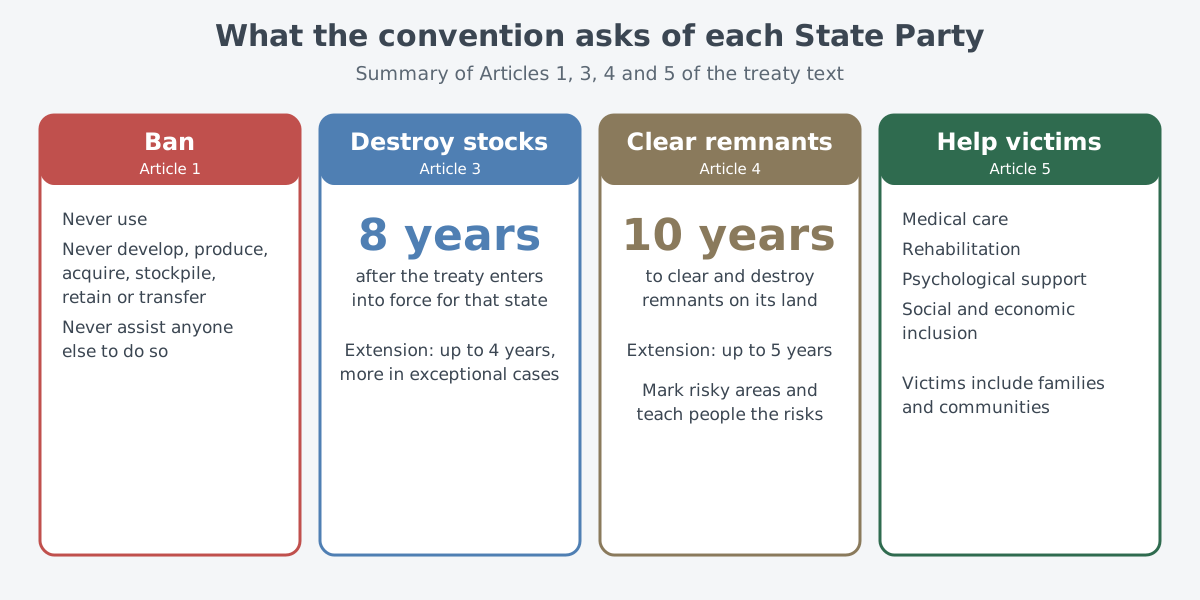
The ban is broad. Under Article 1, a State Party must never use cluster munitions under any circumstances. Developing, making, acquiring, storing, keeping or handing them over are all ruled out, and so is helping or encouraging anyone else to do these things. Mines are outside the scope of the treaty.
The treaty does more than ban. It also requires states to get rid of what they already hold and what has already fallen. Article 3 says each State Party must destroy its stockpiles no more than eight years after it becomes bound by the treaty.
A state that cannot meet the deadline may ask for up to four more years, and in exceptional cases for further four-year extensions. A limited number may be kept to develop detection, clearance and destruction techniques and to train people in them.
Article 4 deals with what lies on the ground. Remnants in areas a state controls must be cleared and destroyed within ten years of the date the treaty binds that state. If new remnants appear later, the ten-year clock starts when the fighting that left them is over.
Meanwhile, contaminated areas must be marked around their edges, and people living in or near them must be taught about the risks. Extensions of up to five years may be requested.
Article 5 covers victim assistance. States Parties must give victims health care, rehabilitation and mental health support, and help them take part in social and economic life. Victims include not only the people directly hurt but also their families and communities. The ICRC notes that no earlier international humanitarian law (IHL) treaty had a victim assistance rule this detailed.
Each State Party sends a yearly report to the head of the United Nations, the Secretary-General. It covers items such as which kinds of cluster munitions were destroyed, how many, and which areas are contaminated. An ICRC paper from September 2019 puts the total destroyed by States Parties at 1.4 million cluster munitions, holding 175 million submunitions.
What about joint military operations with a state that has not joined? Article 21 lets States Parties work and operate militarily alongside non-party states.
Even then, a State Party may not itself use, stockpile or transfer cluster munitions. It also may not expressly ask for their use when the choice of munitions is under its own exclusive control. States Parties must also do their best to discourage non-party states from using them.
The treaty also has a withdrawal rule. It has no end date, but any State Party may choose to leave. A withdrawal takes effect six months after the notice is received. If the state is in an armed conflict at that point, the withdrawal waits until the conflict ends.
States outside the treaty and shifting policies
The status page of the UN Treaty Collection lists 112 parties and 107 signatories. Seven states stayed out of the talks and did not sign: China, Egypt, India, Israel, Pakistan, Russia and the United States.
Washington has not joined the treaty. The Department of Defense has long held that cluster munitions are militarily necessary.
In November 2009, Harold Koh, then the State Department Legal Adviser, spoke on this point. He said the United States had determined that its national security interests could not be fully ensured under the convention's terms. The alternative the United States favored was not a ban but technical fixes that would leave the weapons inactive once a conflict ended.
That direction changed as well. In 2008 the Department of Defense set a goal: after 2018, cluster munitions should leave a dud rate of no more than 1%. A new policy in November 2017 largely reversed it. It allows cluster munitions that miss the 1% standard to be used in extreme situations, and it sets no deadline to replace them.
Several governments, UN bodies and nongovernmental groups have charged that Russia used cluster munitions after it invaded Ukraine in 2022. Twice in 2023, in July and in September, Washington said it would send cluster munitions to Ukraine.
The list of parties has also shrunk. Lithuania filed its withdrawal notice with the UN Secretary-General on September 6, 2024, and under Article 20 the withdrawal took effect on March 6, 2025.
Where this meets lasers: the list of banned weapons
In the ICRC's view, this convention makes cluster munitions one of the weapons prohibited under international humanitarian law. That list also includes blinding lasers, chemical and biological weapons, anti-personnel mines, exploding and expanding bullets, and weapons whose fragments cannot be detected.
The ICRC explains that the convention reinforces basic customary rules of IHL that apply to every state. Parties to a conflict must always tell civilians apart from combatants, aim only at military objectives, and keep taking care to protect civilians and civilian property.
Cluster munitions and blinding lasers work in completely different ways and serve different purposes. Even so, both were handled the same way: instead of judging each use, a whole class of weapon was put on the banned list. The first article below explains what the laser rule prohibits.
What to read next
- Eye safety and international rules: the protocol on blinding laser weapons: a case where international humanitarian law banned a laser weapon.
- Precision-guided bombs: what gets added to a plain bomb: how guidance is added to a bomb.
- Autonomous weapons and human control: another weapons debate that continues under the CCW.