Picture a single shell in flight. It might burst the moment it touches the ground, or in the air. It might burst only after it has gone into something. Why can the same kind of round go off at such different moments?
The answer is a small device on the round called a fuze. This article looks at impact fuzes, time fuzes, delayed action and the proximity fuze, and asks what signal each one waits for, using public classifications and records.
What a fuze decides
Start with two words that sound the same: fuse and fuze. A US federal rule on moving hazardous materials gives a description of explosive terms, for information only. It says the useful convention is that a fuse is a cord-like igniting device, while a fuze is a device used in ammunition.
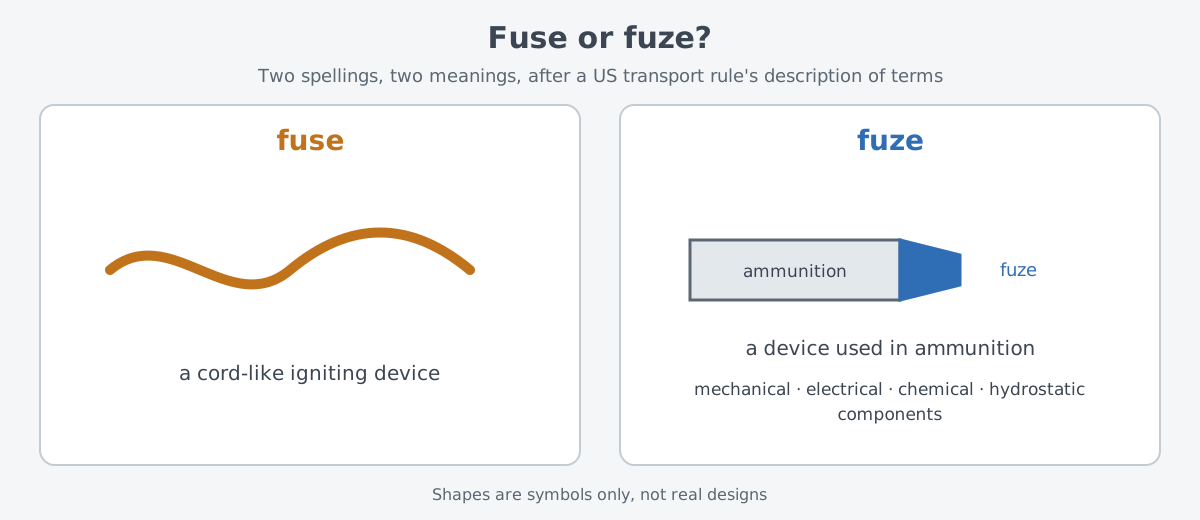
In that same description, a fuze is something made to begin a detonation or deflagration inside ammunition. They contain mechanical, electrical, chemical or hydrostatic parts, and they generally have protective features. This is a transport rule, not a military dictionary. Still, the meaning is clear: the fuze is the part that wakes up the explosive inside a round.
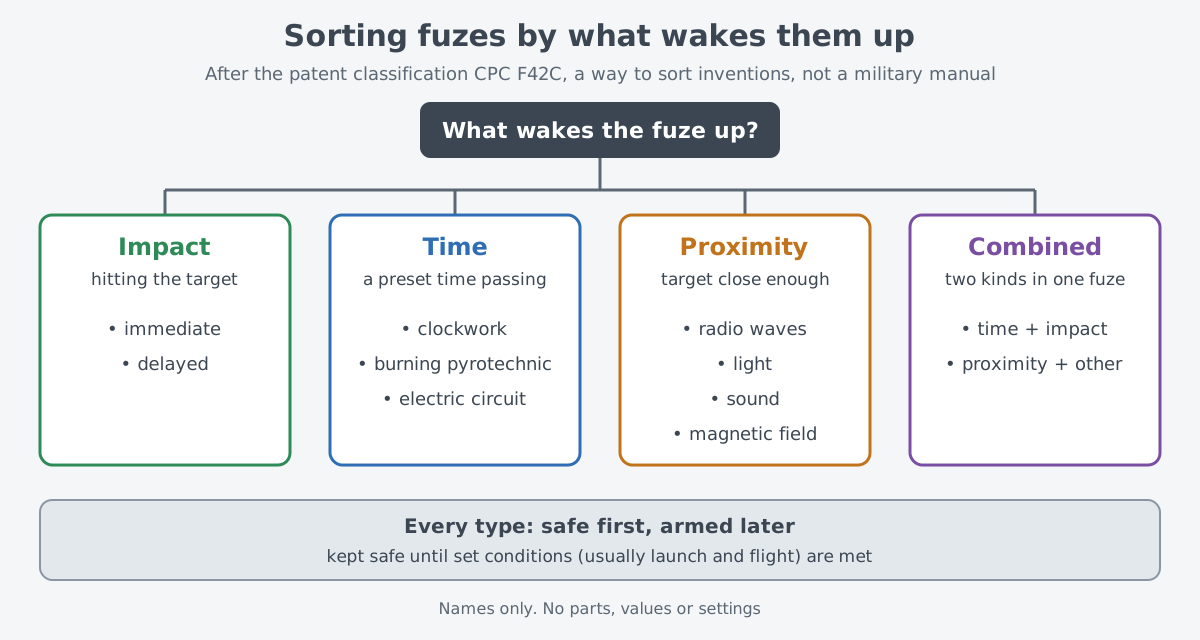
To sort fuze types, this article uses group F42C of the Cooperative Patent Classification (CPC). It is a patent system for filing inventions, not a military manual, yet it sums up the job of a fuze well. In this scheme, a fuze lets the explosion happen only under certain conditions. It also sets the moment, instant or delayed, and the manner, such as impact, proximity or water pressure.
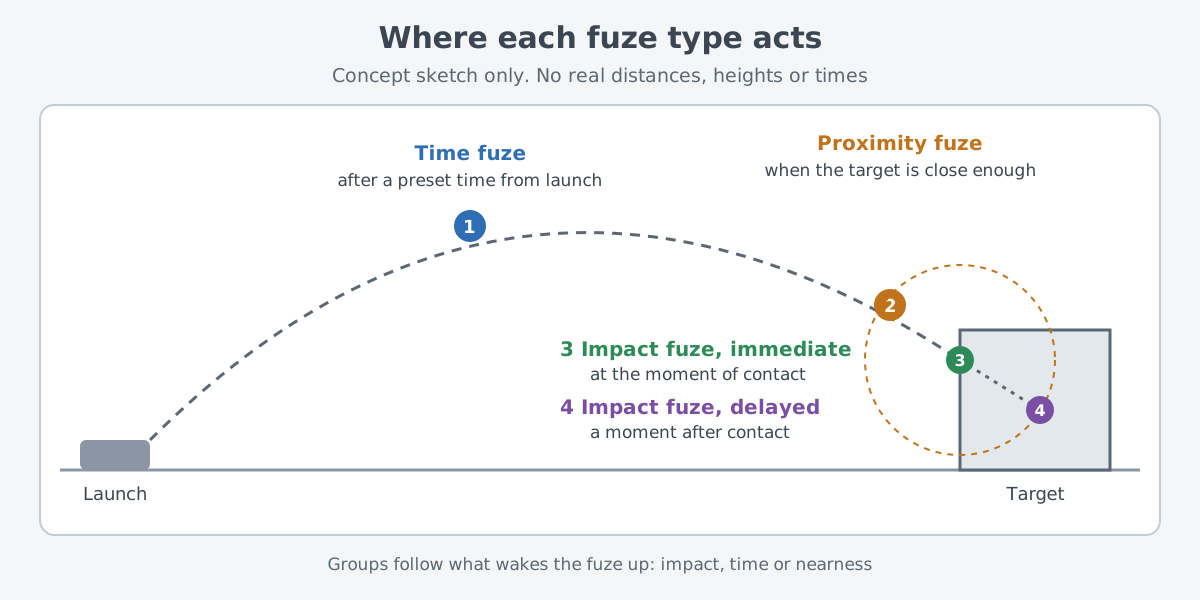
The CPC sorts its main fuze groups by what wakes the fuze up. That means a physical effect such as hitting something, time passing, or a target coming near. The figure places those differences along one flight path.
Impact fuzes: at the moment of contact
The easiest type to picture is the impact fuze. The CPC defines it as a fuze set off only when the round strikes. A mechanical part takes the shock of hitting the target, or a sensor detects it, and then the warhead is set off.
Think of a doorbell: it rings only when someone presses it, and an impact fuze likewise starts work only when it touches something. The real thing is different, though. A doorbell rings whenever it is pressed, but a fuze is guarded so that a bump before the right conditions are met does not set it off.
Impact action is still a basic choice today. In 2015 the US Army described a new fuze, the Precision Guidance Kit (PGK), that turns ordinary 155 mm rounds into GPS-guided ones.
It goes into the fuze well of a round like any standard fuze. On reaching the target, it works in one of two modes chosen in advance: point detonating or proximity. The Army began handing the kit to troops in 2013.
Delay: a moment after contact
An impact fuze does not always fire at the instant of contact. The CPC definition says an impact fuze sets off the warhead "immediately or delayed," and the scheme has its own subgroup for delayed action after the fuze is triggered. The signal is the same impact, but the moment of firing is pushed a little later.
The idea of bursting at the right spot inside a target, rather than at the surface, shows up in other fuzes too. A 2005 report from the US National Research Council (NRC) describes the improved GBU-24 penetrator, whose void-sensing hard-target fuze sets it off at the best point inside a target. That fuze senses empty space instead of counting time, but the aim is similar. Weapons built for underground sites are covered in "Bunker busters: what makes a deep-penetrating weapon different."
The name "delay action" also appears in records more than a century old. The Australian War Memorial holds a set of First World War official records. One August 1918 document in it has a title describing a long delay action fuze that Germany made in 1917 for demolition, with a diagram. So fuzes with "delay" in their names already existed by then.
Time fuzes: a shell with a clock
Here the signal is time, not a hit. The CPC defines a time fuze as one that sets off the round after a preset time from when the fuze itself started. The timekeeping comes from clockwork or from a pyrotechnic that burns. Electric time fuzes, where a circuit keeps the time, sit in a separate group.
The scheme splits the ways of keeping time into several branches. Some use mechanical means, including spring motors; some use chemical action; some use combustion, including burning elements shaped like rings. On the electric side, there is a branch for time delay made by a circuit.
A kitchen timer is a close match. It goes off on its own once the set time runs out. The difference is clear, too. A person watches a kitchen timer, but a time fuze counts down alone in flight, using the time set before firing.
That is why "setting the fuze time" became a step in weapon systems. Ben Clymer's 1993 history of US Navy mechanical analog computers shows this. For more than 40 years, those computers pointed big naval guns and set the fuze time on each shell.
More recently, an autoloader tested by the US Army listed fuze setting among its mechanical loading tasks, along with loading the projectile and charge and closing the breech. Both stories continue in "Fire-control systems: linking sensors and weapons" and "Autoloaders: handling heavy ammunition."
Combined fuzes and the proximity fuze
Some fuzes hold two methods at once. The CPC puts "combined time and percussion or pressure-actuated fuzes" in the same group as time fuzes. Under double and multiple fuzes sit an impact fuze joined with a clockwork time fuze and an impact fuze joined with an electric time fuze. A proximity fuze joined with other fuzes has its own place there too.
A museum object shows one. Item REL30610 at the Australian War Memorial is a Zdr 2 fuze from Germany that combines time and percussion action, from the First World War. It served in high explosive rounds of a German 7.6 cm light mortar used in the trenches. It is an improved late-war pattern made in 1917, and its aluminium timing rings carry markings in seconds.
It was found near Bullecourt, France, that same year. The memorial's official records also hold a November 1917 document on fitting rubber covers to time fuzes and to combined time and percussion fuzes.
The fourth branch is the proximity fuze. The CPC defines it through an electronic circuit with a non-contact proximity sensor. The circuit first judges that the target is close enough for the warhead to work well, and only then starts the explosion. Sensor kinds named there include electrostatic, optical, acoustic and magnetic.
Why burst near a target at all? A NIST history of the task given to the National Bureau of Standards (NBS), one branch of proximity fuze research, gives two reasons. A direct hit is often hard, and bursting close to the target is good enough. Also, bursting some distance away from the target can often do more damage.
A 2026 US Army article adds that proximity fuze ammunition means a round no longer has to hit directly or burst at a pre-set point. The fuze uses a small radar to sense threats and goes off within lethal distance. The development story is in "Proximity fuzes: working without a direct hit," and present-day use is in "Anti-aircraft artillery in the missile age."
Keeping it safe until it should work
A fuze sets off the round, and it also keeps the round from going off too soon. The CPC has a separate group called "arming-means in fuzes; safety means for preventing premature detonation of fuzes or charges." This matches the transport rule's note that fuzes generally have protective features.
The definition of that group is short. It covers mechanisms or electric circuits that keep a fuze safe until certain set conditions are met. Once all of them are met, these switch the fuze to the armed state on their own. Those conditions are usually about launch and flight.
This is the real gap between an impact fuze and a doorbell. Before firing, the fuze ignores anything that looks like a signal. It wakes only after the set launch and flight conditions are met. That waiting is as much a part of its job as the firing itself.
Where this meets lasers: measuring distance with light
Look further into the CPC proximity group and it branches by what the fuze uses to sense nearness. Some work by radio waves, some by sound waves, some by changes in a magnetic field, and some by the strength of light or radiation like light. Under the light branch there is even a subgroup for fuzes that use active distance measurement.
The group names alone do not say what kind of light is used or how. Still, measuring distance with light is a familiar idea on the laser side. A laser rangefinder and lidar send out laser light and use the light that comes back to measure distance. That principle is covered in "Measuring with lasers: range finding and lidar basics."
What to read next
- "Proximity fuzes: working without a direct hit": how one of the four branches, the proximity fuze, was developed in the Second World War.
- "Measuring with lasers: range finding and lidar basics": the laser side of measuring distance with light.
- "Bunker busters: what makes a deep-penetrating weapon different": weapons meant to go off at the right spot inside a target.