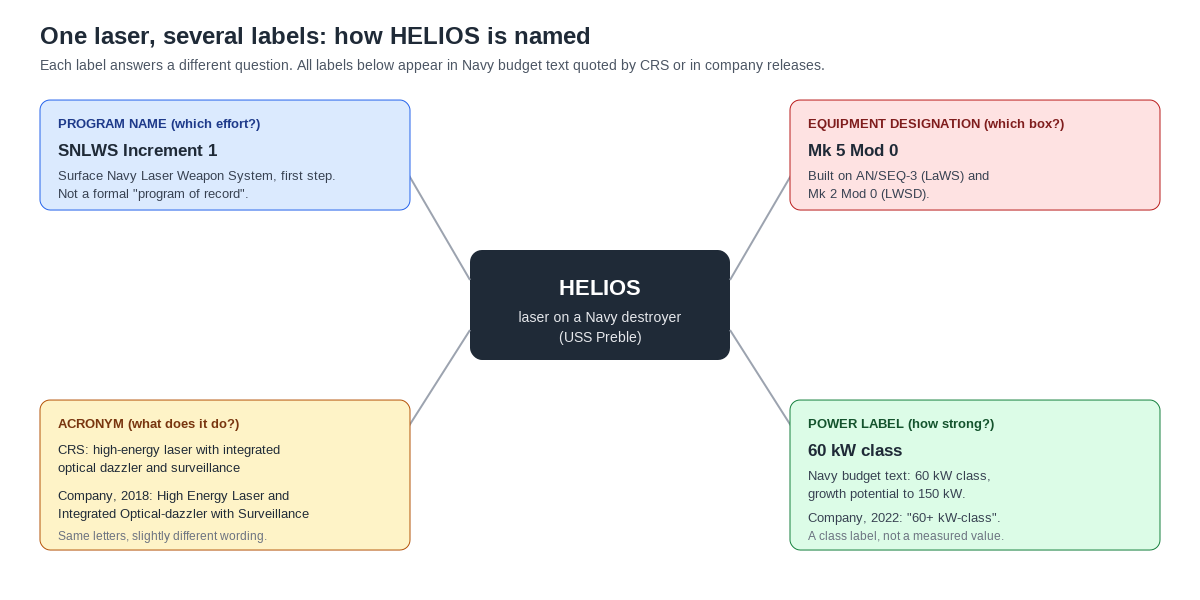
One paragraph of a U.S. Navy budget document calls the same laser by three names. It starts with HELIOS, then says SNLWS, and ends with Mk 5 Mod 0. A first-time reader could easily think there are three lasers.
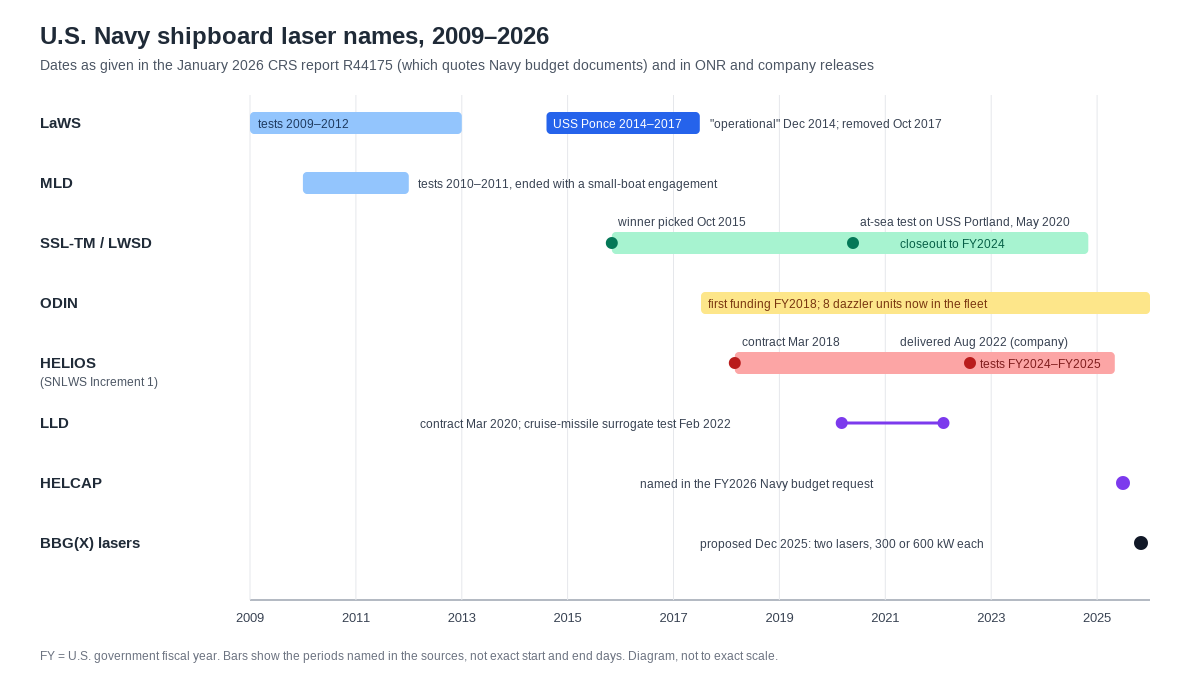
Since about 2009 the Navy has carried its work on shipboard lasers under a string of names: LaWS, MLD, LWSD, ODIN, HELIOS, LLD and HELCAP. This page covers what each name points to, the order in which the names appeared, and how to read the kW figures attached to them.
The main source is the 2026 update of report R44175 on shipboard lasers from the Congressional Research Service (CRS). That report reprints passages from Navy budget documents word for word. Releases from the Office of Naval Research (ONR) and a manufacturer fill in the rest.
Why one laser carries several names
Each name answers a different question. Some names tell you which effort, or program, you are looking at. Others tell you which piece of equipment. Short acronyms sit on top of both so that people can remember them.
The program name of HELIOS is SNLWS Increment 1, the first step of the Surface Navy Laser Weapon System. The equipment designation is Mk 5 Mod 0. HELIOS itself is an acronym built from a phrase that describes what the system does. The CRS report puts the link in one line: SNLWS Increment 1 is called HELIOS.
The lasers here are high-energy lasers (HELs). In discussions of Navy shipboard lasers, a beam power of 10 kW or more usually marks a high-energy laser. The shipboard lasers covered in the CRS report are solid state lasers (SSLs), so "SSL" shows up often in the documents.
The intended uses come in stages. At first the lasers would dazzle and confuse surveillance sensors and deal with small boats and drones. Later they might take on anti-ship cruise missiles (ASCMs). The order of the names roughly follows these stages.
The first names: LaWS and MLD
The earliest name is LaWS, short for Laser Weapon System. Between 2009 and 2012 the Navy tested this prototype against drones, first on land and then on a ship at sea. CRS gives its beam power as a "reported" 30 kW.
LaWS was installed on USS Ponce in August 2014, and in December 2014 the Navy declared it an "operational" system. ONR announced the operational demonstrations, held from September to November, on December 10, 2014. When Ponce was decommissioned in October 2017, LaWS came off the ship. Those three years at sea are covered in detail in 2014: LaWS on USS Ponce.
LaWS has other names too. The Navy's 2017 program guide called it SSL-QRC. The letters stand for solid state laser, quick reaction capability. Navy budget documents list it with the equipment designation AN/SEQ-3.
Around the same time there was another prototype called MLD, the Maritime Laser Demonstration. The Navy tested it in 2010 and 2011. The tests ended with an MLD on a Navy ship engaging a small boat.
A demonstrator built through competition: SSL-TM and LWSD
The next pair of names splits into a program and a device. Solid State Laser Technology Maturation (SSL-TM) is the program. The prototype shipboard laser it produced is the Laser Weapons System Demonstrator (LWSD). In budget documents the LWSD carries the equipment designation Mk 2 Mod 0.
Several industry teams competed to build the LWSD, which was to reach as much as 150 kW of beam power. The Department of Defense named Northrop Grumman the winner on October 22, 2015. Note that 150 kW was the ceiling set for the competition, not a power shown at sea.
In January 2018 the Navy announced plans to install the LWSD on the amphibious ship USS Portland. Then, on May 22, 2020, it announced that Portland had used the LWSD to disable a drone in an at-sea test on May 16, 2020. According to the FY2025 budget submission, SSL-TM removal, final report and closeout started in FY2023's second quarter, with completion planned for FY2024's fourth quarter.
ODIN: a laser that dazzles instead of destroying
ODIN is a different kind of name. In Navy budget text, ODIN is a shipboard capability to "dazzle" unmanned aerial systems (UASs) and other platforms. In other words, it is a dazzler: a device that blurs an opponent's surveillance sensors rather than breaking the target.
ONR's 2022 release describes the range of options for Navy lasers as running between two ends. One end is non-lethal measures such as optical "dazzling" and disabling sensors. The other end is destroying a target. ODIN sits at the first end.
Even the spelled-out name varies a little. Within the 2026 CRS report alone, the summary has "Optical Dazzling Interdictor, Navy" and the body has "Optical Dazzler Interdictor Navy." If articles spell it out in slightly different ways, they still mean the same system.
According to the budget text, ODIN was developed and fielded with research and development money and is not a formal program of record. Its first year of funding was FY2018. Eight ODIN units are operational in the fleet, installed on eight Arleigh Burke-class destroyers. The report gives no power figure for it.
HELIOS: the first step of SNLWS
HELIOS is an acronym for "high-energy laser with integrated optical dazzler and surveillance." The effort aimed to develop and field quickly a 60 kW-class high-energy laser and a dazzler in one integrated weapon system. The CRS report adds that the laser had growth potential to 150 kW. Besides drones, small boats and surveillance sensors, it was meant to help with combat identification and battle damage assessment.
The contract came in 2018. On March 1, 2018, Lockheed Martin announced a $150 million Navy contract; with options, the total could reach $942.8 million. The company said that, as the first increment of the SNLWS program, it would deliver two test units by FY2020. One would go to an Arleigh Burke-class destroyer and one to land testing at White Sands Missile Range.
On August 18, 2022, the company announced that it had delivered a "60+ kW-class" HELIOS to the Navy. In the same release it described HELIOS as the first tactical laser weapon to be fitted into ships already in service, which is the company's own claim. According to CRS, the system was installed on the destroyer USS Preble (DDG-88).
In Navy budget text, HELIOS is integrated with the Aegis combat system. Development of the Mk 5 Mod 0 HELIOS drew on the earlier AN/SEQ-3 LaWS and the Mk 2 Mod 0 LWSD. Navy testing and fleet support for HELIOS ran from the first quarter of FY2024 through the fourth quarter of FY2025. SNLWS is not a program of record either.
Names aimed at cruise missiles: LLD and HELCAP
LLD, the Layered Laser Defense, does not appear on the Navy's roadmap chart. On March 9, 2020, the Department of Defense announced a contract with Lockheed Martin to integrate and test an LLD prototype on a littoral combat ship.
ONR's release of April 13, 2022 describes a demonstration held that February. It marked the Navy's first use of an all-electric high-energy laser weapon against a stand-in for a subsonic cruise missile in flight. The test was held at White Sands Missile Range, at the Army's High Energy Laser Systems Test Facility. In the same release ONR said there is no plan to field the LLD, which was built as a demonstration system.
HELCAP states its goal in its name: the High Energy Laser Counter-ASCM Program. The FY2026 budget text says HELCAP has developed a laser source capable of defeating anti-ship cruise missiles. It also describes DETAM, an effort to test prototype weapons against stand-in missile targets on a laser weapon testbed. HELCAP is not a program of record either.
All the names on one page
| Name | Spelled out, and other names | What it is | When, in official sources | Power as written in official sources |
|---|---|---|---|---|
| LaWS | Laser Weapon System; designation AN/SEQ-3; program guide name SSL-QRC | Prototype laser | Tests 2009–2012; on Ponce 2014–2017 | Reported 30 kW |
| MLD | Maritime Laser Demonstration | Prototype laser | Tests 2010–2011 | No figure given |
| SSL-TM / LWSD | Technology maturation program / demonstrator; designation Mk 2 Mod 0 | Program and demonstrator | Winner picked 2015; at-sea test 2020 | Up to 150 kW (competition target) |
| ODIN | Optical Dazzling Interdictor, Navy | Dazzler | First funding FY2018; eight units | No figure given |
| HELIOS | SNLWS Increment 1; designation Mk 5 Mod 0 | Integrated laser and dazzler | Contract 2018; tests FY2024–FY2025 | 60 kW class (growth potential to 150 kW) |
| LLD | Layered Laser Defense | Demonstration system, no plan to field | Contract 2020; test 2022 | No figure given |
| HELCAP | High Energy Laser Counter-ASCM Program | Technology program against cruise missiles | FY2026 budget text | No figure given |
| BBG(X) lasers | Lasers on a proposed guided missile battleship | Plan | Announced December 2025 | 300 kW or 600 kW each, two lasers |
The Navy groups SSL-TM, ODIN and HELIOS under one more label, the Navy Laser Family of Systems (NFLoS). Count the umbrella names as well, and the list in news stories grows longer still.
Reading the power numbers
The kW figures in the table share a unit but are not the same kind of number. The 30 kW for LaWS is a "reported" beam power, and the 150 kW for the LWSD is a ceiling set for a competition. The 60 kW for HELIOS is a class, and the 300 and 600 kW for BBG(X) are plans. For more on how to read these, see How to read laser weapon news.
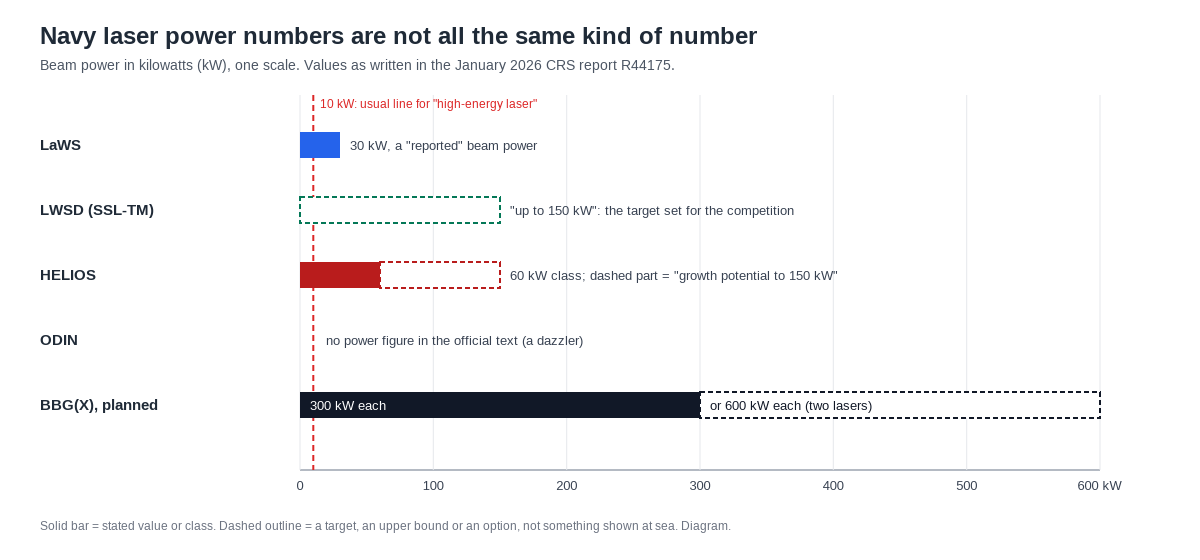
The biggest number belongs to the newest name. On December 22, 2025, the administration proposed a new class of guided missile battleships, BBG(X). The Navy says each ship is to carry two lasers rated at 300 kW or 600 kW of beam power apiece. CRS notes that lasers this strong, particularly at 600 kW, might be able to counter some kinds of anti-ship cruise missiles.
The same report lists questions Congress may ask. One is whether 300 kW or 600 kW laser technology can mature in time for ships bought in the early 2030s. Another concerns the roadmap: the Navy's May 2024 chart, unlike its August 2022 chart, no longer shows SNLWS Increment 2 and Increment 3 as future efforts. CRS leaves the reason for that change as a question for Congress to put to the Navy.
New names do not change the basic conditions for lasers at sea. The limits CRS names are line of sight, atmospheric absorption, scattering and turbulence, and thermal blooming. Because of the air, shipboard lasers cannot be all-weather weapons. Bigger numbers on the label still come with these limits.
What to read next
- 2014: LaWS on USS Ponce, the First Laser Deployed on a Warship: three years at sea for the first name, LaWS
- Laser weapon programs that have been made public: laser weapons that other countries and services have announced officially
- Public High-Energy Laser Tests, 1975–2026: A Timeline: the tests before and after the shipboard lasers, on one line
- Destroyers and frigates: why warships have different names: the kind of ship that carries HELIOS and ODIN