On January 11, 2007, an eight-year-old weather satellite broke apart near 850 km above Earth. By the end of that year, the U.S. Space Surveillance Network had listed 2,317 of its pieces. Only 22 had come back down into the atmosphere. Hitting the satellite took a moment, but the pieces stayed up.
Why does one test against one satellite turn into a problem that lasts years, or even centuries? This article looks at five publicly known cases in which an interceptor launched from the ground or the air destroyed a satellite, and at what each left behind. It also asks why the same kind of breakup ends so differently at different heights, and how a pledge to stop such tests came about.
When one satellite becomes a cloud
Most anti-satellite (ASAT) tests in this article are of the direct-ascent kind. An interceptor launched from the ground strikes a satellite in orbit directly.
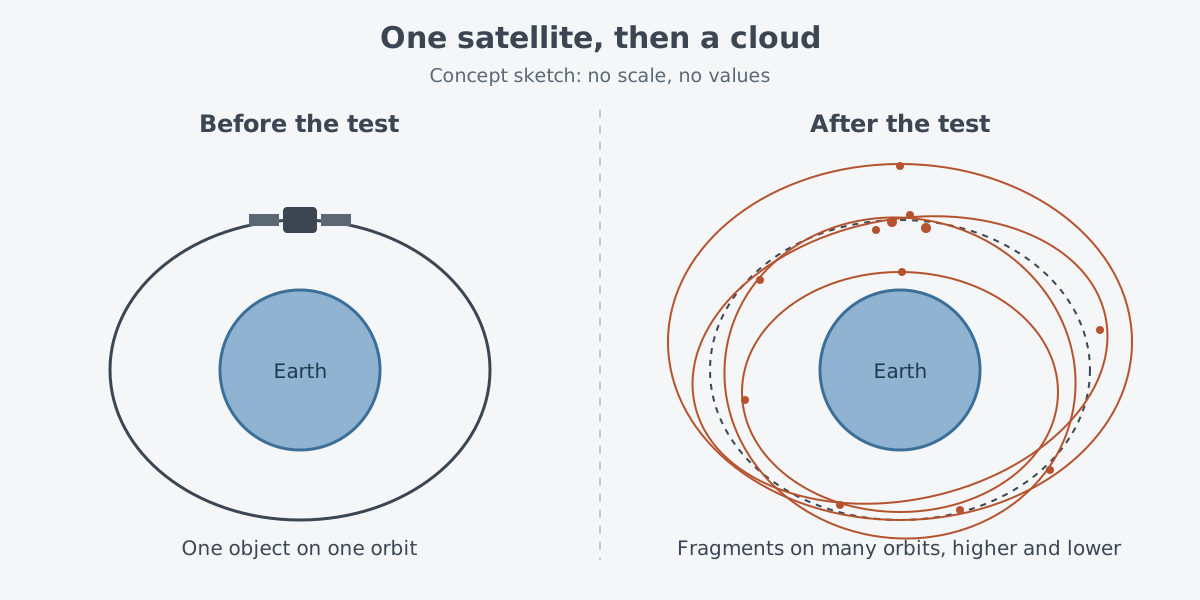
The struck satellite does not stay in one piece. Its fragments scatter onto many orbits, some higher and some lower than the original. Debris from the 2007 test reached heights anywhere between 200 km and over 4,000 km. Cosmos 1408, destroyed in 2021, was below 500 km before the test, yet some of its fragments reached apogee altitudes as high as 1,440 km.
Why do these pieces matter? In low Earth orbit (LEO), orbital debris moves at 7–8 km per second. Even a collision with a small piece carries considerable energy. Small pieces also far outnumber large ones, so most of them are too small to follow on a regular basis.
Picture a handful of sand thrown across a highway. Space is different: there are no lanes, and each piece follows its own orbit, so the risk spreads over a wide band of altitudes rather than one spot.
In 1978, two researchers at NASA's Johnson Space Center, Donald J. Kessler and Burton G. Cour-Palais, published a paper on this. They argued that each fragment from a collision raises the chance of further collisions, so a belt of debris could grow around Earth.
Five satellites destroyed by four countries
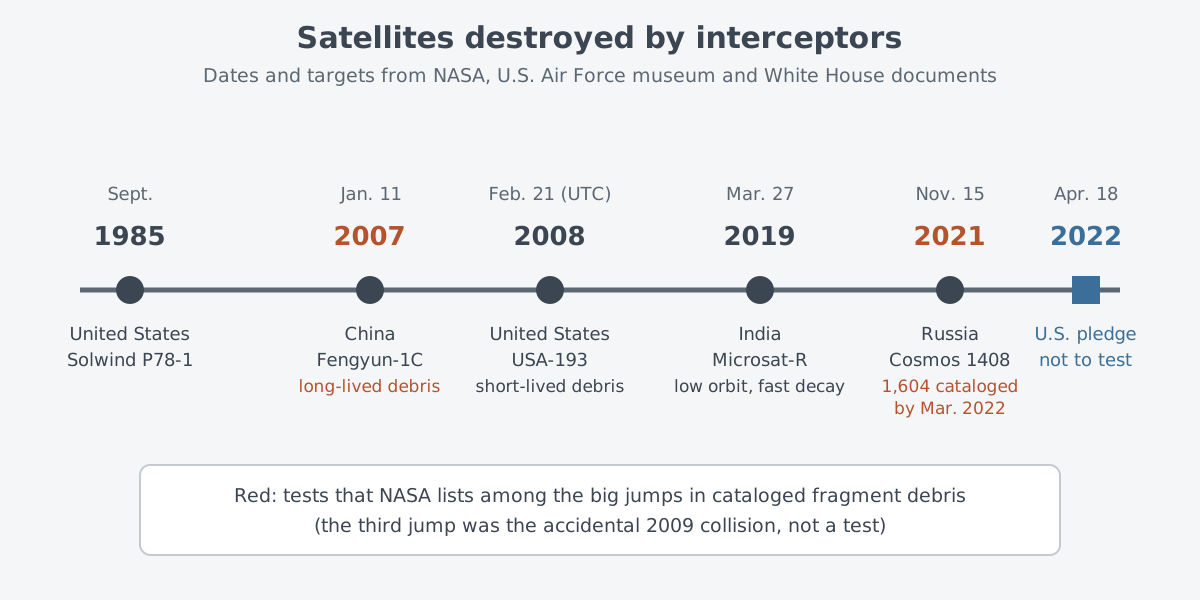
The first case covered here comes from the Cold War. In the late 1970s, the United States expected the Soviet Union to build "killer satellites" that could destroy U.S. reconnaissance and communication satellites. According to the National Museum of the U.S. Air Force, an air-launched ASM-135A missile destroyed the U.S. solar observation satellite Solwind P78-1 in a pre-planned test in September 1985. The satellite still worked, but several of its instruments had failed.
The program did not last. Political and public concern about the arms race reaching into space, along with budget and development issues, affected it, and the U.S. Air Force ended the program in 1988.
The second case is the Chinese test of January 11, 2007, mentioned above. The target was Fengyun-1C, an old Chinese weather satellite. NASA's Orbital Debris Quarterly News (ODQN) described the resulting cloud as the worst single event to pollute LEO in 50 years. Within two months, over 1,200 pieces had been officially cataloged.
The 2008 intercept was a different kind of event. It was not a weapons test: the United States struck its own satellite, USA-193, to reduce the danger from its fall. The satellite had failed right after reaching orbit, so the hydrazine in its propellant tank was unused and frozen. Analyses showed the tank could survive a natural reentry, and the hydrazine released after it landed could harm people.
On February 14, the U.S. government announced it would try to destroy the tank at a very low altitude just before the satellite reentered. The satellite was hit on February 21 (UTC) just below 250 km and broke apart badly.
On March 27, 2019, India destroyed its own satellite Microsat-R using a direct-ascent anti-satellite weapon launched from the ground. The satellite had been launched on January 24 that year. On November 15, 2021, Russia destroyed Cosmos 1408, an old Soviet signals intelligence satellite launched in 1982, in a direct-ascent ASAT test. The U.S. Space Force identified more than 1,500 large, trackable fragments shortly afterward, and by March 7, 2022, the U.S. satellite catalog listed 1,604 of them.
The satellite may belong to one country, but its debris stays in the paths of many satellites at those altitudes. The NOAA Office of Space Commerce wrote that the 2021 test would likely create hundreds of thousands of smaller pieces. Gen. James Dickinson of U.S. Space Command said the debris would threaten satellites and space missions for years and force more collision avoidance maneuvers.
Altitude sets how long debris lasts
The five cases ended so differently mainly because of altitude. The NASA Orbital Debris Program Office (ODPO) explains that debris higher up generally stays in orbit longer. Below 600 km it normally falls back within several years. At 800 km, decay often takes centuries, and above 1,000 km debris normally keeps circling for at least 1,000 years.
Set the five satellites against this guide and the differences show. USA-193 broke up just below 250 km, and most of its debris came down within an hour, with the rest left in short-lived orbits. By late March, only a small share of the first pieces remained up there.
Microsat-R was at about 265–294 km. More than 400 fragments were tracked at first, but the low altitude and fast orbital decay made cataloging hard. Of the 101 pieces that entered the public catalog, 49 were still in orbit on July 15, 2019.
Cosmos 1408 had sunk to about 465–490 km before the test. NASA expected more than 90% of its fragments to reenter within 5 years. In the meantime, the effect depended on height. Because the breakup happened below 500 km, a mission flying at around 400 km felt more of the effect than one at 700 km.
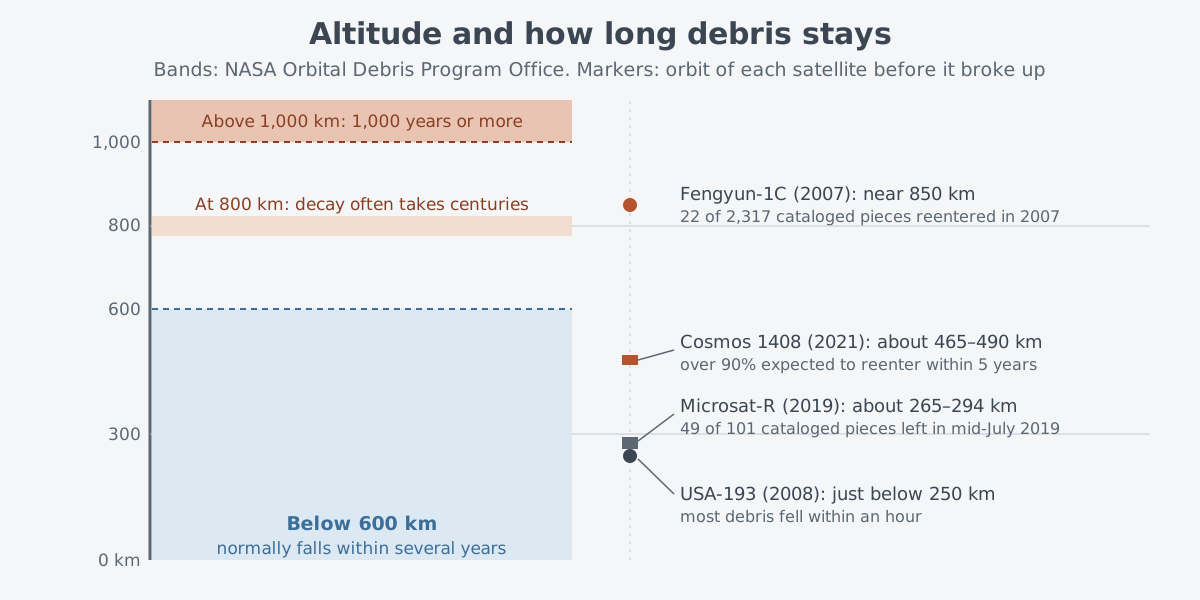
Fengyun-1C broke up near 850 km, a height where decay often takes centuries. That matches the April 2007 newsletter, which said most of the debris went into orbits with lifetimes of decades and even centuries.
A fragment still dodged 14 years later
In 2021, the International Space Station (ISS) maneuvered twice to avoid possible collisions with large debris. The maneuvers came on November 10 and December 3, and they were the station's only debris avoidance maneuvers that year. The November 10 move came after a high-risk conjunction with a fragment from the 2007 Fengyun-1C test.
More than 14 years after the test, a piece of it still crossed the path of a crewed station. A 2008 NASA report also noted Haystack radar results on this event. They supported the view that this single breakup roughly doubled the number of LEO debris pieces 1 cm and larger.
The whole catalog shows the mark as well. Fragmentation debris has made up most of the cataloged population so far, and it jumped sharply three times. The jumps came from the 2007 Fengyun-1C test, the accidental 2009 collision between Iridium 33 and Cosmos 2251, and the November 2021 Cosmos 1408 test. Two of the three jumps came from anti-satellite tests.
A pledge to stop testing
An international guideline already existed in 2007. The fourth United Nations space debris mitigation guideline calls for steering clear of deliberate destruction and similar harmful acts. It names the deliberate breakup of spacecraft and rocket stages in orbit, which leaves long-lived debris, as something to avoid.
On April 18, 2022, the United States went a step further. Speaking at California’s Vandenberg Space Force Base, Vice President Kamala Harris committed that the United States will not conduct destructive, direct-ascent ASAT missile tests. The fact sheet said the United States seeks to make this a new international norm for responsible behavior in space, as the first country to make such a declaration. The Vice President asked other countries to make pledges of their own.
The reason given was debris. Long-lived debris from these tests threatens satellites and other objects in space that matter to the security, economy and science of every nation, and it puts astronauts at greater risk. The pledge is about stopping new tests; it does not clear the debris already in orbit.
Where this meets lasers: measuring debris with light
To avoid debris, you first need to know where it is, and this is one place where the laser comes in. Satellite laser ranging (SLR) uses a short-pulse laser, a light receiver and precise timing electronics. Together they measure how long light takes to travel from a ground station to a satellite's retroreflectors and back. That round-trip time gives the distance.
The International Laser Ranging Service (ILRS) set up its Space Debris Study Group on October 26, 2014. Several SLR stations now track space debris. A missile broke the satellites apart, but light helps keep watch over the pieces.
What to read next
- Space situational awareness: what passes near satellites: the bigger picture of cataloging debris and avoiding collisions.
- Measuring with lasers: range finding and lidar basics: how the round-trip time of light gives a distance.
- Reconnaissance satellites: information from orbit: what the satellites at risk from debris actually do.