On May 11, 1991, the last missile covered by one treaty was destroyed. Under that treaty, signed by the United States and the Soviet Union four years earlier, the two countries had removed 2,692 missiles in total. The Cold War was not only a race to build more weapons. It also produced promises to cut numbers, or to get rid of a whole type of weapon.
Promises like these are called arms control treaties. This article looks at two of them. The Intermediate-Range Nuclear Forces (INF) Treaty emptied out an entire range band. New START put a ceiling on nuclear warheads and launchers with three numbers.
The sections below follow what each treaty counted, how it was checked, and how it ended.
What arms control does
An arms control treaty is an agreement between countries to limit the number or types of their weapons. Two parts of the text get the most care. One is the definitions, which say what gets counted. The other is the checking, which shows whether the other side keeps its word.
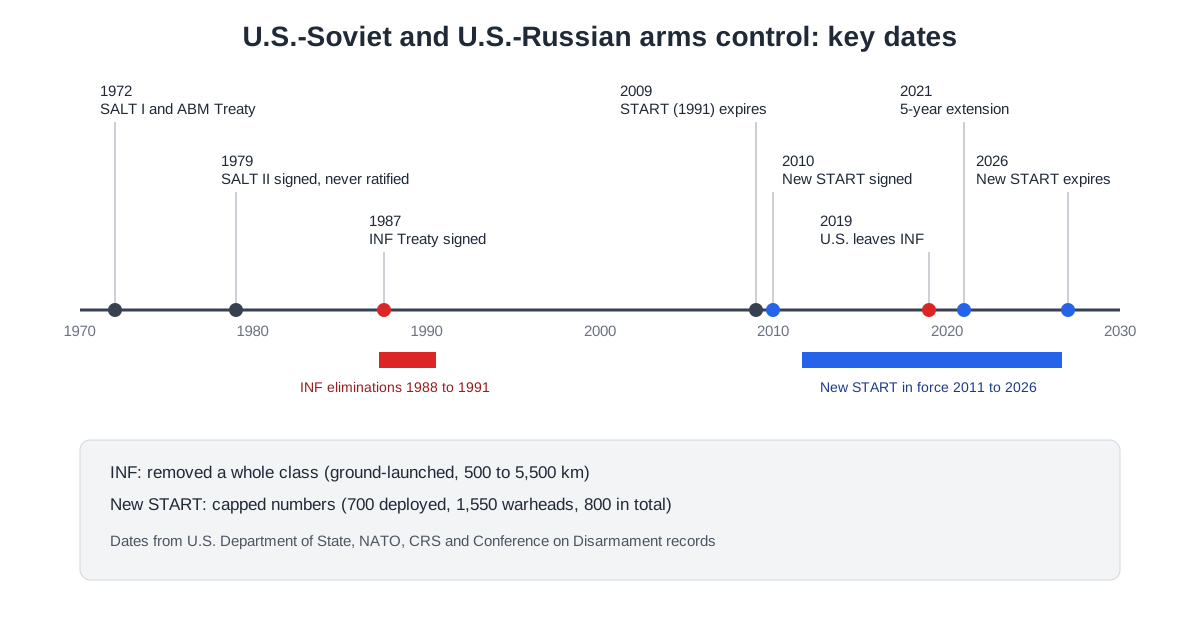
The United States and the Soviet Union first agreed to cap how many nuclear missiles they held on May 26, 1972. President Nixon and General Secretary Brezhnev signed the Anti-Ballistic Missile (ABM) Treaty and an interim Strategic Arms Limitation (SALT) agreement in Moscow. The ABM Treaty also covered the defensive side, limiting each country to 200 interceptors for strategic missile defense.
Not every treaty took effect. SALT II, signed in Vienna on June 17, 1979, was never ratified. Even so, its negotiations settled one way of checking. That was national technical means (NTM), which included collecting telemetry signals and using photo-reconnaissance satellites.
The INF Treaty: removing a whole class
The United States and the Soviet Union signed the INF Treaty on December 8, 1987, and it took effect on June 1, 1988. By June 1, 1991, both countries had to get rid of every ballistic and cruise missile launched from the ground with a range of 500–5,500 km.
The treaty defined weapons by range band. A ground-launched missile able to reach 1,000–5,500 km counted as intermediate-range, and one able to reach 500–1,000 km counted as shorter-range. Both bands were banned. The parties could not possess or produce the launchers either, not just the missiles.
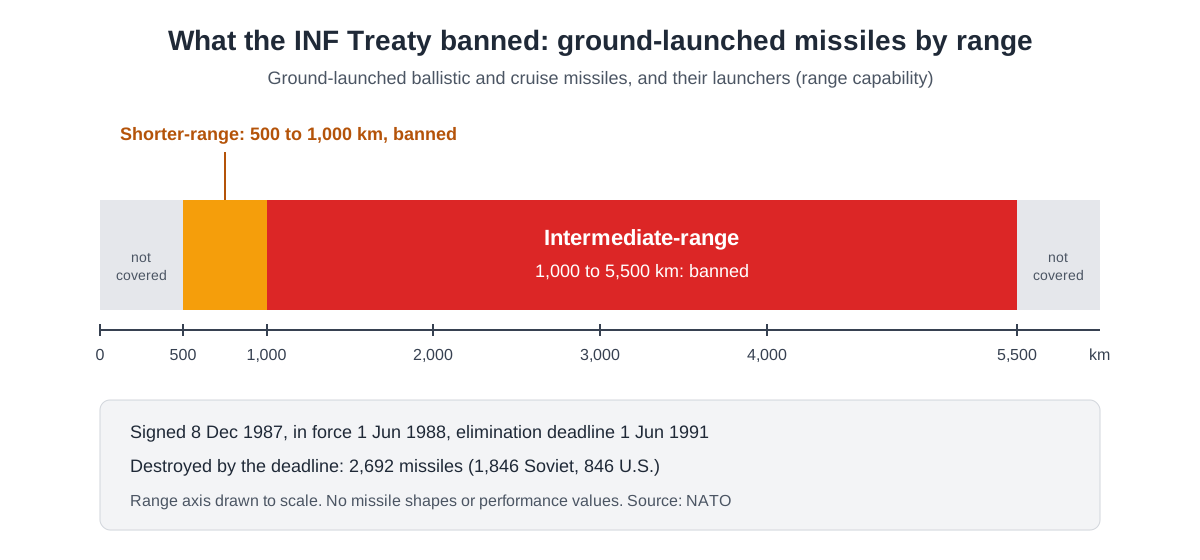
Picture two marks on a ruler, with everything between them cleared away. In practice it was not that tidy. Later, the two countries reached different judgments about whether a particular missile fell inside the band.
When the deadline arrived, the two sides had destroyed 2,692 shorter- and intermediate-range missiles. Of these, 1,846 were Soviet and 846 were American. NATO describes this as the first time an entire category of weapons able to carry nuclear warheads was eliminated.
How the INF Treaty ended
The dispute centered on a Russian missile system called SSC-8, known in Russia as 9M729. According to NATO's timeline, the United States first raised concerns about this system with Russia on May 23, 2013. On December 9, 2017, Russia acknowledged that the missile existed but said it complied with the treaty.
On December 4, 2018, the United States formally found that Russia had seriously broken the treaty. On February 1, 2019, it announced that it would suspend its treaty obligations, and on February 2 it gave six months' notice of withdrawal. The withdrawal took effect on August 2, 2019, under Article XV of the treaty.
The U.S. State Department said it was withdrawing because Russia had not destroyed the missile and returned to compliance. NATO's position is that all Allies agree the missile violated the treaty. The Russian position recorded in these sources is the claim that the missile complied.
Statements also looked ahead. The State Department called for future arms control with both Russia and China at the table. On June 26, 2019, NATO defense ministers confirmed that they did not plan to place new nuclear missiles on land in Europe and were not seeking another arms race.
New START: three numbers
New START was signed on April 8, 2010, and took effect on February 5, 2011. It took the place of the 1991 Strategic Arms Reduction Treaty (START), which expired on December 5, 2009, and it also superseded the 2002 Moscow Treaty. On December 22, 2010, the U.S. Senate approved ratification 71 to 26.
Where INF removed a class of weapons, New START put ceilings on numbers. It has three central limits.
- 700 deployed intercontinental ballistic missiles (ICBMs), submarine-launched ballistic missiles (SLBMs) and nuclear-capable heavy bombers combined
- 1,550 nuclear warheads on them
- 800 launchers for ICBMs and SLBMs, plus heavy bombers, counting both deployed and non-deployed
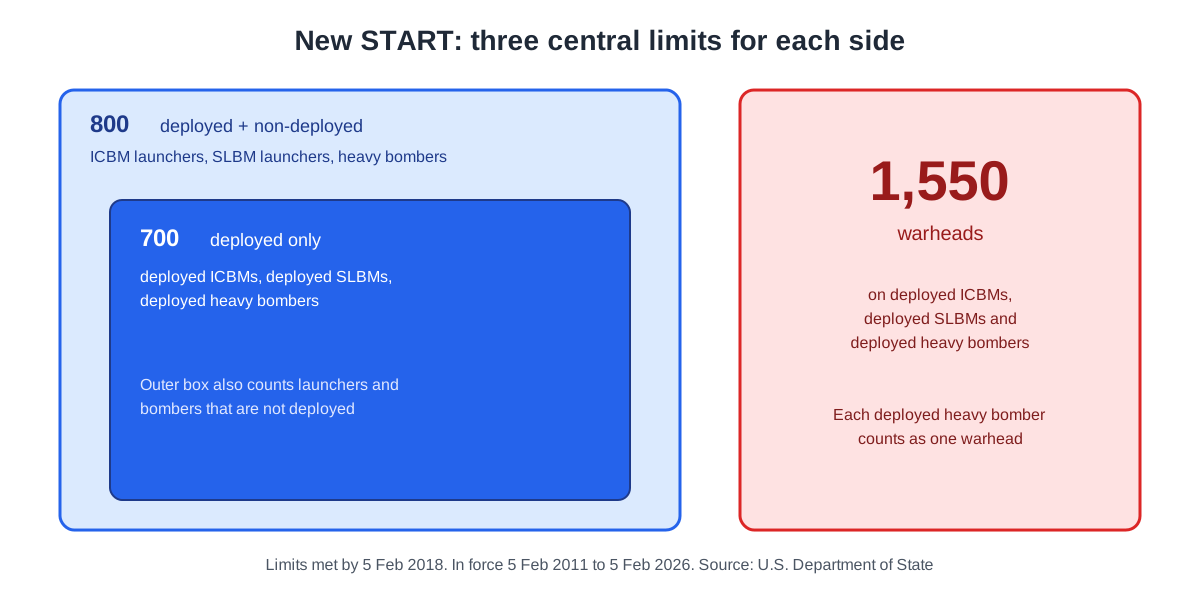
The gap between 700 and 800 is worth a closer look. The 700 counts only what is actually deployed, while the 800 also counts launchers and bombers that are not deployed. The two countries had seven years to reach the limits, met all three by February 5, 2018, and stayed at or below them afterward.
Counting rules and checking
Once the numbers are set, the question is what counts as one. A deployed heavy bomber counts as one warhead toward the limit, whatever it carries. Delivery vehicles such as missiles, and their warheads, stay counted until the conversion or elimination steps in the treaty's Protocol are complete.
Some things sit outside the limits. U.S. missile defense programs, current or planned, are not limited by New START. The treaty does, however, ban turning ICBM and SLBM launchers into launchers for missile defense interceptors.
Checking happens in several layers. The two sides exchange data on the numbers, locations and technical characteristics of the weapon systems and facilities the treaty covers, and they send regular notifications. Every ICBM, SLBM and heavy bomber gets a unique identifier. Each year the two sides trade telemetry, in equal amounts, for up to five ICBM and SLBM launches.
On-site inspections number 18 a year.
Type One inspections, at sites with both deployed and non-deployed systems, can happen up to 10 times. Type Two inspections, at sites with only non-deployed systems, can happen up to 8 times. Each Type One inspection can confirm the number of reentry vehicles on one deployed ICBM or SLBM. National technical means such as satellites are allowed, and interfering with them or hiding things from them is banned.
Think of it as two sides mailing each other their ledgers and opening the storeroom a set number of times. In reality it is far stricter than a ledger. The treaty fixes the places and the number of visits. If one side stops opening the door, the other side finds it harder to assess what it has.
The last years of New START
New START's original term was 10 years, until February 5, 2021, and it could be extended once by up to five years. The two countries agreed to a five-year extension, which kept the treaty in force through February 4, 2026.
In the meantime, Russia announced that it was suspending the treaty. In June 2023 the U.S. State Department stated that this claimed suspension was legally invalid and that Russia remained bound by its treaty obligations. The facts the State Department listed were that Russia was refusing inspections, staying away from the Bilateral Consultative Commission (BCC) that implements the treaty, and no longer sending notifications. As a countermeasure, the United States stopped providing its own data and notifications.
Russia, for its part, has claimed that the procedures the United States used to convert SLBM launchers and B-52H heavy bombers were not consistent with the treaty. In the U.S. view, these procedures leave the converted launchers and bombers unable to use nuclear weapons. That takes them out of the treaty count, and the procedures comply fully.
The State Department assessed that Russia did not engage in significant activity above the treaty limits in 2022. Without inspections and notifications, however, the U.S. ability to assess Russian deployments was degraded.
The treaty expired on February 5, 2026. The next day, U.S. Under Secretary of State Thomas DiNanno spoke to the Conference on Disarmament. He said the treaty's single five-year extension had already been used in 2021, so it could not legally be extended again.
DiNanno said the warhead and launcher limits set in 2010 no longer fit, pointing to one nuclear power expanding its arsenal quickly and to nuclear systems outside the treaty. He also said China's nuclear arsenal has no limits and no transparency. The United States said it wants a better agreement.
Where this meets lasers: treaties define weapons
When reading an arms control treaty, start with the definitions. INF sorted weapons by launch mode and range band, and New START by deployment status and counting rules. Depending on how a definition is written, the same weapon can fall inside a treaty or stay outside it.
Laser weapons have an international rule too. Protocol IV of the Convention on Certain Conventional Weapons (CCW) defines a weapon by what it is designed to do, not by a number. It bans using laser weapons built specifically to blind the unaided eye permanently, and it bars transferring them to other states or to non-state groups. What the protocol bans, and what it leaves out, continues in the protocol on blinding laser weapons.
What to read next
- Eye safety and international rules: the protocol on blinding laser weapons: how an international rule for laser weapons defines what it covers.
- Ballistic missiles: why they climb high and come down: how the ballistic missiles that INF sorted by range actually fly.
- Cruise missiles: how they resemble aircraft: the working principle of the ground-launched cruise missiles that INF also banned.
- SLBMs: how a missile starts from under the sea: one of the three delivery systems that New START counted.