Why factory lasers changed
A thin beam of light runs across a thick steel plate, and the plate splits apart. Run the same light along the seam between two metal parts, and they join into one piece. One of the lasers that cut and weld steel this way is the fiber laser.
A fiber laser sends the light it makes along the core, the central path of a glass fiber. Factories already had lasers in place before it, such as the carbon dioxide (CO₂) laser. So what was different enough to bring fiber lasers into the factory?
The answer has four parts. Fiber lasers turn a fairly large share of their electricity into light, shed heat easily, focus to a small spot, and have almost no mirrors to align.
From electricity to light: wall-plug efficiency
A laser takes in electricity and gives out light. How much laser light comes out for the electricity put in is called wall-plug efficiency (WPE). The wall plug is the socket on the wall. The question is what percentage of the power drawn from that socket ends up as laser light.
TWI (The Welding Institute), a welding research organization in the UK, points out that lasers generate light with low efficiency. This is especially true next to other welding processes. A TWI technical FAQ gathers typical efficiencies for several laser types in one table. The table carries no date, so read its numbers as the table's typical values rather than figures for today's products.
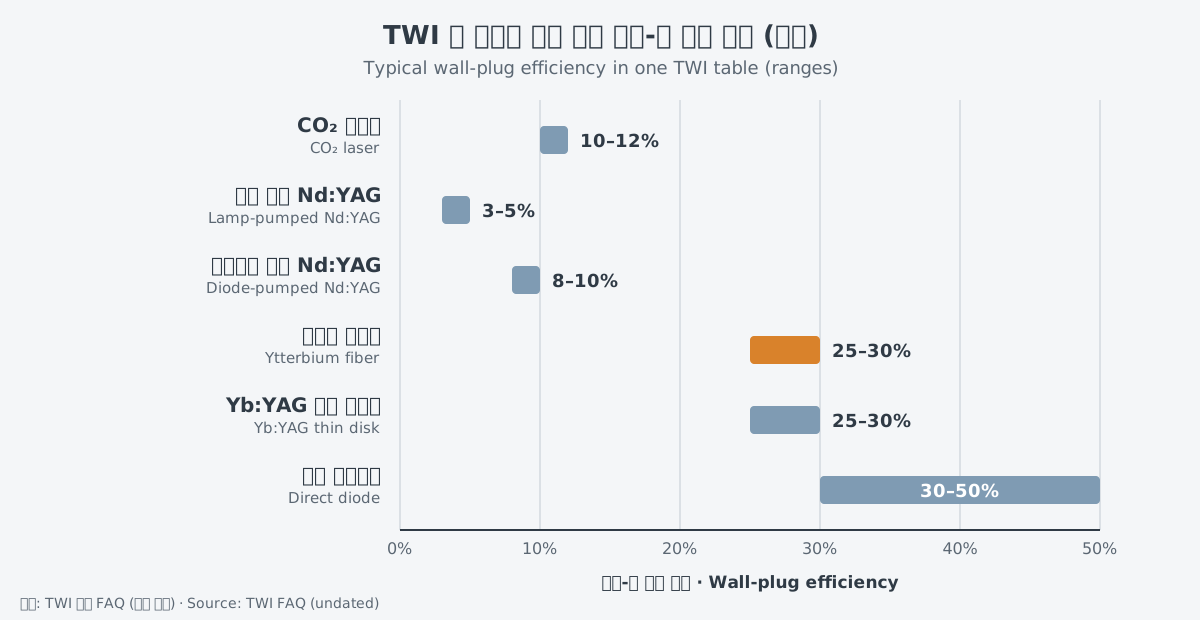
In this table, the ytterbium fiber laser sits at 25–30%. That is several times the 3–5% of a lamp-pumped Nd:YAG laser. It is not at the top, though. The Yb:YAG thin-disk laser has the same 25–30%, and the direct-diode laser reaches 30–50%.
An ytterbium fiber laser amplifies light in ytterbium-doped fiber (YDF). The maker IPG Photonics states that the typical electrical efficiency of its YLS industrial fiber lasers is over 40%, and that its YLS-ECO lasers reach over 50%. There is no telling whether these were measured under the same conditions as the TWI table. All the numbers and phrases from IPG and nLIGHT in this article are what the companies say about their own products.
Two things support the efficiency of fiber lasers. One is pumping, the way energy goes in. The other is the shape of the fiber.
Solid-state lasers can get their pump light from a lamp, such as a flashlamp, or from an array of laser diodes. A diode array is much brighter than a normal flashlamp. Its light also covers a much narrower range of wavelengths, so it can be tuned right onto a wavelength the laser medium absorbs well.
As a result, the pump light is absorbed more efficiently and heating effects drop. The closer the pump energy is to the laser energy, the stronger this effect. This principle holds across diode-pumped solid-state lasers. The TWI table shows the same split for Nd:YAG lasers: 3–5% when lamp-pumped and 8–10% when diode-pumped.
High-power fiber lasers also turn pump light from diodes into laser light. A 2010 review paper by Richardson, Nilsson, and Clarkson credits their success in the high-power arena largely to the fiber's geometry, its long, thin shape. The abstract adds that this shape makes it possible to convert fairly low-brightness diode pump light into high-brightness laser output efficiently.
Describing its own side-pumping technique, IPG explains that pump light reflects many times inside the cladding around the core and crosses the core again and again. There, rare-earth ions in the core, such as ytterbium, absorb the light and emit it again. The article on double-clad fibers looks at how pump light gets in.
A shape that sheds heat easily
A full pot of hot soup stays hot for a long time. Split the same soup into several small bowls, and it cools much faster. More of its surface now touches the air.
The gain medium of a laser also sheds heat through more or less surface depending on its shape. Stretch the same volume into something long and thin, and the surface per unit of volume grows. IPG explains that a fiber's huge surface-to-volume ratio helps remove heat and helps avoid thermal lensing, an effect caused by heat. In some lasers, such as a lamp-pumped Nd:YAG laser, thermal lensing can allow only a limited range of pump power settings.
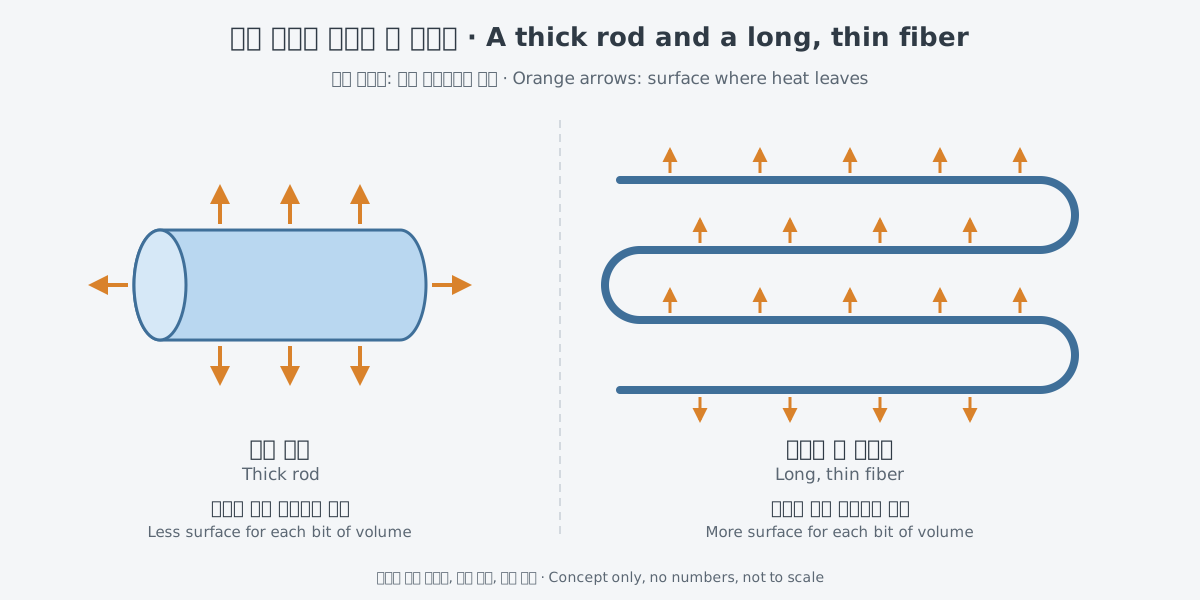
The soup comparison breaks down in one place. Soup only cools from the outside, while a fiber keeps making heat in its core, and that heat has to be carried away. What the comparison shows is one idea only: more surface makes it easier to let heat out.
The review abstract also says the fiber's shape gives "considerable resilience" to the effects of heat generated in the core. Resilience is not the same as having no heat problem.
How the heat is removed varies by product. In IPG's comparison table of high-power continuous-wave products, the cooling row reads "water or air" for one product line and "air cooling up to 1.5 kW" for another. The same page names air, water-to-air, and water-to-water as cooling options.
A beam that focuses to a small spot: beam quality
To cut a steel plate, the light has to be focused hard onto one spot. So a laser has another value to weigh besides its power: beam quality. In IPG's technical overview, beam quality represents, in practice, how much a laser beam can be focused.
There are two common measures. Single-mode lasers, where light travels in just one mode, are usually rated by M², read "M squared." Multimode lasers, with many modes, are rated by the beam parameter product (BPP). For both, a smaller value means higher beam quality.
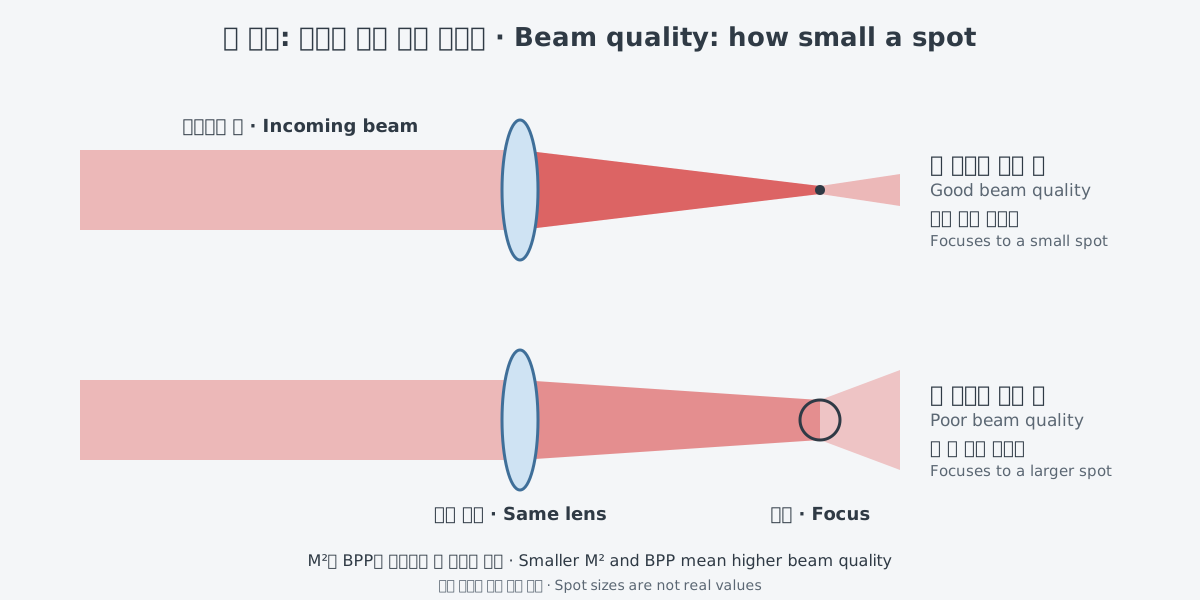
IPG treats an M² of 1 as a perfect beam. Real devices cannot quite reach it, but IPG says industrial fiber lasers reliably achieve M² of 1.1 or less.
Beam quality ties back to pumping as well. One important advantage of diode-pumped solid-state lasers is that they turn pump power from fairly low-cost, low-beam-quality diode arrays into a near-diffraction-limited output beam. They do it with good efficiency. In effect, light of low beam quality goes in, and light of very high beam quality comes out.
A fiber laser sends the light it makes along its core and concentrates the energy in a small area inside the glass. It is also easy to pass that light into a passive fiber, which only carries light, for transmission. In the IEEE Milestone record's view, fiber lasers proved exceptionally well suited to generating high-quality beams of many kilowatts efficiently, greatly expanding laser use in cutting, welding, and other machining.
The 2010 review abstract likewise credits cladding-pumped fiber devices, which send pump light into the cladding, with outstanding output power, beam quality, overall efficiency, and wavelength flexibility. Still, beam quality does not always need to be high. In IPG's examples, higher beam quality improves processing speed and quality in jobs that need a tightly focused beam, such as cutting, drilling, and welding. Wide-area heat treatment and cleaning do not need particularly high beam quality.
Fewer mirrors to align
Lasers are machines, and machines need care. TWI's maintenance notes show CO₂ lasers needing their mirrors cleaned and realigned, typically every 500 hours. Some solid-state lasers need their lamps changed typically every 1,000 hours and their diodes typically every 10,000 hours.
Trained staff can do this work in-house. Apart from that, each laser technology needs skilled servicing at regular intervals, usually carried out by the manufacturer. For ytterbium fiber lasers, TWI's note is that general maintenance is not required.
Makers point to the fiber laser's design. In IPG's description, a fiber laser is a monolithic, entirely solid-state, fiber-to-fiber design with no free-space mirrors or optics, that is, no optical parts sitting in open air. Fibers of different types and core diameters are joined to combine the pump, amplifier, and beam delivery fibers. IPG says this removes the risks of contamination, damage, and misalignment that come with free-space optics.
IPG says this design lets fiber lasers run in the harshest working environments. They can be lifted by cranes and moved on wheels, and they need no vibration-isolated floors or temperature-stabilized rooms. IPG also presents fiber lasers as free of complex optics, frequent service, and consumables, which makes them much easier to build into machines.
Comparing with other industrial lasers
Put efficiency and maintenance side by side from the single TWI source, and the fiber laser does not lead on every count. The ytterbium fiber laser's efficiency matches the thin-disk laser at 25–30% and falls below the direct-diode laser's 30–50%. It is higher than the CO₂ laser's 10–12% and the lamp-pumped Nd:YAG laser's 3–5%.
In the maintenance notes, the ytterbium fiber laser is the one singled out as needing no general maintenance. Maintenance for thin-disk and direct-diode lasers does not appear in those notes. The lamp and diode change intervals are also given only for "some solid-state lasers," without naming which ones.
IPG goes further. It points to two things together: delivering light through fiber and efficiently converting electricity into light. In its claim, these make fiber lasers a significantly more practical solution in many cases than legacy CO₂ lasers or disk lasers. The condition "in many cases" means this does not hold for every job.
From the lab to the factory
Fiber lasers began in a lab, not a factory. The IEEE Milestone record dates the start to 1961. That year, Elias Snitzer and colleagues built and ran the world's first optical fiber laser at the former American Optical complex in Southbridge, Massachusetts. The work drew on Snitzer's earlier research, which led to the first glass solid-state laser in 1961, and on his work with optical fibers.
Three years later, the same team demonstrated the first optical fiber amplifier. Meanwhile, the abstract of a 2014 review paper by Shi and colleagues in Applied Optics dates the first demonstration of a glass fiber laser to 1964. The first fiber laser thus dates to 1961 in the IEEE Milestone and to 1964 in the Shi abstract.
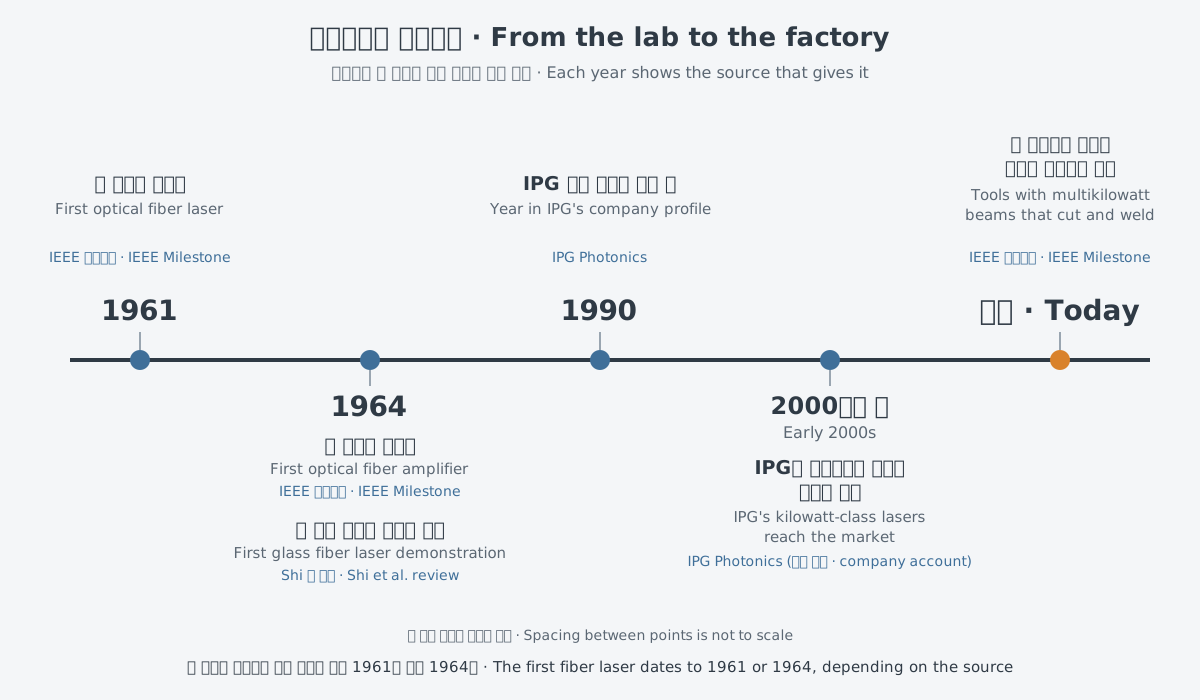
The factory side of the story lives in company records. IPG Photonics opens its company profile with the line that it has been applying light since 1990. IPG also explains that its kilowatt-class lasers came to market in the early 2000s, and that their power-to-volume ratio has since improved more than 10 times.
The 2010 review abstract closed by looking ahead ten years. It considered how coming advances in pump lasers, fiber design and fabrication, architectures, and functions would affect fiber laser performance and industrial and scientific adoption. The 2014 review abstract sums up steady progress since the first demonstration in wavelength coverage, linewidth, output power, pulse energy, and ultrashort pulse width, with uses spreading into many fields.
Today the fiber laser is a tool on the production floor. In the IEEE Milestone record's words, fiber lasers have become powerful tools in manufacturing, generating multikilowatt beams that cut and weld materials from plastics to metals.
IPG presents its lasers and laser systems as used in material processing, medical procedures, and advanced applications. On its advanced manufacturing page, nLIGHT names uses for its lasers from precision cutting and welding to microfabrication and additive manufacturing. For metal additive manufacturing, nLIGHT says its high-power fiber lasers enhance speed, stability, and cost efficiency. The official websites of both companies are gathered on the Manufacturers page.
The limits that remain
No technology comes with advantages only. The 2010 review abstract names the key factors that currently limit fiber laser performance across operating regimes. Three stand out: thermal management, optical nonlinearity, and damage.
A shape that sheds heat easily does not end the work of thermal management. What the fiber's shape provides is "considerable resilience" to heat, not freedom from heat. Optical nonlinearity and damage sit on the same list.
Efficiency is worth a second look too. Read the 25–30% in the TWI table the other way around, and 70–75% of the electricity put in does not become laser light.
Which laser fits depends on the job. Some jobs, such as wide-area heat treatment, do not need particularly high beam quality.
What to read next
- "Double-clad fibers and how pump light gets in": a closer look at how pump light travels through the cladding and is absorbed in the core.
- "Limits of a single fiber (1): nonlinear effects (SBS, SRS)": the basic idea of the scattering that appears as power goes up.
- "Limits of a single fiber (2): heat and mode instability": how heat can unsettle beam quality.