The light a fiber laser emits starts as pump light. When pump light from diodes goes into a gain fiber, most of it is absorbed in the core and builds up the laser light. So where does the rest go?
The rest stays in the cladding and keeps flowing along the fiber. A cladding light stripper (CLS) is the part that deliberately pulls this light out of the fiber and turns it into heat. This article looks at where light in the cladding comes from, why it has to be thrown away, how it is pulled out, and where the stripper goes.
The part got a one-line introduction, by name and use, in "Isolators and fiber components: keeping light from going backwards". Which layer of a double-clad fiber the pump light enters is covered in "Double-clad fibers and how pump light gets in". This article picks up the story of pump light that is not used up by the end.
Where light in the cladding comes from
Fiber lasers and amplifiers that run at high power often use double-clad fiber. The laser light travels in the thin core, while the pump light travels in the wide inner cladding around it and is absorbed as it crosses the core. A large share of the pump light is absorbed this way, but a small share keeps going along the inner cladding.
That is not the only source of cladding light. Cladding light can also come from the following.
- Unabsorbed pump light: pump light that crosses the core but is never absorbed.
- Amplified spontaneous emission (ASE): light that excited atoms emit on their own and that the amplifier then amplifies.
- Stray light from splices and bends: light that strays from its path where fibers are joined or bent.
Splices are especially common around the pump combiner. A fiber combiner can have several splice points that carry strong pump light, and pump light can scatter at those boundaries. One patent also looks at a combiner that gathers the light of several lasers into one output fiber. It notes that not all of the wanted light enters the core, and some of it ends up in the cladding.
Why leftover light is a problem
According to researchers at OFS Laboratories in New Jersey, in the United States, multi-kilowatt lasers and amplifiers built on double-clad fiber made big strides over the decade before their paper. Even so, light carried in cladding modes still left challenges for reliability and beam quality.
Heat is a problem too. A review chapter released as a preprint explains that strippers remove residual pump light so that nearby parts and free-space optics are not damaged by heat. It adds that they also stop signal and ASE that scatter backward from getting back into the core, where they would be amplified once more.
The life of the parts is at stake as well. How much light sits in the cladding matters for how long high-power fiber components last, which is why high-power systems use strippers to remove it. In a 2019 paper, researchers at Bilkent University's UNAM called the stripper vital, one of the key parts in high-power fiber lasers.
The principle: breaking total internal reflection
First, how a fiber traps light. In a glass fiber, the core's refractive index is higher than the cladding's. Light is held in the core by total internal reflection (TIR) at the boundary with the cladding, so it travels with little loss.
Total internal reflection has two conditions. The angle at which light strikes the boundary must exceed the critical angle. The material outside must also have a lower refractive index than the material inside. If the outside is higher, total internal reflection cannot happen.
The inner cladding of a double-clad fiber traps pump light in the same way. The core has the highest index and the outer cladding the lowest, and the outer cladding may be made of glass or polymer with a lower index. Pump light bounces at the boundary between the inner and outer cladding as it moves forward.
A stripper breaks this condition on purpose. Along one section, a material with a higher index than the inner cladding touches its outside, so total internal reflection no longer holds there. Pump light crosses the boundary into that material, and once out, it is absorbed nearby and becomes heat.
The laser light in the core passes through this section unchanged. The core is still surrounded by the lower-index inner cladding, so total internal reflection at the core's own boundary stays in place.
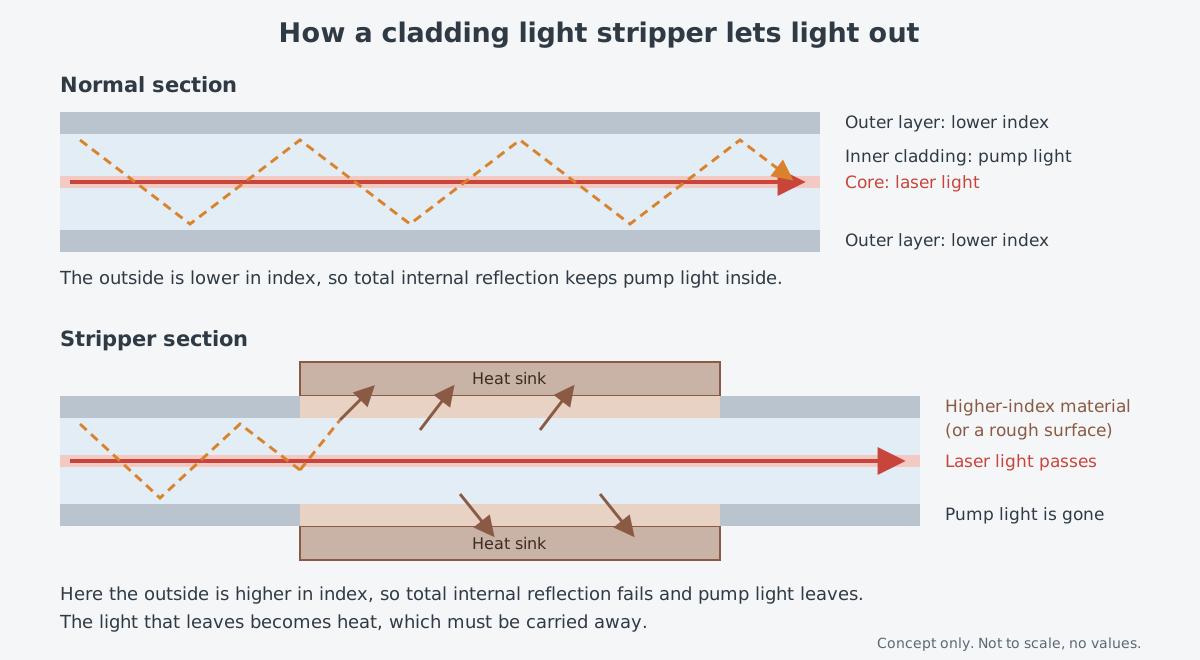
Picture a hallway lined with mirrors, with one window cut into the wall. Light bounces off the mirrors and runs down the hallway, but where the window is, it escapes. The real stripper differs in one way. Outside its "window" sits material that absorbs the light and turns it into heat, and that heat still has to be carried away.
Another route roughens the surface instead of changing the index. At a smooth boundary light bounces back evenly, but at a rough surface it scatters, and part of it leaves the cladding.
Three approaches and their weak points
Many ways to pull out cladding light have been studied. A 2017 conference paper from Bilkent University lists a high-index polymer coating, a roughened cladding surface, a soft metal coating that absorbs the light, and CO2 laser processing. Every approach has limits.
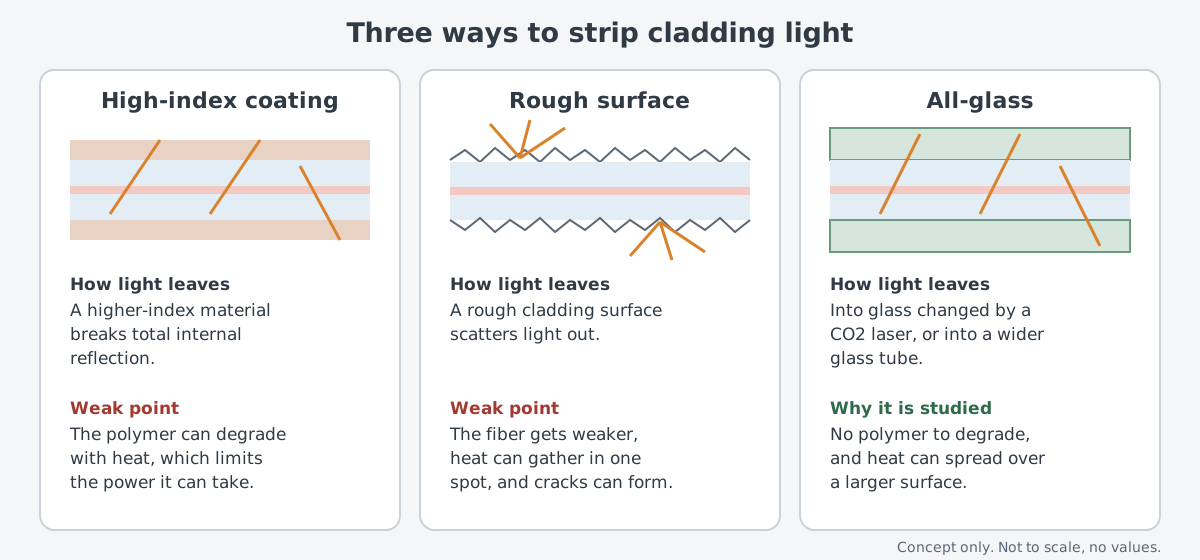
- High-index coating: The simplest method is to splice on a fiber coated with a high-index material. Because the coated length can be long, the share of light it removes can be very high. But the most power it can pull out is capped by the point at which the polymer gets damaged, and nonlinear effects grow as the fiber gets longer. Heat damage to the recoated polymer is named as a limit as well.
- Rough surface: The cladding surface is roughened, for example by etching, so light scatters out. Very high attenuation has been reached this way, but the roughening weakens the fiber, and heat can pile up in one spot or tiny cracks can form in the cladding wall. The OFS researchers judged long-term reliability a concern, especially in manufacturing, because etching damages the glass surface and the area for shedding heat is limited to the cladding diameter.
- All-glass: This route avoids polymer. One method uses a CO2 laser to change the structure of the cladding and disturb the light's path. Another collapses a glass tube, index-matched to the cladding, onto the fiber. In the tube method, cladding light spreads into the tube's larger volume before it passes through a heat-sinking layer to a metal housing, and the authors write that spreading heat over a much larger surface makes the device more reliable.
Heat is the shared problem for every approach. A fiber is thin, so the surface where light leaves is small, and heat builds up in that small area. Some high-power commercial products carry a note that they need a water-cooled heat sink. Where a fiber laser's heat goes is covered in "Cooling and thermal management: where the heat that did not become light goes".
Where it sits in an amplifier
A stripper is not only at the very end of the laser. Cutting down unwanted light matters all through the amplifier, and not only at the output end. The review chapter mentioned above names common spots inside the amplifier: on the far side from the pump combiners, and between the pump lasers and the combiners.
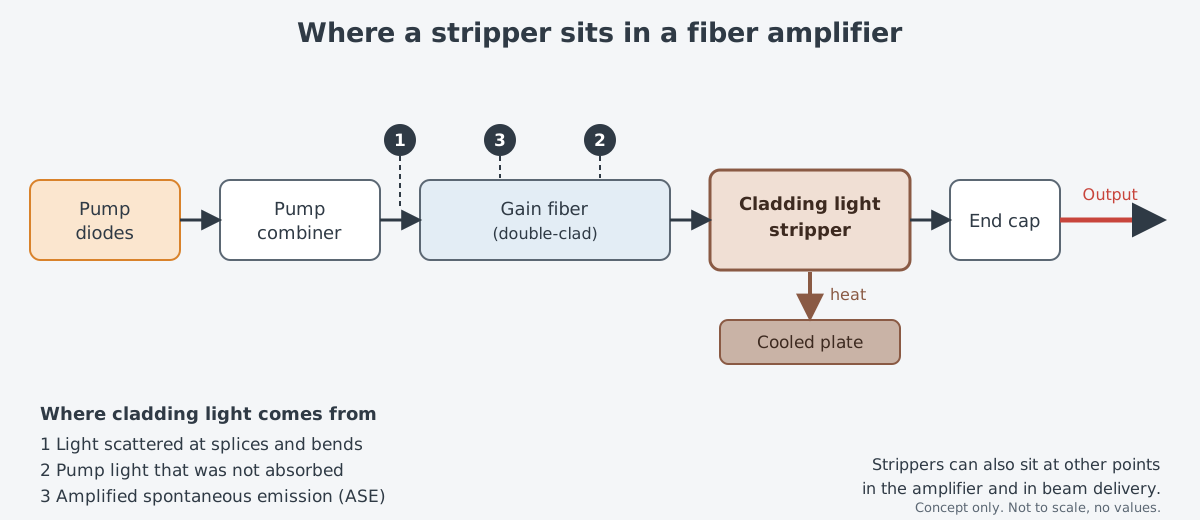
Strippers are also used where the light heads out. Commercial products include cladding mode strippers for beam delivery, and end caps and collimators with a stripper built in. The OFS researchers listed as an advantage that their glass tube method can use the amplifier's delivery fiber itself for stripping, so no extra fiber or splices are needed.
The combiner that gathers pump light and the end cap at the output are covered in "Pump and Signal Combiners and Endcaps: Fiber Parts Inside an Amplifier". The stripper sits between and around those two parts, cleaning up light that has strayed from its path.
Measuring how well it strips
A stripper's performance is usually stated as how much it cuts the cladding light, in decibels (dB). Removing 99% of the incoming cladding light is 20 dB. That means one hundredth of the light is left.
Still, it is hard to say flatly that a stripper gives so many dB for a given fiber. Researchers at Fraunhofer IOF found that stripper efficiency depended on the numerical aperture (NA) of the cladding light. They concluded that no single efficiency number can be trusted for a fiber as a whole unless the nature of the light it guides is taken into account.
Numerical aperture describes the cone of angles of light a fiber accepts. So the same stripper can score differently depending on the angles at which the cladding light is spread. That is why, when reading an attenuation figure in product material, it helps to ask what light it was measured with.
Measuring is tricky in itself. The usual ways either add a stripper, which changes the fiber for good, or put a pinhole in front so that only the core light gets through. A new way to measure the cladding light in double-clad fiber without changing the fiber appears in the 2018 Fraunhofer IOF paper.
How research and products developed
The reference list of the 2017 Bilkent paper includes three earlier works. The first is "High power cladding light stripper" by Wetter, Faucher and Sévigny in the 2008 SPIE proceedings. The others are "Fabrication and evaluation of a 500 W cladding-light stripper" from 2013 and a 2014 Applied Optics paper on a stripper using soft metals.
Later papers went on to methods that do not rely on polymer. In 2017, Bilkent University researchers presented an all-glass stripper made by CO2 laser processing. In 2020, researchers at BİLGEM of the Scientific and Technological Research Council of Türkiye (TÜBİTAK) published a polymer-free stripper with a roughened surface in Applied Optics. In between, Bilkent's UNAM researchers described a method that combines two kinds of etching in 2019, and Fraunhofer IOF researchers presented the measurement problem seen above in 2018.
Products have settled in as well. A 2013 webinar from Coherent, which makes laser fibers, stated that strippers and end caps are commercially available to match various standard large mode area (LMA) fibers. FiberBridge Photonics of Hannover, Germany, offers strippers for kilowatt-class laser systems in versions for active and passive fibers and for polarization-maintaining fiber. The company describes them as keeping beam quality and polarization.
Where a fiber laser sits in a laser weapon, from the chip to the effector, is shown in "Following One Laser Weapon: From Chip to Effector".
What to read next
- "Double-clad fibers and how pump light gets in": which layer the pump light handled by a stripper enters in the first place.
- "Pump and Signal Combiners and Endcaps: Fiber Parts Inside an Amplifier": the combiners and end caps that sit before and after a stripper.
- "How a fiber guides light: core and cladding": the total internal reflection a stripper breaks on purpose, and the structure of a fiber.