Euronaval 2026 opened on November 3 at the Villepinte exhibition center north of Paris. It is a large show for naval equipment only. On the first day, the French shipbuilder Naval Group showed a concept warship. Next to about 100 missile cells, its description listed "a 100 kW laser."
Putting lasers on warships is not just this one concept. On the same day, the missile maker MBDA put lasers into its counter-drone note. A shipbuilding study and a French carrier trial from a few weeks earlier point the same way.
This letter in brief
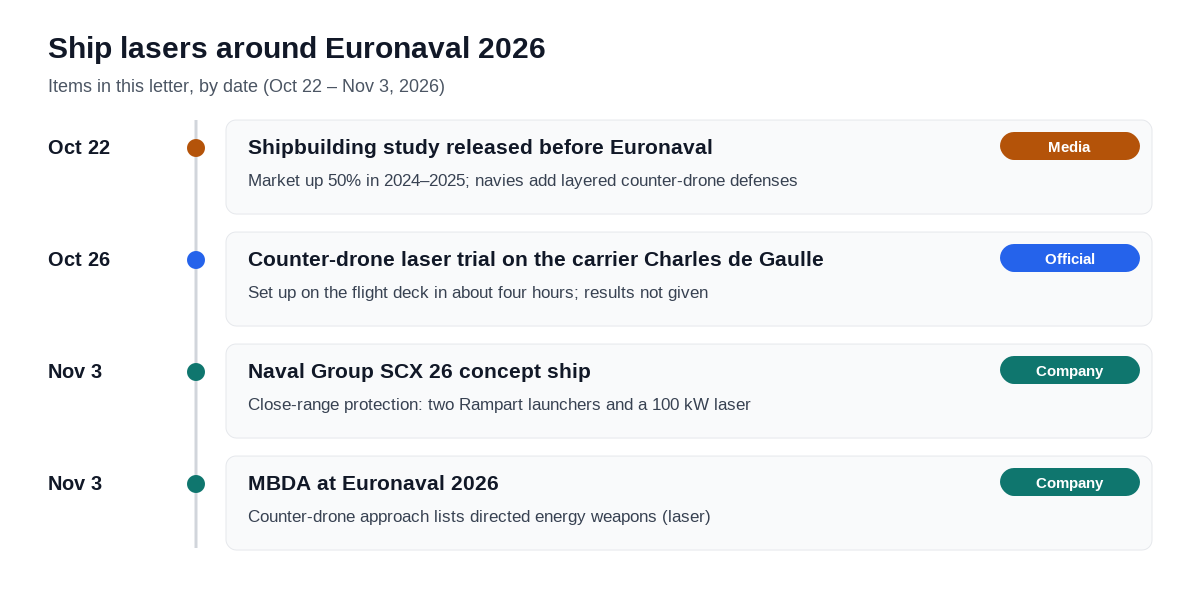
- Naval Group unveiled the SCX 26 concept ship on November 3 and said its close-range protection combines two Rampart launchers and a 100 kW laser. On the same day, MBDA wrote that its counter-drone approach includes laser directed energy weapons.
- A shipbuilding study released before the show said the market grew 50% in 2024–2025 and that navies are rushing to add layered counter-drone defenses, lasers among them. The laser trial on the carrier Charles de Gaulle was reported again.
- The maker of the SCX 26 laser, any test plan for it, and numerical results from the Charles de Gaulle trial were not disclosed.
Naval Group's SCX 26 concept ship
Naval Group introduced its new concept ship, the SCX 26, on its website on November 3. A concept ship is an exercise in looking ahead at the technologies, layouts and ways of operating that navies may need. It is not necessarily tied to a real building program.
The ship is 170 m long and displaces 8,000 t. It is designed for 30 knots and a range of more than 8,000 nautical miles. The main armament is more than 100 vertical launch system (VLS) cells and an electromagnetic gun that can fire rapidly.
The laser goes into the close-in layer, next to two Rampart multipurpose modular launching systems. The weapon fit as a whole is meant to counter many threats arriving at once while staying cost-effective.
The stern holds a mission bay for launching, recovering and updating drones. The crew is 150, with room for another 100 senior officers and specialists. One line on the company page sums up the idea: technology does not replace the crew but gives it new capabilities.
What MBDA said about counter-drone and lasers
The European missile maker MBDA also posted a note on opening day. Its counter-drone section pairs established surface and air defense weapons with newer technology. The newer technology named is laser directed energy weapons, for "effective, low-cost neutralisation."
SEA WARDEN appears in the same note as a system for surveillance and response in sensitive sea areas. MBDA experts will speak in the show's conference room on November 5, with the multi-domain drone threat among the topics. No laser equipment is named, and no power level is given.
A shipbuilding study: navies stack counter-drone layers
On October 22, Naval News covered the World Defense Shipbuilding 2026 study released ahead of Euronaval. According to the article, worldwide spending on military and paramilitary shipbuilding grew 50% in 2024–2025 to $122 billion. Measured by the weight of ships built, output rose from nearly 1 million t to about 1.5 million t.
Growing drone threats are pushing advanced navies to field layered counter-drone defenses quickly. The layers listed are interceptor drones, lasers and rapid-fire guns. The show itself is growing too, with more than 700 exhibitors expected, 45% more than in 2024.
The Charles de Gaulle laser trial, reported again
On October 26, Defence Industry Europe reported the counter-drone laser trial on the carrier Charles de Gaulle, citing the French Navy magazine Cols Bleus. An Air and Space Force team set up the equipment on the flight deck in about four hours. It consisted of cameras, a lidar, a laser source, cooling equipment and an operator station.
The trial happened on a deployment that ended on July 11, after 166 days at sea. How many drones were engaged, and how the trial went in detail, is not stated.
The outlet judged that calling it the "first trial on a ship" is uncertain. The equipment in the photos looks like HELMA-P, a system France had tried at sea before. The original account and what it disclosed are covered in the Charles de Gaulle laser trial letter.
Where the laser sits on a warship
In the SCX 26 layout, the laser sits in the close-range box, not next to the missile cells. That makes it the last layer of the ship's defense. Its job is to stop drones that have already come close. Lasers here share roles with missiles and guns rather than replacing them.
A laser uses electricity instead of ammunition. So two questions always come with it: how much power the ship can make, and how much heat it can shed from the light that did not leave the laser. The heat side is in cooling and thermal management, and the power side is in naval gas turbines and integrated electric propulsion.
One number such as "100 kW" says little about performance on its own. How tightly the beam focuses, how much the air over the sea blurs it, and how long it must stay on one target all matter too. How to read such numbers is gathered in how to read laser weapon news.
What to watch next
- November 5: MBDA experts speak in the Euronaval conference room on topics including the multi-domain drone threat.
- November 6: Euronaval 2026 closes.
- 2029: the target for the German Navy's laser weapon system to be operational. On July 9, Germany's procurement office (BAAINBw) signed a development contract with a working group of MBDA Deutschland and Rheinmetall, and Rheinmetall said the demonstrator had sailed 28,000 nautical miles in the North Sea, the Baltic and the Mediterranean aboard a frigate.
What to read next
- Lasers, interceptor missiles and guns: how they share the work: for a wider view of where the laser sits in a ship's close-in defense.
- Electromagnetic railguns: launching with electricity: for the principle behind the electromagnetic gun on the SCX 26.
- French Navy magazine Cols Bleus reveals a counter-drone laser trial on the flight deck of the carrier Charles de Gaulle: for the original account of the trial summarized here.