Point four flashlights at one spot on a wall. The spot gets brighter than it is with one flashlight. Nobody matched the rhythm of the light or split it into colors. The simplest way to merge many lasers looks a lot like this scene.
The picture differs in some ways. A laser beam spreads far less than a flashlight beam, and each beam needs its own mirror to land on the same spot.
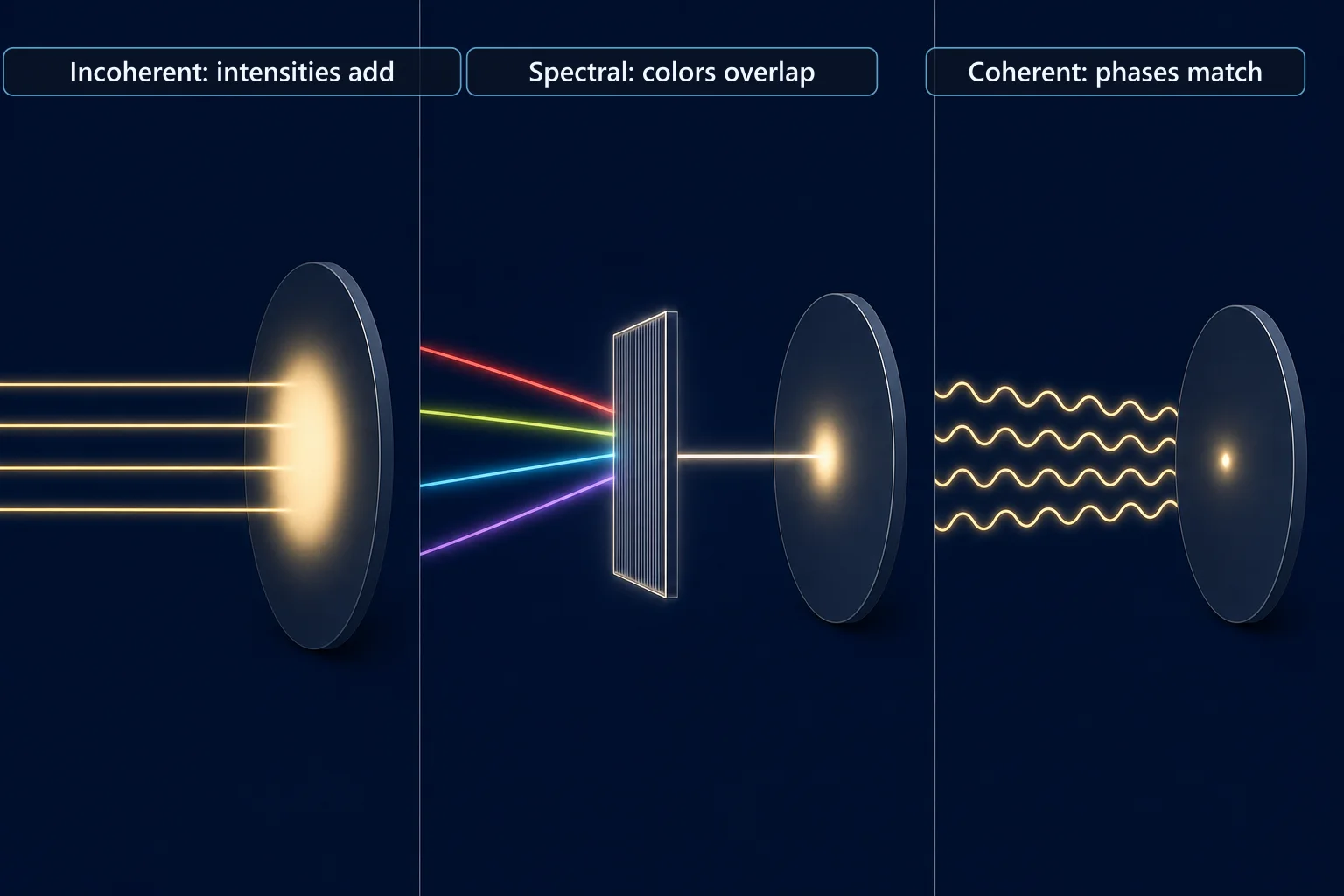
The two methods covered in the overview article and the earlier articles of this series each had something to match. Coherent beam combining (CBC) matches the rhythm of the light so that the beams interfere with each other. That rhythm is the phase. Spectral beam combining (SBC) controls the color of each beam, its wavelength.
What happens if you match neither and simply overlap the beams? This article looks at what that third path leaves out, and what it pays instead.
Overlapping without matching
Incoherent beam combining gathers power by overlapping the beams from separate lasers at one distant point. A 2013 article from the U.S. Naval Research Laboratory (NRL) explains that a beam director does this job. The beam director is made of several independently controlled steering mirrors, and each mirror aims one beam. Adaptive optics can be added as an option.
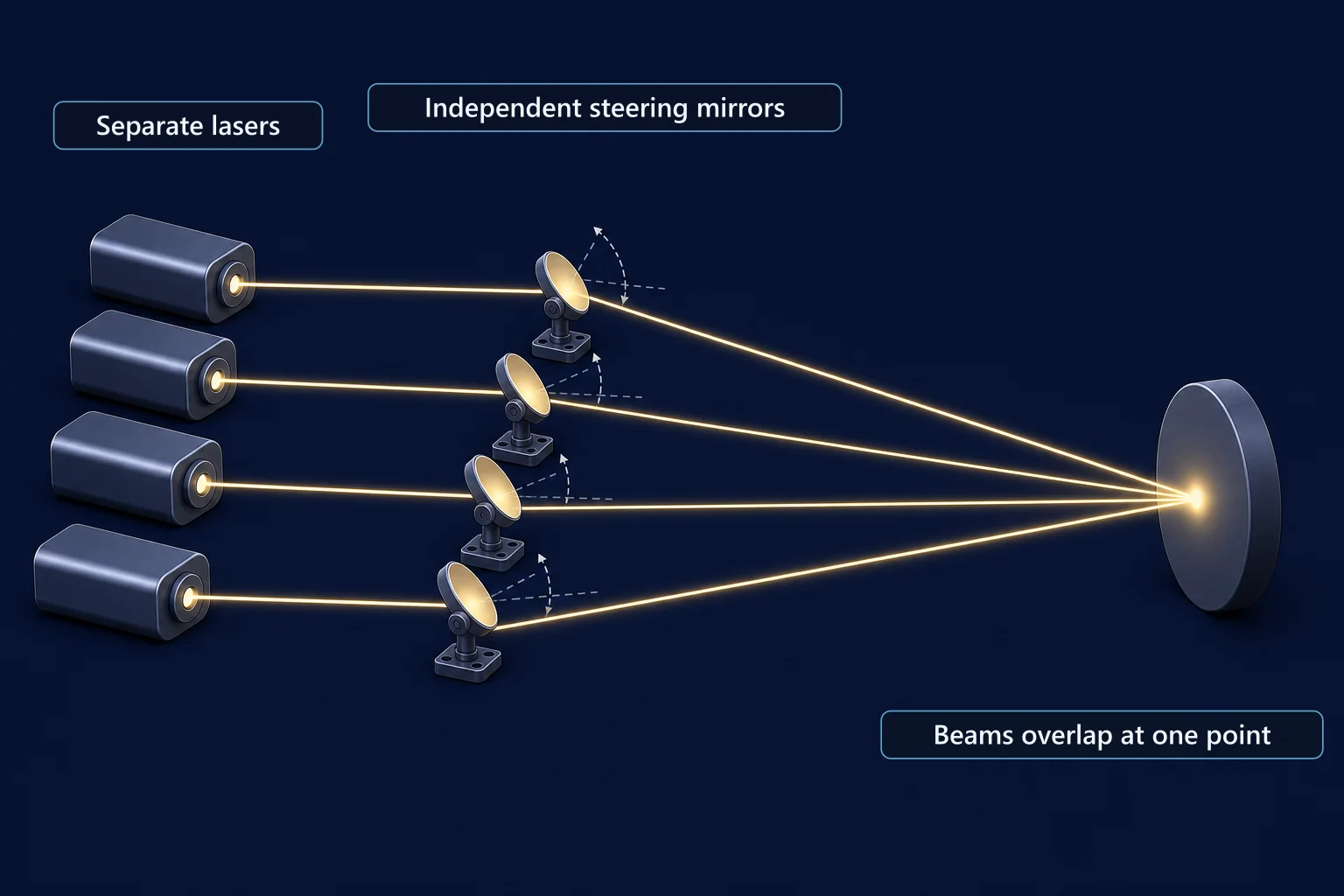
Why does each beam need its own aim? Even if the beams start out parallel, a tiny difference in angle pulls their spots far apart over a few kilometers. In air, beams also wander a little. The steering mirrors adjust the angle of each beam slightly so that every spot lands on the same place far away.
Light overlapped this way does not interfere, so at the spot the intensities add, not the fields. Why beam combining is sorted by coherence, and when intensities add, is explained in detail in the overview article.
What you do not have to match
An NRL researcher said that incoherent combining requires neither phase locking nor polarization locking of the individual lasers. He added that it can be readily scaled up to a compact and reliable system.
The weight of that claim shows next to the other two methods. Coherent combining must control the phase of each beam, and spectral combining must control the wavelength of each beam. Incoherent combining keeps only the one task all three share: pointing control, which sets the direction of each beam.
Why combine many lasers at all? The 2013 NRL article noted that one single-mode fiber laser can produce about 10 kW of continuous power. Reaching higher power takes many fiber lasers combined. Lasers built on single-mode fiber are, in the laboratory's view, a good fit for incoherent combining and long-range use.
The price: brightness
When you leave something out, you usually give something up. What incoherent combining gives up is brightness.
Brightness looks at power together with the size of the window the light comes out of and the angle it spreads into. It tells how much power leaves through how narrow a window, at how narrow an angle. If light is focused at the same angle, brightness, not power, sets the intensity at the focus. A beam with high power still does not reach a high intensity at one spot if it is wide or spreads a lot.
Working from that definition gives the following picture. Set many beams side by side and overlap them, and the power grows with the number of lasers. But each beam still spreads at its own angle, and the beams together take up a wider aperture. So brightness does not rise as fast as power.
The spot gets brighter, like the wall with four flashlights, but it does not get smaller than the spot of each single beam.
The other two methods part ways here. Wavelength beam combining can raise brightness along with power, and both grow in proportion to the number of elements combined.
Tile N subapertures like a microwave radar and match their phases, and the beam narrows in the far field while the on-axis intensity grows as N². Both cases appear in a 2014 article in the journal of MIT Lincoln Laboratory. The point that diode laser arrays set side by side without beam combining fall short of the brightness needed is covered in the overview article.
What changes over distance: the air
Is coherent combining then always better? Inside a laboratory it can look that way. When light has to cross several kilometers of air, the story can change.
A 2016 paper in Applied Optics by authors from the NRL side makes two points. First, fiber and slab lasers running at high power have wide linewidths, so their phase and intensity jump randomly on time scales shorter than a nanosecond. Combining them coherently would need equipment that controls phase precisely and very fast, and the authors said that, to their knowledge, such technology does not exist yet.
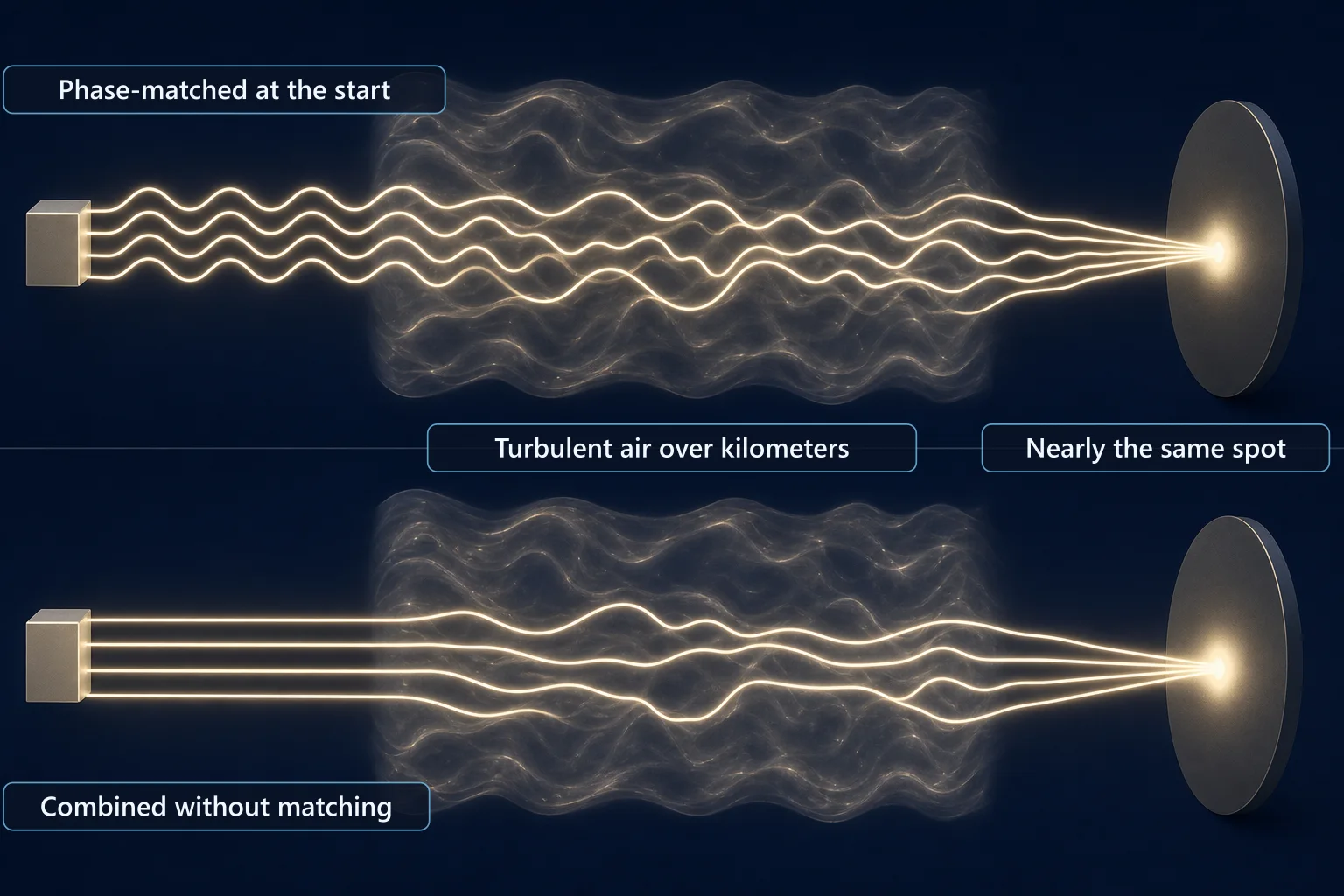
The second point is atmospheric turbulence. Shimmering air scrambles the coherence of a beam before it reaches the far end.
In the authors' simulations, with moderate turbulence over several kilometers, coherent combining had little advantage over incoherent combining. With strong turbulence, the intensity profiles of the two were nearly indistinguishable. The paper concludes that matching phases at the transmitter does little under ordinary air conditions.
Not everyone shares this view. One maker of high-energy laser components names spectral and coherent combining as the main approaches in high-energy laser systems, and says coherent combining can compensate for atmospheric fluctuations. Which approach works better may depend on distance, air and system, and public material alone cannot settle it.
Public tests
NRL tested incoherent combining in real air. According to the laboratory, the architecture was first proposed in 2005. Validation tests began as early as 2008 at the Starfire Optical Range at Kirtland Air Force Base, New Mexico. The tests showed the concept at long range, quantified thermal blooming, and characterized beam wander and spread more precisely.
An abstract that an NRL researcher gave at a University of Maryland seminar in the 2008–2009 academic year lists the numbers up to that time.
| Test | What was made public |
|---|---|
| First propagation experiment (end of 2007, Dahlgren, Virginia) | Incoherently combined fiber lasers sent over 1.2 km. Propagation efficiency above 90% at 3 kW of continuous power |
| Starfire Optical Range | 4.6 kW sent over 3.2 km. Propagation efficiency above 80% |
| Equipment at the time of the talk | 4 fiber lasers, 6.2 kW of combined continuous power |
A key component of the program was a beam director for multiple fiber lasers, able to handle high average power. Dropping the matching work moves the heavy load onto the mirrors that aim each beam and the hardware that holds them.
The uses the laboratory names are shipboard missile defense, small craft defense and power beaming to unmanned aerial vehicles. In the 2013 NRL article, the approach appears as having proven effective in Laser Weapon System (LaWS) prototypes temporarily deployed on select Navy ships.
Incoherent combining inside fiber
Incoherent combining does not only happen with mirrors in open air. Another way bundles the fibers of many lasers and gathers their light into one fiber. FiberBridge Photonics, a maker of high-energy laser components, lists incoherent combining next to coherent and spectral combining in its beam combiner products. A figure note on the company's page describes industrial lasers as "beam combining with fiber bundles."
The same problem follows here. According to a technology licensing page at MIT, combining light from different lasers incoherently while keeping high brightness is hard with conventional fiber bundling. The same page describes the fiber that receives the bundled light as a multimode output fiber.
The definition of brightness explains why this is hard. The light of one fiber comes out of a very thin core. Bundle many fibers and the power grows with the number of strands, but the area the light comes from also grows to cover many cores plus the cladding between them. To take in all that light, the output fiber needs a thick core, and light from a thick multimode fiber spreads more than a single-mode beam from one strand.
The window gets wider and the angle does not shrink, so brightness does not rise as fast as power. However tightly the fibers are packed, the cladding between strands remains. That is why incoherent combining pays the same price whether it uses mirrors in open air or a fiber bundle. The combiner itself, as a part, is covered in "Pump and Signal Combiners and Endcaps."
The three methods in one table
| Item | Incoherent combining | Spectral beam combining (SBC) | Coherent beam combining (CBC) |
|---|---|---|---|
| What is matched | Direction of each beam (pointing) | Direction and wavelength | Direction and phase |
| What overlaps the beams | Independently moving steering mirrors, or a fiber bundle | A dispersive element, for example a grating | A combining element, or side-by-side beams that interfere far away |
| What adds up | Intensity | Power of beams with different wavelengths | Fields (interference) |
| Brightness | Does not rise as fast as power (explanation) | Rises with power, in proportion to the number of elements | With a tiled array, far-field on-axis intensity grows as N² |
| Burden named in the sources | Beam director and mirrors, keeping brightness when bundling fibers | Managing linewidth and wavelength | Fast, precise phase control, and an advantage that shrinks in turbulence (simulations by one group) |
What to read next
Earlier in the series
- Why beam combining is needed, and its three approaches: starts from when intensities add and when fields add.
- Walking Through a Coherent Beam Combining System: follows the hardware in the right column of this article's table, in order.
- Spectral Beam Combining in Detail: follows the middle column of the table step by step.
Coming next
- "Diffraction Gratings: The Part That Merges Colors": looks at what the part at the heart of spectral combining has to endure under strong light.
- "Pump and Signal Combiners and Endcaps": looks at the combiner that gathers light through a fiber bundle, as a part.