A ship packed with vehicles reaches a beach and opens its huge bow doors. There is no pier and no crane, yet the vehicles drive straight off through the doors. A ship was built to do exactly this in World War II, and today's amphibious ships carry on the same job in several ways.
Ships normally load and unload in a port. So how do you move large numbers of people and vehicles to a shore with no pier and no crane? Drawing on public U.S. government sources, this article starts with the World War II ship that drove onto beaches. It then moves to today's ships that let water inside, and ends with a smaller ship heading back to the beach.
To a shore with no port
The main job of a U.S. Navy amphibious ship is to take Marines, along with their gear, vehicles, and supplies, to faraway areas and put them to work ashore. The Navy operates the ships, and the crews are Navy sailors. The Marines are carried along as embarked troops.
Two things make these ships useful. One is large storage space. The other is the ability to move people and equipment from ship to shore by helicopter and landing craft, with no need for port facilities. The Congressional Research Service (CRS) says these two features could make amphibious ships handy for many kinds of missions, in war and outside it.
They are not only for landings against an opposing force. They are also used where no opposing force exists, and their listed uses include humanitarian assistance and disaster response, evacuating civilians, and maritime security work such as anti-piracy operations. Reaching a shore without a port is just as useful when the job is not combat.
A ship that drives onto the beach: the World War II LST
The Landing Ship, Tank (LST) was designed from the start to land vehicles on a beach. British and American planners worked out its design together at a meeting in November 1941, and the United States built the ships for both countries. When the war ended, 1,051 LSTs had been completed.
When an LST reached a beach, its massive bow doors opened. Vehicles drove straight off, and a 2008 U.S. Army article says they came off "ready for combat." With the LST, landing forces could skip strongly guarded harbors and come ashore at any beach that suited them.
The ship was 328 feet long. Armored vehicles rode on the tank deck below, and unarmored vehicles on the main deck above. It could carry 2,100 tons of cargo and about 200 soldiers. That 2,100 tons is the weight of the load, which is a different number from displacement, the weight of water the whole ship pushes aside.
A garage that floods: the well deck
Today's large amphibious ships, in many cases, carry landing craft inside and send them out. The space they use for this is the well deck.
Picture a big garage built into the back end of the ship. That is the well deck. Water can be let into it, and that is what allows landing craft to float out and come back. A large stern gate, a bit like a garage door, closes off the entrance.
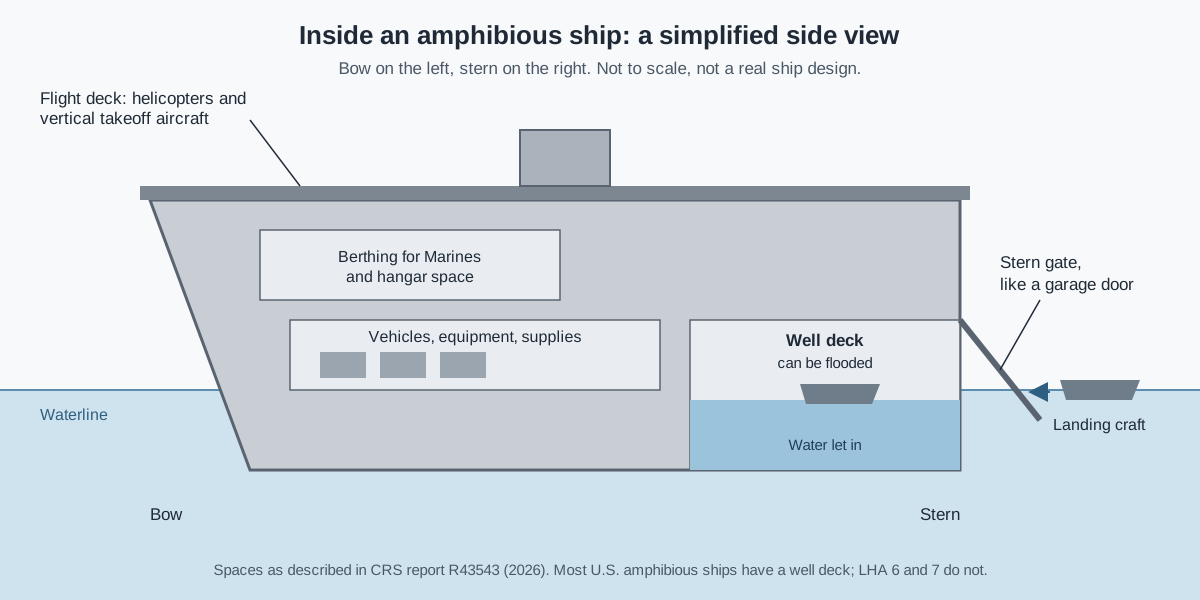
The garage picture is easy to imagine, but the purpose is different. A home garage keeps a car parked on a dry floor. A well deck lets water in so that landing craft can be sent out and taken back in.
An amphibious ship has many other spaces too. There is berthing for Marines and storage for wheeled vehicles, equipment, and supplies. Helicopters and fixed-wing aircraft that use vertical take-off and landing (VTOL) get a flight deck and a hangar deck. Landing craft reach the shore by sea, and helicopters reach it by air.
Reading amphibious ship types from their letters
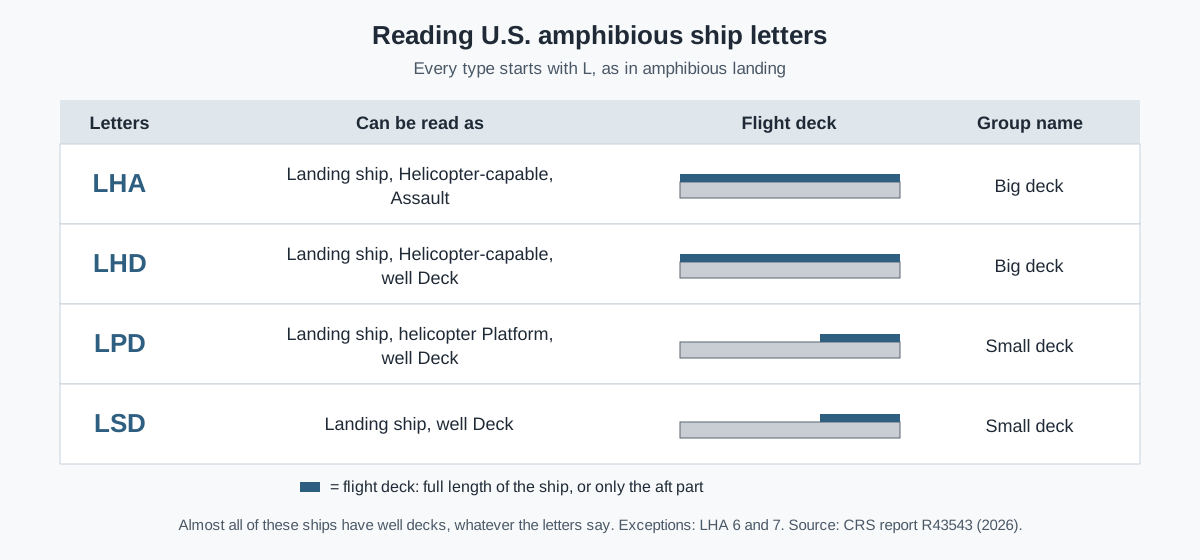
Every U.S. Navy amphibious ship designation starts with L, as in amphibious landing. The letters after it describe the ship.
LHA can be read as landing ship, helicopter-capable, assault, and LHD as landing ship, helicopter-capable, well deck. LPD is landing ship, helicopter platform, well deck, and LSD is landing ship, well deck. The letters follow the pattern of the ship type symbol.
The letters can mislead, though. Almost all of these ships have a well deck, whether the designation says so or not. The exceptions are LHA 6 and 7, which have expanded aviation support instead of a well deck.
Flight deck length gives another way to group them. LHAs and LHDs have flight decks running the full length of the ship, so they are called "big-deck" amphibious assault ships, and from the outside they resemble mid-size aircraft carriers. LPDs and LSDs have flight decks only at the aft end, so they are sometimes called "small-deck" amphibious ships.
How big amphibious ships are
By the figures in a December 2024 CRS report, an LHA/LHD-type ship measures 844–855 feet and displaces 40,000–45,000 tons at full load. An LPD-17 class ship measures 684 feet and displaces 24,900 tons at full load. Next to the World War II LST, an LPD-17 is about twice as long, and an LHA/LHD about two and a half times.
At the start of fiscal year 2026, the Navy had 32 larger amphibious ships. They were 9 of the LHA/LHD types, 13 of the LPD-17 Flight I class, and 10 of the older LSD-41/49 class. Section 8062 of Title 10 of the U.S. Code requires at least 31 operational amphibious ships, including at least 10 LHA/LHD types. A defense authorization act added this rule on December 23, 2022.
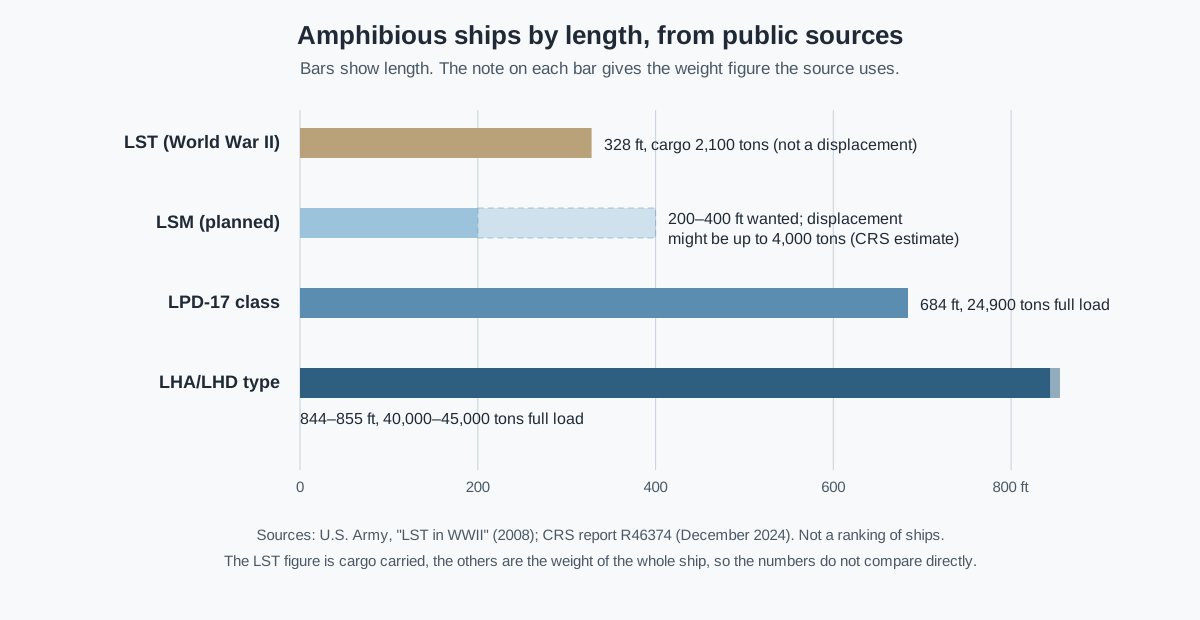
The numbers in the chart are not all the same kind. The LST's 2,100 tons is cargo, while the rest are full load displacements of whole ships. What displacement measures is covered separately in the naval article "Hulls and Displacement: How a Warship's Size Is Described."
Back to the beach: the Medium Landing Ship
A ship going the other way is also planned. Under its Medium Landing Ship (LSM) program, the Navy plans to buy somewhere between 18 and 35 new amphibious ships. They would be much smaller than current amphibious ships and much cheaper to buy and run, one ship at a time.
A December 2024 CRS report lists the features the Navy and Marine Corps are after. The ship would be 200–400 feet long, with a 12-foot draft and a crew of about 70. It would hold 50 Marines plus 648 short tons of equipment. It would have a helicopter landing pad and would serve for 20 years, shorter than the 30–45 years expected of the larger ships.
The beach ability stands out. The ship should be able to run up onto a beach sloping at 1:40 and let vehicles drive on and off, known as roll-on/roll-off. On a 1:40 slope, the beach surface rises 1 foot for each 40 feet the ship travels toward land. The 12-foot draft serves the same goal, letting the ship pass through shallow water near the beaches it serves.
The size is still an estimate. CRS suggests such a ship might displace up to 4,000 tons, about 1/10 to 1/11 of an LHA/LHD and about 1/6 of an LPD-17. The Navy said in December 2025 that the first LSMs would follow the LST-100, a design by the Netherlands-based shipbuilder Damen Naval. It expects building to begin late in 2026 and hopes to receive the first ship by 2029.
The LST in LST-100 stands for Landing Ship Transport, so it shares only the letters with the wartime Landing Ship, Tank. Still, the two share a goal. Both are ships that reach a beach and unload vehicles.
Where this meets lasers: an amphibious ship carried the first fielded laser weapon
One ship comes up again and again in laser weapon stories. It is USS Ponce, which carried LaWS, a 30 kW laser prototype, for the U.S. Navy in 2014. The ship's designation was LPD-15, which makes it an LPD-type amphibious ship of the kind described above. CRS counts LaWS as the first directed-energy weapon the Navy fielded for real operations.
CRS calls Ponce "a converted amphibious ship" and notes that it served in the Persian Gulf as a temporary floating forward base. LaWS was installed on it in August 2014. The story behind that laser prototype continues in A history of laser weapons.
What to read next
- Aircraft carriers: turning a ship into an airport: how a ship that looks like a big-deck amphibious ship uses its flight deck.
- VTOL and STOVL: flying from short runways: how the aircraft that fly from an amphibious ship's flight deck get airborne.
- Laser weapon programs that have been made public: public cases, including LaWS on Ponce.