Tank coverage often names a "120 mm L/55 smoothbore gun." Howitzer articles mention a "155 mm/52" gun. The first number clearly gives the size of the gun. But what is the 44, the 55 or the 52 counting?
The two numbers are two measurements of the same thing. The first is the diameter of the hole inside the gun. The second tells how many times longer than that diameter the hole is. This article explains the two terms, shows how to read the numbers in a gun's name, and looks at why barrels are made longer.
Caliber: the diameter of the bore
The hole inside a barrel that the round travels through is the bore. Caliber first means the diameter of this bore. A 120 mm tank gun has a bore 120 mm across.
The same word has three meanings. A military glossary from the U.S. National Park Service (NPS) lists all three. Caliber is the width of the bore, the width of a projectile, and a unit for stating how long the bore is. The third meaning is the second number in a gun's name.
A bore is not always smooth inside. Spiral grooves that make the round spin are called rifling, and a bore with no grooves is a smoothbore. The story of smoothbore guns on main battle tanks continues in the reading list below.
Length in calibers: measuring length in diameters
Length in calibers counts length in multiples of the diameter instead of in meters. Divide the bore length by the bore diameter, and you get the number of calibers. The NPS glossary uses a gun with a 40-foot bore and a 12-inch diameter. Forty feet is 480 inches, and 480 divided by 12 is 40, so the gun is "40 calibers long."
The "L/44" and "L/55" in tank gun names read the same way. They mean a bore 44 or 55 calibers long. The maker Rheinmetall also describes its L55 as a gun based on the L44 with a longer barrel.
Multiply 120 mm by 44 and you get 5,280 mm; multiply by 55 and you get 6,600 mm. So the names imply bore lengths of about 5.3 m and 6.6 m.
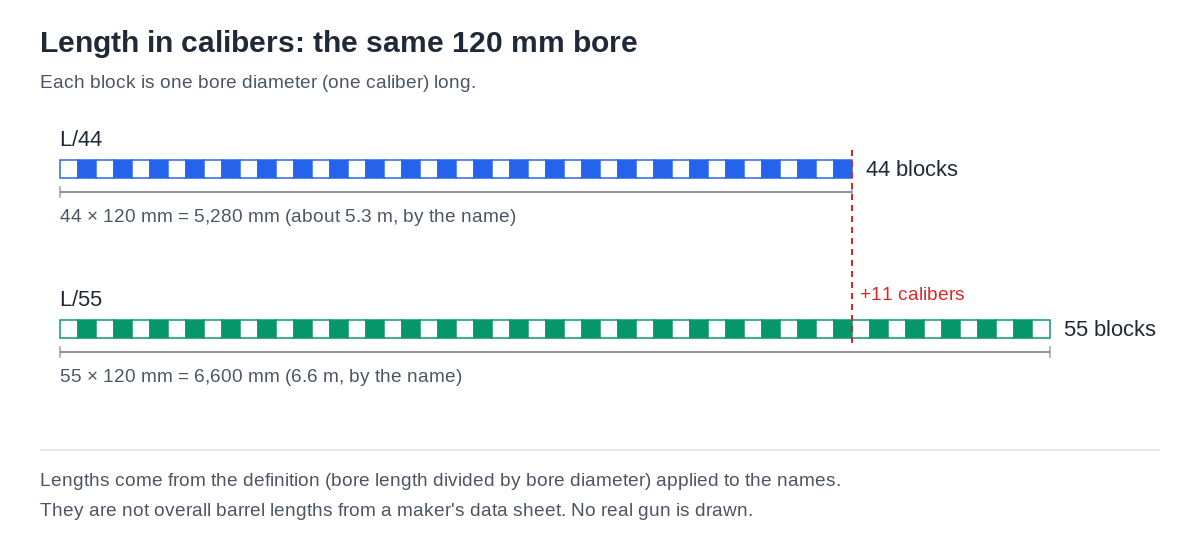
Those two values come from running the definition backward on the name. They are not overall barrel lengths copied from a maker's data. Treat them as the numbers a name carries.
Counting in diameters has an advantage. Guns of different sizes can be compared on one number for how long and slender they are. A 155 mm gun at 52 calibers and a 120 mm gun at 55 calibers differ in meters. Still, the numbers show at once that both bores are more than 50 diameters long.
How to read the numbers in a name
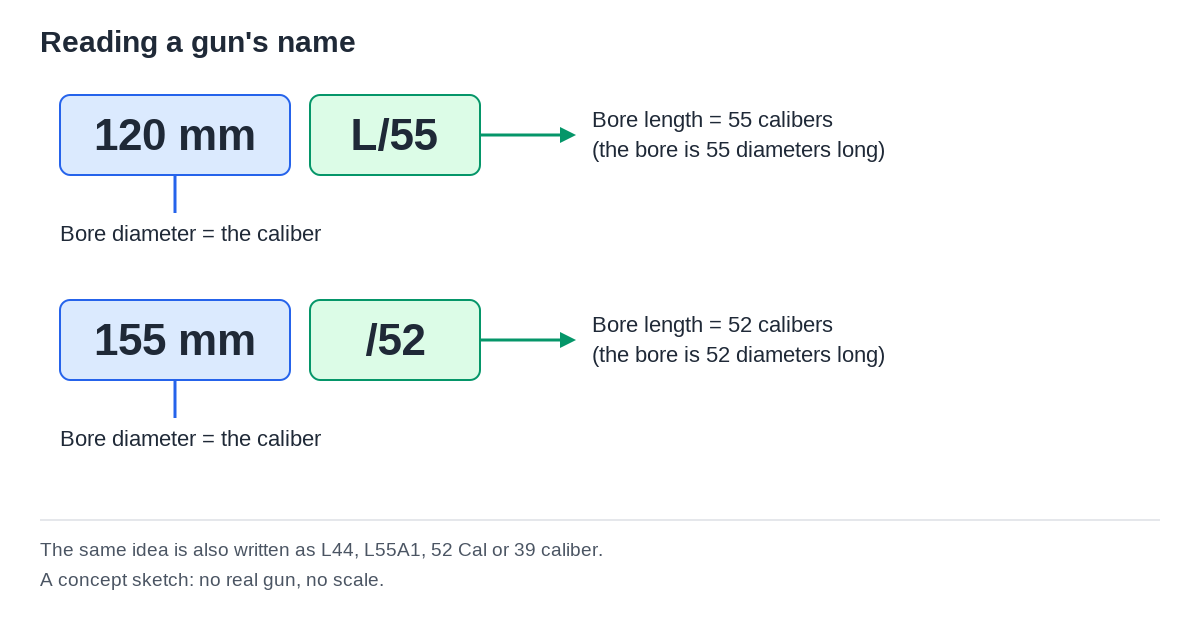
The same idea is written in different ways. The German company Rheinmetall writes its tank guns as "120 mm L44" and "L55," with no slash. The gun on the British Challenger 3 tank appears as the "120mm High Pressure L55A1."
Howitzer names often use a slash or the word "caliber." A 2025 Republic Day release from India's Press Information Bureau (PIB) lists a "155 mm/52 Cal Advanced Towed Artillery Gun System." A U.S. Army article calls the present gun of the M777A2 towed howitzer a "39 caliber cannon," and the barrel tested to extend its range a "55 caliber cannon tube."
| Name | First number (caliber) | Second number (length in calibers) | Used by |
|---|---|---|---|
| 120 mm L44 | Bore diameter 120 mm | Bore length 44 calibers | Rheinmetall |
| 120 mm L55, L55A1 | Bore diameter 120 mm | Bore length 55 calibers | Rheinmetall |
| 155 mm/52 Cal | Bore diameter 155 mm | Bore length 52 calibers | India's PIB |
| 39 caliber, 55 caliber | (not given together in the article) | 39 and 55 calibers | U.S. Army |
As in the last row, some articles write only "39 caliber" with no diameter in front. There, "caliber" is a multiple of length, not a diameter. Since one word carries both meanings, first check whether "mm" sits next to the number.
Why barrels are made longer
What changes when a barrel gets longer? A U.S. Army article on the M777A2 range extension test explains that the longer tube gave both a bigger chamber and a longer stretch of rifling. Combined with one more increment of propellant, that extended the range. As the test lead put it, the longer tube let them push the round "harder for longer, so it goes faster and further."
As the propellant burns, the gas pushes the round from behind while it travels down the bore. A longer bore gives the gas a longer stretch to push before the round leaves the muzzle. Rheinmetall likewise says that in the L55, built on the L44 with a longer barrel, a larger share of the firing energy turns into greater velocity.
The Army article did not credit length alone. That test combined a larger chamber, longer rifling and a stronger propellant charge. The length in calibers by itself cannot give a gun's range or a round's speed.
What comes with length: weight and balance
A longer barrel weighs more and moves the gun's center of gravity forward. A 2016 U.S. Army article quotes the concern that with all the extra barrel, the gun "looks like it may tip over." So a separate barrel was made for mobility tests.
That barrel was an old 52-caliber tube, modified to match the weight. Grooves cut into its outside let engineers hang weights at different points and shift the center of gravity forward or back. That showed the effect on the gun and on how it is operated. Barrel length is not a matter for the barrel alone; it has to fit the carriage and the vehicle as well.
Where it meets lasers: the optical aperture
Optics has its own word for an opening: the aperture. In Korean, one word covers both caliber and aperture. An optical aperture is an opening that light passes through, or the size of that opening. A gun's caliber is the width of the hole the round passes through; an optical aperture is the size of the window the light passes through.
The two do different jobs. In a gun, a larger caliber fires a larger round. In optics, sending a beam out wide through a large aperture shrinks the spread caused by diffraction, so the beam opens up less far away.
That is why the beam director that sends a laser weapon's beam to the target aims for a large aperture. The article on beam director optics explains in detail how a beam that starts wide keeps its width longer.
What to read next
- Tank Guns from Rifled to Smoothbore: why the 120 mm smoothbore became the main tank gun
- Self-propelled howitzers: guns that move themselves: what happens when a 155 mm howitzer goes on a vehicle
- Beam director optics: lenses, mirrors, coatings and a large aperture: why the laser-side aperture needs to be large
- Why a beam spreads: divergence, focus and aperture: the basics that link aperture and beam spread