Imagine throwing twenty darts. A few land near the bullseye, and a few drift out to the edge of the board. If you had to describe that throwing with one number, which number would you pick?
Weapons coverage often uses "a CEP of so many meters" for exactly that job. The full name is circular error probable. This article looks at what the number actually measures, what a single number leaves out, and where laser guidance sits in the story of guided weapons.
The circle that holds half
Circular error probable (CEP) is the radius of a circle. The circle is centered on the aim point and sized so that half of the rounds fired land inside it. That makes CEP a yardstick for the accuracy of one kind of munition. It gives the distance from the aim point that half of the weapons of that type are expected to fall within.
A 2013 U.S. Army article gives an example. Draw a circle with a 50 m radius around a target. A CEP of 50 m means 50% of the rounds should land within that circle.
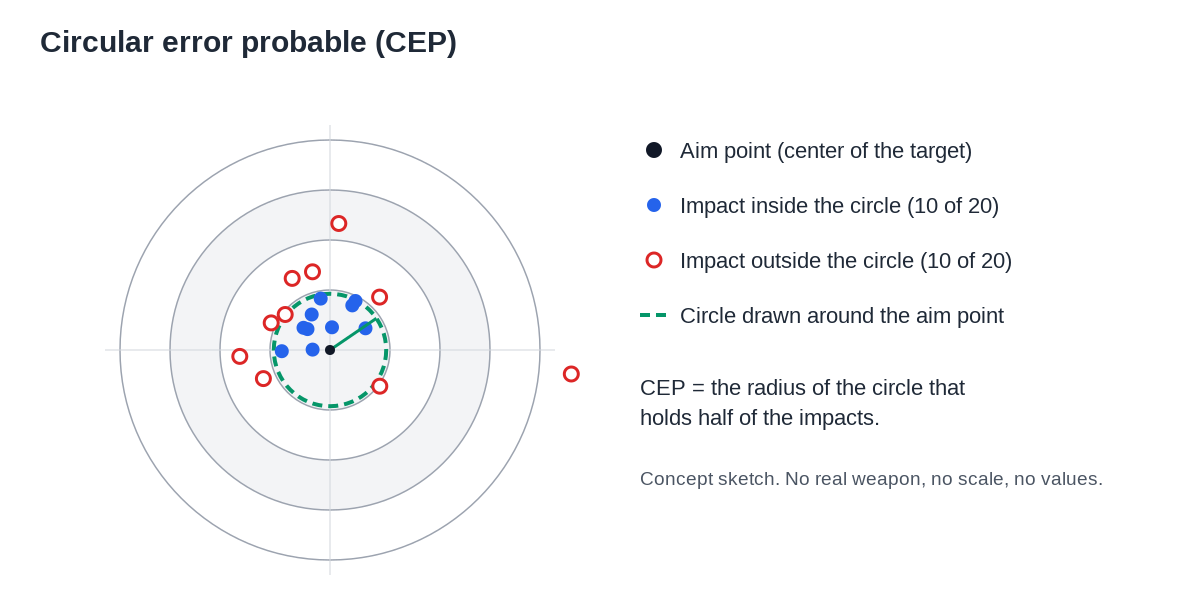
Read the other way, the other half lands outside the circle. A smaller CEP means a smaller circle, so the same half of the rounds gathers closer to the aim point.
Picturing it on a target
Plot the impacts on a target one by one and the idea becomes clear. With twenty points, pick the ten closest to the center and draw the circle that reaches the tenth one. The dashed green circle in the figure above is that circle.
The dartboard is only a picture to help. Wind, weather and distance change with every real round. So a CEP is not a promise about where the next round will land. It is a single number that sums up the scatter of many rounds.
What one number leaves out
A radius is one length. It carries no direction. From the CEP alone, you cannot tell whether the rounds bunched to the left of the aim point or spread evenly all around it.
Measurement science separates these two ideas with different words. The International Bureau of Weights and Measures (BIPM) publishes the International Vocabulary of Metrology (VIM). In it, trueness describes how close the average of repeated measurements is to a reference value. Precision describes how close the repeated measurements are to each other, and it is usually expressed with a measure of scatter such as the standard deviation.
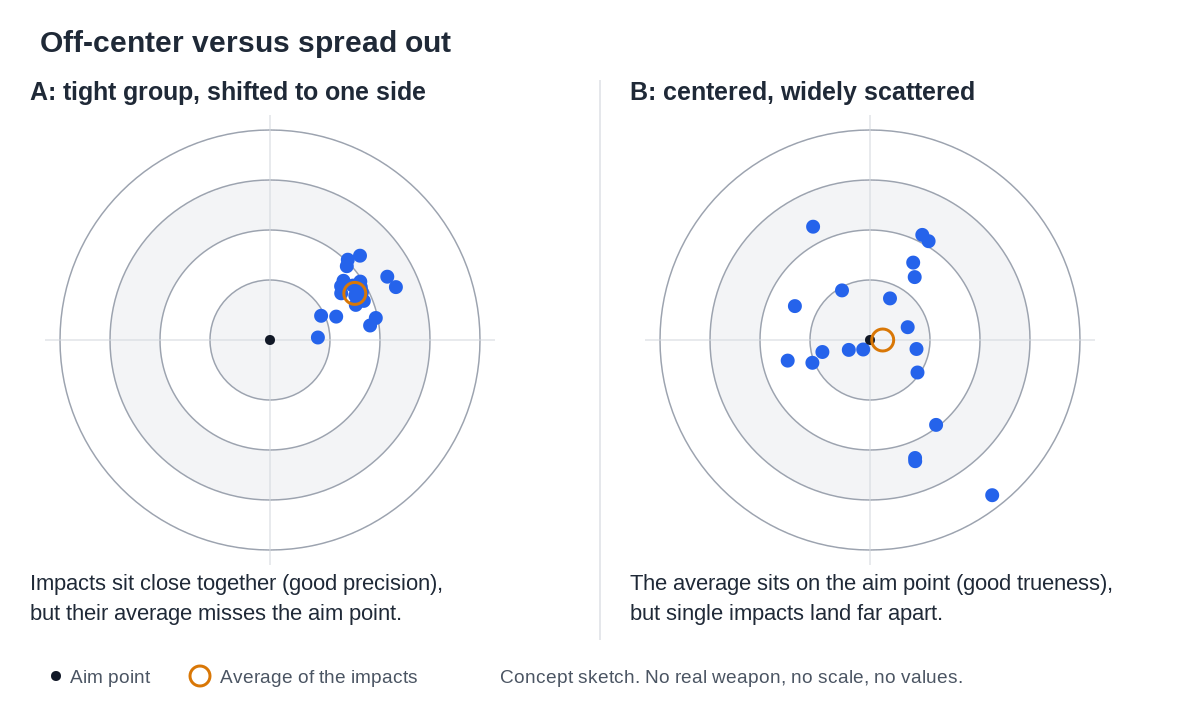
In panel A of the figure, the points sit close together, but their average is pushed to one side. In measurement terms, precision is good and trueness is poor. In panel B, the average lies on the aim point, but single points land far apart. Trueness goes with systematic error, which pushes results to one side, and precision goes with random error, which scatters them.
The word accuracy is kept apart from both. Measurement accuracy means how closely a measured value agrees with the true value, and on its own it is not a quantity given a numerical value. Even so, accuracy is related to both trueness and precision. When people call a CEP "accuracy," it helps to remember that both qualities are mixed into one number.
One more thing lies outside the number: landing close to a target and producing the intended effect on it are different questions. The U.S. General Accounting Office (GAO) reviewed the 1991 Gulf War air campaign. Its report found the data comparing guided and unguided weapons, for both accuracy and effect, thin and often unclear. The two kinds were frequently dropped on one and the same target, and damage assessment fell short, so in most cases nobody could pin down an exact probability of kill.
Precision-guided munitions and CEP
The term precision-guided munition (PGM) often appears next to CEP, and the Pentagon defines it as a guided weapon meant to destroy a point target while keeping collateral damage low. An unguided round simply follows its path. A guided one can adjust its flight to make up for aiming errors, weather and other problems, which raises its chance of a hit. Typical parts for this are inertial measurement units (IMU), GPS receivers, and seekers that home on laser light or on millimeter-wave radar.
The defense primer from the Congressional Research Service (CRS) explains how the word "precision" has shifted. As guidance technology spread, the word stopped pointing mainly to one guidance method, one type of munition or one accuracy figure. It came to mean guided munitions in general, along with how good the intelligence, the planning and the decisions behind their use are. Read that way, a small CEP alone does not capture everything "precision" means.
Where this meets lasers: what laser guidance changed
The Pentagon kept developing precision-guided munitions through the 1950s and 1960s. In the 1960s, laser guidance, semiconductors and other advances in missile technology let munitions hit targets more accurately. In the terms of this article, that can be read as a smaller CEP circle for the same weapon fired many times. Precision-guided munitions came to prominence in the Vietnam War, when the laser-guided bomb arrived.
A laser-guided bomb uses semi-active laser guidance: someone lights the target with a laser, and the bomb's seeker follows the light scattered back from that spot. The device that lights the spot is a laser designator.
How real bombing changed around the Vietnam War is covered in The Thanh Hoa Bridge, 1972: How Laser-Guided Bombs Changed Bombing. The principle of following a laser spot is explained in detail in Laser-Guided Bombs: Following a Reflected Laser Spot.
Laser-guided bombs also stood out in the 1991 Gulf War. According to CRS, precision-guided munitions were only 6% of all munitions used in that campaign. Even so, they hit several key targets, reduced how many combat sorties were needed and kept damage to civilian buildings down.
What to read next
- Laser-Guided Bombs: Following a Reflected Laser Spot: how the laser guidance that raised accuracy works
- GPS-Guided Munitions: How a Tail Kit Changed the Bomb: reducing error with satellite positions instead of a laser
- Laser Designators: Pointing Out a Target with Light: the side that makes the spot the bomb follows
- Light through air: absorption, scattering, turbulence, thermal blooming: how light weakens and spreads as it passes through air