The two terms show up in the news almost as a pair: ballistic missile and cruise missile. Both are guided weapons headed for distant targets, yet they fly in very different ways. One climbs high into the sky and falls back. The other flies low, like an aircraft.
The difference starts with the engine and carries through to navigation and defense. The starting point is how each term is defined.
Two definitions
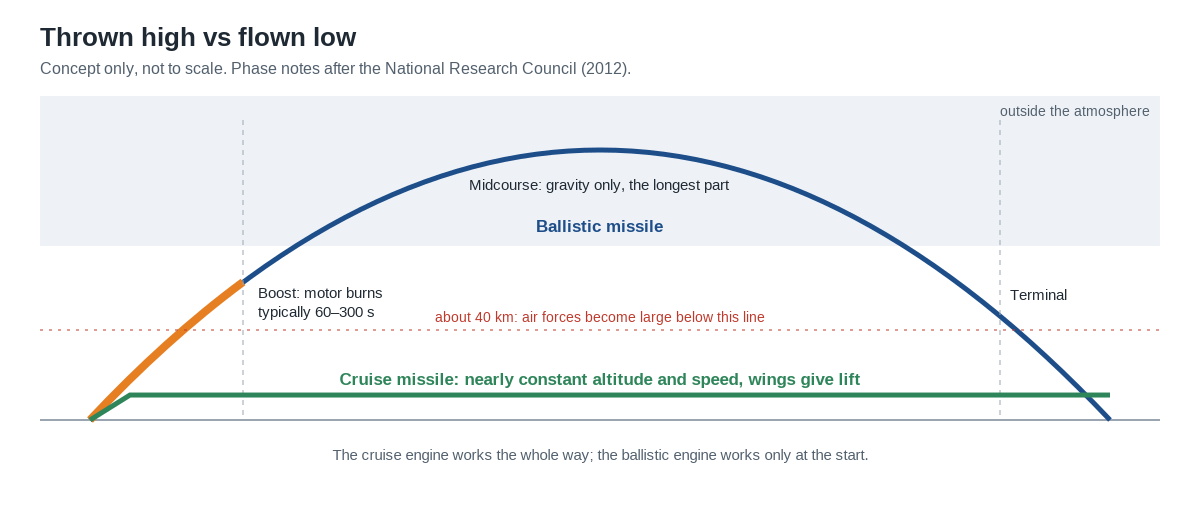
A 2005 Congressional Research Service (CRS) missile survey quotes the definitions of the U.S. Defense Threat Reduction Agency. A ballistic missile is steered while its motor is firing and left unsteered afterward, coasting under gravity and air resistance alone. A cruise missile is a long-range, low-flying guided missile that can be launched from the air, the sea or the land.
A 1979 NASA contractor report gave a more specific picture of the cruise missile. It spends most of its flight at nearly constant altitude and nearly constant speed, with lift from its wings holding up its weight. Highly maneuverable short-range tactical missiles fall outside that definition.
The path: thrown high or flown level
A ballistic missile's flight falls into three parts. The way a National Research Council (NRC) report divides intercepts also divides the flight. There is the boost phase while the motor burns, the midcourse phase after burnout when only Earth's gravity acts, and the terminal phase as it comes back into the atmosphere.
According to the NRC, powered flight in the boost phase typically lasts 60–300 seconds, depending on range and propellant. For missiles that leave the atmosphere, midcourse is the longest part of the flight, and aerodynamic forces on the reentry vehicle become large below about 40 km. The engine works for the first few minutes, and the rest is flown like a thrown ball.
A cruise missile is the reverse. Its engine works the whole way, and its wings hold up its weight. Of the four forces on an aircraft, most of the lift comes from the wings, and the thrust from the propulsion system overcomes drag. When the forces balance, the aircraft cruises at a steady speed.
The engine: a rocket carries oxygen, a jet breathes air
A ballistic missile flies on a rocket. A rocket carries an oxidizer along with its fuel and burns them together in a combustion chamber, so it works where there is no air. Turbines and propellers cannot work in space, where there is no atmosphere. With a midcourse phase above the atmosphere, it is easy to see why a rocket fits.
A cruise missile often uses a jet engine. A jet engine keeps pulling surrounding air into its inlet, and most of its hot exhaust comes from that air. It does not carry an oxidizer, but it works only where there is air.
Some earlier cruise-type missiles were pushed up to cruise speed by solid rocket boosters that later separated. A rocket handles the start, and a jet handles the cruise.
Faster engines exist too. A ramjet gives more speed and performance than the turbojet more often used in cruise missiles, but it is not considered especially fuel efficient.
Finding the way
For a ballistic missile, the definition already says it. It is guided only during powered flight, and after the motor stops, gravity and air resistance set its path. Guidance while the motor burns decides the rest of the flight.
A cruise missile can correct its course throughout the flight. Most modern missiles track their own position with an inertial navigation system. That system is corrected during flight with an outside reference, most often GPS.
How they are sorted
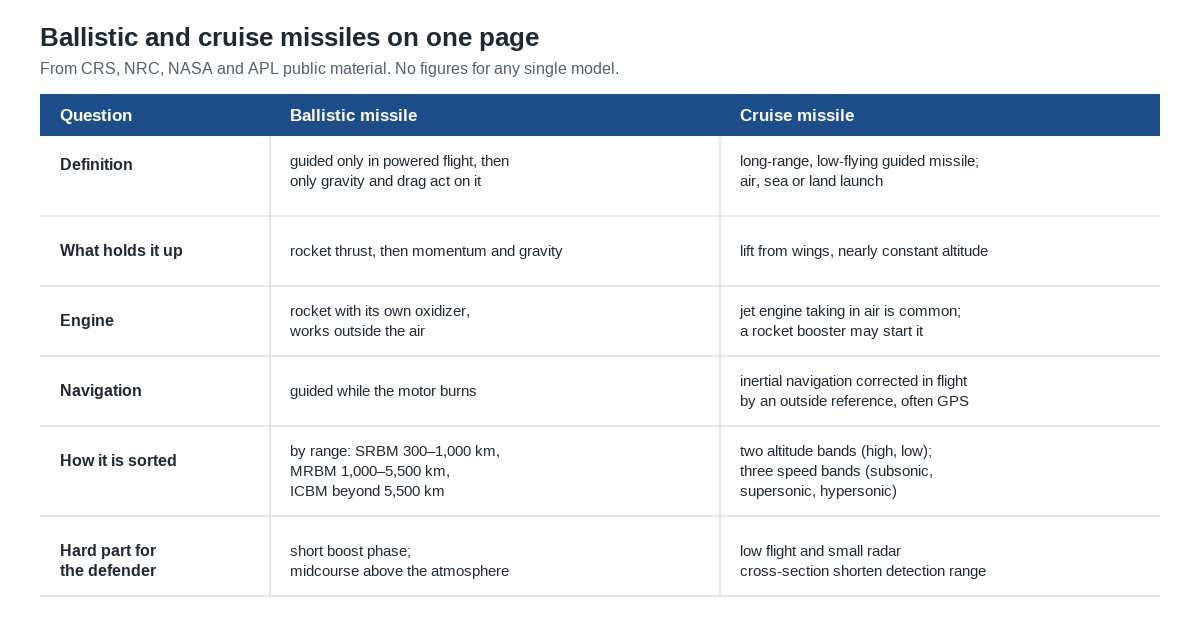
The two missiles are also sorted differently, and ballistic missiles mainly by range. The CRS missile defense primer gives three classes. Short-range ballistic missiles (SRBMs) reach 300–1,000 km. Medium-range ones (MRBMs) reach 1,000–5,500 km, and intercontinental ones (ICBMs) go beyond 5,500 km.
Cruise missiles can be sorted by altitude and speed as well. The 1979 NASA report split cruise altitude into high and low, and speed into subsonic, supersonic and hypersonic. One term covers weapons with quite different characters.
Seen from the defender's side
Ballistic missile defense is divided by flight phase. U.S. hit-to-kill interceptors are each designed to intercept in a particular phase: boost, post-boost, midcourse or terminal. The NRC named the short time of powered flight as the main challenge of boost-phase intercept.
Cruise missiles pose a different problem. A 1993 ship defense article appeared in the journal of the Johns Hopkins Applied Physics Laboratory (APL). It wrote that low-flying cruise missiles with a small radar cross-section shorten the range at which sensors can detect them.
One system can handle both. CRS describes the Army's Patriot as a mobile system built to guard areas against advanced aircraft, cruise missiles and tactical ballistic missiles. From the defender's side, the two are not separate worlds but parts of a wider set of air threats.
In between: hypersonic glide vehicles
Some weapons fit neither column. According to CRS, hypersonic weapons fly at Mach 5 or faster. A hypersonic glide vehicle rides a rocket up and then glides to its target. Unlike a ballistic missile, it leaves the ballistic path and can change course on the way.
The start is handled by a rocket, as with a ballistic missile, but afterward it leaves the ballistic path and glides. Remembering that two terms cannot sort every missile makes the news a little easier to read accurately.
Where this meets lasers
The two missiles also appear differently in laser weapon stories. On the ballistic side, the boost phase was the focus. According to the NRC report, the Secretary of Defense turned the Airborne Laser (ABL) program into a research and development effort. The reason given was the operational and technical difficulty of boost-phase intercept.
On the cruise side, the issue is ship defense. CRS names two key limits for surface ships defending against drones and anti-ship missiles: limited depth of magazine and an unfavorable cost exchange ratio. It sees shipboard solid-state lasers as able to improve both a great deal. The same laser takes on a different job depending on the missile it faces.
Further reading
- Ballistic missiles: why they climb high and come down: the parabola and three phases of flight
- Cruise missiles: how they resemble aircraft: wings, jet engines and terrain matching
- Layered missile defense: why defense comes in layers: stacking phase-by-phase intercepts
- The Speed Ladder: From Walking to Hypersonic Flight and Light: how fast Mach 5 is