Imagine an aircraft on fire and going down. The pilot has only a few seconds, and the air outside is rushing past at very high speed. Is opening a door and jumping enough to survive?
In fast military aircraft it is not, and that is why the ejection seat exists. It throws the whole seat, with the pilot in it, out of the aircraft, then separates person and seat and opens a parachute. This article looks at the steps an ejection seat goes through, how the human body shaped its design, and how it changed in aircraft and spacecraft, using public sources.
Why a parachute alone stopped being enough
Before World War II, people left disabled aircraft at speeds the body could tolerate. A pilot could roll the aircraft on its back, release the safety belt and fall out. A NASA report (CR-2292) sums up what changed: as speeds increased, that technique was no longer feasible, and a parachute alone was no longer enough to survive.
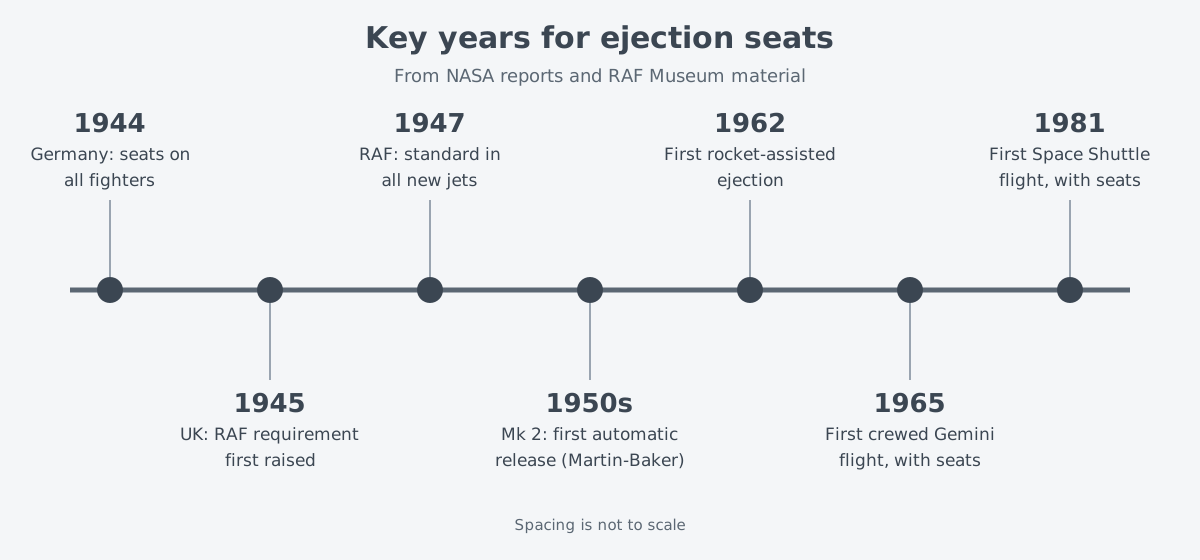
According to the same report, Germany required all fighter aircraft to carry ejection seats in 1944, and about 60 ejections are said to have taken place before the war ended. Britain and the United States followed with development programs, and some standardized hardware existed by 1947.
The British story is mostly the story of one company. The RAF first called for ejection seats in its aircraft in 1945, and from then on the work fell to Martin-Baker. In 1947 the RAF made the company's seats standard in all new jets. The first person to use one of these seats in an emergency was the test pilot Jo Lancaster.
Push out, separate, open
An ejection seat does three main jobs. It pushes the person far from the aircraft, separates person and seat, and opens a parachute. A 1967 NASA technical note (TN D-4031) on the Gemini spacecraft seat shows these steps in detail. That seat held the crew member in place during the mission and served as the escape system in an emergency.
First, a path opens for the seat. On Gemini, a pyrotechnic charge opened a hinged hatch.
Next, gas pressure drives the seat to the end of a tube. This first push comes from a device called a catapult. The same hot gas then lights a rocket motor, which pushes the seat farther away.
Once clear, the person is released. The harness lets go, and a separator forcibly pulls seat and person apart. A falling person tends to tumble. Gemini used a balloon-shaped device called a ballute to steady the crew member and stop the tumbling, and then the parachute opened.
This sequence was not automatic at first. According to the RAF Museum, the Mk 2, which went into several RAF aircraft types during the 1950s, was the earliest Martin-Baker seat to release automatically. After the seat left the aircraft, a small chute called a drogue fired out and deployed the main parachute. It also pulled the person free of the seat, even one who had passed out.
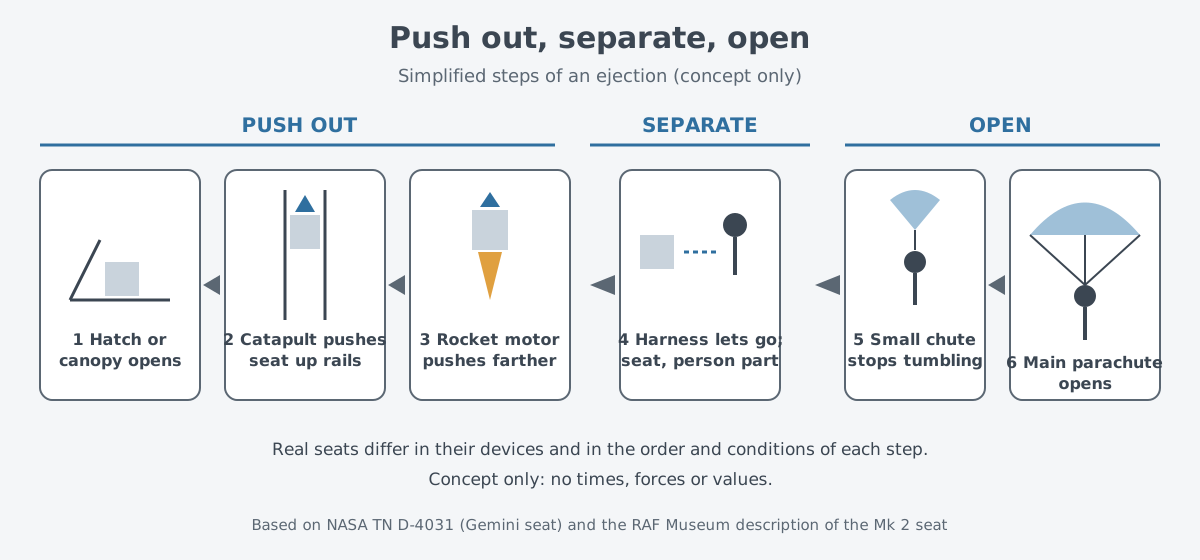
The diagram is a simplified version. Real seats differ in their devices and their order of events, and each type has its own rules for when and under what conditions each step happens.
Limits set by the human body
The harder the seat is pushed, the faster it gets away from the aircraft. Push too hard, though, and the person in it is hurt. Designing an ejection seat means working between those two facts.
So people became test subjects themselves. In the late 1940s, medical officers of the RAF Institute of Aviation Medicine were tested on the ejection tower in studies run together with Martin-Baker. The goal was to find the maximum acceleration and jolt an ejecting person should be exposed to. The institute went on to analyze and advise on the physiological side of the company's seat performance.
The Gemini seat follows the same principle. Its rocket catapult was built to get far enough from the launch pad. Yet it had to stay within accepted limits for acceleration and for the rate of onset, meaning how quickly the acceleration builds up. The design looked not only at how hard the push was but at how suddenly it arrived.
The direction of the push matters too. The Gemini report says the seat back was designed so that the person's center of gravity sat as close as possible to the line along which the catapult force acts. A push that misses the center of gravity starts the body turning.
Push a book on a desk at a corner instead of the middle, and it spins. A person is not a book, though: arms and legs move and postures differ, so real seats also use restraints to hold the body.
Adding a rocket: escape even near the ground
Early seats such as the Mk 2 were powered by cartridges. Report CR-2292 notes that the early M-1 personnel catapult is fairly simple compared with the rocket catapults of later high-speed fighters. As aircraft got faster, the hardware grew more sophisticated.
Speed was not the only reason for adding a rocket. Seats also had to work at very low forward speeds, even in a hover. That led James Martin to add a rocket to the ejection seat. The first rocket-assisted ejection was made in March 1962 from the rear seat of a modified Meteor T7.
Later came seats that could escape at "zero speed, zero altitude." A 1984 NASA flight-test report covers the Rotor Systems Research Aircraft (RSRA). Its Martin-Baker seat could get the crew out in an emergency anywhere from zero altitude and zero speed up through the whole design speed range. Zero altitude and zero speed describe an aircraft sitting still on the ground.
This ability is now written into requirements. A decision by the U.S. Government Accountability Office (GAO) describes one Air Force aircraft requirement. Seats in both cockpits had to eject successfully at zero airspeed and zero altitude, with the aircraft level. The same requirement asked that the aircraft fit a range of pilot sitting heights.
The Air Force was concerned that a change to the seat installation could cause tumbling or a failure to reach enough altitude in such an ejection. A seat works properly only when it fits both the aircraft and the person.
Other ways out: capsules and crew modules
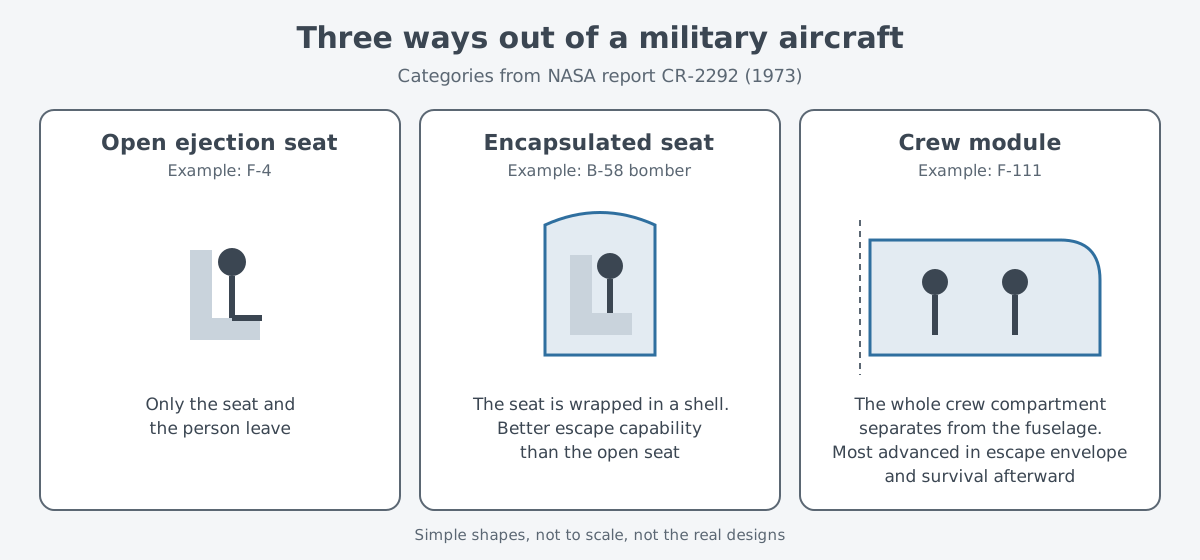
Not every escape system is an open chair. Report CR-2292 divides military aircrew escape into three approaches. In the open ejection seat, only seat and person leave (example: F-4), while the encapsulated seat wraps the seat in a shell (example: the B-58 bomber).
The crew module separates the whole crew compartment from the fuselage (example: F-111). The report judges that the encapsulated seat gives better escape capability than the open seat. It rates the crew module as the most advanced in escape envelope and in survival after escape.
Some crews had no seats at all. Britain's three V-bomber types had ejection seats only for the two pilots. The three rear crew members faced backward, and the Air Ministry of the time doubted that anyone could eject while traveling backward.
Martin-Baker showed in a live test that rearward ejection was possible. Rockets could not be used in that layout, though, because the first seat's rocket exhaust would have burned the two crew members left behind. According to the RAF Museum, rear ejection seats were never fitted.
Ejection seats on spacecraft
Spacecraft faced the same question. Mercury and Apollo used rocket-powered "escape towers" that pulled the whole capsule away in an emergency. The two-person Gemini was different.
The Smithsonian National Air and Space Museum explains that Gemini used ejection seats for escape, and that these seats had to work from zero velocity on the launch pad. Gemini 3 made the first crewed flight of the program on March 23, 1965.
Why did Gemini alone choose seats? The Gemini report says the ejection-seat concept was picked after careful study of three things: weight, how reliably the launch vehicle performed, and how the whole system fit together. That system had to give prime and backup escape over the whole flight.
The Space Shuttle also carried ejection seats at first. Columbia, which made the first flight (STS-1) in April 1981, carried ejection seats during the first four test flights to orbit so that the two pilots could escape an emergency.
Where this meets lasers: start from human limits
At the center of the ejection seat story is not the machine but the human body. Engineers first set the limits of acceleration and jolt a person can take, and then built seats to push as far as possible within them.
Laser safety starts from the same place. The laser safety article covers the maximum permissible exposure (MPE). It is the maximum level of laser radiation people may be exposed to under normal circumstances without adverse effects. Laser products should be engineered so that people are not exposed above it.
The body receives acceleration in one case and light in the other, but in both the human limit is where the design begins.
What to read next
- Carrier catapults and EMALS: on an aircraft carrier, the same word "catapult" means the device that launches the aircraft.
- Solid and liquid rockets: the basic idea behind the rocket motor that gives an ejection seat its second push.
- Laser safety: safety limits that start from what the human eye and skin can take.