A rocket leaves the pad and goes straight up with no wings at all. It can do that because its engines push harder than the rocket weighs. Can a winged aircraft meet the same condition and climb with its nose pointed at the sky?
The answer sits in a single number. Divide the push of the engines by the weight of the aircraft and you get the thrust-to-weight ratio. This article walks through what the ratio measures, why the value 1 matters, and what to watch for when a news story quotes the number.
Four forces on an aircraft
A flying aircraft feels four forces. Lift holds it up, weight pulls it down, thrust pushes it forward, and drag holds it back. The wings make most of the lift that overcomes weight, and a propulsion system such as a jet engine makes the thrust that overcomes drag. When the four forces balance, the aircraft cruises at a steady speed.
Weight and thrust are the two forces this article cares about. Weight depends on the size and materials of the airframe and on the fuel and payload it carries, and it always points down, at the middle of the Earth. Thrust depends on the size and type of the propulsion system and on the throttle setting the pilot picks. It usually points ahead, along the line that runs down the middle of the aircraft.
Thrust divided by weight
The ratio is exactly what its name says: a division.
thrust-to-weight ratio = thrust ÷ weight
Both are forces, so the units cancel and the ratio has no unit. Thrust 12 over weight 10 gives 1.2. Thrust 5 over weight 10 gives 0.5. These are round numbers picked to show the division, not figures for any real aircraft.
NASA Glenn Research Center's beginner's guide to aeronautics calls the ratio an efficiency factor for the propulsion of the whole aircraft. The lift-to-drag ratio speaks for the aerodynamics, and the thrust-to-weight ratio speaks for the propulsion.
In step with acceleration
The ratio is useful because it ties straight to acceleration. Picture an aircraft speeding up in level flight and ignore drag. The only net force pushing it is the thrust, and the thrust-to-weight ratio then equals the aircraft's acceleration divided by the acceleration of gravity (9.8 m/s²).
With a ratio of 0.5, the acceleration in that case is half the acceleration of gravity. Double the ratio and the acceleration doubles too. A real aircraft always has drag, so this is an ideal case that shows what the ratio means.
The gap between thrust and drag has its own name. It is called excess thrust, and the larger it is, the faster the aircraft speeds up.
That is why fighters and experimental high-speed aircraft want a very large excess thrust. They must pick up speed fast and push through the heavy drag that builds at high speed. According to NASA, in most flight conditions a high ratio goes with plenty of excess thrust, and plenty of excess thrust means a fast climb.
Above 1: straight up like a rocket
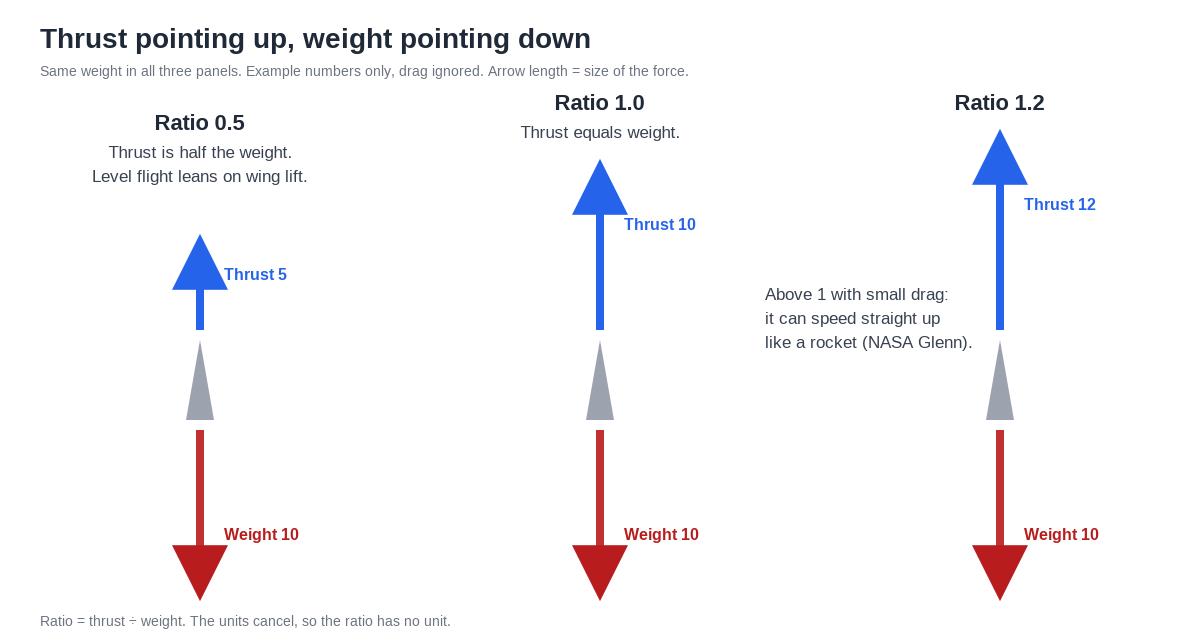
Now picture the aircraft with its nose pointed at the sky. In that attitude the engine thrust points up and the weight points down. The figure keeps the weight at 10 and changes only the thrust.
NASA sums it up briefly. When the ratio tops one and drag stays low, the aircraft can speed up vertically, the way a rocket does. A rocket has to meet the same condition. It must make more thrust than it weighs to leave the pad.
Do not miss that there are two conditions. The ratio has to be above 1, and the drag has to be small as well. The figure leaves drag out.
Does an aircraft with a ratio below 1 fail to fly, then? No. In forward flight, lift from the wings carries the weight, and the engines only have to beat drag. That is the balanced, steady cruise described earlier.
Reading the number with care
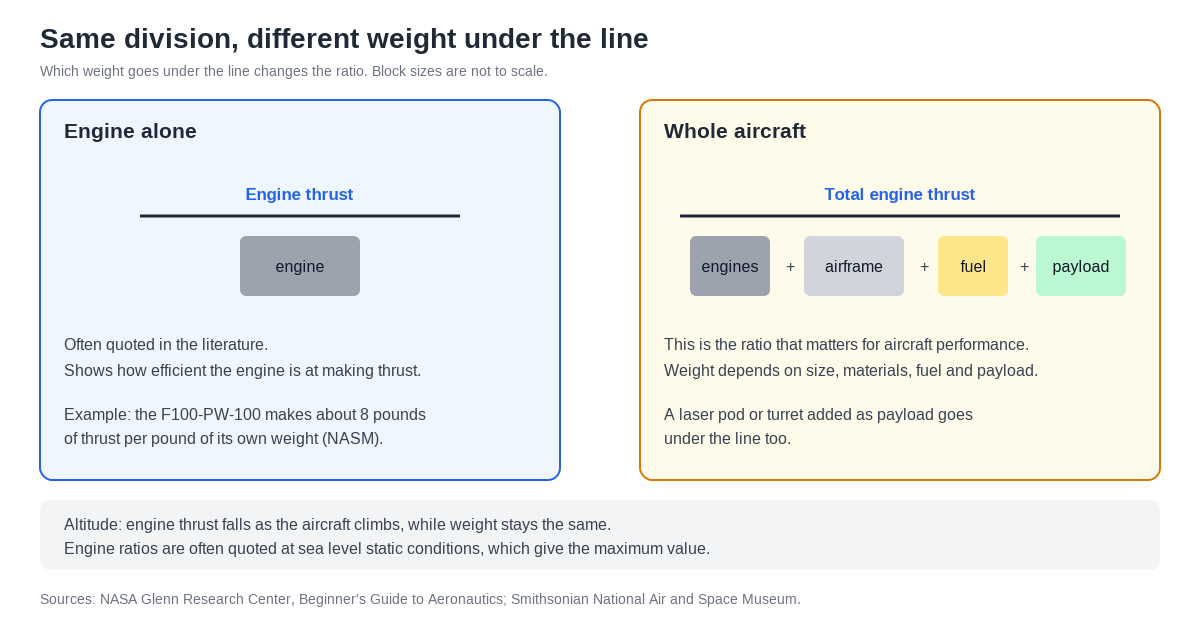
NASA adds a separate warning: be very careful with thrust-to-weight data. The first reason is what sits under the line. Airframes and engines come from different makers, and one engine can go into several airframes, so the literature often quotes the ratio for the engine alone.
That figure shows how efficiently the engine makes thrust. When judging how an aircraft performs, the ratio that matters is the one for the whole aircraft, not the engine alone.
The National Air and Space Museum's page on the F100-PW-100 engine is a good example. The engine went into service on the F-15A and B in 1974. The museum says it makes about 8 pounds of thrust per pound of engine weight. It calls that a key trait for fast military jets that must accelerate quickly and maneuver hard.
The weight under that 8 is the engine's own weight. It does not mean an aircraft with this engine has a ratio of 8.
The second reason is altitude. Engine thrust drops as the aircraft climbs, but the weight stays the same. Engine ratios are often quoted at sea level static conditions: the aircraft stands still at sea level while the engine runs. That gives the largest value the engine can produce.
What sits under the line also changes. Weight depends on the payload and fuel, so the same aircraft divides by a different number depending on what it carries. When a story says an aircraft has "a thrust-to-weight ratio above 1," first ask whether that is the engine or the aircraft. Then ask under what conditions it was measured.
Where lasers come in: added weight goes under the line too
Seen through this division, putting a laser on an aircraft is simple. The laser and the equipment that supports it are payload, and payload counts as weight. If the engines stay the same and only the weight grows, the thrust-to-weight ratio gets smaller.
Weight is a hurdle on the laser weapon side as well. A Congressional Research Service (CRS) report on these weapons lists one issue of technical maturity as meeting the size, weight, and power (SWaP) and cooling needs of today's platforms. It adds that some systems are compact enough for military vehicles, while many need larger or fixed platforms.
On the aircraft side, the U.S. Air Force released a Small Business Innovation Research (SBIR) topic in May 2025. It says the service needs a light weight beam director that can be integrated onto a small airborne platform. A beam director is the optical unit that sends a high-energy laser beam out in a well-focused state. From the aircraft's side, the weight of that unit is one more value added under the line.
What to read next
- Turbofan Engines: How a Fighter Engine Pushes Air: where the thrust on top of the line comes from
- Afterburners: What Burning Fuel a Second Time Changes: a device that draws more thrust out of the same engine
- VTOL and STOVL: flying from short runways: flight in which engine thrust carries the weight directly
- Weight and platforms: fitting on a vehicle, ship or aircraft: weight and power seen from the side of the laser being carried