Push your palm slowly across a pool and the ripples run ahead of your hand. Sweep it through fast and water piles up in front into a sharp crest. Something similar happens to an airplane moving through air. In air, the dividing line is a particular speed: the speed of sound.
Once an airplane passes that speed, the air ahead gets no advance notice that it is coming. A thin surface forms where the pressure and density of the air jump almost at once: a shock wave. The path runs from the speed of sound to the Mach number, shock waves and the sonic boom heard on the ground. It ends with the first supersonic flight in 1947 and the design work that followed.
The speed of sound and the Mach number
Sound is a tiny disturbance passing through the air. Gas molecules move about at random and bump into each other, handing the disturbance along. So how fast sound travels comes down to which gas it is and how warm that gas is.
Earth's atmosphere is mostly nitrogen and oxygen, and its temperature varies with height in a fairly complicated pattern. For a standard atmosphere at sea level, at rest, sound travels at about 761 mph, or about 1,100 ft/s. In metric units it is about 330 m/s. Higher up the temperature is different, so the speed of sound is different too.
An airplane can fly at any speed it likes, whatever the speed of sound. What engineers care about is the ratio of flight speed to the local speed of sound. It is called the Mach number, after Ernst Mach, a physicist of the late 1800s whose work covered how gases flow. Mach 2 means flying twice as fast as the speed of sound at that altitude.
Below roughly 250 mph, a typical figure, air density barely changes. At higher speeds, some of the airplane's energy goes into squeezing the air, and the density changes from place to place. This is called a compressibility effect, and the Mach number sets how large it is.
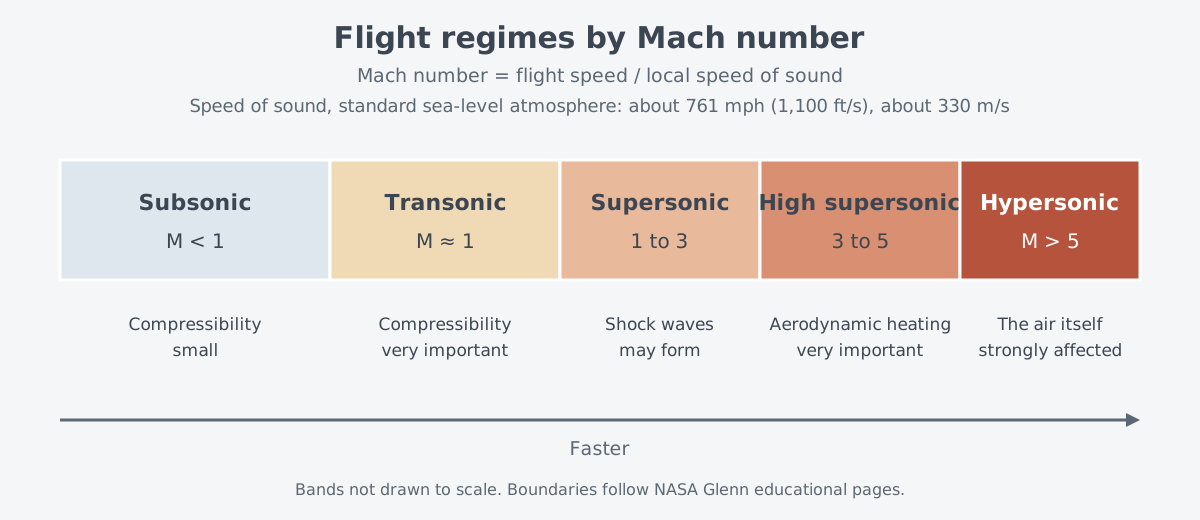
NASA's educational pages split flight into regimes by Mach number. In subsonic flight, far below the speed of sound, compressibility hardly matters and can be set aside. Close to Mach 1, in transonic flight, it starts to matter a great deal.
From Mach 1 to 3, in supersonic flight, an airplane may create shock waves, depending on its form and how fast it goes. Between Mach 3 and 5, designers have to pay close attention to aerodynamic heating. Above Mach 5, in hypersonic flight, so much energy is involved that the air itself is strongly affected.
The Mach number matters in wind tunnel tests as well. The Mach number in the experiment has to closely match the one in real flight. Taking a drag value measured at low speed and using it at Mach 2 gives a completely wrong answer.
Past Mach 1, the air gets no warning
Picture a moving sound source. It keeps sending out round sound waves, and those waves spread at the speed of sound no matter how fast the source moves.
If the source is slower than sound, the waves run ahead of it. In front, the waves crowd together and the gaps shrink. Behind, they spread out. This is the Doppler effect you hear when an ambulance siren changes pitch as it passes.
As the source nears the speed of sound, the gaps between the waves in front shrink almost to zero. The waves stack up in a single line just ahead of the source and form one Mach wave. Past the speed of sound, the source outruns its own waves, and a cone forms around them. The faster the source, the sharper the cone.
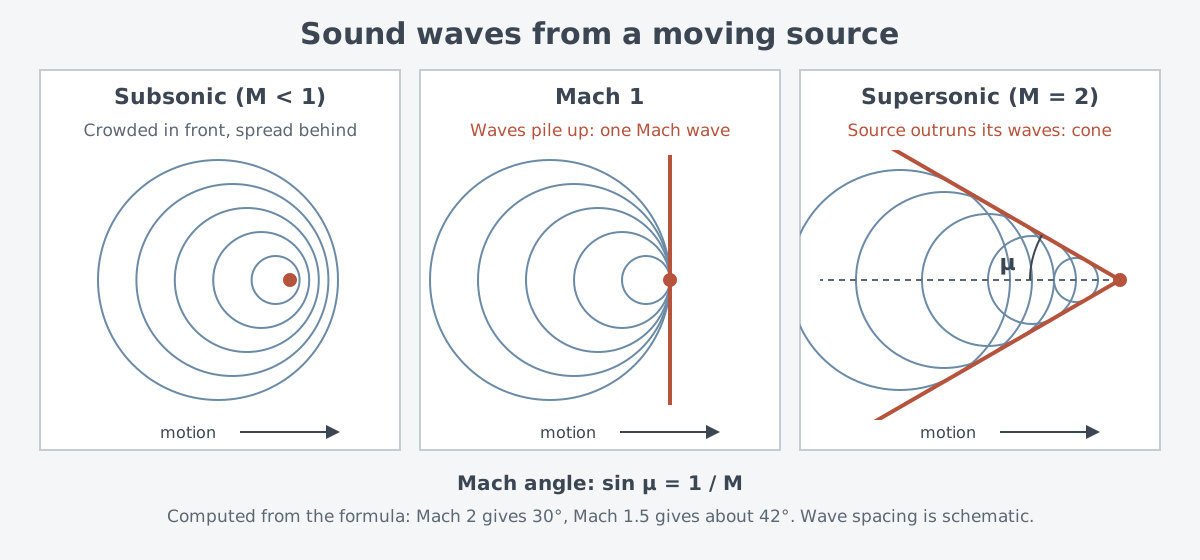
The half-angle of this cone is called the Mach angle. Only the Mach number sets it, and one formula covers it.
\sin \mu = 1 / M
At Mach 2 the sine is 0.5, so the Mach angle is 30°. This cone is the heart of supersonic flow. Small disturbances travel only downstream, inside the cone. Nothing travels upstream, so the air ahead of the airplane gets no signal that the airplane is on its way.
One distinction matters here: this cone is a Mach wave made by small sounds from the source. Around a real airplane, the air bends sharply to follow the airframe, and the shock waves from that flow are not set at the Mach angle. Their tilt is set by the airplane's form and speed. A small sound leaves the air the same after it passes, but air that has crossed a shock wave is changed a great deal.
What a shock wave does to the air
A shock wave appears when something travels above the speed of sound and the space the air must flow through suddenly narrows. A shock wave is a very thin region where the properties of the air change by a large amount. As air crosses it, pressure, temperature and density rise almost at once.
Some things go down instead. Downstream of the shock, the flow slows and its Mach number falls. Total temperature does not change, yet total pressure always ends up lower on the back side than on the front side. A shock is a process that cannot be undone, and that loss is its price.
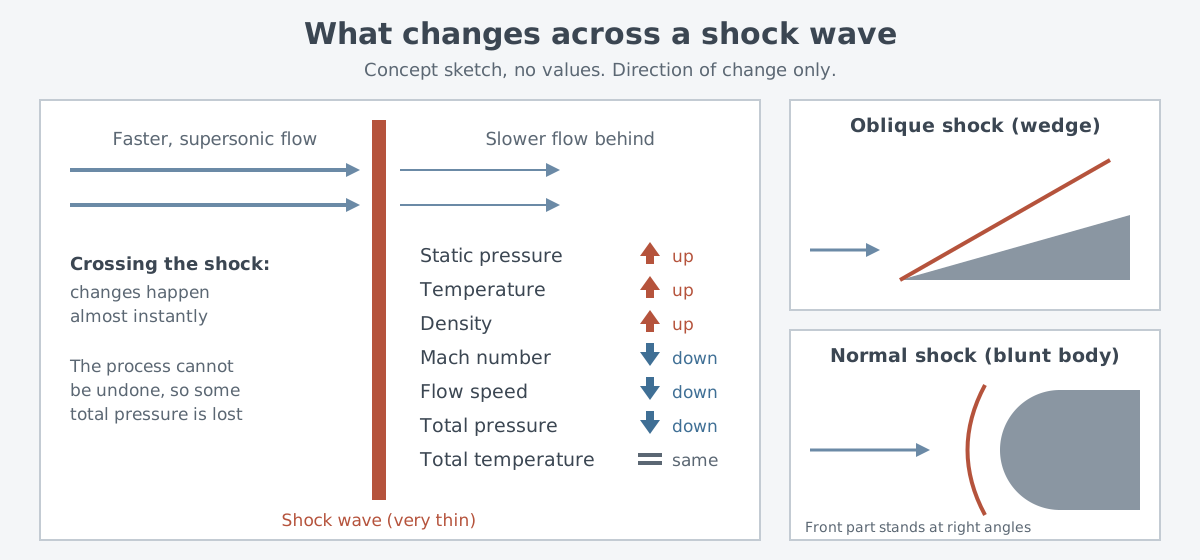
A shock that stands at right angles to the flow is a normal shock. One that leans is an oblique shock. If the flow has to turn too sharply, or the Mach number is too low, a normal shock forms instead of an oblique one. The equations for oblique shocks were set out in a 1951 NACA report, NACA-1135.
On a supersonic airplane, oblique shocks form at the nose and at the leading edges of the wings and tail. They also form at the trailing edges, where the flow returns to its original state.
Shocks are not always a nuisance. The inlet of a fast airplane uses oblique shocks to squeeze the incoming air before it reaches the engine, raising its pressure with no spinning machinery. That idea continues in the article on ramjets and scramjets.
Sonic booms: shock waves heard on the ground
When a supersonic airplane passes overhead, people on the ground hear a noise like thunder, called a sonic boom. Just as a boat pushes out a V-shaped bow wave, air shoved aside by a supersonic airplane forms a shock wave. The real difference is that a bow wave spreads across the water. The shock wave instead forms a cone around the airplane that reaches down to the ground.
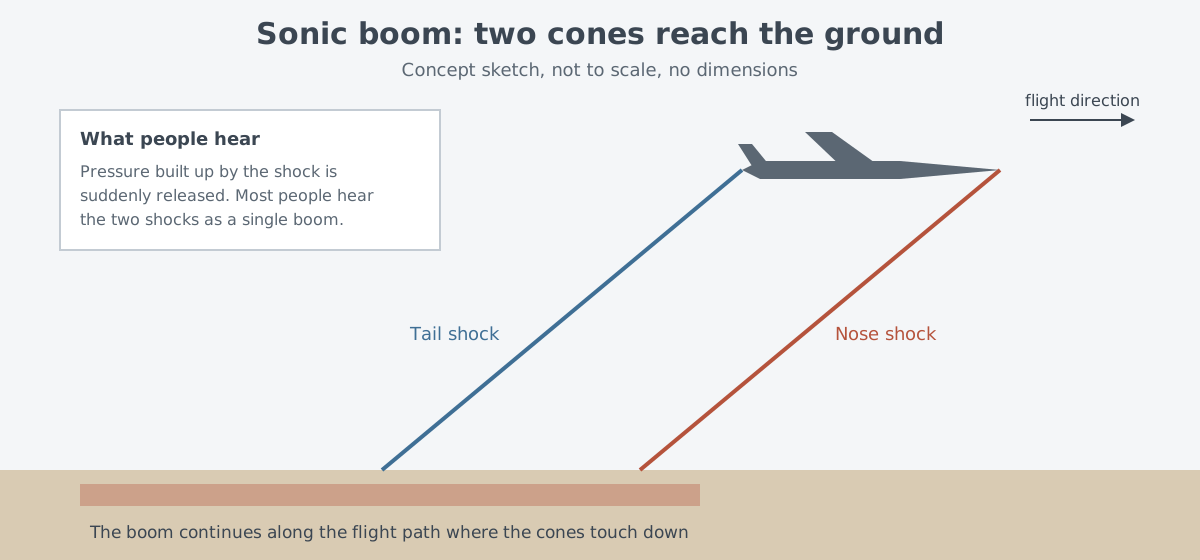
The cone sweeps across the ground along the flight path, so a sonic boom is not a single bang and then silence. It continues along the path across the full width where the cone touches down. The moment when pressure built up by the shock is suddenly released is what the ear hears as a boom.
The pressure change itself is smaller than you might expect. It amounts to just a few pounds of pressure on each square foot, about the same pressure change you feel riding an elevator down two or three floors. What makes it audible is how suddenly it arrives, more than how large it is. Boom strength is measured as overpressure, the pressure added on top of normal atmospheric pressure.
Every aircraft makes two cones, one from its nose and one from its tail. Most people cannot tell them apart and hear a single boom, but with a vehicle as large as the space shuttle two booms are easy to hear. Weight, size and shape, altitude, flight path and weather all affect the strength. Larger and heavier aircraft make stronger shocks, longer and slimmer ones make weaker shocks, and fatter, blunter shapes can make stronger ones.
Sonic booms bother people below and can harm buildings and other property. For that reason, the U.S. federal rule 14 CFR 91.817 bars civil aircraft from flying faster than Mach 1 in the United States without a separate authorization. The rule in force today still contains this ban.
The process of changing that ban has already begun. In July 2026, the Federal Aviation Administration (FAA) published a proposed rule on civil supersonic flight over land. It would repeal the ban and set an interim noise-based certification standard. The comment period closed in August, and the rule has not been finalized.
NASA's goal for its sonic boom research is to find ways to control and reduce shock wave noise so that regulators will allow supersonic flight over land. The X-59 in NASA's Quesst mission is an experimental airplane built to show supersonic flight without loud sonic booms, and it first flew in 2025. NASA plans to ask people how the X-59 sounds to them as it passes above, and to share what it learns with U.S. and international regulators.
Getting past the "sound barrier": the X-1 and the area rule
From the late 1930s, fast airplanes began to see subsonic and supersonic flow over their wings at the same time. Drag went up, the airflow over the wings turned very rough, and the controls lost their bite. Wind tunnels suffered from the same problems, so their data in this range could not be trusted.
That is why some once believed in a "sound barrier" that no airplane could pass. What people called a barrier turned out to be a climb in drag close to Mach 1, caused by compressibility. Because that drag is so high, airplanes still avoid cruising right around Mach 1.
A dedicated research airplane was seen as the only practical way to get the data, and the result was Bell's X-1. Its fuselage copied the outline of a .50 caliber bullet from a machine gun, a shape already known to stay stable at supersonic speeds. A B-29 carried the X-1 aloft and released it from its bomb bay, and the X-1 then climbed to its test altitude under rocket power.
On October 14, 1947, Charles Yeager flew at Mach 1.06, 43,000 ft up. NASA records him as the first person to fly supersonic. The Smithsonian National Air and Space Museum lists the X-1 as the first airplane to fly faster than the speed of sound.
Two hours later, the Air Force classified the flight and all its data as Top Secret. Word leaked only in December 1947, and the Air Force confirmed it officially in March 1948.
Even after flying past the speed of sound proved possible, transonic drag remained a problem. In late 1951, Richard Whitcomb at the NACA's Langley laboratory tested a model with a swept wing and fuselage in a transonic wind tunnel. The shock waves in the schlieren photographs were different from what he expected, and bigger. Losses from those shocks were driving the sharp rise in drag at transonic speeds.
Whitcomb decided to look at the wing and body together rather than one at a time. He saw that the cross-sectional area of the whole airplane had to rise and fall from nose to tail along the smoothest curve possible. This is the area rule.
The cross-section jumps where the wing joins the body, so the simplest fix was to pinch the fuselage in at that spot. Engineers of the time called the result a "Coke bottle" shape. Whitcomb received the 1954 Collier Trophy for this work.
Where this meets lasers: air that bends light
The schlieren photographs that showed Whitcomb his shock waves rely on one property of light. Light bends whenever it passes through a change in the density of a fluid. A shock wave is a thin region of steep changes in pressure, temperature and density, so light passing through it is deflected onto a different path from its neighbors.
In a wind tunnel schlieren setup, the bent light is blocked by a knife edge, and the places where the density changes show up as dark lines in the image. The picture is flat, while real shocks fill three dimensions, so reading it takes practice.
NASA has taken this technique into the sky. Two T-38 jets from the Air Force Test Pilot School in the U.S. flew side by side above the speed of sound, about 30 ft apart. NASA photographed their shock waves running into each other, the first such pictures taken from the air. On the ground, shocks like these usually reach people as a sonic boom.
The same property, air density bending light, causes trouble for laser weapons. In atmospheric turbulence, pockets of air at slightly different temperatures mix, bending light a little differently from place to place and spreading and blurring the beam. That story is told in Light through air: absorption, scattering, turbulence, thermal blooming. In a shock wave photograph this property is a tool; for a laser beam it is a limit to work around.
What to read next
- Ramjets and scramjets: engines without fans: engines that use shock waves to squeeze air.
- Hypersonic glide vehicles: a different flight path: vehicles that fly in the range above Mach 5.
- Afterburners: What Burning Fuel a Second Time Changes: a device that adds the thrust needed to beat drag near the speed of sound.
- Wing Shapes: Why Swept, Delta and Swing Wings Exist: how transonic and supersonic drag reshaped wings.
- Light through air: absorption, scattering, turbulence, thermal blooming: why air bends and blurs a laser beam.