An airliner crossing an ocean and a fighter in a dogfight do very different jobs. One has to fly a long way on as little fuel as possible. The other has to gain speed in an instant. Yet both carry turbofan engines.
How can engines with the same name do both jobs?
The answer lies in how the engine divides the air it pushes.
This article starts with the basic parts of a jet engine, then shows how a turbofan splits its air into two streams and how the split separates fighters from airliners. It also follows the history from Whittle's patent to adaptive engines that change their bypass ratio.
A machine that throws air backward
Thrust is the push that carries an airplane forward through the air. It is what beats drag, the force that holds the airplane back. A jet engine pushes air hard toward the rear, and the reaction pushes the engine forward. This is Newton's third law: action and reaction.
Stand in a small boat and throw a heavy ball off the back, and the boat drifts a little forward. An engine works in a similar way.
A real engine, though, handles a steady stream of air rather than a few balls, and that air already enters at the airplane's own speed. So two things matter: how much air leaves the engine, and how much faster it leaves than it came in. Thrust grows with both.
In cruise, thrust only needs to match drag. To speed up, thrust has to be larger than drag. The difference is called excess thrust, and the more of it there is, the faster the airplane accelerates. How much excess thrust a design wants is exactly what separates fighter engines from airliner engines.
The five parts of a jet engine
Today, most airliners and military aircraft fly on gas turbine engines, which people usually call jet engines. The turbojet came first, and it is the simplest gas turbine. It is easiest to understand in five parts.
| Part | What it does |
|---|---|
| Inlet | Brings a steady flow of outside air into the engine |
| Compressor | Rows of small wings each raise the pressure a little. Like an electric fan, it takes energy to turn |
| Burner | Mixes a small amount of fuel into the compressed air and burns it |
| Turbine | Takes energy from the hot flow, like a windmill, and turns the compressor through a shaft |
| Nozzle | Speeds up the flow on its way out |
Very little of the flow is fuel. According to NASA Glenn Research Center's education pages, a typical jet engine mixes only 2 pounds of fuel with 100 pounds of air each second. Most of the hot exhaust is simply outside air that passed through.
The flow leaving the nozzle moves faster than the air that came in. That difference in speed creates thrust. The turbine's energy turns the compressor, and the compressor feeds air back to the burner, so the engine keeps itself running in a loop.
A fan that splits the air in two
A turbofan is the most modern version of this basic gas turbine. A large fan sits in front of the core, meaning the compressor, burner and turbine, and an extra turbine at the back drives that fan. The fan and its turbine sit on their own shaft, which runs inside the core's shaft. Because it has two shafts, engineers call this layout a two-spool engine.
After the fan, the air splits in two. One stream enters the core, where it is compressed, burned with fuel, and sent out through the turbines and nozzle. The other stream goes around the outside of the core, much like the air behind a propeller. This outer stream is only sped up a little as it passes the fan.
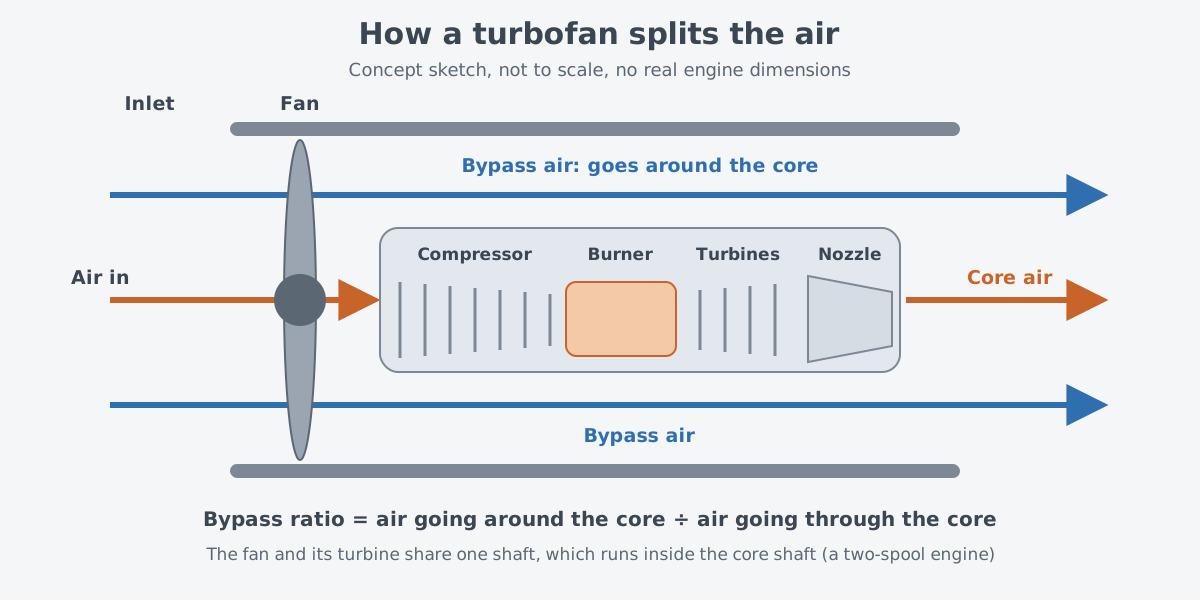
Comparing the two streams gives the bypass ratio. You divide the amount of air that goes around the core by the amount that goes through it. A bypass ratio of 2 would mean that for every 1 part entering the core, 2 parts go around it. Part of a turbofan's thrust comes from the core, and part comes from the fan.
A lot of air a little, or a little air a lot
If thrust grows with both the quantity of air and its gain in speed, there are two ways to make the same thrust. You can speed up a lot of air by a little, or a small amount of air by a lot. The first way saves fuel. Propellers and fans move air efficiently, so giving a big mass of air a small push burns less fuel.
Adding the fan raises the core's fuel use only slightly. A turbofan therefore gets extra thrust while burning almost the same fuel as the core alone. Turbofans with a high bypass ratio come close to the fuel efficiency of a turboprop.
So why not just use a propeller? In a turboprop, a gas turbine core drives a propeller. But a propeller loses efficiency as the aircraft flies faster.
A fan is surrounded by the inlet and has many blades, so it stays efficient at speeds where a plain propeller would not. As a result, slow transports use propellers, while fast transports and airliners use high-bypass turbofans.
Why airliner and fighter engines differ
Most of an airliner's or cargo plane's working life is spent cruising. For them, efficiency and low fuel use matter more than excess thrust.
Fighters and experimental high-speed aircraft are different. They need a great deal of excess thrust to gain speed fast and push through the heavy drag of high speed. For them, engine efficiency matters less than raw thrust.
That is why many modern fighters use low-bypass turbofans fitted with afterburners. Even a low-bypass turbofan uses fuel more efficiently than a basic turbojet. A fighter with such an engine can cruise efficiently and still have high thrust in a dogfight.
A fighter may fly much faster than sound, but the air entering the engine must move slower than sound for good efficiency. So the inlet slows supersonic air down before handing it to the engine.
The Mach number compares flight speed with the speed of sound. In those terms, the airplane can pass Mach 1 while the air in front of the engine drops below Mach 1. A ramjet, which squeezes air with high speed alone and has no fan or compressor, deals with this in another way.
Two published numbers show the difference clearly. According to the Smithsonian National Air and Space Museum, the F100-PW-100 used in the F-15A and B is an afterburning turbofan with a fan bypass ratio of 0.36:1. The manufacturer GE Aerospace designed the GE9X for the Boeing 777X family and gives its bypass ratio as about 10:1. The company credits the large fan diameter for that higher ratio.
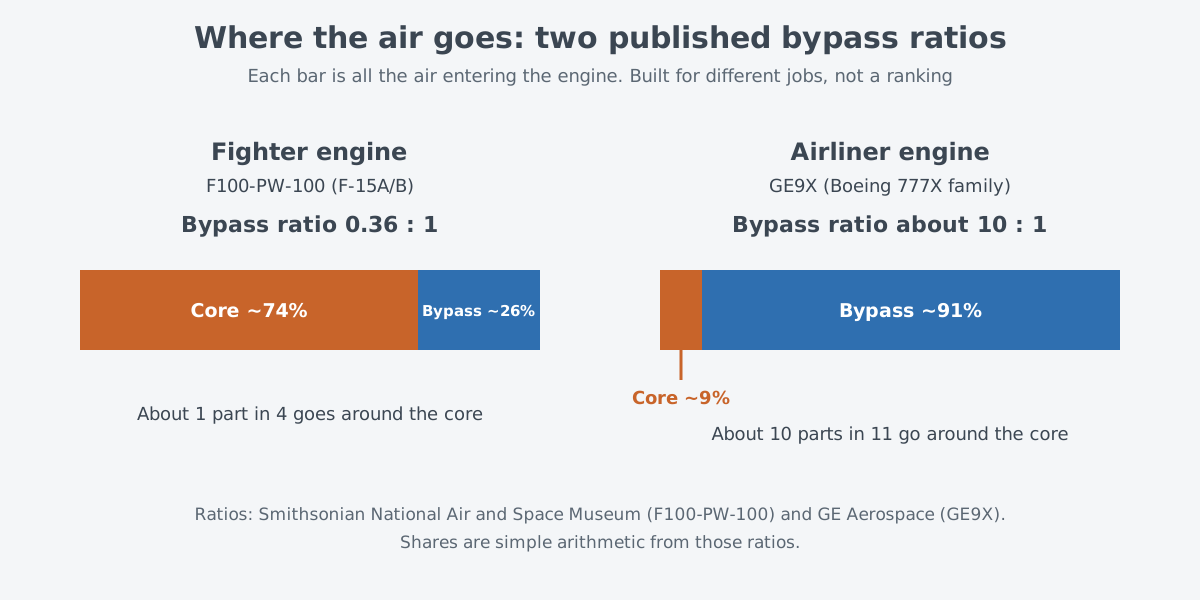
Turned into shares, a little over one part in four of the air entering the F100-PW-100 goes around the core. In the GE9X, only one part in eleven passes through the core and the rest goes around it. The two engines were built for different jobs, so these numbers are not a ranking of which engine is better.
The museum notes that the F100-PW-100 makes about 8 pounds of thrust for each pound of its own weight. It calls this a vital quality for high-performance military jets, which must accelerate fast and maneuver hard. That figure is the thrust-to-weight ratio applied to the engine alone.
How the afterburner works has its own article, "Afterburners: what changes when you burn fuel a second time."
From turbojet to turbofan
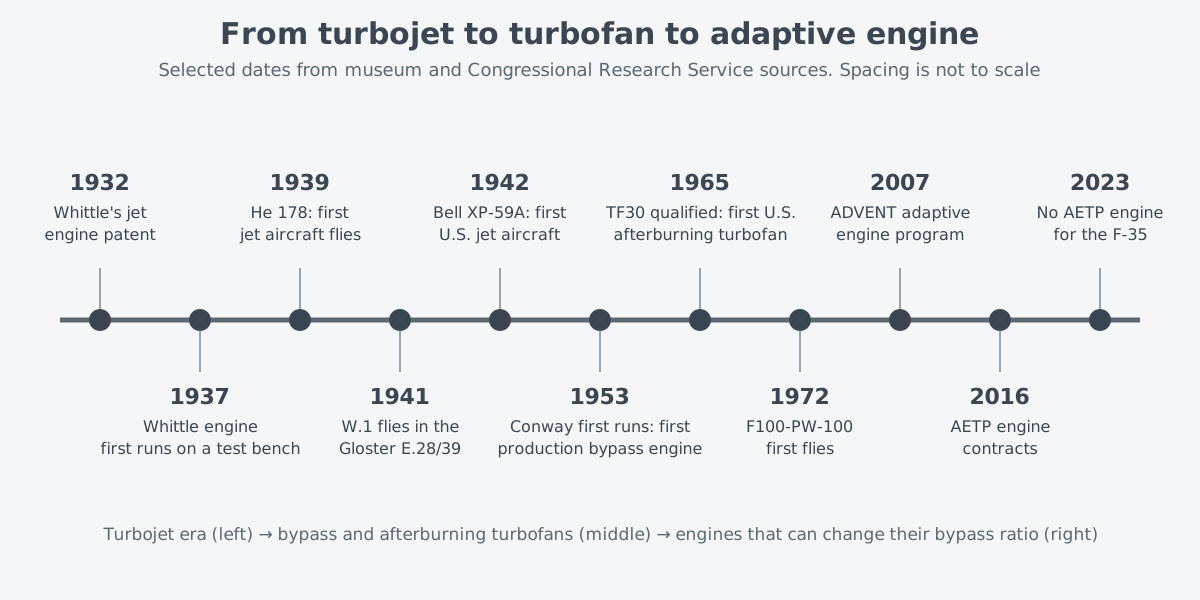
The story of the jet engine begins with one patent. According to the Smithsonian museum, Frank Whittle patented his jet engine in 1932, and the company Power Jets was formed in 1936. Whittle's test engine first ran on a test bench on April 12, 1937.
The first jet aircraft to fly was the He 178, designed by the German company Heinkel, which first flew on August 27, 1939.
In Britain, the Air Ministry signed a contract in 1939 to flight-test Whittle's W.1 engine in the new Gloster E.28/39. The W.1 made its official flight in that aircraft on May 15, 1941. On October 1, 1941, General Electric (GE) in the United States received the W.1X engine along with plans for the W.2B production engine. GE improved the design into the IA, and on October 2, 1942, the IA flew the Bell XP-59A Airacomet, America's first jet aircraft.
U.S. government research grew alongside it. A NASA Glenn Research Center presentation says America's first turbojet was tested at the center's Lewis Field in the 1940s. In the 1950s, its researchers broke new ground on transonic compressors, cooled turbines and steady afterburner burning.
The turbofan came next. The Rolls-Royce Conway was the first bypass engine to go into production. The British government funded its development in 1952, and it first ran in 1953.
As the museum puts it, turbofans burn less fuel per unit of thrust than turbojets, give more takeoff thrust and run more quietly, which suits them to long-range airliners. The Conway flew on airliners such as the Douglas DC-8-40, Boeing 707-420 and Vickers VC-10, as well as the Handley Page Victor bomber and tanker. It was later replaced by engines with much higher bypass ratios.
Fighters added the afterburner. Pratt & Whitney developed the TF30 as a private venture. The civil use first planned for it never came, but the engine saw wide military use and became the first American turbofan with an afterburner. The military formally qualified it in 1965, and it powered the A-7, F-111 and F-14A, and went out of production in 1986.
Pratt & Whitney won the U.S. Air Force's 1970 contest to design the F-15's engine. The resulting F100-PW-100 flew for the first time in July 1972, and it went into service on the F-15A and B in 1974. The F100 family also powers the F-16.
Military and civil engines also fed each other. The CF6-6, GE's first major turbofan for airliners, grew out of GE's large TF-39 turbofan, the engine of the Lockheed C-5A transport. In the 1970s, NASA's Energy Efficient Engine (EEE) program led to high-efficiency designs such as the GE90 and PW4000 that power the Boeing 777.
Engines that change their bypass ratio
Every engine so far is built around one bypass ratio. A Congressional Research Service (CRS) report on the F-35 explains that typical jet engines are tuned for one of two goals. One is economy, the choice for airliners and military transports; the other is performance, the choice for fighters. So could an engine change its bypass ratio in flight?
In 2007 the U.S. Air Force set up the Adaptive Versatile Engine Technology (ADVENT) program. Adaptive technology varies the bypass ratio so the engine can switch modes, burning fuel more efficiently and adding thrust so the aircraft can fly farther and stay up longer. Such engines can also handle heat better.
In its fiscal year 2016 budget request, the Air Force proposed carrying the technology forward under a new name, the Adaptive Engine Transition Program (AETP). In 2016, both GE and Pratt & Whitney won contracts to develop AETP engines. Pratt's engine is called the XA101, and GE's is the XA100.
The story continued from there. According to a 2024 CRS report, Air Force Secretary Frank Kendall said in March 2023 that the service would integrate neither the XA101 nor the XA100 into the F-35. He asked instead for money to upgrade the core of the F-35's existing Pratt & Whitney F135 engine, a program called the Engine Core Upgrade (ECU).
Where this meets lasers: the engine as a source of power and cooling
The F-35 shows that an engine does more than push the airplane. CRS reports that, in the F-35 program office's view, the Block 4 and TR-3 improvements require the F135 to supply more power and cooling. The ECU is meant to extend range, add thrust and cool the engine. The 2022 Selected Acquisition Report (SAR) recorded growing demand for power and cooling, and ways to give the F-35's electronics more power and cooling were among the options under study.
These are words that come up again and again with laser weapons. The CRS primer on directed-energy weapons lists meeting size, weight and power (SWaP) and cooling requirements as a hurdle for fitting these weapons onto today's platforms. Some systems are small enough for military vehicles, but many need larger or fixed platforms. SWaP and cooling needs can also cap how far a high-energy laser reaches and how good its beam is.
Each time new electronics are added, the same question follows: how much more power and cooling can the engine supply? How a laser turns electricity into light, and where its leftover heat goes, continues in Power and efficiency and Cooling and thermal management.
What to read next
- Thrust vectoring: steering with the engine: how bending the engine's exhaust turns the aircraft.
- Ramjets and scramjets: engines without fans: engines that squeeze air with speed alone, without a fan or compressor.
- Afterburners: what changes when you burn fuel a second time: a closer look at the afterburner fitted to low-bypass turbofans.
- Stealth aircraft: truly invisible?: from the same military aircraft category, how an airframe's shape relates to detection.
- Cooling and thermal management: where the heat that did not become light goes: how laser weapons deal with heat.