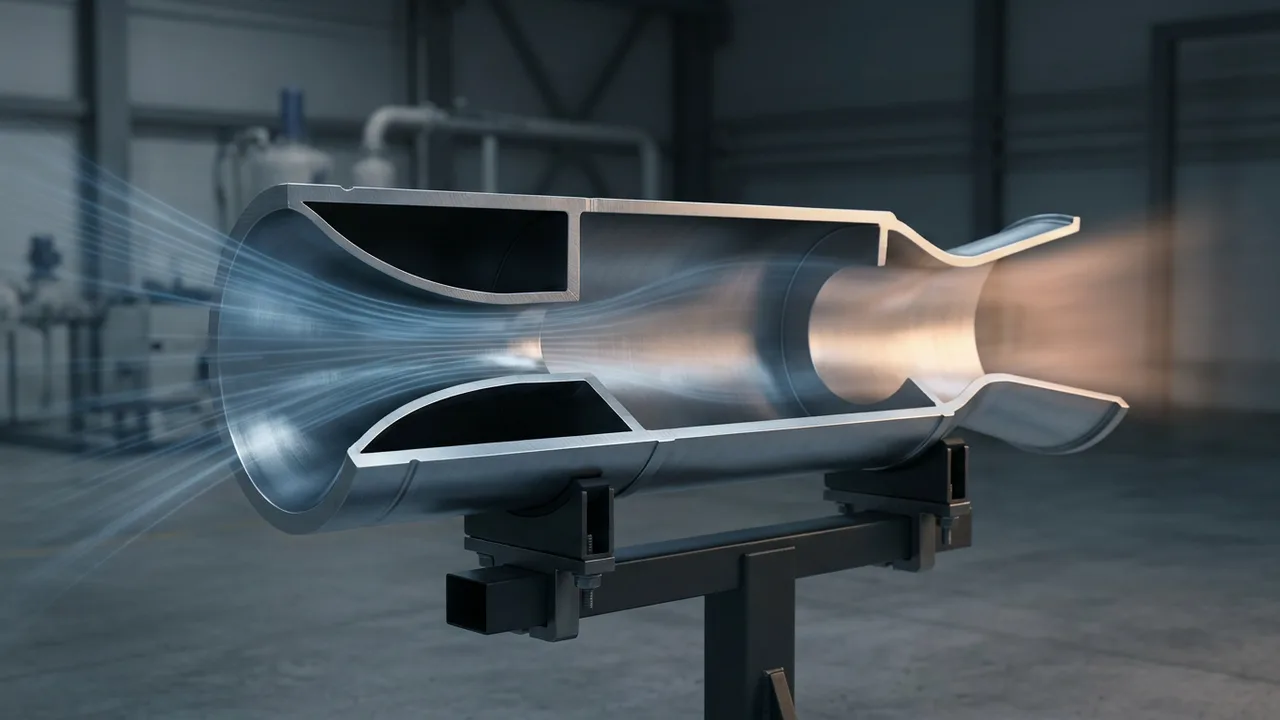
Inside an airliner's jet engine, wheels packed with small blades spin in row after row. This is the compressor, and its job is to squeeze air. Yet some jet engines have no spinning parts at all. These are the ramjet and the scramjet.
How do you squeeze air without bladed wheels? The answer is the vehicle's own speed. Air rushing at the engine is caught by the inlet and pressed together.
The catch is that this speed has to come from somewhere else first, and near Mach 5 a second wall appears. That wall is exactly where ramjets and scramjets part ways.
What every jet engine does
Thrust is the force that moves an aircraft through the air. Every kind of propulsion gets its thrust from Newton's third law: action and reaction. An engine throws gas backward hard, and the reaction pushes the engine forward. How much thrust it gets depends on how much gas passes through and how fast that gas leaves.
In a jet engine, the last place the gas speeds up is the nozzle. Hot gas from burning fuel gains speed as it passes through, and the reaction to that is thrust. There is one condition. To keep gas flowing out of the nozzle, the fuel must burn at a pressure above that at the nozzle outlet.
So every jet engine must squeeze air before it burns it. Every jet engine has an inlet to take in outside air. What differs is how each engine raises the pressure after that.
Let go of a blown-up balloon and it flies off opposite to the air rushing out. A jet engine is similar, but not the same. The balloon only empties the air stored inside it, while a jet engine keeps taking in outside air and burning it with fuel.
Turbojets: a fan squeezes the air
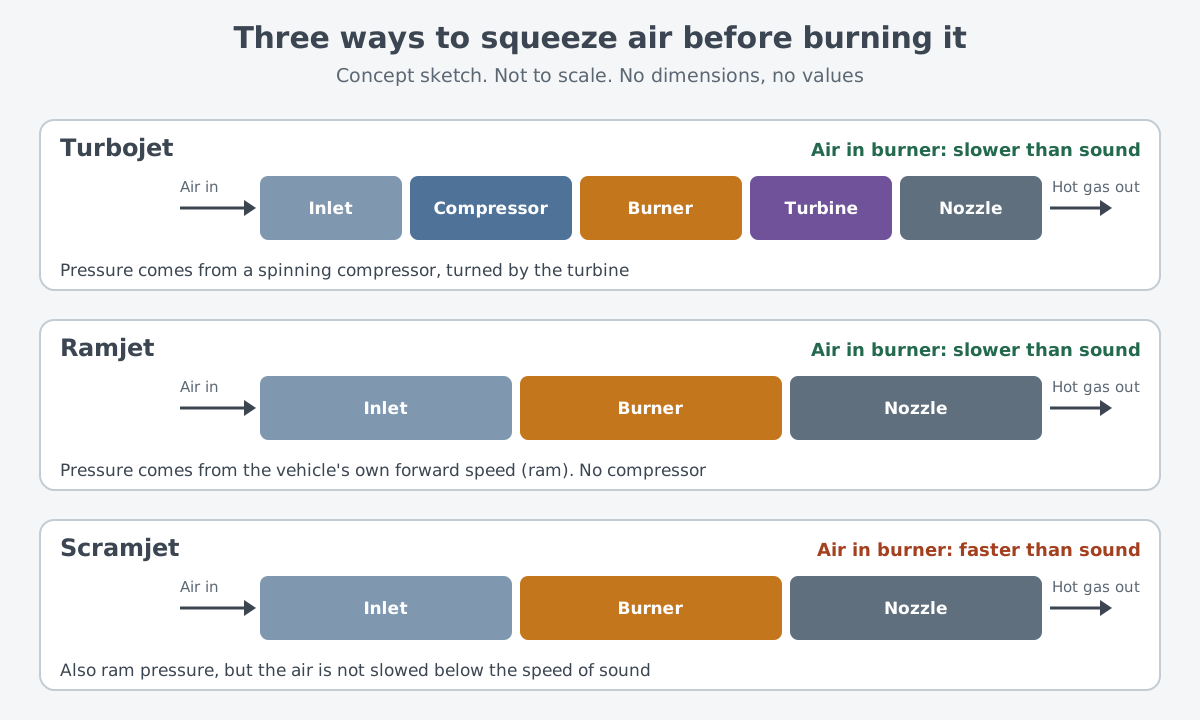
Today, most airliners and military planes fly on gas turbine engines, the engines people usually call jet engines. The earliest and simplest of these is the turbojet.
A turbojet pulls large amounts of surrounding air into its inlet, all the time. The air then enters the compressor.
NASA's Glenn Research Center describes the compressor as rows of small wings, each row adding a small rise in pressure, and compares it to an electric fan. The "fan" in the title means this compressor. Like a fan, it needs energy to turn, and the air leaving it is squeezed far above the outside pressure.
Fuel is mixed into this air and burned in the burner. Before the hot gas reaches the nozzle, it passes through the turbine. The turbine spins like a windmill as it takes energy from the flow, and a central shaft uses that energy to turn the compressor. Even after the turbine takes its share, enough energy is left to send the gas out of the nozzle fast and make thrust.
Ramjets: speed squeezes the air
A ramjet has no compressor and no turbine. It builds high pressure by "ramming" outside air into the burner with the vehicle's forward speed. That is where the "ram" in the name comes from. With no rotating machinery, it weighs less than a turbojet and is simpler to build.
Hold your hand out of the window of a moving car and you feel the air push hard on your palm. The faster the car, the harder the push. A real ramjet does not stop the air dead the way a palm does. Its inlet slows the incoming air while driving it toward the burner.
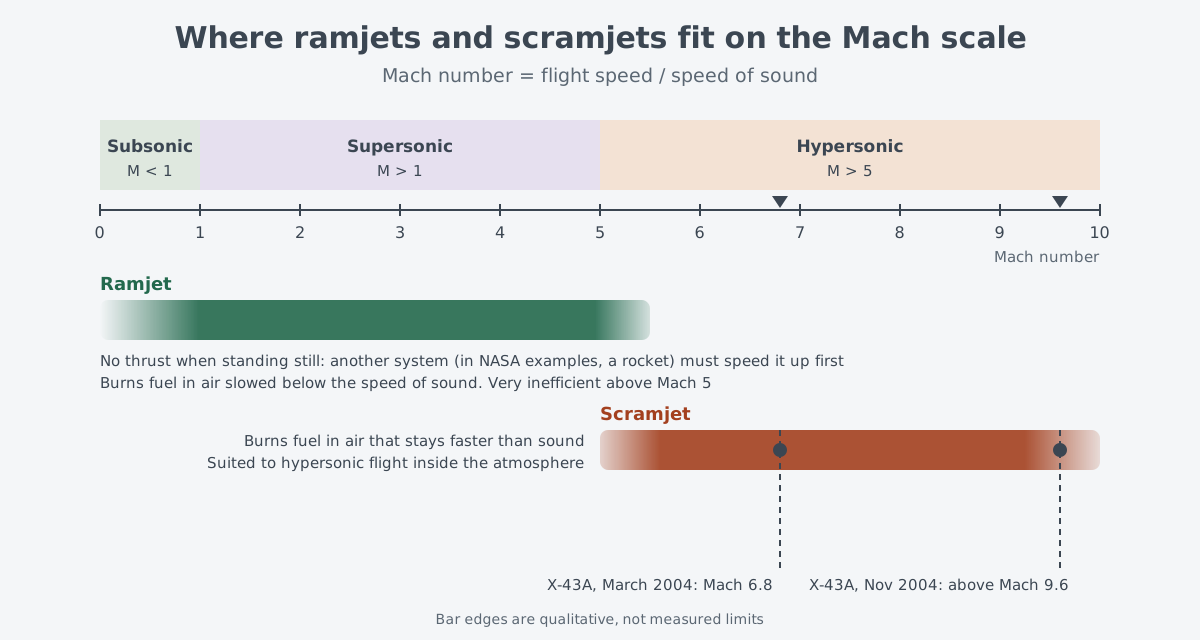
This design has a clear price. A ramjet gives thrust only while the vehicle is in motion. Standing still, it makes none. So another propulsion system has to speed the vehicle up until the ramjet starts to produce thrust.
NASA's ramjet page shows two such cases: an X-15 rocket plane carrying a ramjet under its body, and a missile ramjet inlet in a wind tunnel test. In both, a rocket first brings the ramjet up to speed. After that, the ramjet works better as speed rises, until aerodynamic losses become the main factor.
The ramjet is not a new idea. Some of the first ideas behind it came from Europe in the early 1900s.
The Mach 5 wall and the scramjet
High speeds are described with the Mach number. It is the flight speed divided by the speed of sound in that air.
M = V / a
Here M is the Mach number, V is the flight speed, and a is the speed of sound in that air. Below Mach 1 the flight is subsonic, and above Mach 1 it is supersonic. Beyond five times sound speed (M > 5) it is called hypersonic. An object flying supersonically creates shock waves at its surface.
In a ramjet, fuel burns in air moving at subsonic speed inside the burner. So in supersonic flight, the inlet has to slow the incoming air to below the speed of sound. Shock waves in the inlet cause losses as it does this.
Past Mach 5, a ramjet turns very inefficient. Much faster than that, the shock losses grow so large that no net thrust is left.
The fix was to keep the air faster than sound instead of slowing it below that speed. In the 1960s, engineers proposed an improved ramjet that burns its fuel in supersonic air. Its full name is supersonic combustion ramjet, shortened to scramjet. With smaller losses from slowing the flow, it can make net thrust even on a hypersonic vehicle.
Both engines burn fuel with outside air. That is why, inside the atmosphere, they are more efficient than a rocket, which has to carry all of its oxygen. NASA's educational pages describe the ramjet as suited to very high speed flight in the atmosphere, and the scramjet as suited to hypersonic flight in the atmosphere.
Flight tests and missiles
The aircraft that showed a scramjet could really fly was NASA's X-43A. This uncrewed test vehicle rode at the front of a Pegasus rocket, which a B-52 aircraft released. The rocket took it to nearly Mach 7, and then the X-43 separated and flew on its scramjet. Here too, a rocket handled the first part of the speed.
NASA presents the flight as the result of forty years of research on supersonic combustion ramjets. In March 2004, an aircraft powered by a scramjet flew freely for the first time.
For about 11 seconds, the X-43A flew on scramjet power at Mach 6.8, about 5,000 mph. On November 16 the same year, a second, identical vehicle passed Mach 9.6, about 6,800 mph. It was the X-43A project's last flight, and each of the two flights set a world speed record for an air-breathing aircraft.
On the weapons side, these engines show up in discussions of hypersonic weapons. A Congressional Research Service (CRS) report defines hypersonic weapons as those that fly at Mach 5 or faster and splits them into two main types. Hypersonic glide vehicles are launched by a rocket and then glide to a target. Hypersonic cruise missiles fly on high-speed air-breathing engines, that is, scramjets.
The same report covers HAWC, the Hypersonic Air-breathing Weapon Concept, run by the Defense Advanced Research Projects Agency (DARPA) with Air Force support. Its aim was to develop and demonstrate key technologies for an air-launched hypersonic cruise missile. DARPA ran HAWC tests in March 2022, July 2022 and January 2023 with a B-52 bomber as the launch aircraft, and the program has ended.
What stays hard: heat and starting speed
The first problem is heat. NASA's educational pages note that at high supersonic speeds, aerodynamic heating becomes very important in aircraft design. At hypersonic speeds, some of the vehicle's energy goes into exciting the bonds of nitrogen and oxygen molecules, so air chemistry enters the force calculations. An inlet is basically a hollow tube, but ramjet and scramjet inlets must be made of materials that can stand high temperatures.
The second problem is starting speed. Neither a ramjet nor a scramjet can get going on its own. The ramjet hung under the X-15, the missile ramjet inlet in the wind tunnel, and the X-43A all relied on a rocket to supply the first speed. The engine has to be paired with another propulsion system.
The third is that the engine and the body have to be handled together. After the scramjet was proposed, the tests that followed covered both designing a supersonic burner and fitting the inlet and nozzle more closely into the airframe.
How to deal with heat is an important question for laser weapons as well. How a high-power laser handles the energy that does not become light, through thermal management, continues in Cooling and thermal management.
What to read next
- Cruise missiles: how they resemble aircraft: the big picture of missiles that fly on air-breathing engines.
- Hypersonic glide vehicles: a different flight path: the other branch of hypersonic weapons.
- Solid and liquid rockets: what the fuel form changes: the rockets that give ramjets and scramjets their first speed.
- Cooling and thermal management: where the heat that did not become light goes: how laser weapons deal with heat.