A jet engine moves forward by burning its fuel once. So what happens if you spray more fuel into the hot exhaust that has already burned? A device built on that idea is called an afterburner.
Thrust goes up by a good amount. In return, fuel use climbs steeply and the nozzle becomes heavier and more complex. This article uses NASA Glenn Research Center's educational pages to explain how it works and what it costs, then follows its development from a U.S. wind tunnel in 1945.
Once more, behind the turbine
Start with the turbojet, the simplest kind of gas turbine engine. Air enters through the inlet, gains pressure in the compressor, and burns with fuel in the burner. In a typical jet engine, each second about 100 lb of air is mixed with only 2 lb of fuel.
The hot gas spins the turbine the way wind turns a windmill, and the turbine drives the compressor through a central shaft. Even after the turbine has drawn energy from the exhaust, enough remains to push the gas out of the nozzle at high speed. Thrust is the reaction to throwing that gas backward.
The afterburner sits right behind the turbine. To give back part of the energy the turbine took, it sprays fuel straight into the hot exhaust and burns it. The basic turbojet gets a longer nozzle, with a ring of flame holders inside it. When the afterburner is switched on, extra fuel flows in through those rings.
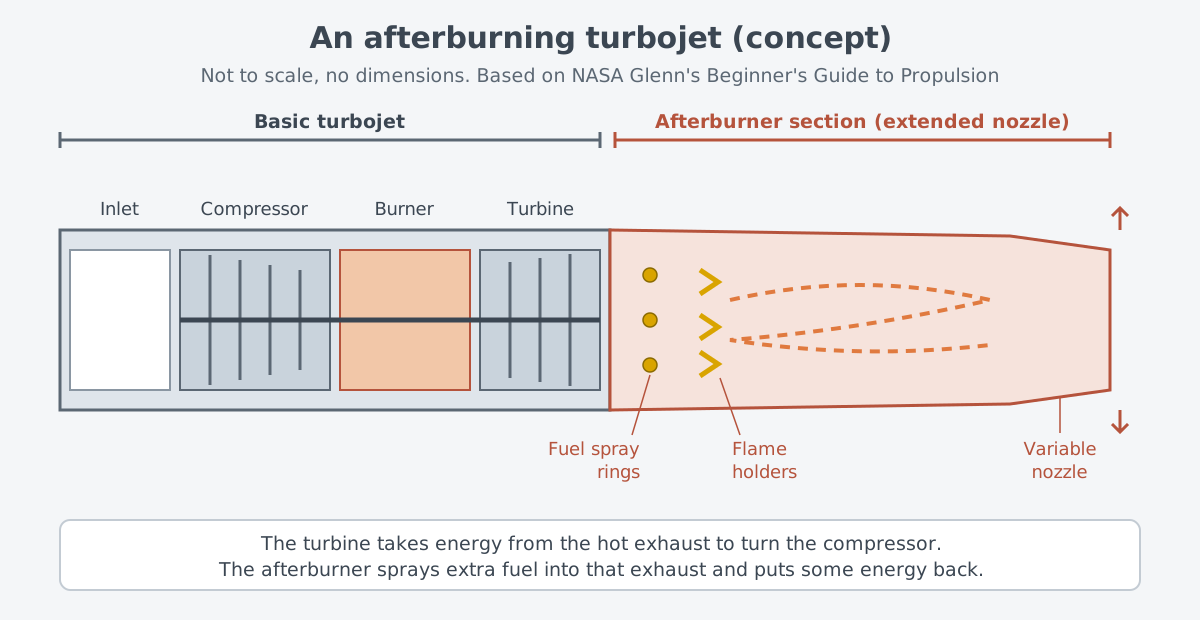
With the afterburner off, the engine runs like a plain turbojet. Think of it as an add-on combustion chamber that is lit only when needed. Because it is a mechanically simple way to add thrust, it appears on both turbojets and turbofans.
More thrust, much more fuel
The extra fuel adds thrust as it burns, but it burns less efficiently than fuel in the engine's main burner. You get more thrust and burn a lot more fuel.
How much more? Engineers measure this with thrust specific fuel consumption (TSFC). It takes the mass of fuel an engine burns each hour and divides it by the thrust the engine makes. It plays a role a bit like a car's fuel economy rating, but it divides by thrust instead of distance, and a smaller number means less fuel.
An airplane has to carry its fuel for the whole flight. That is why the fuel needed to make thrust can matter even more than the thrust itself. When two engines make the same thrust, the one with the smaller TSFC uses less fuel.
NASA's educational pages give a worked example. Picture a turbojet making 2,000 lb of thrust that reaches 3,000 lb with the afterburner on. If TSFC stayed at 1.0, the fuel flow would be 3,000 lb per hour. But a typical TSFC for an afterburning turbojet is 1.5, so the fuel flow becomes 4,500 lb per hour.
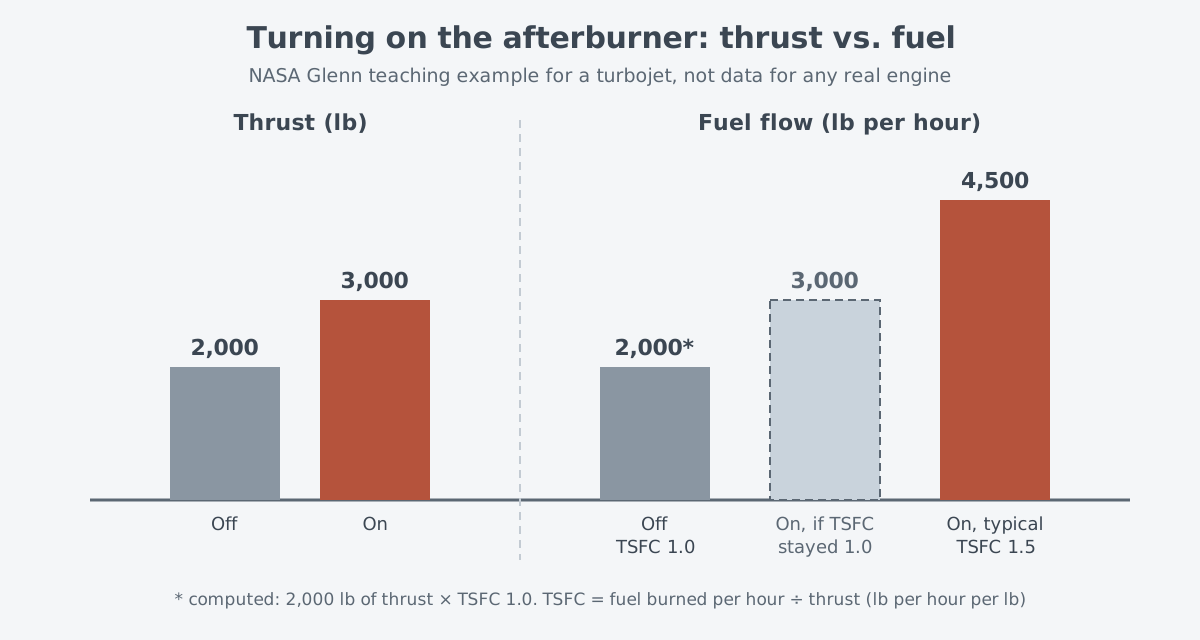
Working the same way, the fuel flow before switching on is 2,000 lb per hour. Thrust went up by half, while fuel more than doubled.
These are teaching numbers. NASA's typical figures (turbojet 1.0, turbofan 0.5) are both sea level static values. The TSFC of any given engine changes with speed and altitude.
Why the nozzle has to open up
Turning on the afterburner makes the exhaust hotter. To pass the same mass of gas, the nozzle then needs a larger flow area.
So an afterburning nozzle has to be built with variable geometry, able to open and close. Such a nozzle is heavier and more complex than a simple turbojet nozzle. The part that sprays fuel may be simple, but the nozzle behind it carries a price in weight and complexity.
Who uses afterburners
Near the speed of sound, drag rises sharply. That rise is why people once believed in a "sound barrier"; in fact it was an increase in drag near sonic speed caused by the compressibility of air. For this reason, airplanes avoid cruising close to Mach number 1. A fighter that wants to go faster than sound has to overcome this drag, and an afterburner offers an easy route to the thrust it needs.
Airliners and cargo planes are in cruise for most of each flight. For them, engine efficiency and low fuel use matter more. Fighters and experimental high-speed aircraft need to accelerate quickly and beat the high drag of high speed, so very high thrust comes before engine efficiency. The gap between thrust and drag is called excess thrust, and the larger it is, the faster the airplane accelerates.
Most modern fighters fit an afterburner to a turbojet or to a low bypass turbofan. A low bypass turbofan still uses less fuel than a basic turbojet. So the aircraft can cruise economically and call on the afterburner when it needs high thrust, such as in a dogfight. Even when the airplane flies much faster than sound, the air entering the engine must move slower than sound for high efficiency.
So the inlet brings supersonic air down to a slower speed.
There is one exception on the airliner side. According to NASA, afterburners are used only on supersonic aircraft such as fighter planes and Concorde, the supersonic airliner. Once in cruise, Concorde switches its afterburners off. Left on, they would use up its fuel before it reached Europe.
A technology refined in an altitude wind tunnel
In the United States, the afterburner was refined in a wind tunnel that imitates high altitude. NASA Glenn's history pages describe the mid-1940s work. Researchers of the National Advisory Committee for Aeronautics (NACA) ran General Electric's TG-180 (J35) many times in the tunnel, known as the Altitude Wind Tunnel or AWT.
In the opening test series of early 1945, an afterburner was lit in altitude conditions for the first time. That early version performed only marginally, yet development moved quickly, and before long most jet engines carried an afterburner as standard.
By testing a range of flame holder and fuel system designs on that engine, the researchers greatly improved combustion at high altitude. The document list from that period also uses the name "tailpipe burner." NASA names restarting at high altitude, afterburners and variable-area nozzles among the tunnel's most important contributions to jet engines of that era. Glenn also lists pioneering stable afterburning as one of its achievements of the 1950s.
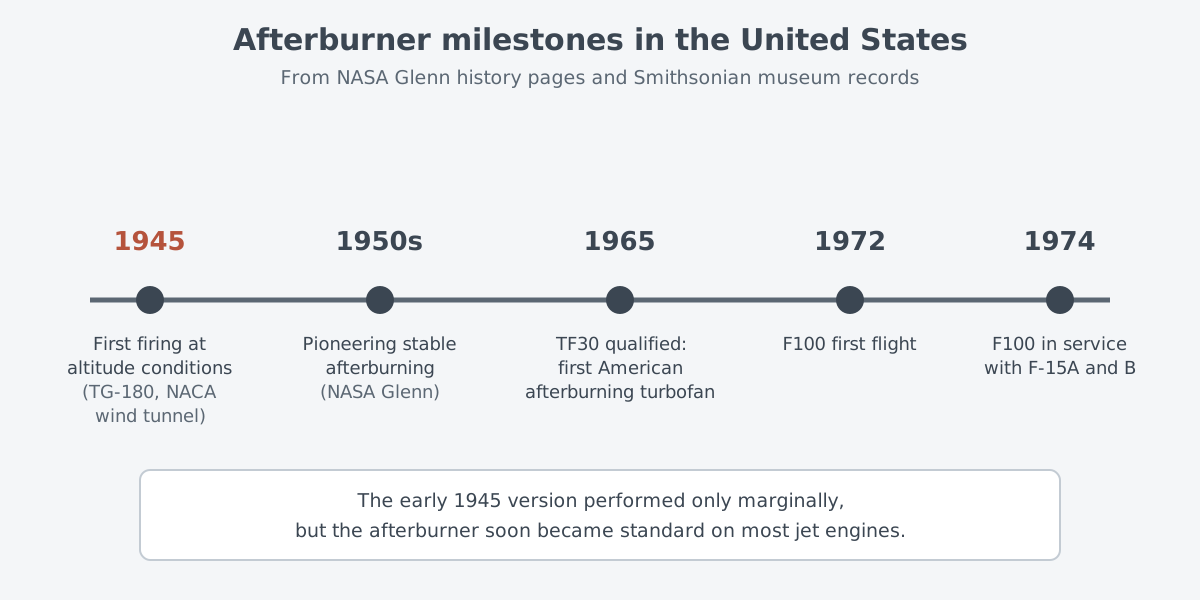
The afterburner also moved onto turbofans. In the records of the Smithsonian National Air and Space Museum, Pratt & Whitney's TF30 is described as the first American afterburning turbofan. The TF30 series passed its official military qualification in 1965, powered the A-7, F-111 and F-14A, and went out of production in 1986.
The museum record lists the type of the F-15's engine, the F100-PW-100, as "Turbofan, afterburner." Its first flight came in July 1972, and it began service on the F-15A and B in 1974.
Where this meets lasers: power traded for efficiency
An afterburner gives up efficiency to gain power. The question of how much you get back for what you put in comes up with laser weapons too. In a laser, the share of electrical input that comes out as light sets the size of the power supply and cooling. Power and efficiency works through that point with examples.
An engine's TSFC and a laser's efficiency are different numbers. Still, both articles show the same pattern: the price of more power comes back as fuel or electricity, and as the weight of the equipment that has to handle it.
What to read next
- Turbofan Engines: How a Fighter Engine Pushes Air: how the engine that carries the afterburner splits its air in two.
- Ramjets and scramjets: engines without fans: engines that squeeze air with flight speed instead of a compressor.
- Thrust vectoring: steering with the engine: how bending the exhaust turns an aircraft.
- Power and efficiency: the share of electricity that becomes light sets the size of the system: why efficiency sets the size of a laser weapon system.