A laser takes light and makes it grow before letting it out. How does that happen? This article looks at the three parts that do the job, one at a time, with three diagrams.
The OpenStax university physics textbook names three basic components of a laser: the gain medium, a source of power, and a mechanism that feeds light back. On this site, these three are called the gain medium, pumping and the optical resonator.
It helps to read "What is a laser? How it differs from a light bulb" first, but this article is written to stand on its own.
How light is multiplied: stimulated emission
The electrons in an atom move up and down between several energy steps, called energy levels. Three things can happen between electrons and light.
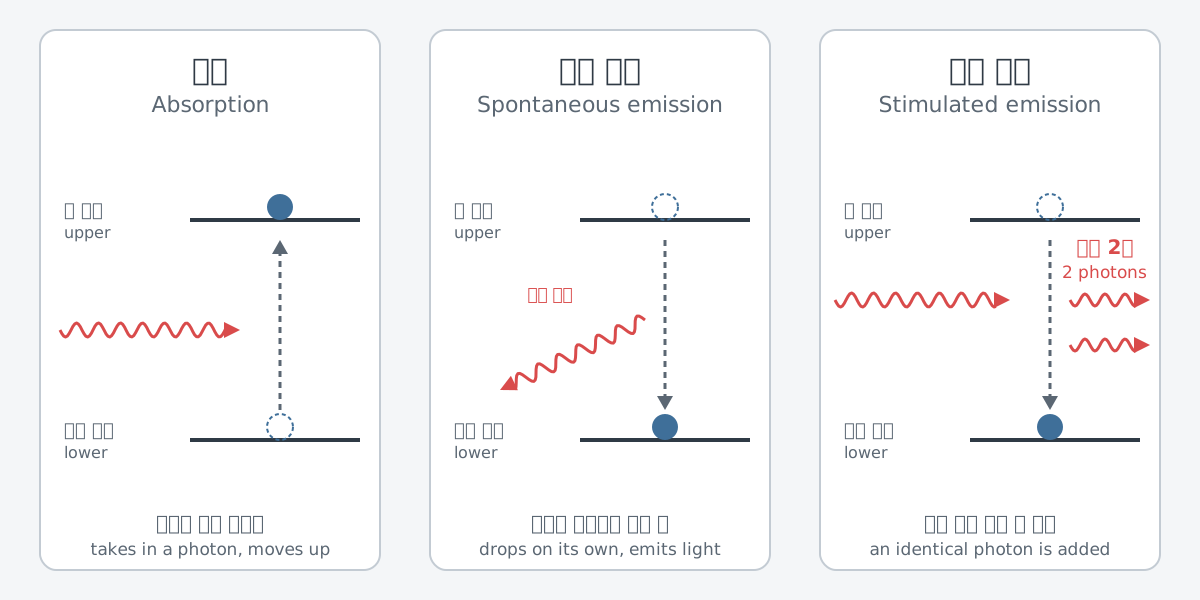
The first is absorption. When a gain medium absorbs light energy, its electrons move up to higher levels. An atom absorbs only photons of the correct wavelength.
The second is spontaneous emission. An excited atom, even on its own, can return to a lower state by emitting a photon. That photon leaves in a random direction.
The third is the key to the laser: stimulated emission. The idea first appeared in a 1917 paper by Albert Einstein. When a photon of the right energy (wavelength) meets an excited atom, the atom releases one more photon. The new photon travels in the same direction, with the same frequency and the same phase as the first one.
One photon calls out a second photon identical to itself. These photons go on to stimulate other atoms, so the same event repeats like a chain reaction. This is why the light in a laser grows.
Part one, the gain medium: the material that amplifies light
A gain medium is a material that can amplify light passing through it. A solid such as glass, or a gas, is an example. RP Photonics, a reference work on optics, also lists semiconductors, dye solutions, and crystals and optical fibers that contain added ions as kinds of gain medium.
Not every material can amplify light, though. As light passes through a medium, atoms in the lower level absorb light, while atoms in the upper level add light through stimulated emission. In thermal equilibrium, higher levels hold fewer atoms, so a state with more atoms in the upper level does not arise by itself. If nothing is done, more atoms sit in the lower level, and absorption wins.
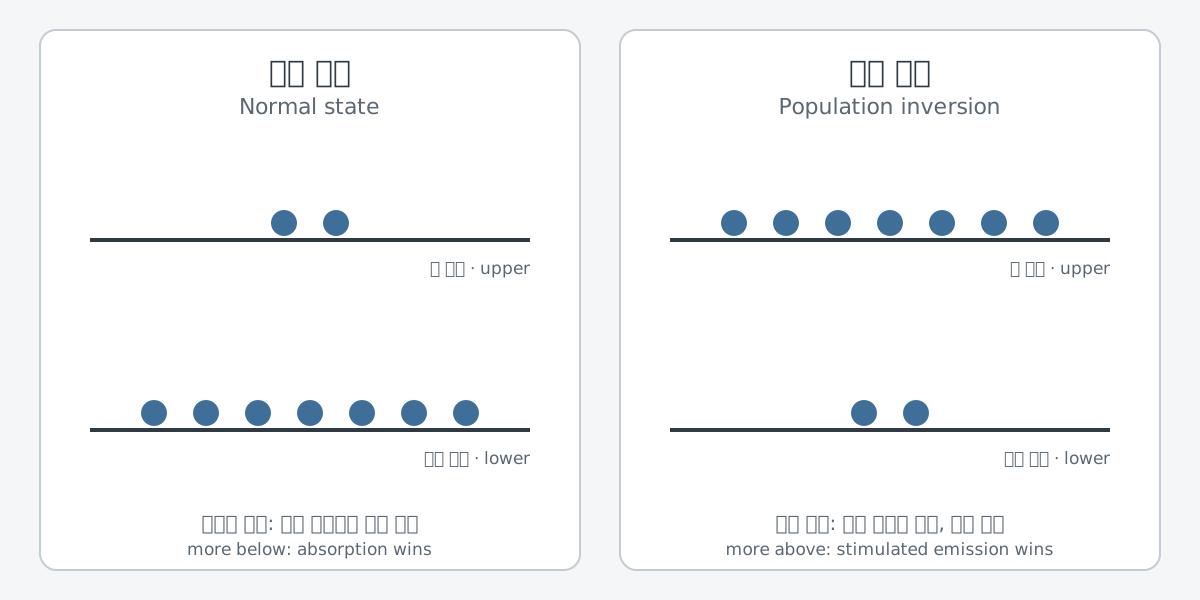
That is why a state with more atoms in the upper level than in the lower level has to be created. It is called a population inversion. Most excited electrons return to the ground state right away, but some stay in a long-lived excited state called a metastable state. The textbook calls the condition in which most atoms are held in this state a population inversion, and light can be amplified only when there is one.
Picture a road lined with booths, some taking a coin and some handing one out. Your coins grow along the road only if more booths hand them out.
In reality, the booths are not fixed. An atom that gave up light drops to the lower level and absorbs next time, so pumping must keep lifting atoms. Also, some excited atoms drop down on their own through spontaneous emission, regardless of the light passing by.
Part two, pumping: how energy is put in
As shown above, a population inversion does not form if nothing is done, so energy has to be supplied from outside to lift atoms to the upper level. This is called pumping. Electrons in atoms of glass, crystal or gas absorb the energy of an electrical current or a light and become excited. So pumping energy comes in as electricity or light.
Pumping with light is called optical pumping. Common pump sources are discharge lamps, laser diodes (semiconductor lasers) and other lasers. In the ruby laser that Lawrence Livermore National Laboratory (LLNL) describes, a flash tube fires and puts energy into the ruby rod.
Pumping with electricity is called electrical pumping. It is used especially for gas lasers and semiconductor lasers (laser diodes). Either way, the goal is the same: to create a population inversion in the gain medium so that it is ready to amplify light.
Part three, the resonator: mirrors that trap and select light
A resonator sends light back into the gain medium so that it passes through many times. Many lasers do this with a mirror at each end of the medium. Photons reflected by the mirrors travel back and forth through the medium and build up stimulated emission. The textbook calls this a mechanism that feeds light back, and many lasers create it by reflection.
According to a history article from the American Physical Society (APS), the idea of fitting a pair of mirrors, one at each end, came from Arthur Schawlow. A resonator has self-reproducing field patterns, called resonator modes. In plain words, they are patterns of light that survive inside it.
The abstract of the 1958 paper by Schawlow and Charles Townes in Physical Review says that conditions such as highly reflecting only the end walls can select a single mode. The result is extremely monochromatic and coherent light.
The two mirrors do different jobs. One sends back nearly all of the light. The other, the output coupler, lets part of the light through. The light that passes through this partially reflective mirror is the laser beam.
How the three parts work together
The diagram below puts the three parts in one picture.
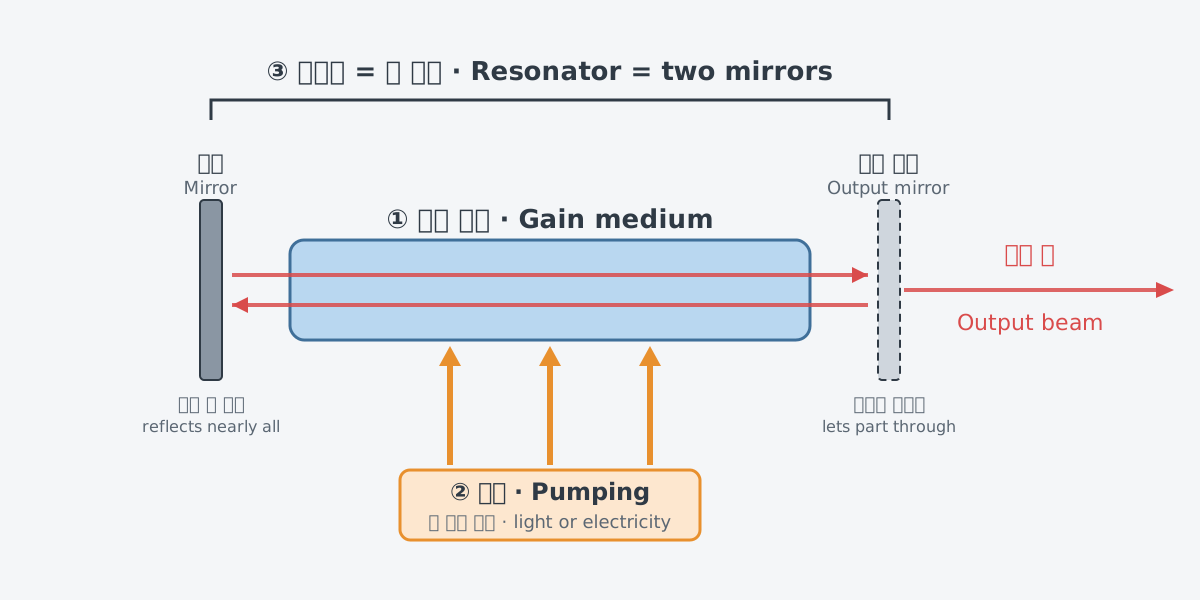
| Part | What it does | Where it is in the diagram |
|---|---|---|
| ① Gain medium | Amplifies light through stimulated emission | The bar in the middle |
| ② Pumping | Puts energy in to create a population inversion | The arrows coming in from below |
| ③ Resonator | Sends light back so it passes through the medium many times | The two mirrors at the ends |
Step by step, it goes like this. Pumping creates a population inversion in the gain medium. A few photons from spontaneous emission act as the first seed from which laser light builds up.
Photons traveling between the mirrors multiply through stimulated emission each time they cross the medium. LLNL describes this as "two become four, four become eight." In reality, absorption, mirror losses and the light leaving through the output coupler mean the number does not exactly double each time. Light heading off to the side never returns to the mirrors and cannot keep growing, while light traveling straight between them keeps growing and becomes a one-direction beam.
This leads to the idea of a threshold. The laser threshold is the state where the gain the light receives just equals the losses of the resonator. While pumping is too weak for the gain to make up for the losses, the laser does not start emitting light. Above the threshold, more pumping gives more laser output.
The output coupler is tied to this threshold as well. A lower transmission lowers the pump power needed at threshold but can reduce efficiency, so it is often chosen for the most output power.
What to read next
This site is easiest to follow in the order of the reading path. After this article, the following are suggested.
- Laser types at a glance: gas, solid-state, fiber, semiconductor: how lasers are grouped by their gain medium.
- "Oscillators and amplifiers: making light, then growing it": why a small laser is built first and its light is grown later.
- "What is a fiber laser? Growing light inside a thin glass fiber": what a laser looks like when the gain medium is an optical fiber.