Almost everyone knows the word "laser." Far fewer have heard of the "maser," which came first. The two words differ by one letter. The L in laser stands for light, and the M in maser stands for microwave.
Amplifying electromagnetic waves through stimulated emission worked first with microwaves, not light. In early 1954, at Columbia University in the United States, a device using ammonia gas did it for the first time. How could anyone amplify with microwaves instead of light, and with gas molecules at that?
Before the laser, the maser
Maser is an acronym for "microwave amplification by stimulated emission of radiation." According to the Nobel Prize biography of Charles Townes, the name was coined by Townes and his students. A laser is the same phrase with light in place of microwaves.
Masers and lasers give concentrated, coherent beams of microwaves and of light, respectively. Only the wavelength of the radiation differs; the principle underneath is the same. Wavelengths and the kinds of electromagnetic waves are covered in Light basics: waves, wavelength, frequency and photons.
Stimulated emission: radiation that calls up more
That shared principle is stimulated emission. A packet of light, a photon, can meet an atom and make an electron drop to a lower energy level. An extra photon with the same energy then comes out.
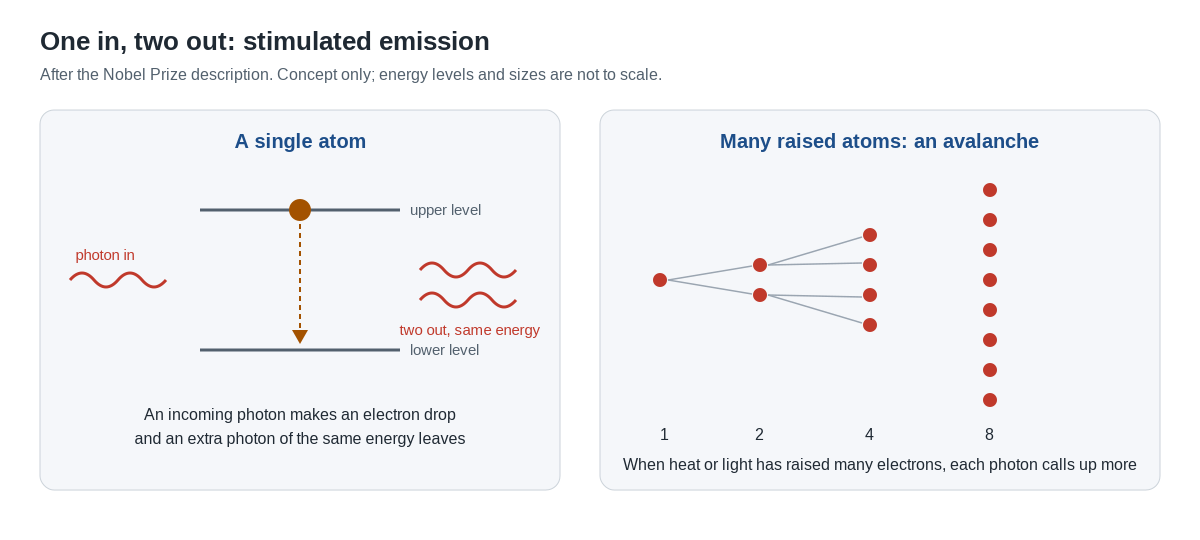
One goes in, two come out. If heat or light first raises many electrons to higher levels, an avalanche-like effect follows as they come down. It resembles a snowball growing as it rolls downhill. The difference is that the photons do not multiply in any old way; the new ones carry the same energy as the photon that set them off.
The first maser, built with ammonia gas
Townes spent 1933–1947 on the staff of Bell Telephone Laboratories, then moved to Columbia University in 1948 to study how microwaves and molecules act on each other. In 1951 he came up with the idea of the maser. Within months, he and his co-workers began building a device that used ammonia gas as its active medium.
This first maser did not heat the molecules or shine light on them to lift them up. It picked out molecules that were already in the upper state. Ammonia molecules leave a source as a narrow beam and pass through a focuser. Using uneven electric fields, the focuser removes ground-state molecules from the beam and gathers excited ones into a resonant cavity whose walls conduct electricity well.
The cavity then holds far more molecules in the upper state than in the lower one. Once enough of them collect, an electromagnetic field starts to oscillate in the cavity, and its energy leaves as microwaves. What moves up and down here are the two energy states of the ammonia molecule. In his 1964 Nobel lecture, Townes said his student James Gordon played a crucial role in getting the device working after two and a half years of experiments.
In early 1954, electromagnetic waves were amplified and generated by stimulated emission for the first time. A paper received on May 5 that year appeared in Physical Review volume 95 on July 1. It was written by Gordon, Zeiger and Townes, and its title was "Molecular Microwave Oscillator and New Hyperfine Structure in the Microwave Spectrum of NH3." NH3 is ammonia.
Amplifier, spectrometer and a very steady clock
The next year, on August 15, 1955, the same three authors published "The Maser—New Type of Microwave Amplifier, Frequency Standard, and Spectrometer" in Physical Review volume 99. As the title says, the device could serve as a microwave amplifier, a spectrometer or an oscillator. The difference between an amplifier and an oscillator is explained in Oscillators and amplifiers: making light, then growing it.
The numbers in the abstract show what the device did well. As an oscillator, its frequency stayed within at least 4 parts in 10¹² over about a second. Over an hour or more, it stayed within at least 1 part in 10¹⁰. Used as a spectrometer, it removed the usual Doppler broadening and reached a resolution of 7 kc/s.
A frequency that steady means the device could act as a very precise clock or reference. That is why "frequency standard" is in the title. As an amplifier, the authors expected a noise figure close to the theoretical limit of 1. In other words, it could boost very weak signals while adding almost no noise.
From microwaves to light
Once the maser worked, the next question was obvious: could the same thing be done with light? The Nobel Prize biography says that in 1958 Townes and his brother-in-law Arthur Schawlow showed in theory that masers could run on infrared and visible light. They also proposed how to do it in particular materials.
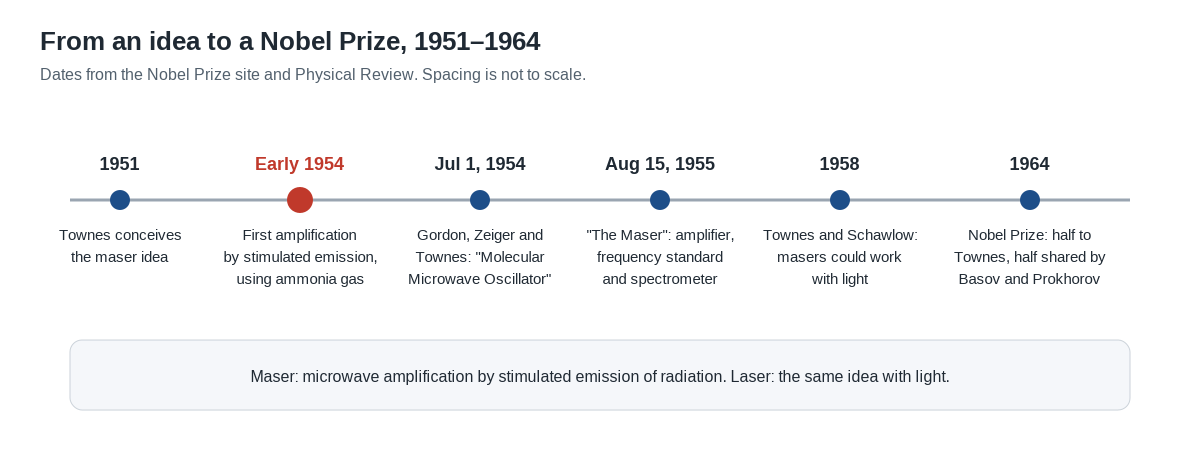
That work became a joint paper on optical and infrared masers, or lasers. The story of the first laser that actually shone after this proposal continues in "May 16, 1960: Maiman's Ruby Laser."
The 1964 Nobel Prize
The 1964 Nobel Prize in Physics was split in two. Half went to Charles Townes, and the other half was shared by Nicolay Basov and Aleksandr Prokhorov of the Soviet Union. When they won, Basov and Prokhorov worked at the P.N. Lebedev Physical Institute in Moscow, and Townes was at MIT.
The prize was given "for fundamental work in the field of quantum electronics, which has led to the construction of oscillators and amplifiers based on the maser-laser principle." The Nobel Prize site notes that in the 1950s the three men made stimulated emission usable in masers and lasers. A path first opened with microwaves reached light within a few years, and the prize honored both under one principle.
What to read next
- May 16, 1960: Maiman's Ruby Laser: the day the maser idea first became light
- The three parts of a laser: gain medium, pump and resonator: the structure that turns stimulated emission into a laser
- Oscillators and amplifiers: making light, then growing it: the two uses named in the maser paper's title