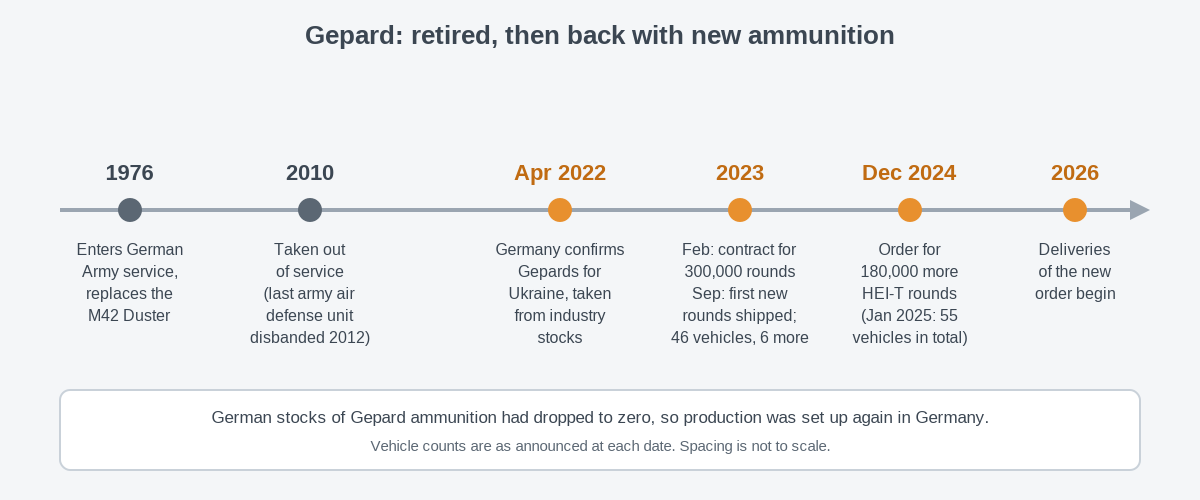
In April 2022, the German government decided to send old air defense vehicles to Ukraine. They were Gepards, which entered German Army service in 1976 and left it in 2010. Each carried two 35 mm cannons.
Why would a gun built in the Cold War to stop low-flying jets and helicopters be called back in the age of drones? And once it was back, what was missing? This article starts with the Gepard and its ammunition, then follows smarter rounds, newly ordered gun vehicles and the jobs guns cannot do, using public sources. It reflects the situation as of October 2026.
Why guns again
Small drones are a hard problem for defenders. The Congressional Research Service (CRS) points to the size, speed and flight altitude of many drones. Add the trend of drones growing more common, cheaper and more sophisticated, and CRS says these are widely regarded as a large technical and operational challenge for the Pentagon. Here a drone means an unmanned aerial system (UAS).
Then there is the math of cost. Using a missile worth several hundred thousand dollars to bring down a hobby drone gives questionable value, and it leaves fewer missiles for more valuable threats. An article by an Army ammunition program office appears on the official Army site. It argues that because threats are getting cheaper and more common, cheap kinetic means have to be part of the defense.
Guns appear on the Pentagon's list of options too. The list puts guns next to new, possibly cheaper interceptor missiles, electronic warfare, high-power microwaves and directed energy. The long history of air defense guns and the price of missiles are covered first in Anti-aircraft artillery in the missile age. This article focuses on what changed from 2022 on.
Gepard: an air defense gun back from storage
The Gepard was one of the two pillars of the German Army's air defense branch. It entered service in 1976, replacing the older U.S.-built M42 Duster, and it used the chassis and engine of the Leopard 1 tank. Its job was to follow fast-moving tank and mechanized infantry units and guard them against low-flying ground attack aircraft and helicopters.
The hull carried a search radar that turned to scan the sky and a tracking radar that followed a target. The tracking radar let the crew fight even in weather where the gunner could not see well. The two 35 mm cannons were also meant for ground targets.
After the Cold War, the army's air defense branch shrank. The Gepard was taken out of service in 2010, and the branch was disbanded in 2012 when its last systems were retired.
On April 26, 2022, Ukraine's supporters met at Ramstein in Germany. There, then German Defense Minister Christine Lambrecht confirmed that Gepards would go to Ukraine. The German defense ministry said the vehicles would come from industry stocks and that the government had approved the export the day before the meeting. It was also the first time Germany sent used armored vehicles directly, without a Ringtausch, a swap arrangement with another country.
The number handed over depends on when it was announced. A September 2023 press release from the German defense firm Rheinmetall says 46 had been made available, with six more to follow. A January 2025 release says 55 had been handed over in total.
Rheinmetall's 2023 release says the Gepard is used against the kamikaze drones Russia sends at Ukrainian cities.
When the ammunition ran out
A gun needs rounds. According to Rheinmetall's September 2023 press release, Germany's stock of Gepard ammunition had fallen to zero after the vehicles left service. Rheinmetall writes that the German government looked abroad as well, but other countries would not hand over their stocks for political or constitutional reasons.
The release also says even the tools once used to make the original rounds were gone, and the 2023 contract and shipment figures below come from it too.
The answer was to make new ones. In February 2023, German Defense Minister Boris Pistorius announced that capacity to make Gepard rounds would be built at Rheinmetall in Germany. A deal for 300,000 rounds had been signed a few days before.
Existing 35 mm rounds from the main gun of an infantry fighting vehicle (IFV) were modified to suit the Gepard. The first lot left for Ukraine in September 2023, with 40,000 rounds due by the end of that year.
The 300,000 rounds were split into two types of 150,000 each. One is an armor-piercing round (APDS-T) for hard targets. The other is a high-explosive incendiary round with tracer (HEI-T), made to bring down typical air defense targets such as aircraft and guided missiles.
According to Rheinmetall's January 2025 announcement, Ukraine's defense ministry ordered 180,000 more HEI-T rounds in December 2024. Germany is paying, and deliveries start in 2026. The maker says the rounds can be used against many kinds of airborne targets, drones among them.
A gun without rounds is of no use. The number of times a vehicle can respond with the rounds on board is called depth of magazine. For the Gepard, that magazine needed a factory behind it.
Smarter rounds: airburst and proximity fuzes
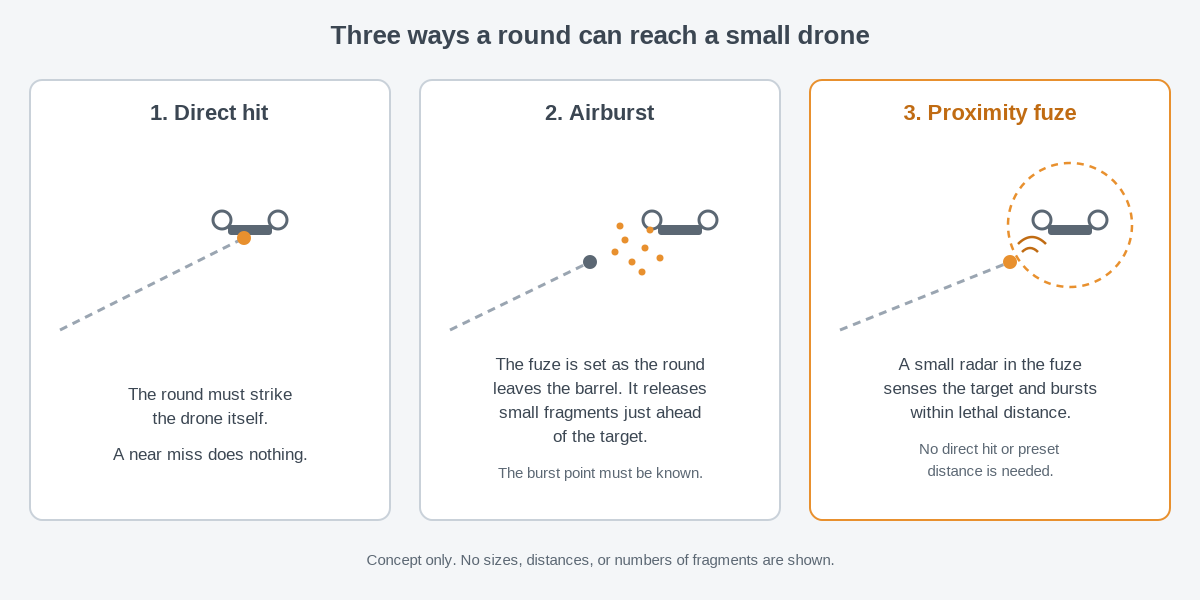
Hitting a small, fast drone directly with a gun round is hard. Older rounds are very lethal, but they must strike the threat to have an effect. When the targets become small, fast aerial threats, even trained crews on systems built for air defense find a direct hit very difficult. So two ways of making a round burst near the target are in use.
The first is the airburst round. It holds many small fragments and carries a programmable fuze. Each round is given a set moment to burst, and it then releases its fragments just ahead of the oncoming target.
Picture a spray nozzle instead of a single jet of water. The real difference is that the round does not spray at random: each one releases its fragments at one set moment, in front of the target.
That set moment is the key. The Army office that handles ammunition for the Bradley infantry fighting vehicle points out that a round bursting at a preset distance needs that distance to be known. The preset assumes the target is not moving, so it does not suit small drones that move. An exact range to a target that moves fast is hard to get.
The second is the proximity fuze. Instead of carrying a burst time set in advance, the fuze itself notices when the target is close and bursts. The details of how it works are in Proximity fuzes: working without a direct hit.
The U.S. Army has already fielded 30 mm proximity-fuzed rounds on its mobile counter-drone system (M-LIDS), on the Marine Corps' MADIS and with partner countries. Building on that, it made the 25 mm XM1228 BADGER.
The round is meant for the M2 Bradley with no change to the vehicle or its weapon. The Army expects it to reach units in 2027. The Army says it raises the number of responses a vehicle can make with the rounds it carries, in other words its depth of magazine.
New gun vehicles
The rounds are not the only thing changing. New gun vehicles are being ordered with drones in mind.
In February 2024, the German armed forces ordered the Skyranger 30 from Rheinmetall, mounted on the eight-wheeled Boxer vehicle. The order covers one prototype and 18 production vehicles, with an option for 30 more, at a gross value of €595 million. It is part of Germany's short-range and very short-range air defense system (NNbS). The test and approval prototype was handed over at the end of January 2025, and production vehicles are planned for 2027 and 2028.
One turret holds a 30 mm revolver cannon, surface-to-air missiles and sensors. In Germany it will first carry Stinger missiles and later switch to a newly developed missile made just for drone defense. The maker says that rounds with a programmable airburst point make the system especially suited to drone defense. The first customer was Austria, which ordered 36, and Rheinmetall says it has also delivered the Skynex air defense system, which fires the same family of airburst rounds, to Ukraine.
The United States has a similar package. The Marine Corps' MADIS uses a pair of Joint Light Tactical Vehicles (JLTV). One carries an XM914E1 30 mm cannon, Stinger missiles and electronic warfare equipment, and the other carries radar plus kinetic and non-kinetic counter-drone equipment. In both countries, the gun is not set apart but packaged with missiles, electronic warfare and sensors.
What guns cannot do
A gun fires only what it carries. As the Gepard showed, when the rounds run out, a factory has to start up again. Smarter rounds ease the problem of direct hits, but an airburst round needs to know when to burst, and a proximity-fuzed round still has to fly to within lethal distance.
In official sources, guns hold one layer among several. The Army counter-drone manual quoted by CRS defines a layered defense as one that gives multiple chances to respond. Ideally it starts at the greatest range from friendly forces, before an attacking drone can release its weapons.
BADGER sits inside the same picture. The Army presents the round as the Bradley's answer at middle and close range. It works alongside tools that reach farther or stay closer, forming a layered defense with both kinetic and non-kinetic tools. In the words of Army Major General David Stewart in October 2024, no single bullet will solve this problem.
How the pieces connect is covered in Counter-drone systems: why one device is not enough, and how to compare costs is covered in The cost of drone defense.
Where this meets lasers
Right next to guns on the Pentagon's list of options sits directed energy. Its best-known form is the high-energy laser (HEL), which uses light as a weapon. The Gepard story led back to an ammunition factory. In the same way, comparisons between lasers and guns come down to two yardsticks: how many shots can be carried and what each response costs.
Official sources do not treat the two as replacements for each other. Lasers, interceptor missiles and guns: how they share the work sets the three side by side. Its four yardsticks are cost, number of shots, weather, and size, weight and power. Laser prototypes aimed at drones continue in "Lasers Against Drones: From Iron Beam to National Prototypes."
What to read next
- Anti-aircraft artillery in the missile age: the long story of air defense guns, from World War II radar and proximity fuzes on.
- Proximity fuzes: working without a direct hit: how a small radar inside a round makes it burst near its target.
- Lasers, interceptor missiles and guns: how they share the work: three ways to defend the sky, side by side on four yardsticks.
- "Using Drones to Catch Drones: Interceptor Drones": launching a drone instead of a round (same series, in progress).