Ocean footage shot from the air, a camera feed from under a bridge, a thermal image of a hillside during a search. Ask who made the small drone behind scenes like these, and many people name one company first. A January 2025 Federal Register notice from the U.S. Department of Commerce puts a number on it. Products from China-based companies make up at least 75% of the U.S. consumer drone market, a figure drawn from a 2021 market analysis.
So who makes the rest? This article puts five companies beside DJI on one map: Autel, Skydio, Teal, Parrot and ACSL, sorted by country and by customer. It then follows how a few U.S. government lists are redrawing that map, and how one battery exposed a supply chain problem.
This article reflects the situation as of October 2026.
Two ways to draw the map: country and customer
An unmanned aircraft system (UAS) is the aircraft, its controls and the link between them, taken as one system. Most companies here build small UAS (sUAS) that fit in a hand or a backpack. The aircraft look alike, but the companies stand in quite different places.
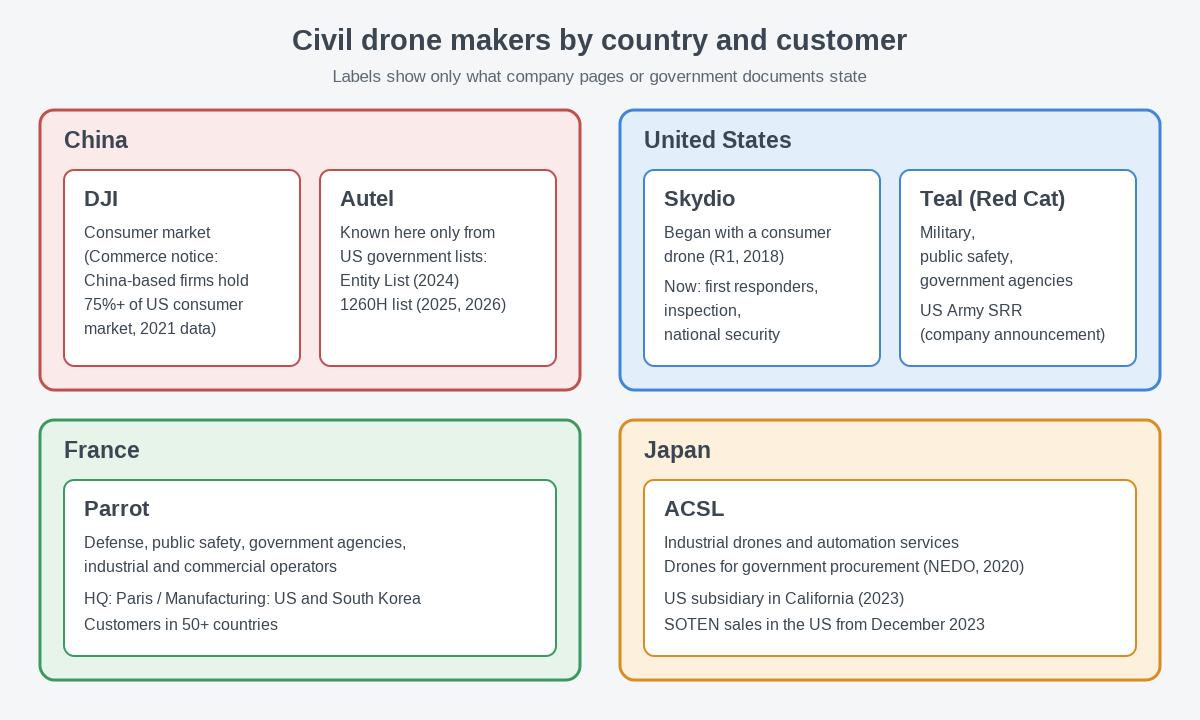
The first measure is country. That means where the headquarters sits and where the products are made, which are not always the same. Parrot, a French company, has its headquarters in Paris but says manufacturing takes place in the United States and South Korea. One nationality label rarely tells the whole story.
The second measure is the customer. Some drones go to hobbyists taking pictures, some to police and fire services, some to companies inspecting their facilities, and some to the military. One company often serves several of these at once, and its center of gravity can shift over time.
China: Autel beside DJI
DJI gets its own article in this series, "DJI: The Company That Built the Civil Drone Market," which is still being written. This section looks at another Chinese name, Autel. Autel's company website did not open for this article, so everything here comes from U.S. government documents.
A final rule from the Commerce Department's Bureau of Industry and Security (BIS), effective June 12, 2024, added "Shenzhen Daotong Intelligent Aviation Technology" in Shenzhen to the Entity List. One of its aliases is "Autel Robotics." The Entity List names parties that need a special license to receive U.S.-origin items.
Two reasons are given. One is sending controlled goods to Russia after it invaded Ukraine in February 2022. The other is obtaining, or trying to obtain, American items that go into unmanned aerial vehicles so that Chinese military bodies could use them.
Every item covered by the Export Administration Regulations (EAR) now needs a license for this company, and applications are reviewed with a presumption of denial. The wider framework is covered in Export Controls: What ITAR and the Wassenaar Arrangement Restrict.
Six months later, on January 7, 2025, the Department of Defense published its list of "Chinese military companies" in the Federal Register. Section 1260H of a defense authorization act requires this list every year, and the 2025 edition includes both "Autel Robotics Co., Ltd." and DJI. Autel Robotics appeared again in the June 10, 2026 notice. This time the stated reason was that it is a "military-civil fusion contributor" to China's defense industrial base.
The companies' own moves also show up in government records. An FCC notice in the Federal Register on February 5, 2026 shows the filings. Autel Robotics had filed an Application for Review of the FCC's decision, and DJI a Petition for Reconsideration.
The United States: Skydio and Teal
Skydio's company page starts with its founders meeting as MIT graduate students in 2009, where they worked on autonomous drone research. Later they helped launch Project Wing, a drone effort at Google, and the company itself was founded in 2014. Its first product, the R1 in 2018, was a consumer drone.
The website looks quite different today. Its menu is built around uses such as drones as first responders (DFR) for police and fire, asset inspection and national security. The product list shows the X10, X10D, R10 and F10. The company says it designs, assembles and supports its products in the United States, and its headquarters is in San Mateo, California.
Teal Drones is a subsidiary of the American company Red Cat. The Teal 2 thermal drone comes out of Teal's own Salt Lake City factory. A December 2023 Red Cat press release names three kinds of users for it: U.S. military units, public safety groups and U.S. government agencies. The release says it is Blue UAS certified and FAA Remote ID approved.
Teal's link to the U.S. Army runs through the Short Range Reconnaissance (SRR) program. Its goal, in Red Cat's words, is to give platoons of 20–50 soldiers small drones they can carry in a rucksack. In December 2023 Teal became one of two finalists, and Teal's founder said the program had started with more than 37 bidding vendors.
On November 19, 2024, Red Cat announced that it had won the SRR Program of Record. Army offices, including the Project Management Office for Uncrewed Aircraft Systems and the Army Test and Evaluation Command, first tested and evaluated Teal's next-generation drone. The aircraft is called Black Widow. The Army's stated acquisition objective is 5,880 systems, a number the company noted may change over the five-year period of performance.
As of October 2026, Teal's website sits under the name "Red Cat Aerial." Its product list now shows products such as the Fang first-person view (FPV) drone alongside the Black Widow and Teal 2. Red Cat also owns Blue Ops, a subsidiary that builds uncrewed surface vessels.
Europe and Japan: Parrot and ACSL
Henri Seydoux founded Parrot in 1994 and is still its chairman, CEO and main shareholder. Its head office is in Paris, and product development happens in Europe. It has been listed on Euronext Paris since June 2006.
Parrot has more than 400 employees and reported €78 million in revenue in 2024. Most of that revenue comes from outside France, and the company sells to governments and companies in more than 50 countries. It names defense, public safety, government agencies and industrial and commercial operators as customers. The product list shows the ANAFI UKR, ANAFI USA and ANAFI Ai, and Pix4D, software that turns aerial photos into maps and 3D models, is also part of Parrot.
Japan's ACSL began in November 2013 in Chiba Prefecture as the Autonomous Control Systems Laboratory. Its headquarters is now in Edogawa, Tokyo, and it makes industrial drones and offers services that automate work with autonomous technology. It listed on the Tokyo Stock Exchange in December 2018. In April 2020 it was chosen for a NEDO program, "Development of Safe and Secure Drone Basic Technology," to develop drones for government procurement.
ACSL set up a U.S. subsidiary in California in January 2023. In December 2023 it delivered 50 SOTEN small camera drones to a U.S. distributor and began selling in the United States. SOTEN was updated to meet FAA Remote ID requirements. ACSL plans to grow U.S. sales as drone buyers pay more attention to economic security.
Government lists redraw the map
Here are the lists so far, side by side. The Commerce Entity List deals with export licenses, the Defense Department's 1260H list designates Chinese military companies, and the FCC Covered List deals with radio equipment authorization. The Blue UAS Cleared List works the other way: it lists aircraft the Defense Department has approved. The names sound alike, but each list does a different job.
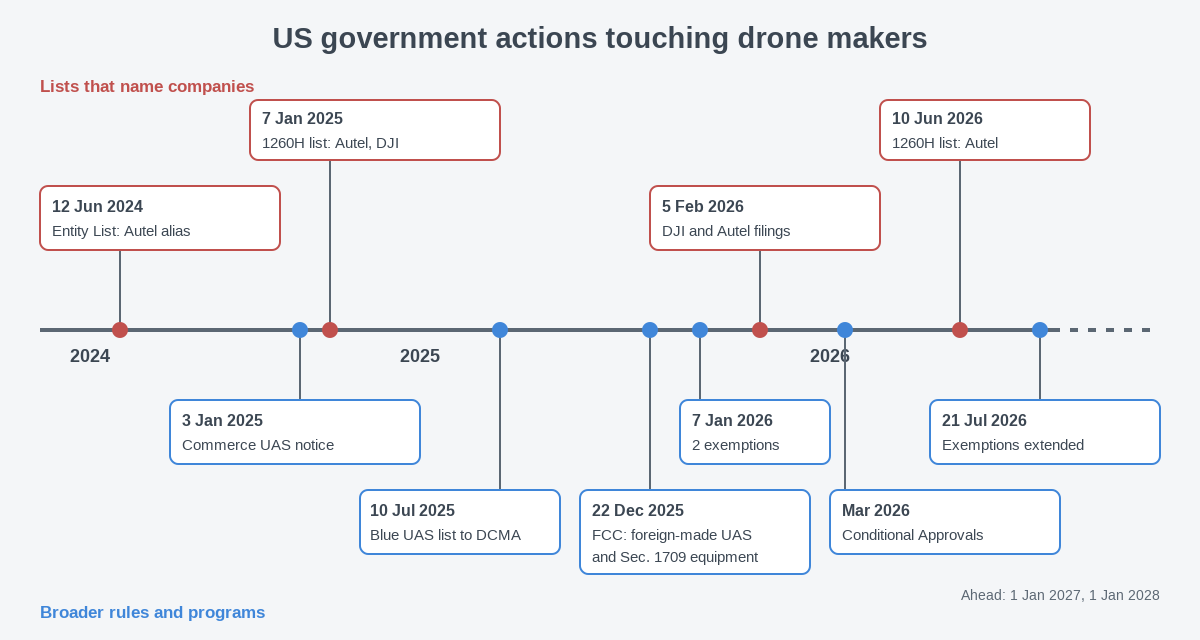
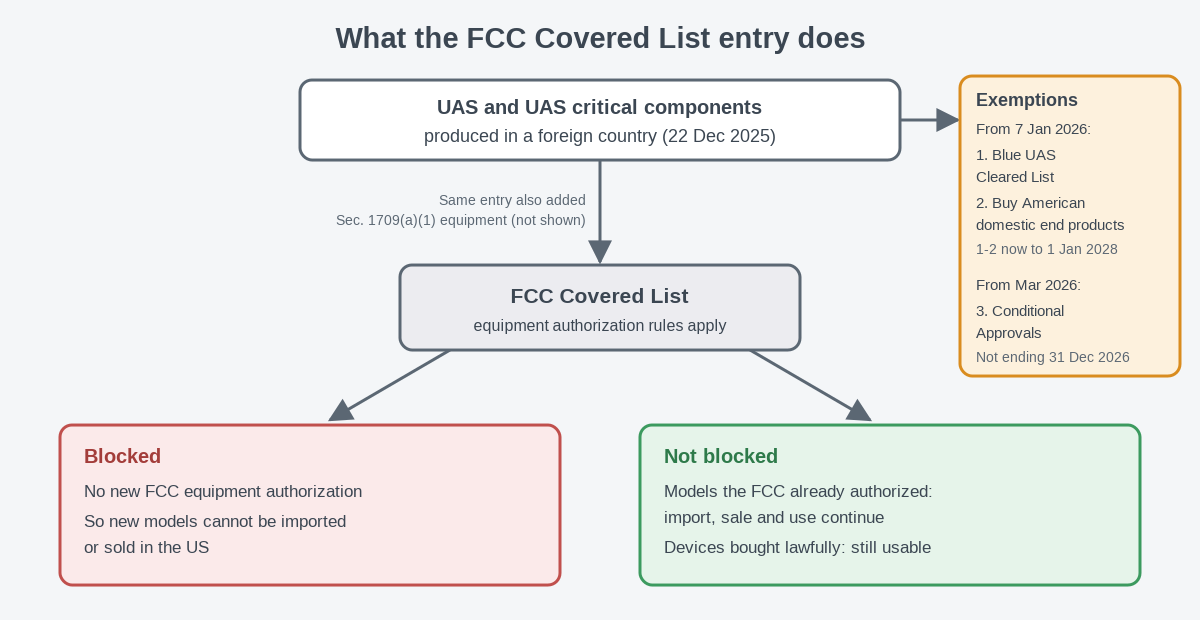
The broadest change came on December 22, 2025. The FCC's Public Safety and Homeland Security Bureau put foreign-made uncrewed aircraft systems, along with their critical components, on the Covered List. The step followed a national security determination by an interagency body of the executive branch.
The same entry also added the communications and video surveillance equipment and services listed in Section 1709(a)(1) of the FY2025 National Defense Authorization Act. Apart from that Section 1709 part, the FCC explained, the newly covered equipment is identified by place of production, not by company. For drones, that means aircraft and parts made in any foreign country.
Equipment on the Covered List cannot receive FCC equipment authorization, and so it cannot be imported or sold in the United States. In effect, the path for new models is closed. That does not ban the aircraft already out there. The FCC explained that it does not block the import, sale or use of models it has already authorized, and that consumers can keep using devices they bought lawfully.
On January 7, 2026, the FCC added two exemptions. One covers aircraft and parts on the Blue UAS Cleared List, and the other covers those that count as "domestic end products" under the Buy American Standard.
At first the exemptions ran until January 1, 2027. A new determination announced on July 21, 2026 keeps these two groups off the list on that date as well. It ends on January 1, 2028.
A third path has opened as well. From March 2026, specific aircraft and parts with a Conditional Approval came off the Covered List one by one. These approvals come from the Department of War (Defense) or the Department of Homeland Security, and more were added several times through June 22. The July 21 determination states that these Conditional Approvals do not end on December 31, 2026.
The Blue UAS list itself is changing hands. It is moving from the Defense Innovation Unit to the Defense Contract Management Agency (DCMA). The move follows a July 10, 2025 memo from the Secretary titled "Unleashing U.S. Military Drone Dominance." What the list is and how it works is the subject of "Blue UAS: The Drones the US Government Approves," another article in this series still being written.
Back on the map, the 2024 actions pointed at company names, while the late-2025 drone action used place of production as the test. Where a company builds its products, and whether they sit on an exemption list, became the fork in the road to the U.S. market.
What one battery showed about supply chains
The United States is not the only government using lists. On October 30, 2024, Skydio CEO Adam Bry posted on the company blog a note he had sent to customers. A few weeks earlier, he wrote, China had announced sanctions on Skydio over its sales of drones to Taiwan. At that time Skydio's only customer in Taiwan was the National Fire Agency.
The problem he described was batteries. Skydio had always built its drones in the United States and had spent heavily for years on parts supply outside China. Batteries were one of the few components it had not yet moved. Battery supply would shrink for the next few months, and new sources were not expected before the following spring, so the company would ration batteries to one per drone.
A drone assembled at home can still stall if a single part is tied to another country. The Commerce Department's January 2025 notice makes a related point. Because China-based firms hold such a big share of the market, it says, China can steer the supply chain and cut off access to drone technology. What powers a drone is explained in Drone Power: Batteries, Engines and Hybrids.
The map of companies has two layers, then. On top sit the company names and headquarters. Underneath run the routes parts travel and the government lists that sit on those routes.
What to read next
- Export Controls: What ITAR and the Wassenaar Arrangement Restrict: the framework behind export license tools such as the Entity List.
- Drone Power: Batteries, Engines and Hybrids: what the battery that troubled Skydio does inside a drone.
- FPV drones: flying through the drone's eyes: what an FPV drone is, a type that also appears in Red Cat's product list.
- DJI: The Company That Built the Civil Drone Market; US Restrictions on DJI: From the Entity List to the FCC; Blue UAS: The Drones the US Government Approves; The Drone Supply Chain: Where Motors, Batteries and Cameras Come From: articles in this series still being written.