
Picture a toy-like drone rising over a neighborhood park. If an army fires a missile costing several hundred thousand dollars to bring down a drone like that, does the math work? That is one of the questions people now ask about air defense.
That is why an old weapon, the gun, is back in the conversation. A weapon that hits targets in the sky with shells is called anti-aircraft artillery (AAA). Guns have stayed on even now that missiles are common, and the reasons come down to cost, short distances and changes in how a hit is made.
What anti-aircraft guns are for
The sky that air defense guns cover is mostly the low sky. In the U.S. Army definition that the Congressional Research Service (CRS) cites, short-range air defense (SHORAD) destroys, neutralizes or deters low-altitude air threats. The aim is to protect key fixed and semi-fixed sites as well as forces on the move, and to let those forces move and maneuver.
This definition covers more than air defense artillery (ADA). Air defense capabilities that are not dedicated to the job are included as well. A gun is one of several means of guarding the low sky.
World War II: what radar and the proximity fuze changed
Targets in the sky were hard from the start. In the history of U.S. Navy fire-control computers by Ben Clymer, anti-aircraft fire control was inherently much harder than fire control against ships. Seen from the firing ship, an aircraft could move at high speed and high angular rates. On top of that, an aircraft also moves up and down.
Radar entered this problem in World War II. It was first used to point searchlights and later to point anti-aircraft guns. The SCR-584, delivered from production by mid-1943, tracked aircraft accurately enough to feed anti-aircraft gun directors directly. How a target found by radar is linked to a gun is covered separately in "Fire-control systems: linking sensors and weapons."
The shell changed a great deal too. The proximity fuze put a tiny radar in each shell so that it would burst close to its target. Some 22 million were made by the war's end, and they came to matter greatly to artillery, above all to anti-aircraft guns. Proximity fuzes are still in use, and how they work is explained in "Proximity fuzes: working without a direct hit".
Cut back, then back in focus
In the early 2000s, short-range air defense slipped down the list of priorities. According to CRS, the U.S. Army cut air defense artillery units to free up people for other kinds of units it saw as more pressing back then. The Army reportedly accepted that risk because it believed the Air Force could keep control of the air.
Then the trend turned. Since 2005, air and missile threats to U.S. ground forces have grown sharply. The use of drones has grown exponentially. The means to guard the low sky were needed again.
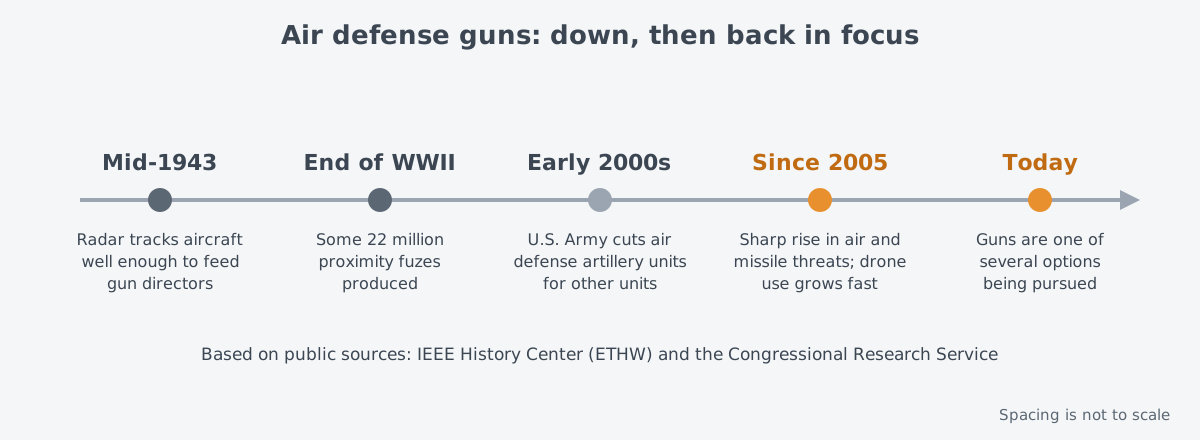
Guns still ride on today's short-range air defense vehicles. The U.S. Army's M-SHORAD (Maneuver Short-Range Air Defense) vehicle is an example. Its Increment 1 turret holds a 30 mm XM914 automatic cannon and a multi-mission radar that can track both ground and air targets.
Cost: an expensive missile for a cheap target?
Missiles are expensive. Depending on the type, CRS puts the procurement cost of one Navy air-defense missile anywhere from several hundred thousand to several million dollars.
A cheap drone makes the math harder. An article on the U.S. Army's official site questions whether it pays to fire a missile worth several hundred thousand dollars at hobbyist drones. It adds that this also creates a readiness problem for higher-value threats. Such missiles suit single targets but should be saved for bigger threats, so in its view cheap kinetic interceptors must be a key part of the defense.
The Department of Defense also sees cost as a key challenge for counter-drone operations. The CRS report on countering drones lists what the department is pursuing: new interceptors that may cost less, gun-based approaches, electronic warfare, and directed energy and high-power microwave weapons. Guns are one branch of that list. No public figure for the price of a single gun round is available, so it is hard to set directly against the price of a missile.
Hitting small targets, and newer ammunition
Guns have their own problem. Legacy ammunition is very lethal but has to hit the threat directly to work. As threats shift to small, fast aerial targets, a direct hit has become extremely hard. Even trained crews on systems built only for air defense struggle with it.
Think of trying to hit a flying tennis ball with another tennis ball. The smaller and faster the ball, the harder it is to make contact. Real shells and drones are far faster and farther away, and the shooter also has to foresee where the target will be when the shell arrives.
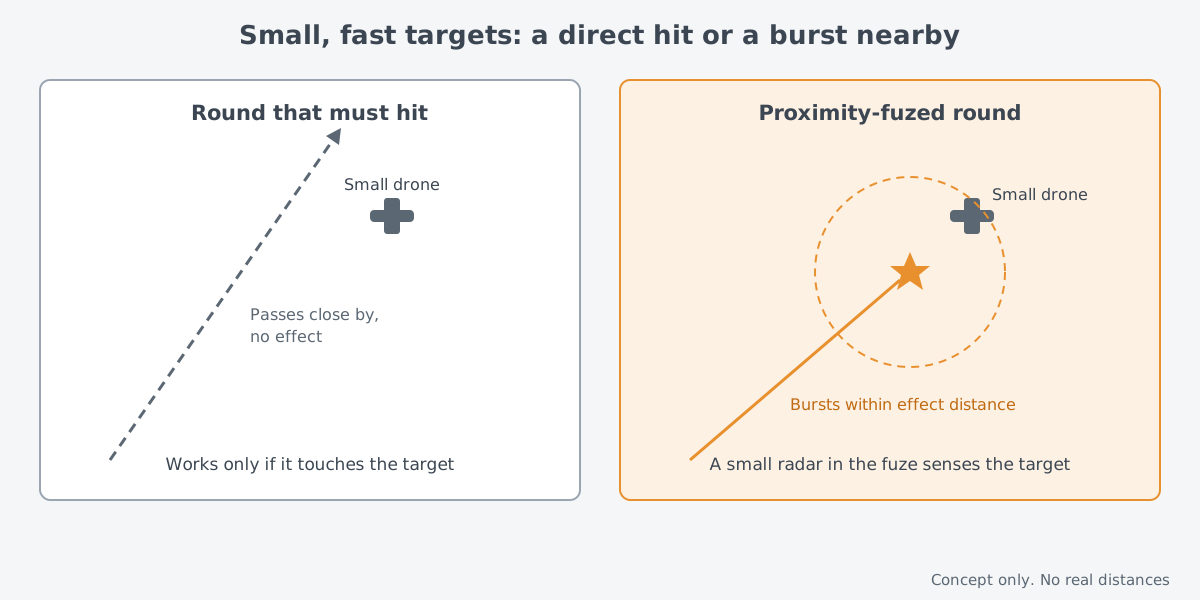
This is where the World War II proximity fuze comes back: a proximity-fuzed round need not strike the target or burst at a preset distance. A small radar in the fuze senses the threat, and the round bursts within a distance where it can have an effect. The CRS paper also reports an Army plan for M-SHORAD Increment 3: a Multi-Mode Proximity Airburst (MMPA) round for the 30 mm gun. It is a multipurpose round for air, ground and personnel targets alike.
One layer among several
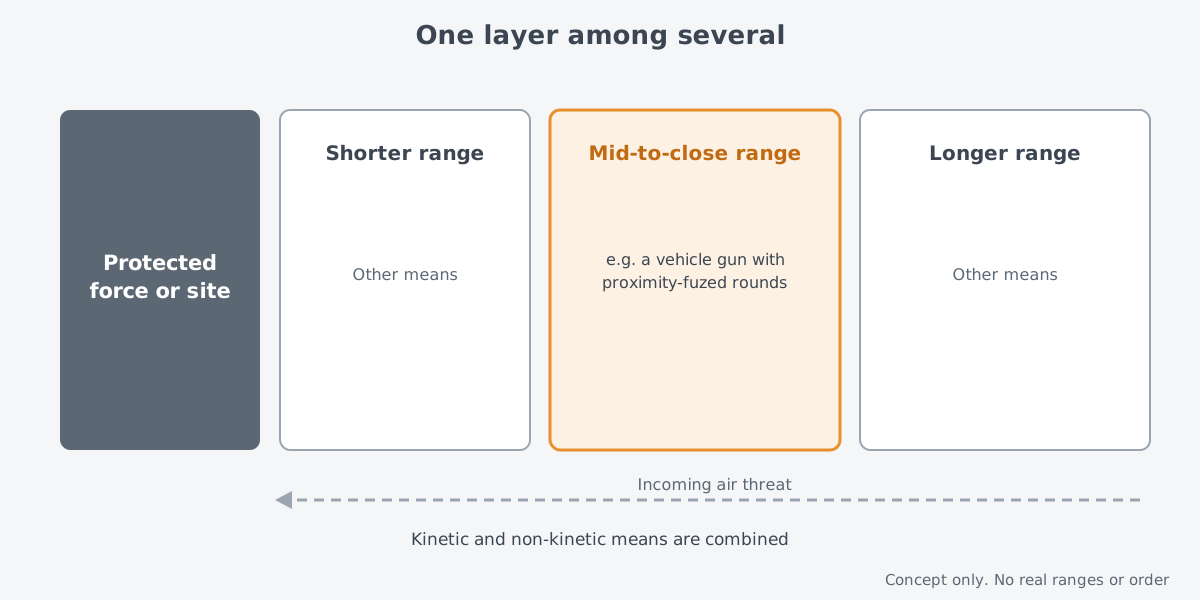
No single gun covers the whole sky. The Army article describes a new proximity fuze round for the Bradley armored vehicle as a countermeasure for mid-to-close range. The round adds to longer-range and shorter-range means, forming a layered defense that combines kinetic and non-kinetic means.
The same gun can serve at sea and on land: the maker RTX (Raytheon) presents its Phalanx as a fast-firing, computer-controlled gun guided by radar. It adds that Phalanx can take on ship-killing missiles and other nearby threats, at sea as well as ashore. On land, it says, the U.S. Army employs it to detect and counter rockets, artillery and mortars. What such a system does on a warship continues in "Close-in weapon systems: a warship's last layer."
Sharing the work with lasers
Missiles and guns alike can fire only what they carry. The list of options the Department of Defense is pursuing also includes directed energy. The best-known example is the high-energy laser (HEL), which uses light as a weapon. How lasers differ from high-power microwaves is covered in "Lasers and high-power microwaves: two kinds of directed energy".
That does not mean lasers push guns aside. The official sources list gun-based solutions, interceptors, electronic warfare and directed energy side by side, and the Army article speaks of a defense that stacks several means in layers. The story of how lasers, interceptor missiles and guns compare continues in "Lasers, interceptor missiles and guns: how they share the work". It uses four measures: cost, rounds carried, weather, and size, weight and power.
What to read next
- "Lasers, interceptor missiles and guns: how they share the work": the three means of defending the sky, set side by side on four measures.
- "Proximity fuzes: working without a direct hit": how a small radar inside a shell makes it burst near the target.
- "Close-in weapon systems: a warship's last layer": the last line of a warship's defense, with sensors and gun tied into one unit.