In 1941, Frank Curry of the Royal Canadian Navy (RCN) kept a diary aboard a small corvette crossing the Atlantic. One entry begins, "What a miserable, rotten hopeless life," and calls staying with a convoy "a full-time job." Veterans Affairs Canada opens its account of the Battle of the Atlantic with these lines.
The fight Curry lived through was the Battle of the Atlantic. It began in September 1939 and ran without a break until Germany's defeat in 1945, the longest campaign of the Second World War.
On one side were German submarines, the U-boats, hunting merchant ships. On the other were convoys, groups of merchant ships sailing together under guard.
Why did this sea route matter so much? And why did a struggle the Allies had been losing turn around in May 1943? This article follows both questions through public records, and looks at why the loss figures differ from one source to the next.
An island that lived by the sea
Britain is an island. In the Second World War it depended on supplies from North America and across the Empire, and almost all of them had to cross the Atlantic in merchant ships. At sea, those ships could be attacked by German submarines and warships.
The German Navy saw that cutting this chain could cripple Britain, and while its surface fleet was small, its submarines were among the most advanced in the world. Robert Rumble, a curator at Imperial War Museums (IWM), says the German Navy prepared for a war of attrition in 1939. Karl Dönitz, he adds, pushed for submarines to sink British cargo ships. The name U-boat comes from Unterseeboot, the German word for submarine, meaning "undersea boat."
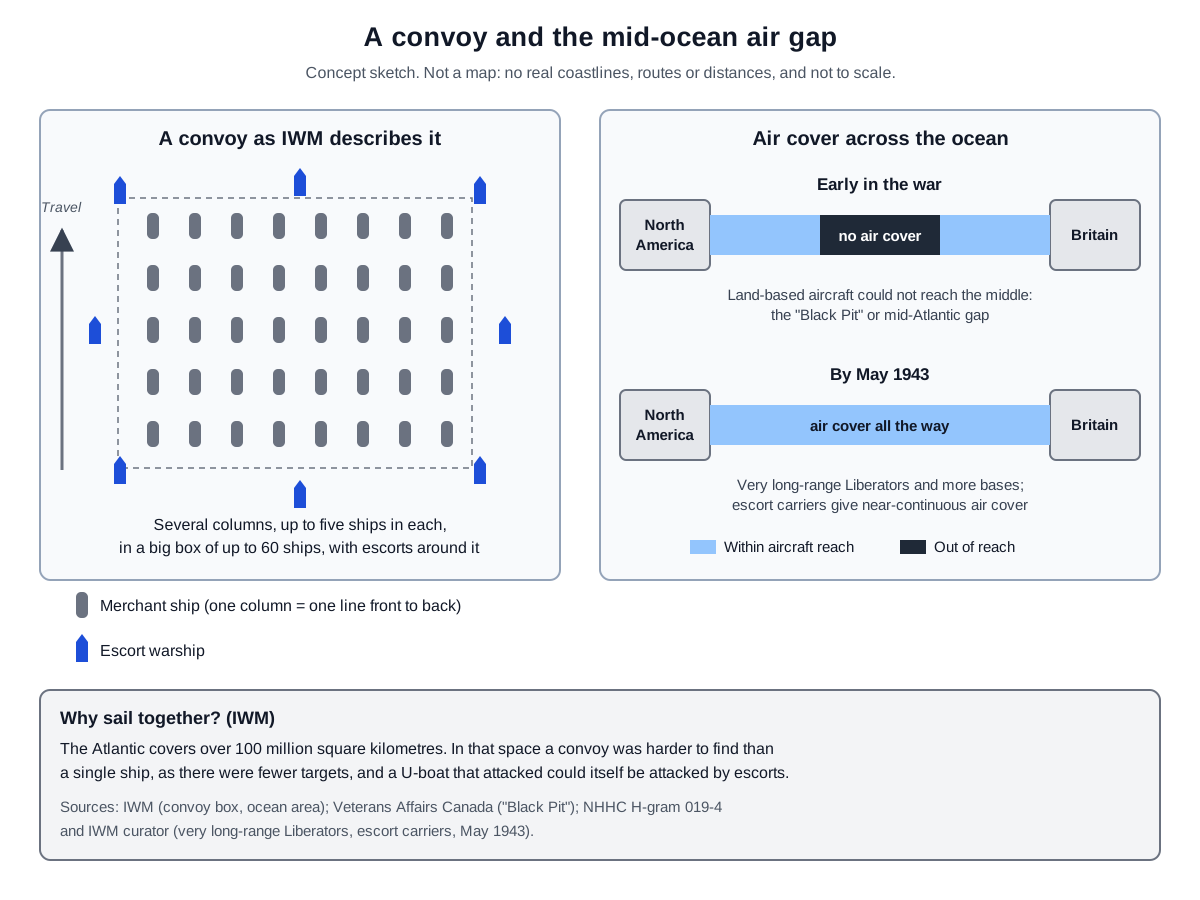
The answer to the threat was the convoy. Merchant ships were grouped together and escorted by warships and, when possible, by aircraft. The first Atlantic convoy sailed on 2 September 1939. The first convoy from Halifax, Canada, was HX-1, which sailed on 16 September.
What did sailing together achieve? When ships gather in one place instead of spreading across the ocean, there are fewer targets, so a convoy was harder to find than a single ship sailing alone. A U-boat that attacked a convoy could also be attacked by its escorts. Convoys sailed in several columns, with up to five ships in each column, forming a big box of up to 60 ships.
The lesson of 1917
This fight had a forerunner. From 1914, Germany waged a U-boat campaign against merchant shipping that almost brought Britain to its knees in 1917. On 4 February 1915, Germany declared a war zone around Britain and sank merchant ships inside it without warning. It dropped this unrestricted submarine warfare on 1 September 1915, then resumed it on 1 February 1917.
The new blockade nearly succeeded. Between February and April 1917, U-boats sank more than 500 merchant ships. Britain's countermeasures came slowly, and the most important of them was the convoy, with merchant ships grouped together and protected by warships.
The lesson did not carry over neatly. The overview by the US Naval History and Heritage Command (NHHC) notes that, as in the First World War, some naval leaders were slow to react to the submarine threat. Convoys had proved vital in 1917–18, yet in early 1942 American officials waited months before insisting on them.
1939–1941: the first convoys and the "happy time"
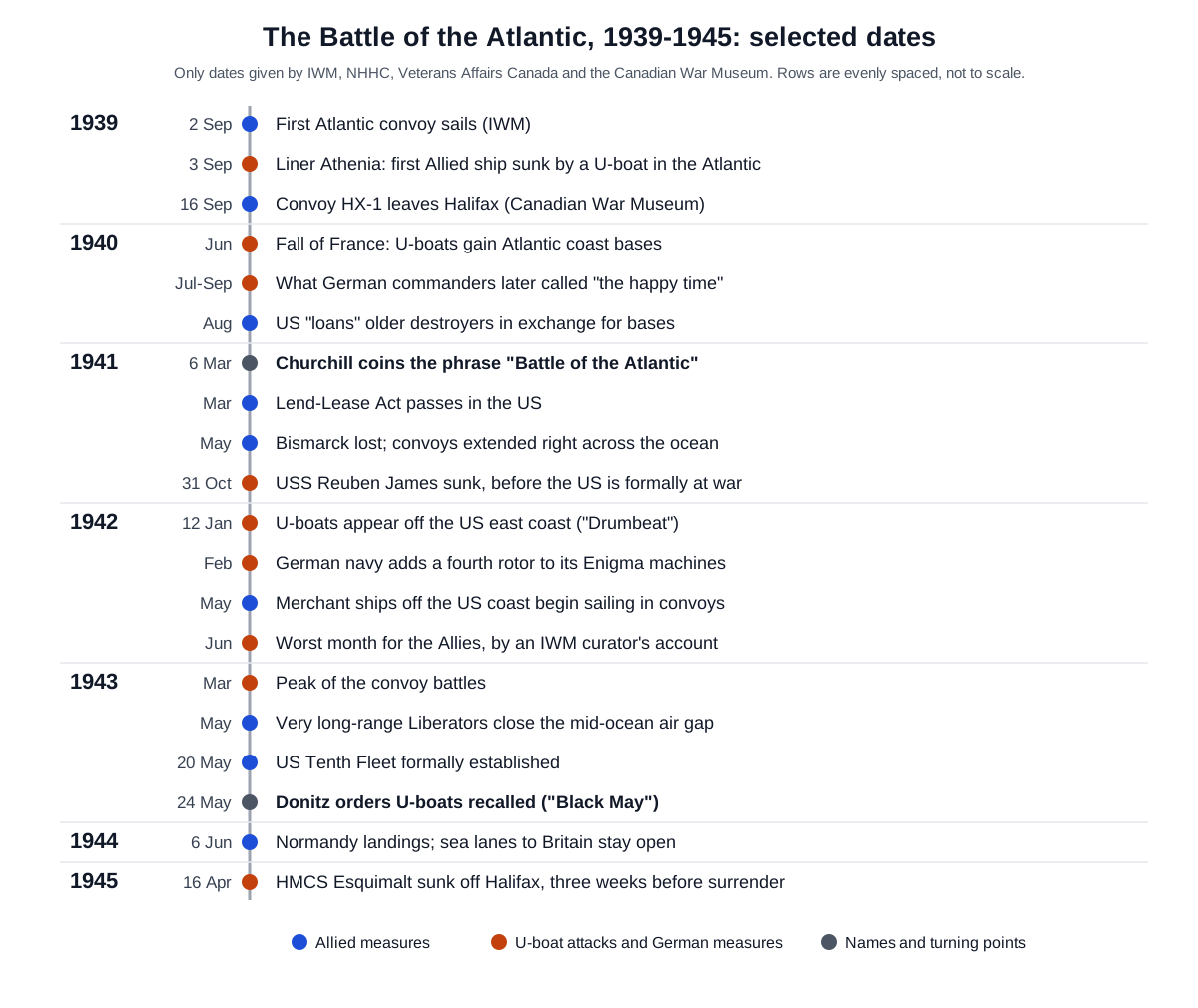
The war at sea began on the first day. On 3 September 1939, the British liner Athenia became the first Allied ship sunk in the Atlantic by a U-boat.
The fall of France in June 1940 changed the picture. With bases on the French Atlantic coast, U-boats could reach farther and stay at sea much longer. German naval commanders later called July to September 1940 "the happy time," and heavy losses went on into early 1941.
Groups of U-boats, the "wolf packs," also appeared around this time. Veterans Affairs Canada records that U-boats first used these tactics in September 1940, attacking convoys from North America to Britain in groups at night. Up to 20% of a convoy's cargo ships were sunk. IWM gives a slightly different timing: it says U-boat production rose in spring 1941, giving Germany enough submarines to form such groups.
By spring 1941, Britain was in the middle of an Atlantic crisis. Merchant ships were going down by the hundred, and at that rate Britain could lose a quarter of its fleet within the year. In the IWM video's account, Britain could build only 1.25 million tons of shipping a year. If the losses of March and April 1941 continued, it would lose 7.3 million tons by the year's end.
The battle got its name in these months. Winston Churchill coined the phrase "Battle of the Atlantic" on 6 March 1941. The name deliberately echoed the Battle of Britain to stress how much was at stake.
In May, the loss of the German battleship Bismarck ended surface raids. The Allies extended the convoy system right across the ocean. Intelligence successes let them route convoys away from danger, and losses finally fell.
The United States, not yet in the war, was already helping Britain. In August 1940, President Franklin Roosevelt arranged a "loan" of older destroyers in exchange for the use of British bases in the Western Hemisphere. In March 1941, the Lend-Lease Act passed, letting Britain receive equipment and supplies first and pay later. On 31 October 1941, U-552 sank the destroyer Reuben James, the first US Navy ship lost to enemy action in the war.
Canada's role grew too. On 31 May 1941, Commodore Leonard Murray took command of the Newfoundland Escort Force. The best known of the new ships joining the Canadian fleet was the corvette. Designed for coastal patrol, it was sent across the ocean only because nothing else was available, and its crew of about 60 lived in intolerably crowded conditions.
The sky still had an empty patch. Aircraft at this time could not reach the middle of the ocean. That stretch, where U-boats often inflicted heavy losses, became known as the "Black Pit."
1942: the American coast and the gap in mid-ocean
After the United States entered the war in December 1941, the battle shifted the next month to the Canadian and American coasts. U-boats announced themselves off the US east coast by sinking the steamer Cyclops on 12 January 1942. This was the German operation known as Drumbeat.
The US Navy was poorly prepared for the assault. Tankers and freighters often sailed alone, and at night their outlines showed against the lights of coastal cities. The Navy also lacked the destroyers and subchasers to guard the coast and escort convoys at the same time.
For the U-boats, these months were the "Second Happy Time." For the Allies, they were a near-disaster that cost more lives, and many more ships, than the attack on Pearl Harbor. From May, merchant ships off the US coast began sailing in convoys, and the U-boats moved on to the Gulf of Mexico and the Caribbean.
The wolf packs then returned to the middle of the Atlantic. By the fall of 1942, Dönitz had nearly 300 submarines available, over ten times the number he had in 1939. A period when the Allies could not read German signals left Allied shipping in crisis by the end of 1942.
There was a reason the signals went dark. In February 1942, the German navy added a fourth rotor to its Enigma cipher machines. Partly as a result, Atlantic convoy losses in the second half of 1942 were three times those of the same period in 1941.
The other side had its own window. From 1941 into most of 1943, the German naval radio intelligence and code-breaking service, B-Dienst, read British convoy codes fast enough to act on them. The British did not know this, and only changed their convoy-routing code in June 1943.
May 1943: the tide turns
The peak came in March 1943. That month U-boats sank 567,000 tons of Allied shipping, and in one ten-day stretch alone 40 merchant ships went down. These figures come from the NHHC director's essay; Veterans Affairs Canada puts the same month at 108 ships and 569,000 tonnes.
Yet two months later the tide had turned. On 24 May 1943, Dönitz ordered his U-boats recalled. According to the IWM video, 34 U-boats were sunk in this "Black May."
What changed? The NHHC director writes that many factors caused the sudden shift in May 1943, and that calling any one of them decisive would not be accurate.
The first factor he names is air power. More long-range aircraft flew from more bases around the Atlantic and from a growing number of escort carriers. Very long-range versions of the B-24 Liberator closed the gap in mid-ocean.
The numbers of ships built and ships lost also traded places. By May 1943, US shipyards were turning out far more ships than Germany could sink, and Germany was losing submarines faster than its yards could replace them. This shift lay behind Dönitz's recall order.
On intelligence, the institutions put the weight in different places. The NHHC director holds that during the May turning point, Allied intelligence on U-boats was at its weakest point of the whole war. Other factors and technologies matured at the same time. The IWM video says the Allies cracked the Enigma code at the end of 1942 and used it to steer convoys away from wolf packs.
IWM sums it up briefly: aircraft carriers, very long-range aircraft and roving "support groups" of warships finally defeated the U-boats at the end of May 1943.
The fight still did not end. Dönitz had more than 200 submarines left. Germany made no concerted effort to resume submarine operations in the Atlantic until the fall of 1943, and from then on it was almost always on the defensive.
U-boats fitted with snorkels kept up their attacks in British and Canadian coastal waters to the end of the war. On 16 April 1945, three weeks before the German surrender, the Canadian minesweeper HMCS Esquimalt went down near Halifax.
Sound, radio, codes and shipyards
The Battle of the Atlantic was also a race in technology. The main Allied tool for finding submerged submarines was Asdic. Later called sonar, it located submarines under water using sound waves.
Asdic needed a highly trained operator to work well. At first it was useless when U-boats attacked on the surface at night. U-boats came up often for a reason. Their diesel-electric engines needed long periods on the surface to draw in air for the diesels, and under water they ran on batteries with only a short range.
Aircraft went after that time on the surface. As more anti-submarine aircraft carried airborne radar, they could attack even at night, when U-boats preferred to surface to recharge their batteries. One German answer was the schnorkel. It let U-boats charge their batteries under water and remain under water for as long as ten days.
Radio mattered in another way, too. Believing their codes were safe, the Germans sent many radio messages. Even when the Allies could not read the contents, traffic analysis and radio direction finding gave clues. Led by the British, the Allies rushed high frequency direction finding (HF/DF) onto ships and aircraft.
Each new weapon drew a reply. Germany developed torpedoes that used acoustic homing to follow the noise of a ship's propellers. Allied scientists answered within 17 days with a noise-maker towed behind a ship, which drew the torpedo harmlessly away.
Ships helped fill the gap in the sky as well. Escort carriers, often built on merchant ship hulls, were slower than large carriers and carried fewer aircraft. But they were cheap and quick to build, which suited them to giving slow convoys continuous air cover. Some tankers and grain ships were also given a flight deck and became Merchant Aircraft Carriers (MACs).
The shipyards were a battlefront of their own. The output of Allied shipyards was an important reason the tide turned. By mid-1943, it was plain that U-boats could no longer sink ships faster than new ones were launched, however many they sank.
Organization changed too. The US Tenth Fleet, formally set up on 20 May 1943, was a fleet with no ships assigned that took charge of the US Navy's anti-submarine war in the Atlantic. Civilian scientists went out on convoy and anti-submarine missions to watch sailors and aviators at work, and closely analyzed the statistics of each engagement. The average number of U-boats at sea each day fell from 108 in May 1943 to 51 in August, a count that covers the Atlantic and Indian Oceans.
Reading the numbers
Battle of the Atlantic figures are hard to quote as they stand. The NHHC director himself warns that its statistics should be taken with a grain of salt, because sources count things in different ways. The chart below keeps each figure with its source.
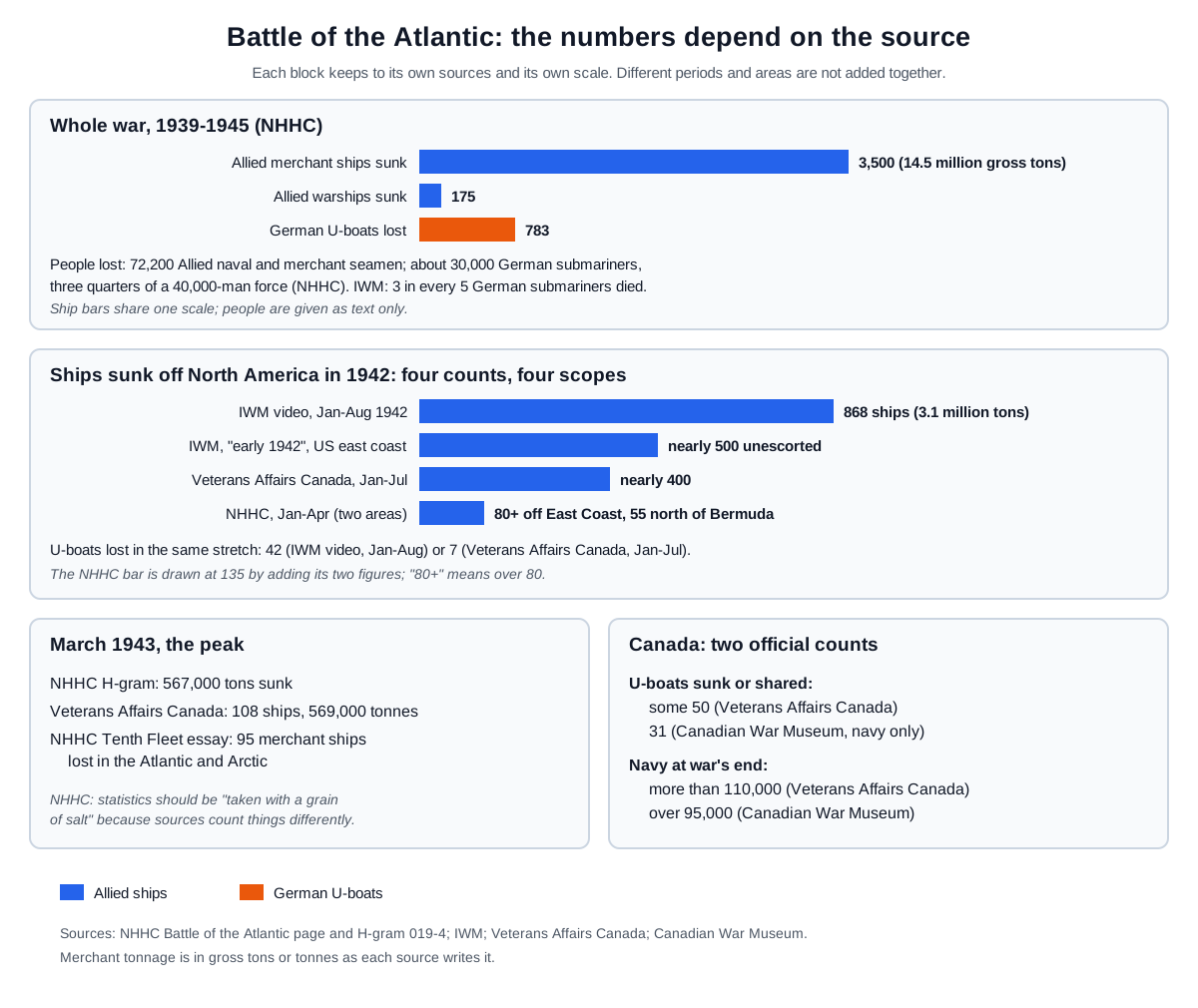
Start with the overall scale. By the NHHC count, from 1939 to 1945, 3,500 Allied merchant ships (14.5 million gross tons) and 175 Allied warships were sunk, and 72,200 Allied naval and merchant seamen died. Germany lost 783 U-boats and about 30,000 sailors, three quarters of a 40,000-man submarine force. In the IWM video's words, three out of every five German submariners died.
Even 1942 off North America comes with four different numbers. An IWM article gives nearly 500 unescorted ships sunk off the US east coast in early 1942. The IWM video gives 868 ships (3.1 million tons) for January to August.
Veterans Affairs Canada gives nearly 400 for January to July, and the NHHC overview gives over 80 off the East Coast and 55 north of Bermuda for January to April. The periods and sea areas differ, so the figures cannot be added up or merged into one.
The U-boats Germany lost over the same stretch also differ: 42 (IWM video, January to August) or 7 (Veterans Affairs Canada, January to July). March 1943 is counted in different units as well. The NHHC director uses tonnage, Veterans Affairs Canada gives ships and tonnes, and the NHHC Tenth Fleet essay counts 95 merchant ships lost in the Atlantic and Arctic.
Canadian figures vary between institutions too. Veterans Affairs Canada credits Canadian ships and aircraft with sinking, alone or with others, some 50 U-boats; the Canadian War Museum, counting the navy alone, gives 31. For the navy's size at the war's end, Veterans Affairs Canada gives more than 110,000 members and the Canadian War Museum over 95,000.
Behind the numbers are people. The RCN lost about 2,000 people, most of them in the Atlantic. Canadian merchant sailors had a casualty rate of one in seven, higher than any of Canada's fighting services, and about 1,500 died. The Merchant Navy Book of Remembrance lists nearly 1,600 names, so even within one institution the count changes with what is included.
What it left
The sea lanes opened by summer 1943 shaped the war on land. IWM's curator explains that open routes between Britain and North America proved crucial for the D-Day invasion and the liberation of Europe over the next two years. The landings took place on 6 June 1944, and the Canadian navy sent many of its best escorts into the English Channel to support them.
By the middle of 1943 the tide had turned, and Allied planners could plan their land campaigns in Europe with more confidence. In the end, six years of fighting were about a supply route, the road of logistics.
Germany's new submarines came too late. By 1945, the German navy had built the fully submersible Type XXI "Electro-boat," but IWM's curator judges it too little, too late.
Lessons remained as well. Technologies such as sonar and radar gave escorts an advantage only after crews had enough time to train with them. There were disputes over whether to put the "defensive" job of protecting merchant ships ahead of the "offensive" job of attacking submarines, though both served the same strategic goal. And the work of scientists and sailors studying statistics together later helped the US Navy develop operational research.
So did memory. A memorial in Point Pleasant Park, Halifax, lists 3,257 Canadians, men and women from both world wars, who lie at sea. Its inscription notes that their graves are unknown and promises that they will be remembered.
What to read next
- Sonar: why sound is used to see underwater: the principle of finding things with sound, which grew out of Asdic.
- Diesel-electric, AIP and nuclear submarines: why U-boats had to surface, and how submarine propulsion developed later.
- Heavyweight torpedoes: how they differ from lightweight ones: the submarine's main weapon, in today's categories.
- Radar: measuring distance and motion with radio waves: the basic principle behind the radar carried by anti-submarine aircraft.
- Destroyers and frigates: why warships have different names: where the names of the escort ships come from.
- Aircraft carriers: turning a ship into an airport: how carriers work, following on from the escort carrier.
- Military logistics: performance must be sustainable: why supplying forces can decide operations.
- Measuring with lasers: range finding and lidar basics: measuring distance with light instead of sound or radio.
- The Battle of Britain: An Air Defense Built on Radar and Control: the battle Churchill echoed when he named the Battle of the Atlantic.