On August 23, 1942, German troops reached the bank of the Volga north of Stalingrad. That evening German aircraft appeared over the city. A little over five months later, on February 2, 1943, the last German group still holding out around the city's tractor factory sent its final radio message.
By then the city lay almost entirely in ruins. Imperial War Museums (IWM) counts Stalingrad among the most decisive battles on the Eastern Front in the Second World War. Yet the German summer offensive was first aimed at oil, not at this city. How did a side objective end up at the center of the fighting?
A summer offensive aimed at oil
In the summer of 1942 Hitler launched a major offensive into southern Russia. Its aim was to destroy what was left of the Soviet Army and, in the end, take the oilfields of the Caucasus. It was called Operation Blau.
When the first advance went well, Hitler divided the southern army group into two to move faster. Army Group A headed for the Caucasus oilfields, and Army Group B headed for Stalingrad. Historian Yan Mann, writing for The National WWII Museum, explains that Stalingrad was not the focus of German planning at first; oil was the goal.
The offensive was not Germany's alone. For the 1942 campaign Romania sent 27 divisions, Hungary 13 and Italy 9, some 440,000 men in all. Most of them served with Army Group South and guarded the flanks of the German Sixth Army as it moved on Stalingrad.
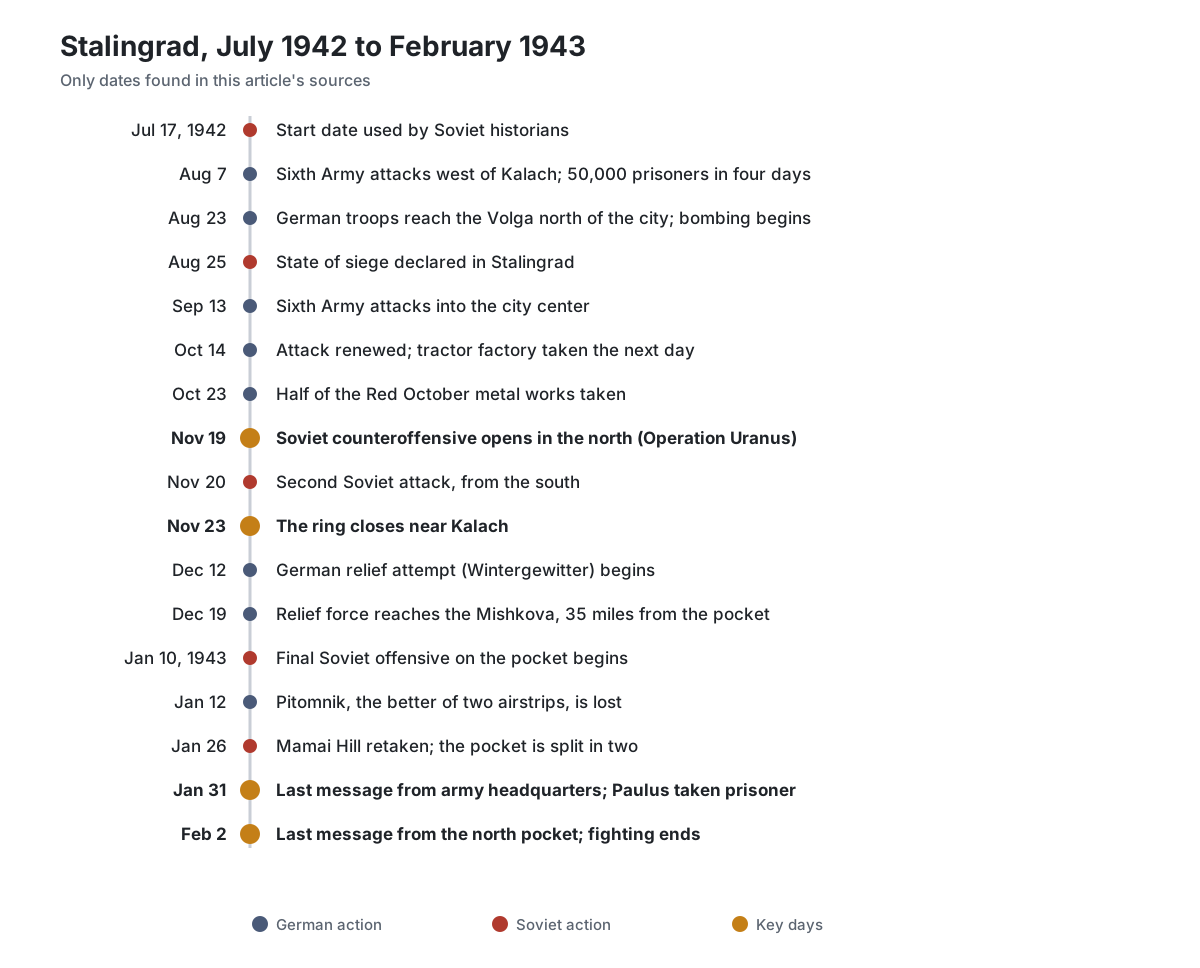
The advance slowed as it went. Friedrich Paulus's Sixth Army covered 55–70 km during the second half of July, or 4–5 km a day. From August 1 to 19 it managed 30–35 km in all, or 1.5–1.75 km a day. Along the way, on August 7, it surrounded forward Soviet units west of Kalach in the bend of the Don and took 50,000 prisoners in four days.
The city on the Volga
Stalingrad stands on the high west bank of the Volga, 560 miles from Moscow. It stretches along the river like a crescent 15 miles long from north to south. It also carried the name of the Soviet dictator, Joseph Stalin.
Soviet historians date the start of the battle to July 17, 1942, but German troops reached the city itself in late August. The German XIV Panzer Corps broke out on August 21 and in three days pushed a thin spearhead to the Volga north of the city. The day German troops reached the riverbank is recorded as August 23. On August 25 the Soviet high command, the Stavka, declared a state of siege in the city and began to evacuate all civilians.
The city kept making weapons while it fought: T-34 and T-60 tanks built in and around Stalingrad went to tank battalions as soon as they left the factory. On the approaches to the city, though, many tanks were lost to breakdowns. In one case, twelve Soviet tank brigades lost 326 tanks in six days, and 200 of those losses were breakdowns. What goes into a tank as a machine is covered in Main battle tanks.
Fighting for blocks, buildings and floors
On September 13 the Sixth Army attacked into the center of the city. Earlier, its lead corps had aimed at Mamai Hill. At 300 feet high, it is the most prominent feature in the middle of the city.
For the next two months the fighting kept the same shape. Stalingrad to Berlin, Earl F. Ziemke's history published by the US Army Center of Military History, describes it as a bloody struggle in which single blocks and buildings became major military objectives. Sometimes the two sides held different floors of the same building.
On October 14 Paulus renewed the attack. Soviet historians see the next two weeks as the most bitter of the whole battle. On the second day German troops took the tractor factory in the northern part of the city and reached the Volga, splitting the Soviet bridgehead in two. On October 23 they took half of the "Red October" metal works.
By October most of the city was in German hands. Even so, Soviet troops held on to the Volga bank and ferried reserves over from the far side.
In November the way the river freezes became important. Most Russian rivers freeze solid from bank to bank in a few days, but the lower Volga does not. It first forms slush and then floating ice, and at the latitude of Stalingrad it takes weeks, sometimes months, to freeze over.
All that time the Soviet 62nd Army defending the city had to get all of its supplies and replacements from across the river. By the time the freeze began, the 62nd Army under Vasili Chuikov held only two bridgeheads.
November 19: the encirclement
The Soviets waited for the Allied landings in North Africa and for the ground to freeze hard enough to carry tanks, then opened the offensive on November 19, 1942. Snow had been falling since midnight, so heavily that nothing could be seen.
The blow fell not on the Germans but on the allies guarding their flank. At 8:50 a.m., after about an hour and a half of artillery fire, the Soviet 5th Tank Army and 21st Army attacked the Romanian Third Army. The Romanians, who had taken over the Sixth Army's front west of the Don, had no antitank weapons heavier than 47 mm. The next day, November 20, the 57th and 51st Armies broke through the Romanian VI Corps south of the Beketovka bridgehead.
The two thrusts met by the Don. Late on November 23, the Soviet IV Tank Corps, which had crossed the Don and covered the ten miles in between, met the IV Cavalry Corps and closed the ring. The US Army history names the meeting place as Sovetskiy, while the Reagan Library article from the US National Archives (NARA) names Kalach.
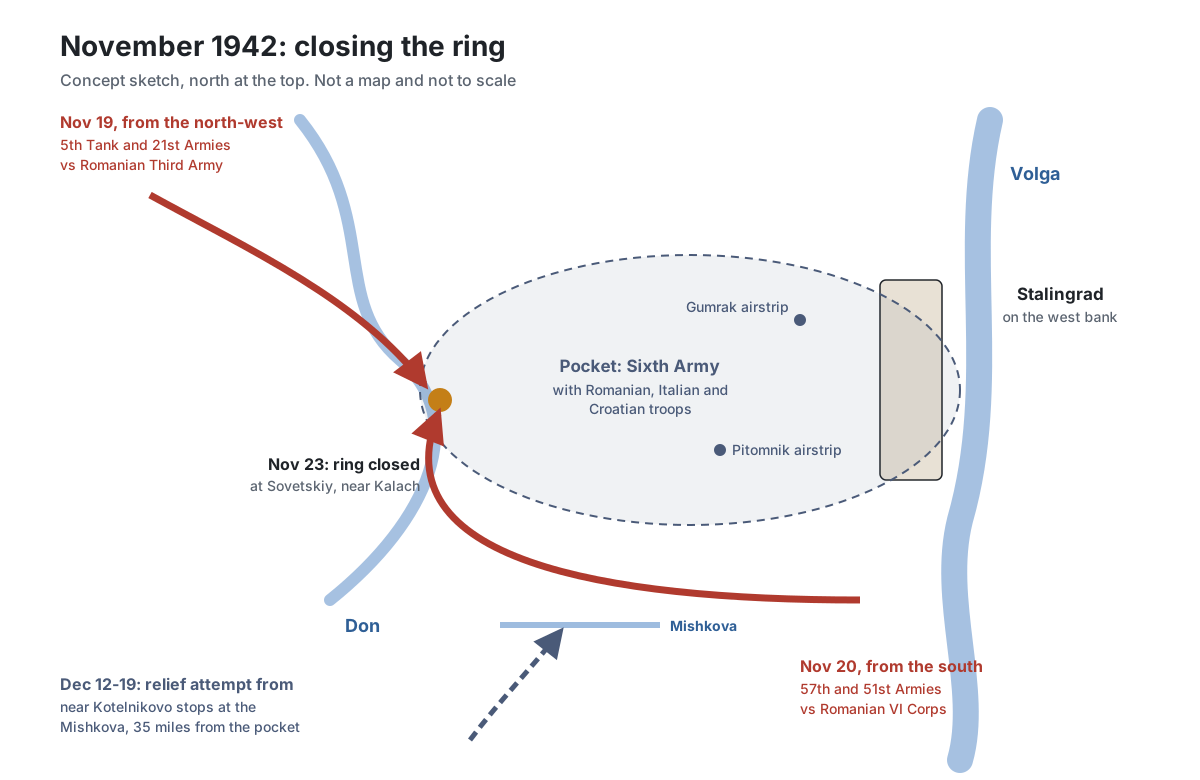
This was Operation Uranus, launched in mid-November by Georgy Zhukov and Aleksandr Vasilevsky, two Soviet generals. Inside the ring, the German Sixth Army was trapped together with Romanian, Italian and Croatian troops.
The counterstroke did not appear overnight. On October 9 an order ended dual command, under which political commissars could challenge commanders. On October 16 another order allowed tank and mechanized formations to be used on their own. Yan Mann sees these decisions as part of the planning for Operation Uranus, which took weeks of preparation.
Supply by air and the relief attempt
Hitler forbade the Sixth Army to break out. His decision to hold rested on two assumptions. A relief force could be gathered outside, and until then the Sixth Army could be kept going by supply from the air.
There were not enough aircraft from the start. On November 25 Wolfram von Richthofen, commander of the Fourth Air Force, reported that he had 298 Ju 52 transports and needed 500 to supply Stalingrad. A Ju 52 carried 1 ton, and the He 111, a twin-engine bomber pressed into use as a transport, carried at most 1,000 pounds. On November 29, 38 Ju 52s and 21 He 111s took off, and 12 Ju 52s and 13 He 111s landed inside the pocket.
The promises were not one number either. Paulus wrote to Erich von Manstein that the first three days of air supply had brought only a fraction of the promised 600 tons a day. Another passage of the same book gives the promised amount as 300 tons a day and puts it at about half the Sixth Army's daily need. The NARA article says 700 tons a day were needed to supply the 270,000 men left inside.
Far less actually arrived. From December 1 to 23 the average was 90 tons a day, and in the first three weeks of January it was 120 tons a day. Only one day, December 7, reached 300 tons. Why keeping forces supplied matters as much as performance is the subject of Military logistics.
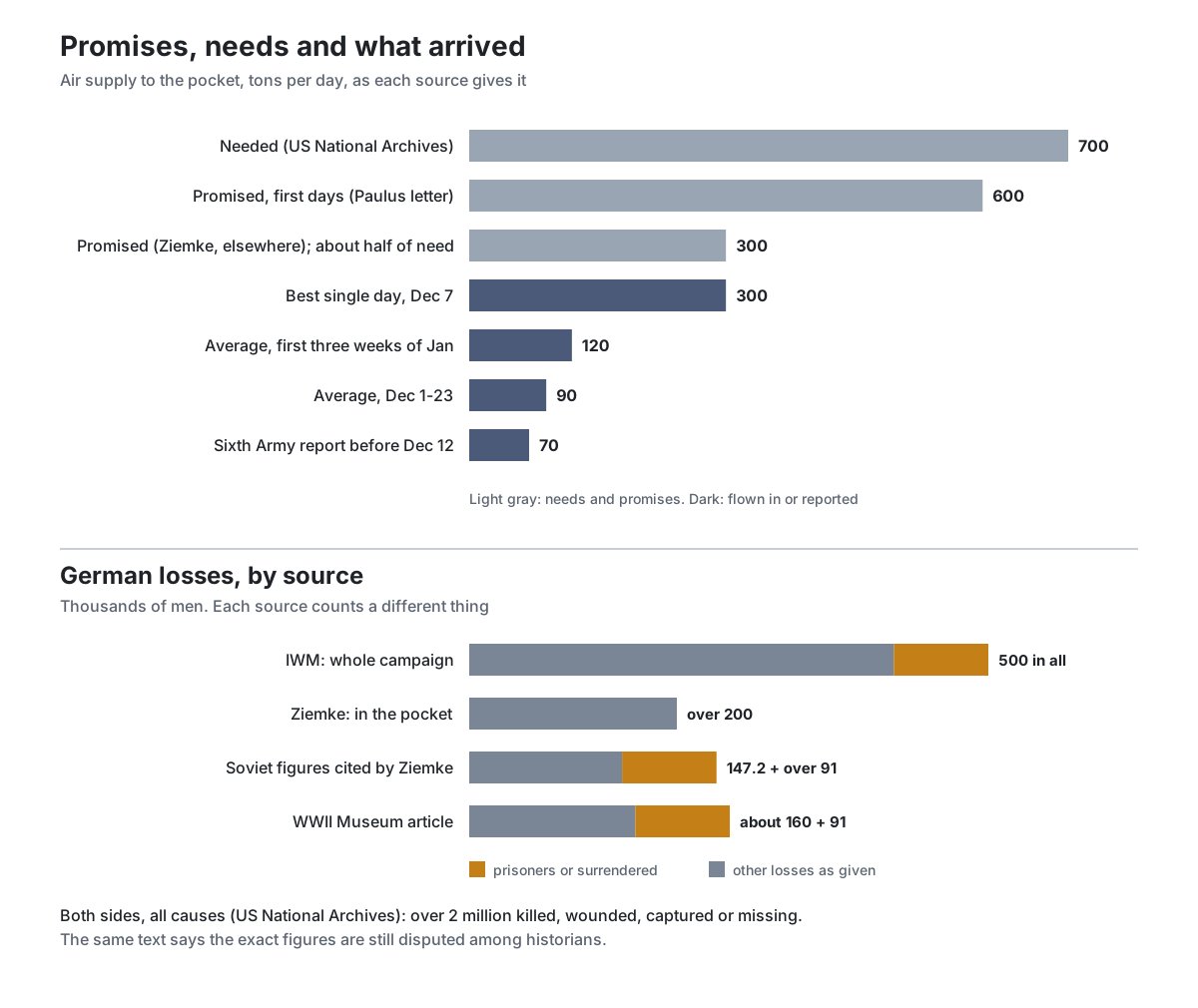
The relief operation outside was called Wintergewitter, or Winter Storm. Manstein's Army Group Don planned to push from near Kotelnikovo toward Stalingrad, and the LVII Panzer Corps set off on the morning of December 12. By then the Sixth Army was reporting that only 70 tons a day had been flown in on average.
On December 19 the relief force reached the Mishkova River, 35 miles from the pocket. After two days of fighting it still could not get beyond the river. The Sixth Army inside and the relief force outside never met.
January 31 and February 2
In early January the Soviet Don Front, which faced the pocket, had 281,000 men and 250 tanks by Soviet figures. After the Sixth Army rejected surrender demands on the two days before, the final offensive began on January 10. On January 12 the Sixth Army lost Pitomnik, the better of its two airstrips. Once Gumrak was lost as well, supplies dropped from the air were the only way left.
On January 26 the Soviet 62nd Army retook Mamai Hill. The same day, tanks of the 21st Army arrived from the west and linked up with it, splitting the pocket into a northern and a southern part.
At 6:15 a.m. on January 31, Sixth Army headquarters, in the basement of a department store on Red Square, radioed that the Russians were at the door. About an hour later its last transmission came through. Paulus had been promoted to field marshal the day before, and he became the first German officer of that rank ever taken prisoner.
In the north, around the tractor works, the 33,000 men of XI Corps held out for another 48 hours. At 8:40 a.m. on February 2, Army Group Don received the last message from the north pocket. That day the whole city surrendered, and the remaining 91,000 Axis soldiers became prisoners.
The people left in the city
People still lived between the armies. Olga Kucherenko, writing for The National WWII Museum, says that up to half a million civilians were still in Stalingrad as German troops closed in during late summer 1942. Women and children made up the great majority.
According to the official story, everyone was evacuated except those directly defending the city. In reality, city officials put off the evacuation until the last possible moment. By the evening of August 23, when German aircraft arrived, only about 100,000 of the 700,000 residents had left. A week of bombing destroyed 90% of the housing, and as many as 70,000 people died, though these numbers are contested.
Those who stayed became part of the battle. During the fighting, 75,000 residents joined the armed forces in various roles. From mid-October German troops drove up to 10,000 residents a day out of their sector on foot toward the west. At year's end, at most 15,000 civilians were left in the German-held part of the city.
After the battle the damage was so severe that some people proposed building a new city elsewhere and leaving the ruins as a memorial. The survivors' stories stayed buried for a long time, and it took nearly 50 years for them to gain recognition.
Numbers that differ by source
The figures split as soon as you look at German losses. Each source counts a different scope, on a different basis.
- IWM puts German losses for the whole Stalingrad campaign at 500,000 men, of whom 91,000 were taken prisoner.
- The US Army history puts losses in the pocket at somewhat over 200,000 and adds that the exact total was apparently never determined. During the fighting, 30,000 wounded were flown out.
- Soviet figures quoted in the same book give 147,200 German killed and wounded and over 91,000 captured. These are well below the first Soviet claims, but the book still considers them high.
- One National WWII Museum article says about 160,000 men of the Sixth Army died before 91,000 survivors surrendered.
The size of the trapped force also differs: 270,000 in the NARA article and a quarter of a million in that same museum article. Most of the 91,000 who surrendered died in Soviet camps, and only 5,000 returned to Germany within ten years of the war's end.
Totals for both sides are larger and less certain. The NARA article says more than 2 million people on the Soviet and Axis sides were killed, wounded, captured or missing, though historians still argue over the exact figures. Historian Jochen Hellbeck describes the death toll as surpassing 1 million. Soviet losses had not been made public by the time the US Army history was written.
"Turning point" and two myths
People at the time knew what was at stake. On September 14, 1942, The New York Times wrote that whether Stalingrad stood or fell, its desperate defense would deeply shape the course of the war. News of the Soviet victory in February 1943 hit Europe and the wider world like a thunderbolt.
IWM calls the battle "one of the most decisive battles on the Eastern Front." The US Army history treats it, together with Guadalcanal and the North African landings, as the point where the Axis began to fall back on all fronts. The NARA article likewise names 1942 the decisive turning point in the Allies' favor, alongside the Guadalcanal campaign, Operation Watchtower, and the Torch landings in North Africa.
The first weighs it within the Eastern Front, while the other two tie it to battles on other fronts in the same period. None of the three says Stalingrad alone turned the war.
For a long time the battle was remembered in two ways. Yan Mann notes that during the Cold War each side offered its own explanation shaped by ideology. In Western writing, a view heavily shaped by German accounts took hold. It held that German troops met little resistance until the fight for the city itself began, and that the army was trapped when its allies collapsed on the flanks.
The Soviet side had a myth of its own. Propaganda claimed that Stalin's brilliant command had drawn the Germans to the gates of Stalingrad on purpose. No real footage exists of the moment the two Soviet pincers met, either; the Soviets later staged the link-up and filmed it. A diorama in Moscow's Museum of the Great Patriotic War follows that staged scene.
The partial opening of Soviet archives over the past few decades has allowed a more nuanced picture. Even so, Yan Mann writes that many questions remain unanswered. Numbers that refuse to settle on one value are among them.
What to read next
- Operation Barbarossa: Germany's Invasion of the Soviet Union: how the 1941 invasion led to the southern offensive of 1942.
- Military logistics: performance must be sustainable: why delivering a few hundred tons a day to a pocket is so hard, in terms of today's logistics.
- Main battle tanks: is it all about the gun?: what kind of machine the tanks sent straight from the factory to the front were.
- Turning points in military technology: the idea of a "turning point" seen from the technology side.
- A history of laser weapons: from chemical to electric lasers: how far weapons technology has come since the Second World War, and the main subject of this site.