Picture a fighter jet sitting in a hangar. On paper, it belongs to the air force. But if one missing part keeps it on the ground today, its speed and range do nothing for anyone that day.
A weapon's performance is usually described in numbers such as speed, range and accuracy. Those numbers only matter when the weapon can actually be used. So what does it take to keep a weapon usable, and how much does that logistics cost? And how early does that cost need to be weighed?
What logistics covers
NATO doctrine AJP-4 starts with a wider term, sustainment. It is the provision of six things that Alliance operations and missions need: personnel and logistics, medical and military engineering support, finance, and support from contractors. Logistics is one of those six strands.
Logistics in turn has four functions: supply, movement, maintenance and services. Logistics means planning, preparing, coordinating and carrying out those four, and it uses civil and commercial resources alongside military ones. What it is for: building combat power and keeping it.
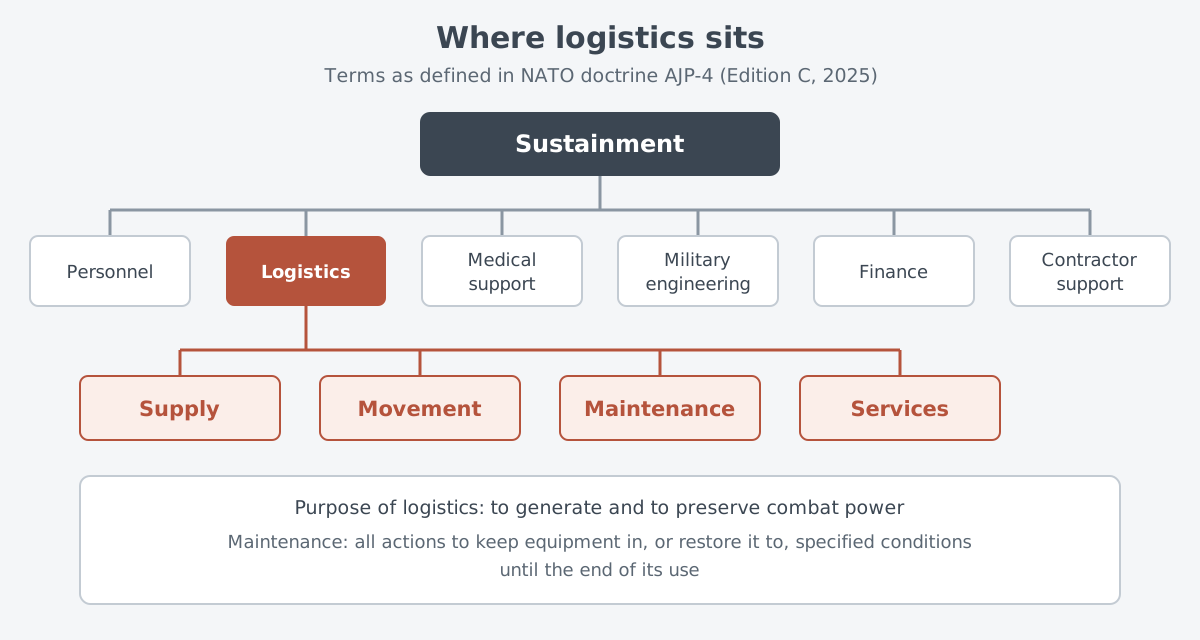
The word maintenance covers more than you might expect. It means every action that keeps equipment in a set condition, or brings it back to that condition, for as long as the equipment is in use. Besides inspection, testing and repair, it includes modification, recovery, rebuilding, and taking parts from one item to use on another.
The four functions do not work alone. They are tightly linked and together back every kind of military activity. More broadly, the doctrine says the sustainment functions as a whole shape how fast, how long and how hard actions and operations can go on.
Most of a weapon's cost comes after purchase
When you buy a car, the sticker price is not the whole story. Fuel and repairs add up year after year. For weapons, that share is much larger. A 2026 report by the U.S. Government Accountability Office (GAO) puts operating and support (O&S) costs at about 70% of everything a weapon system costs over its life, historically.
The car comparison only goes so far. For a weapon, costs after purchase make up most of the life-cycle cost, and changes to hardware and software after purchase are even counted as a category of their own.
Those costs cover spare parts for repair, maintenance in depots and in the field, contracted services, engineering help and personnel, among other items. Keeping weapon systems such as aircraft, ships and ground combat vehicles going costs the U.S. Department of Defense tens of billions of dollars a year.
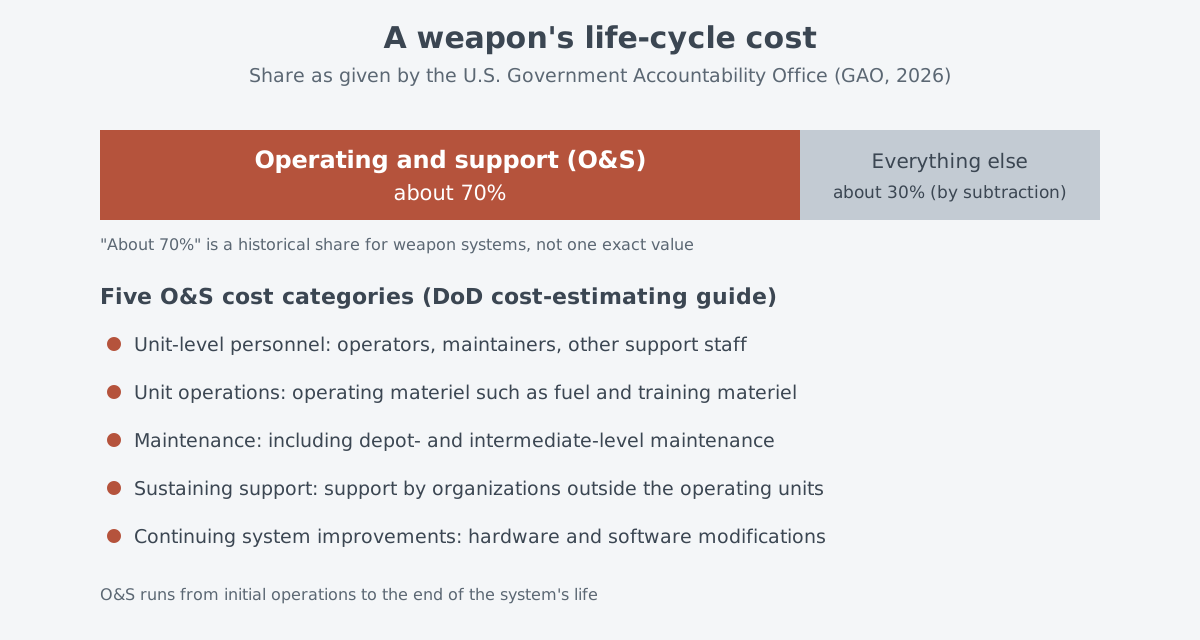
The Defense Department's cost-estimating guide sorts O&S costs into five categories. The first is the operators and maintainers assigned to units. The second is what units use to operate, such as fuel and training supplies. The rest are maintenance, including depot and intermediate levels; support from organizations outside the units; and hardware and software changes that keep a system running and up to date.
Why so much? Part of the answer is that weapon systems hold many complex technical subsystems and parts, and reaching the readiness levels the services require takes costly spare parts and logistics support.
Owning it versus being able to use it
The number of aircraft a military owns is not the number that can fly today. One way to measure the gap is the mission capable rate. It is the share of all the time in which an aircraft is able to fly and carry out at least one mission.
In a 2022 report, GAO looked at 49 types of U.S. military aircraft. Across fiscal years 2011 to 2021, just four reached their yearly mission capable goal in more than half of those years. Twenty-six never met the goal in any fiscal year, and in fiscal year 2021 alone, only two met it.
The trend differed by service. Comparing fiscal 2021 with fiscal 2011, the average rate fell for the selected Air Force, Navy and Marine Corps aircraft, to varying degrees; only the selected Army aircraft rose. The problems program officials named included aging aircraft, maintenance challenges, and trouble getting parts and supplies. None of the three shows up on a performance sheet.
Why support costs grow beyond the estimate
The United States required regular sustainment reviews for each weapon system. Until December 2025, the law had each military department run one within 5 years of declaring initial operational capability, then every 5 years after that. A review checked O&S costs, performance and the support strategy, and came with a fresh, independent estimate of what the rest of the system's life would cost.
There were 36 reviews in fiscal 2023 and 2024, and in them the Defense Department found "critical" O&S cost growth in 14 systems. Growth counts as critical when the estimate for the remaining life cycle is at least 25% above the latest independent estimate, or at least 50% above the original baseline. The Air Force reported no such systems in this period, so all 14 were Army and Navy systems.
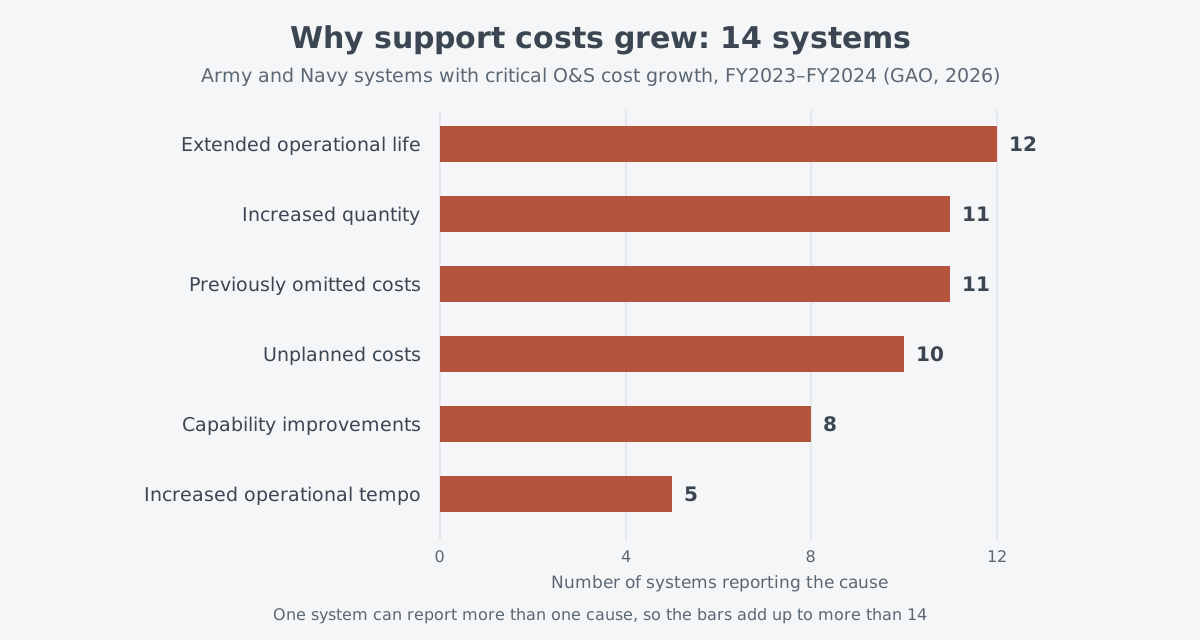
The most common cause was a longer operational life, reported by 12 of the 14. Increased quantity and previously omitted costs came next with 11 each, then unplanned costs with 10, capability improvements with 8, and a higher operational tempo with 5. One system could report several causes, so the bars add up to more than 14.
As an example of a longer life, the MH-60S program is now expected to serve 50 years instead of 30. Unplanned costs include rising spending on fuel, transport, repairable parts, maintenance, and crews or maintainers. Updated inflation guidance and obsolescence were also common causes. Obsolescence here means a part can no longer be obtained because nobody produces it anymore.
Fixing a maintenance problem can also save money. The Army reported that a software update would solve a top maintenance issue on its Common Remotely Operated Weapons Station (CROWS). It had not finished putting that update in place. By GAO's estimate, finishing it would save over $130 million across the roughly 30 years the program has left, and the Defense Department agreed with the recommendation.
Planning for maintenance at the design stage
If so much money is spent after purchase, it makes sense to look at it before buying. Section 4325 of Title 10 of the U.S. Code puts this idea into law. The Secretary of Defense must issue and keep up guidance for assessing, managing and controlling what major weapon systems cost to run and support.
A few of the required elements show the direction. The military departments must collect reliability and maintainability data from testing and use it in system design decisions. They must cut O&S costs by shaping the design early in development. Before key acquisition decisions, an independent logistics assessment must look for features likely to drive future costs and design changes that could lower them.
The law also calls for reliability metrics. The guidance must use those metrics as triggers to look further into their causes and to build strategies that improve reliability, availability and maintainability at an affordable cost. In effect, how rarely a system breaks and how easily it can be fixed become design-stage questions, alongside the numbers on the performance sheet.
Where this meets lasers: electricity instead of a magazine
Seen through logistics, laser weapons look a little different. The Congressional Research Service (CRS) names two key limits for Navy surface ships defending against drones and anti-ship missiles. One is a shallow "depth of magazine," and the other is a poor cost exchange ratio.
When a ship has used up its air-defense missiles and close-in weapon system rounds, it may need to sail to a safe place to reload. Vertical launch system cells cannot be refilled at sea while the ship is moving.
A shipboard solid-state laser (SSL) runs on electricity taken from the ship's general power supply. CRS notes that it can be fired again and again as long as the laser keeps working and the ship still has fuel for its generators. Those two conditions matter. The reloading problem does not vanish; it becomes a question of fuel, electric power, and keeping the laser itself in working order.
A question CRS raises for Congress shows the same point. It asks whether the surface ships the Navy plans to buy will have the room, weight margin, electric power and cooling to use lasers fully. How much electricity becomes light, and where the leftover heat goes, continue in Power and efficiency and Cooling and thermal management.
What to read next
- The cost of drone defense: how cost per shot and equipment cost are compared, and on what basis.
- Power and efficiency: the share of electricity that becomes light sets the size of the system: how much of a laser weapon's "ammunition," electricity, turns into light.
- Strengths and limits of laser weapons: the ability to fire again and again, and the conditions attached to it.