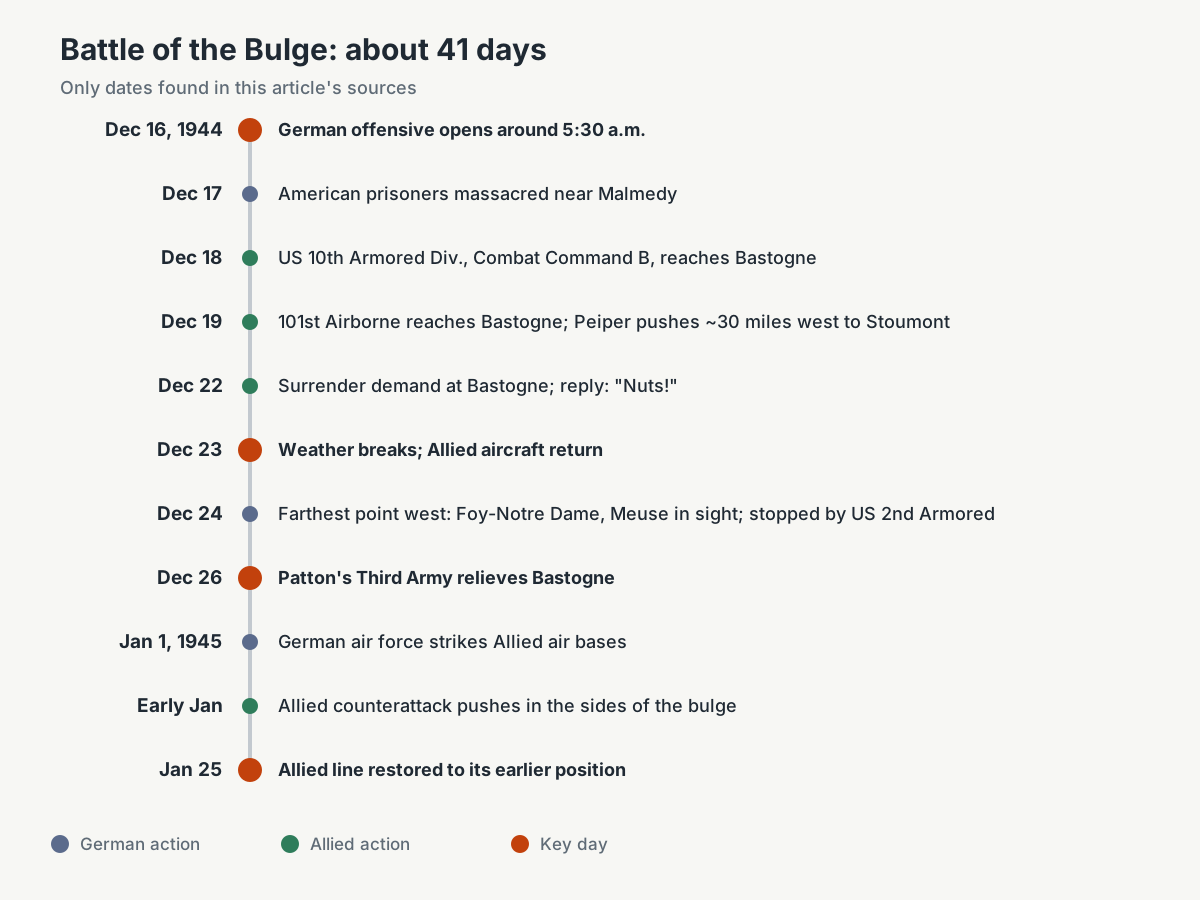
Around 5:30 in the morning on December 16, 1944, German attacks fell on American positions in the Ardennes forest, which spans Belgium and Luxembourg. It was a misty winter morning. The sector was held by American divisions that were either new to combat or worn out, sent there to rest and gain experience.
Since the Normandy landings, the Allies had moved fast, and the war seemed almost over. So why did Germany pour what it had left into an offensive through a forest? How far did it get, and why did it stop? This article follows the 41 days of fighting through records from the US Army, the Imperial War Museums (IWM) and the US National Archives (NARA).
A war that seemed almost over
After D-Day, the Allies swept across Europe. Paris and much of France were liberated. At times the troops moved so fast that they got ahead of their supply lines and had to halt.
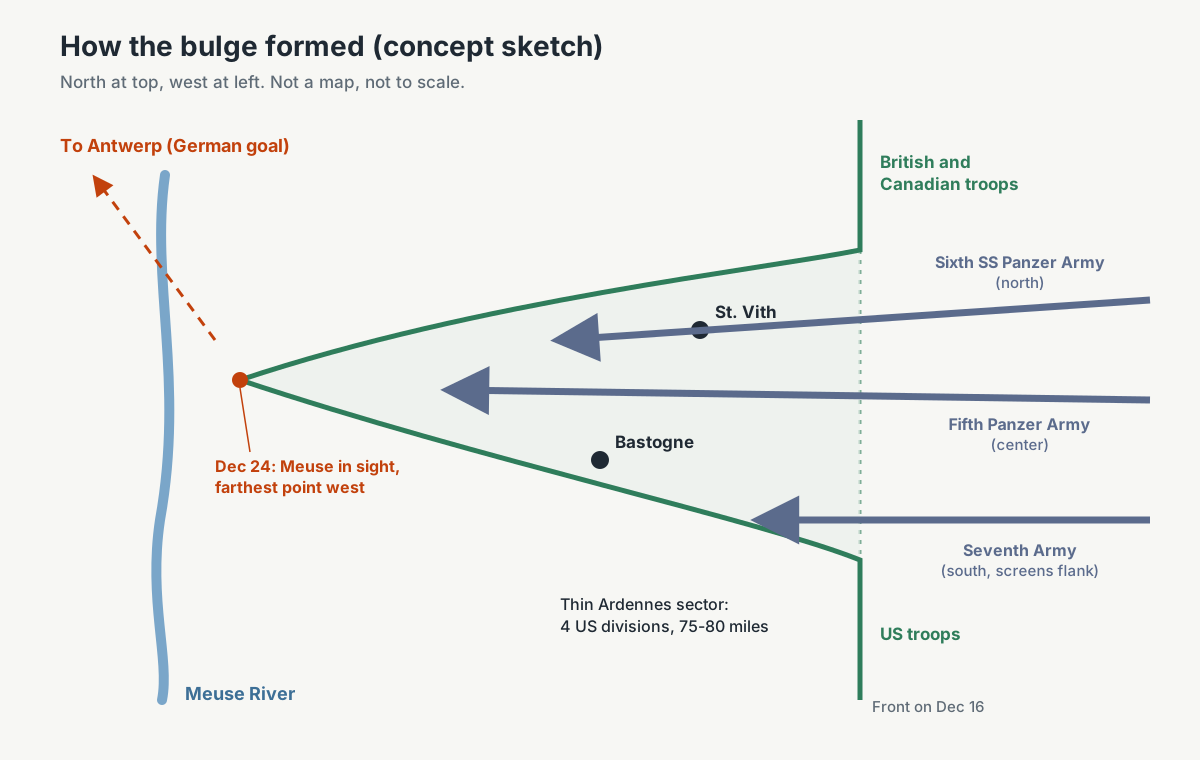
Even so, the Allies kept pushing hard toward the German homeland. Canadian and British troops anchored the north end of the front, and Americans held the south. The Ardennes, between them, was held by only a thin and weak line. American commanders counted on the forest to help block any German offensive.
This stretch of front had dense woods and few roads. According to the US Army Center of Military History (CMH), four American divisions held it, new or battle-worn, placed there for rest and seasoning. The length of the front is given as 75 miles or 80 miles, depending on which of this article's sources you read.
A plan aimed at Antwerp
The decision was Hitler's. His generals protested, and IWM notes that even his own generals did not believe the offensive would work. Hitler pulled men and weapons from other fronts, even the eastern front, where he was losing to the Russians.
The goal was Antwerp, a port in Belgium. The plan was to break through the thin line, cross the Meuse River and reach the port, driving toward the English Channel and splitting the Allied armies. It was an attempt to repeat what German forces had done to the Allies in May 1940.
The operation was named Autumn Fog (Herbstnebel). It is often called Watch on the Rhine (Wacht am Rhein), but a NARA archives technician calls that name inaccurate. About 24 German divisions were committed.
The attack came in three parts. The Sixth SS Panzer Army in the north and the Fifth Panzer Army in the center made the main thrusts. The Seventh Army, mostly infantry, attacked Allied lines in the south to screen the flank of the two panzer armies.
The morning of December 16
That morning the attack involved over 200,000 German soldiers and close to 1,000 tanks. The surprise was complete. The Germans pushed west through the middle of the American line, and the bulge they created gave the battle its name.
By the end of the first day of heavy fighting, the American front had broken. German forces surrounded most of an infantry division, seized key crossroads and pushed their lead units toward the Meuse.
Behind the lines, fear spread first. There were stories of paratroopers landing in the rear and of English-speaking Germans in American uniforms seizing bridges and cutting phone lines. Belgian townspeople took down their Allied flags, and Paris police kept the city under a curfew all night.
Soldiers did whatever they could. Some quizzed strangers with obscure questions about American life to catch possible infiltrators.
Two road junctions: St. Vith and Bastogne
In a forest with few roads, every place where roads met mattered. What slowed the German advance was the quick arrival of reinforcements and the stubborn American defense of the road junctions at St. Vith and Bastogne.
On December 18, Combat Command B of the US 10th Armored Division got to Bastogne, and the 101st Airborne Division arrived the next day. Then parts of the German Fifth Panzer Army surrounded the town.
Colonel Roberts, who led Combat Command B, wrote in February 1945 that neither the 101st nor the armor could have held Bastogne alone. Together, he wrote, their strength was tripled. His "together" also included the 705th Tank Destroyer Battalion.
On December 22, the Germans demanded surrender. Brigadier General Anthony McAuliffe, who was temporarily leading the 101st Airborne, answered with one word: "Nuts!" German officers took it as a rougher, firmer refusal.
Something else happened to the north. By December 19, Kampfgruppe Peiper of the Sixth SS Panzer Army had reached Stoumont, almost 30 miles to the west. Along the way, near Malmedy, surrendered American soldiers of Battery B, 285th Field Artillery Observation Battalion, were massacred.
The numbers differ by source. A NARA article says 130 prisoners were killed, while a National WWII Museum exhibit description says only 43 of more than 120 men survived.
War crimes against prisoners and Belgian civilians only hardened American resistance. In 1946, senior Waffen-SS officers, including Sepp Dietrich and Joachim Peiper, were defendants in the "Malmedy trial." The records of that trial are now held by NARA.
Roads, fuel, weather and the sky
Tanks and guns were not the only things that mattered in this battle. Roads, fuel and weather counted as well. The offensive needed men and resources that Germany did not have.
Fuel is the clearest example. The German tanks were hungry for fuel, and bad weather disrupted supply lines and made the shortage worse. American soldiers moved or burned key gasoline stocks so that German tanks could not use them.
The weather also held the sky back. Poor weather at first kept Allied air support grounded, until the skies cleared on December 23. A V Corps sector record of the time, quoted by NARA, calls it a "fateful break in the weather." Allied aircraft could now hit German transport and troops hard enough to cut their fighting strength.
Supplies reached besieged Bastogne from the air. A surviving photo shows American troops collecting supplies and ammunition brought in by gliders. Another shows scouts on a snowy field hiding under white bedsheets.
The German air force also made one large effort. On January 1, 1945, it struck Allied air bases in north-west Europe and caused serious damage. But it took losses it could never make up.
Stopped short of the Meuse
The farthest German point west came on December 24. The Fifth Panzer Army's 2nd Panzer Division got as far as Foy-Notre Dame, a village within sight of the Meuse, but the US 2nd Armored Division drove it back. The northern, central and southern advances all stalled well short of the river.
In the south, Patton's US Third Army turned north and struck the German flank. At that point the Third Army had about 230,000 men. In the north, British Field Marshal Bernard Montgomery took temporary command of the American forces to coordinate the defense and the counteroffensive.
On December 26, Third Army units cut through to Bastogne. The National WWII Museum also presents, in its exhibit, the role of the 761st Tank Battalion, an African American unit, in lifting the Bastogne siege.
Through January, American troops waded through deep snow and struck at both flanks of the bulge as it shrank. The Germans were pushed out of Belgium and Luxembourg, and by January 25 the Allies had restored their line to its earlier position. From December 16 to that day, the fight had lasted about 41 days.
Civilians in the forest towns
Battle histories usually list soldier casualties in detail. The civilians of Belgium and Luxembourg who died in the same fighting have been missing from most accounts.
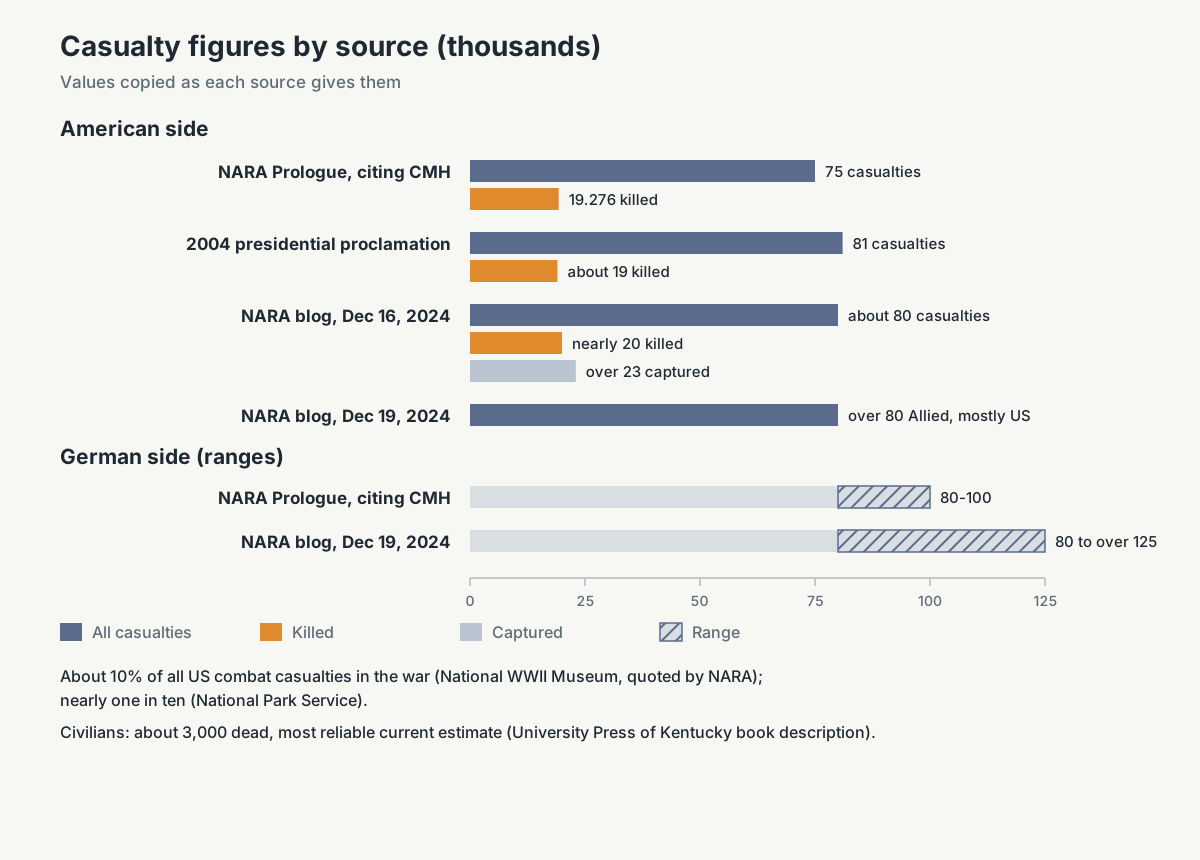
The University Press of Kentucky describes Peter Schrijvers' book The Unknown Dead this way. By the most reliable current estimates, about 3,000 civilians died in the Ardennes during six weeks of fighting. Some of the dead were victims of war crimes by German units at the front and by Nazi security services in the rear. Others died from the heavy toll of the Allied response, such as massive bombing of small towns.
The hardship did not end with the fighting. Towns had to be rebuilt, and abandoned land mines and explosives were a serious problem.
Numbers that differ by source
There is no single casualty count. Each source gives somewhat different values for the same battle.
- NARA's Prologue magazine (2014), citing CMH, gives 75,000 American casualties and 19,276 killed. That is more American dead than in any other battle of the war, Okinawa, Guadalcanal and Iwo Jima among them.
- The 2004 presidential proclamation for the 60th anniversary says over 600,000 Americans took part, with 81,000 American casualties, about 19,000 of them killed.
- A NARA records blog post of December 16, 2024, gives roughly 80,000 American casualties, nearly 20,000 killed and more than 23,000 captured.
- A post on the same blog on December 19 says over 80,000 Allied soldiers, mostly Americans, were killed, wounded or captured over five weeks.
The German figures cover a wider range. The CMH figures cited in Prologue give 80,000–100,000, and the December 19 post gives anywhere from 80,000 to over 125,000. Even troop counts differ: the US Army feature page counts more than 700,000 Allied troops, and the proclamation over 600,000 Americans.
Shares show the weight more clearly. The National Park Service writes that nearly one in ten American casualties of the whole war came from this month-long battle.
Many names and what remains
The battle has many names. The Germans called it Operation Watch on the Rhine, the French the Battle of the Ardennes, and the Western Allies the Ardennes Counteroffensive. Because the front line bulged out on the map at the height of the fighting, it is remembered today by the name Battle of the Bulge.
The result was clear. The Allies could replace their losses, but Germany had used up its manpower and materiel. Hitler could never again mount a western offensive that large, and in early spring the Allies crossed into the heart of Germany.
Verdicts should be read along with who made them. British Prime Minister Winston Churchill called it "undoubtedly the greatest American battle of the war." The US Army feature page says that, by participation and losses, it "arguably" ranks as the biggest battle in the history of the American military. Prologue describes it as a key turning point toward the Allies and among the deadliest battles of the Second World War.
Some famous images also need care. The well-known film of the "Ambush at Poteau," shot by a Waffen-SS propaganda unit, was staged for the camera, as NARA explains. US forces captured the film before it could be developed in Germany. NARA holds Ardennes campaign records that include statements from German prisoners, intelligence reports and details of war crimes, and researchers can find them in its catalog.
What to read next
- The Fall of France, 1940: Armor Through the Ardennes: the 1940 breakthrough that Germany tried to repeat in 1944.
- Military logistics: performance must be sustainable: why tanks short of fuel stop, in terms of today's logistics.
- Main battle tanks: is it all about the gun?: what the tanks that drove snowy forest roads have become today.
- Turning points in military technology: the idea of a "turning point" seen from the technology side.
- A history of laser weapons: from chemical to electric lasers: how far weapons technology has come since the Second World War, and the main subject of this site.