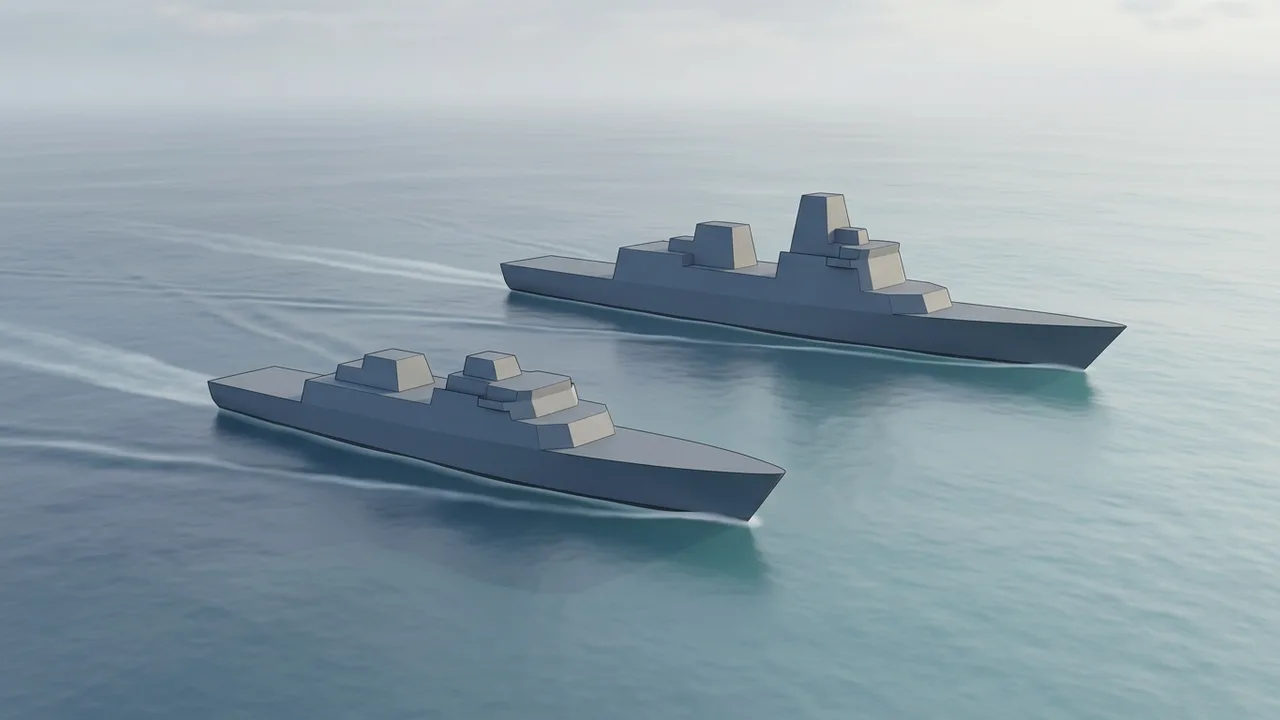
Destroyers and frigates come up in the news all the time. The names alone suggest that a destroyer drives enemies away and a frigate guards something. Yet one navy's frigate can be as large as another navy's destroyer, and in the United States the same ship once went from frigate to destroyer overnight.
So what decides which name a warship gets? This article follows where the two names came from, how the U.S. Navy has changed them, and why sizes vary so much between navies, using public government sources. In Korean, frigate is usually translated with a word that means "escort ship," but this article keeps the original word, frigate.
A name that began with hunting torpedo boats
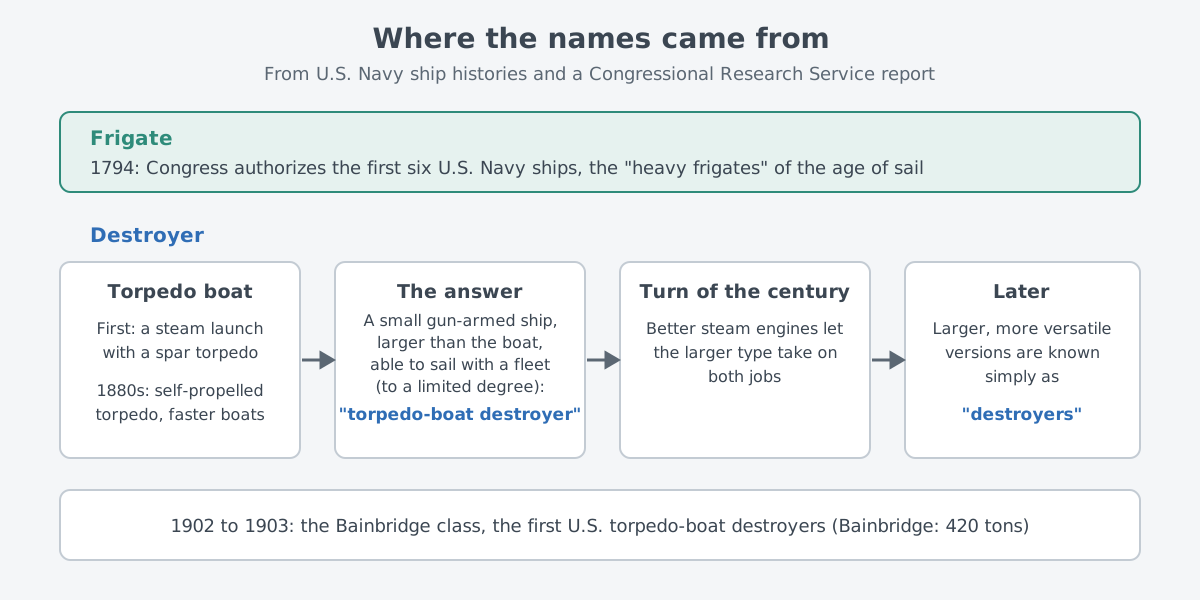
The first torpedo boats were small steam launches. They carried a "spar torpedo": a long pole on the bow with a bomb at its end. In the 1880s the self-propelled torpedo arrived, and torpedo boats grew larger and faster so they could attack enemy ships from a distance. Even so, they still stayed close to the coast.
For a fleet, this was a real problem. How do you protect ships that have to approach a coast guarded by torpedo boats? One answer was a small ship armed with guns, larger than a torpedo boat and able to work with a fleet on the open sea to a limited degree. This ship came to be called the "torpedo-boat destroyer."
For a time, navies developed torpedo boats and torpedo-boat destroyers as separate types. Around the turn of the century, advances such as the triple-expansion steam engine allowed one larger type to be designed for both missions. Larger and more versatile versions of that ship later became known simply as the "destroyer."
The first U.S. Navy class of torpedo-boat destroyers was the Bainbridge class. The lead ship, Bainbridge, entered reserve commission on 24 November 1902 and full commission on 12 February 1903. Her ship history lists a displacement of 420 tons. A U.S. Navy DDG-51 destroyer today is about 9,700 tons, so by the numbers alone, ships with the same type name have grown more than twentyfold.
Frigate: a name from the age of sail
Frigate is a much older name than destroyer. In 1794 the U.S. Congress authorized the Navy's first six ships: United States, Constellation, Constitution, Chesapeake, Congress and President. All six were "heavy frigates," warships of the age of sail.
The name lives on. The Navy's new frigate FFG-62 was named Constellation to honor one of the original six. It is the fifth U.S. Navy ship to carry that name. Destroyers have their own naming custom: U.S. Navy destroyers have traditionally been named for famous naval leaders and distinguished heroes.
Taken together, the two names were never measured with the same ruler. Frigate came from a type of sailing warship, while destroyer came from ships built against one specific threat, the torpedo boat.
1975: the same ships get new names
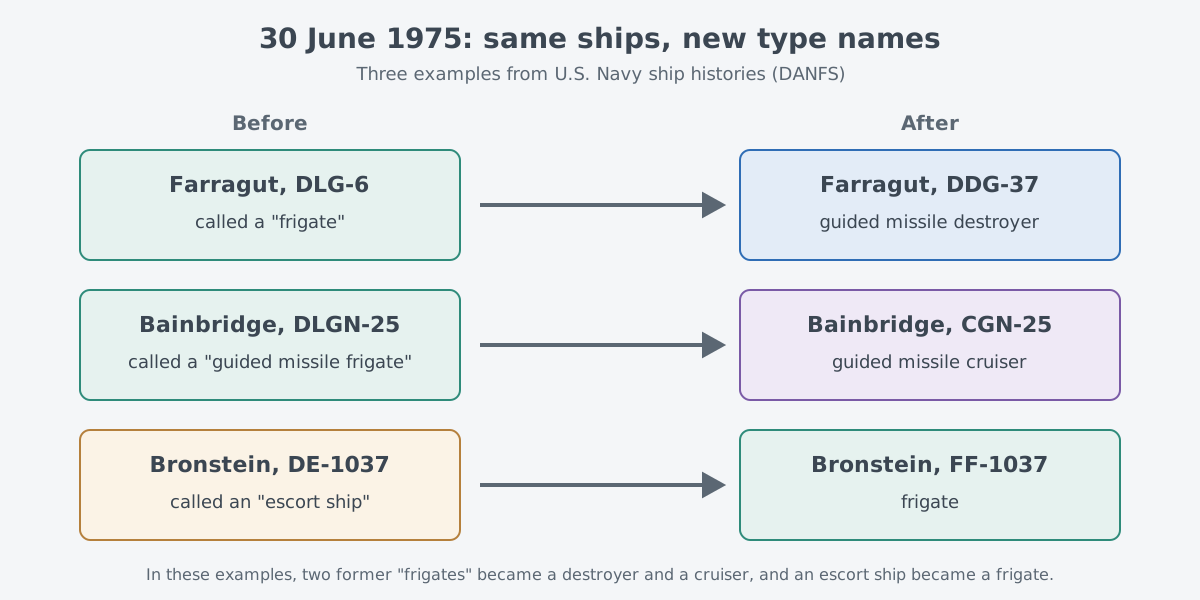
U.S. Navy records from the 1960s show the name "frigate" on ships that would not carry it today. The Navy's ship history calls Farragut, then designated DLG-6, a "frigate." The nuclear-powered Bainbridge (the fourth of that name, DLGN-25) also appears as a "guided missile frigate" in the record of her first voyage in 1962.
On 30 June 1975, these ships changed type. Farragut became guided missile destroyer DDG-37, and Bainbridge became guided missile cruiser CGN-25. On the same day, Bronstein (DE-1037) was reclassified as frigate FF-1037, and until then she had been called an "escort ship."
The same ships received new type names from one day to the next. Yesterday's frigates became a destroyer and a cruiser, and yesterday's escort ship became a frigate. This lines up oddly well with Korean, where frigate is usually translated as "escort ship."
Reading ship types by symbol: DD, FF, G
Letters and numbers such as DDG-51 and FFG-62 are U.S. Navy type symbols and hull numbers. Some types are written with a doubled letter: DD for destroyer, FF for frigate, BB for battleship and SS for submarine. Not every symbol follows that pattern.
The G at the end marks a guided-missile ship, meaning a ship equipped with an air defense system that protects a wide area. So DDG is a guided missile destroyer and FFG a guided missile frigate. When the design had not yet been chosen, an X was added, as in FFG(X).
FF is sometimes rendered as "fast frigate," but the Congressional Research Service (CRS) considers that a less accurate translation. The doubled letters do not mean speed; they are just how the type is written.
Size alone does not decide
So could you sort ships by size instead? Even inside the U.S. Navy, the answer is not simple. Decades ago, U.S. Navy cruisers outclassed its destroyers in both size and capability. After World War II, cruiser designs generally shrank while destroyer designs generally grew.
Since the 1980s, the two types have overlapped heavily in size and capability. The newest destroyers, the Zumwalt (DDG-1000) class, are in fact much bigger than the Navy's cruisers. That is part of why the Navy today puts cruisers and destroyers together as "large surface combatants" (LSCs). Patrol craft, mine warfare ships, Littoral Combat Ships (LCSs) and frigates go together as "small surface combatants" (SSCs).
The gap between frigates and destroyers has narrowed too. The FFG-7 class frigates, which entered service from 1977 to 1989, displaced roughly 3,900–4,100 tons fully loaded, against about 9,700 tons for an Arleigh Burke (DDG-51) destroyer. The new FFG-62 frigate is 8,000 tons, less than a 20% size difference from the DDG-51.
Navy plans have called for moving destroyer buying, from the early 2030s, to DDG(X), a next-generation design of about 14,500 tons. A later CRS report, however, cites press reports that the Navy intends to suspend DDG(X) work as it starts a new guided missile battleship program, BBG(X).
Mission and cost show the difference a little more clearly than size. The DDG-51 is a multi-mission destroyer that puts weight on air defense and open-ocean operations, and it is also called an "Aegis destroyer." In wartime, a frigate is meant to guard ships crossing dangerous waters, from military supply and transport vessels to civilian cargo carriers. For that job it is designed for air defense, anti-surface and antisubmarine warfare.
Cost differs as well. For missions that do not need an expensive cruiser or destroyer, a frigate can be the more cost-effective choice. In the U.S. Navy, a force that mixed high-capability, high-cost cruisers and destroyers with lower-capability, lower-cost frigates was in the past called an example of a "high-low mix."
Even the frigate itself keeps changing. According to a CRS report, in announcements in November and December 2025 the Navy said it wants to limit FFG-62 to two ships at most. It also wants to start a new frigate, FF(X), drawing on the National Security Cutter (NSC) design. That is a ship built for the Coast Guard that CRS calls frigate-like.
Different navies, different yardsticks
In British sources, type names go hand in hand with missions. The UK Ministry of Defence presents the Type 45 destroyer as an air defense warship. Its 2026 Defence Investment Plan names Type 45 destroyers as the Royal Navy's main part in integrated air and missile defense (IAMD). On the frigate side, the plan is to renew the force with antisubmarine Type 26 and general purpose Type 31 ships.
Yet the Type 26 frigate is 6,900 tons. That is larger than the U.S. FFG-7 described above, and in a different world from the first torpedo-boat destroyer of 1902. In Britain this ship is an antisubmarine warship, and eight of them will replace the current antisubmarine Type 23 frigates.
The Chinese case splits the name in two. The CRS report on China's navy describes Type 055, also known as the Renhai class, as a "cruiser (also referred to as a large destroyer)." It reportedly displaces 12,000–13,000 tons. The same ship is a cruiser or a large destroyer depending on who is talking.
Frigates also vary among themselves. A CRS report on options for a new U.S. Navy frigate lists three foreign "frigate designs." They are the Daegu class of South Korea at 3,600 tons, the Mogami class of Japan at 5,400 tons and the F100 of Spain at 6,400 tons. Under one name, sizes differ by nearly a factor of two.
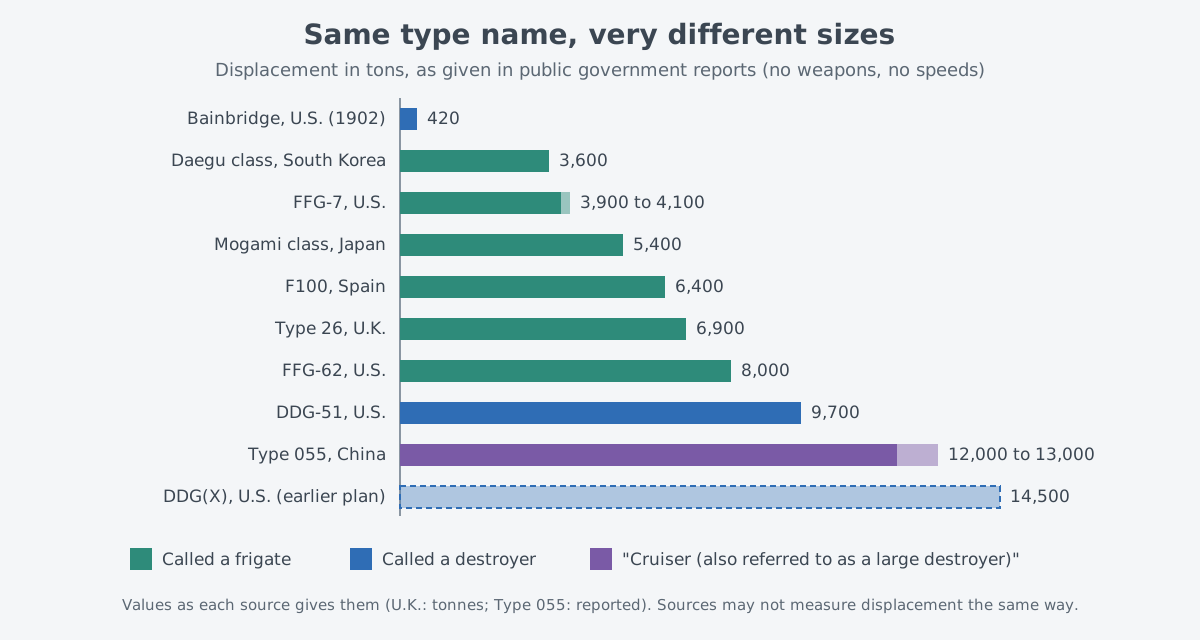
That is why it is hard to compare two navies' ships by type name alone. A type name carries a navy's history and how it divides missions among its ships. When a news story says "destroyer-class" or "frigate-class," it is safer to first ask which navy, and which era, the name comes from.
Where this meets lasers: lasers on destroyers
Destroyers also come up as ships that carry laser equipment. In the U.S. Navy, Eight Arleigh Burke (DDG-51) destroyers have had ODIN, an optical dazzler, installed. The UK Ministry of Defence put a plan in its 2026 Defence Investment Plan to fit DragonFire, a laser directed-energy weapon (DEW) system, to Type 45 destroyers from 2027.
Here, too, it pays to read the names carefully. Two stories may both say "a laser on a destroyer," yet one may mean a dazzler and the other a laser weapon. One may be installed already, the other still a plan.
The basics of laser weapons are in What is a laser weapon? Film versus reality, and public examples are in Laser weapon programs that have been made public.
What to read next
- Vertical launch systems: what sits below a warship deck: the launchers below the decks of destroyers and frigates.
- Close-in weapon systems: a warship's last layer: how a warship handles threats that come close.
- The Aegis combat system: why it sounds like a ship's name: what the "Aegis" in "Aegis destroyer" means.
- How to read laser weapon news: "kW-class", "range" and "cost per shot": how to read the words in shipboard laser stories.