The Citadel of Hue is ringed by stone walls that reach 8 m in places and by a wide, water-filled moat. The Vietnamese royal family had it built in the early nineteenth century. In February 1968, fighting raged inside and around those walls for almost a month.
During the Tet holiday that year, North Vietnamese troops and the Viet Cong struck many South Vietnamese cities at once. In most places, the attackers could not keep what they had taken for more than a day or two. Hue was different. What made the fight there last so long, and what did the people who lived in the city lose during that month?
The offensive as a whole is covered in the Tet Offensive article. This article stays with Hue.
Two halves of one city
Hue was the old imperial capital of Vietnam. In the CMH account, the city had been spared the war's heaviest damage until early 1968. The Perfume River split it in two.
The Citadel stood north of the river. Built during the first two decades of the 1800s, it covered about 6 km², and thick stone walls up to 8 m high ran around it. South of the river was the newer city, with a university, the province headquarters and the main hospital.
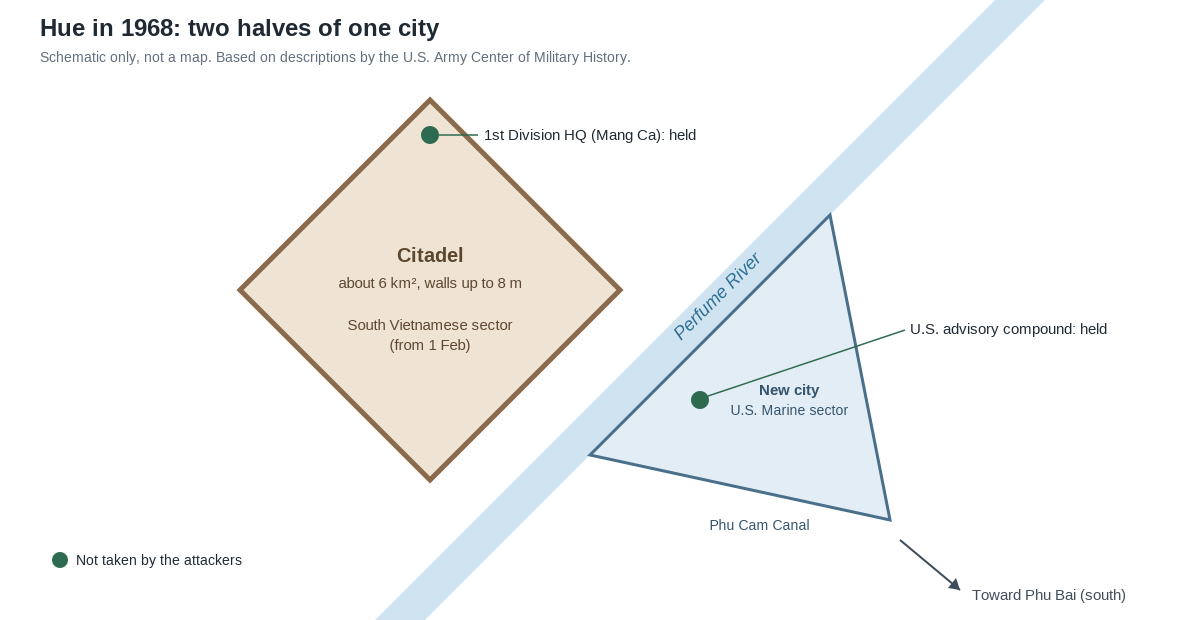
On the night before Tet, there were few soldiers in this large city. The Hue area held under 1,000 active-duty South Vietnamese soldiers, and some of them were home on holiday leave. American personnel usually numbered about two hundred. The South Vietnamese 1st Division headquarters sat in the Mang Ca compound at the northern corner of the Citadel, and the U.S. advisory compound was on the south bank.
A flare in the holiday night
The attackers spent most of December 1967 and January 1968 getting ready. Without being detected, they gathered a force equal to at least fourteen battalions close to the city. The soldiers were told that most residents would greet them as liberators.
At 03:33 on 31 January, a signal flare went up over Hue. The attackers entered the city from several directions at once.
Two places, however, never fell to them: the 1st Division headquarters inside the Citadel and the advisory compound on the south bank. CMH treats these two sites as the footholds for the counterattack that followed.
Twenty-five days in the fog
On the night of 1 February, South Vietnamese and U.S. commanders met and divided the work. South Vietnamese forces would take back the Citadel, and U.S. Marines would clear the city south of the river. They also agreed to keep damage to the historic city as low as they could.
The weather turned bad that same day. Thick fog covered the ground, and the cloud base dropped to 300 feet. Rain and fog came almost every day after that, which sharply cut air support and made it hard to keep units in the field supplied.
The fight south of the river took about ten days. On 10 February, the 1st Marines' commander said that major resistance in the southern city was over. The Citadel held out much longer.
The fighting also spread beyond the city. In villages to the west sat a North Vietnamese regiment that had just made a forced march down from the Khe Sanh area.
The occupation of Hue also cut the road linking the U.S. Army 1st Cavalry Division with its Phu Bai supply base to the south. This happened at a time when the weather was already making resupply hard. How heavily logistics weighs on a battle is covered in the military logistics article.
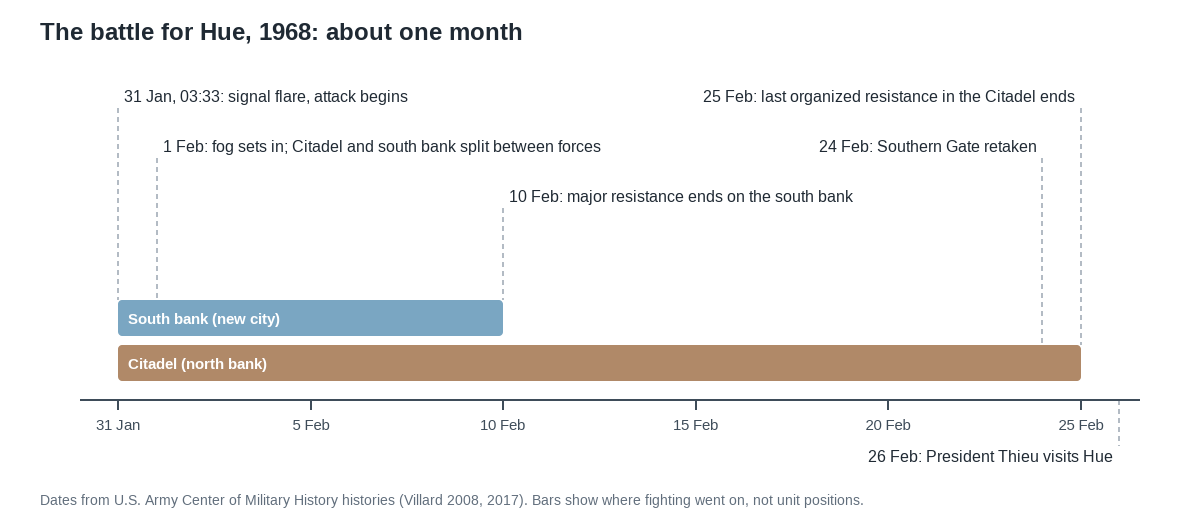
The Citadel fight reached a symbolic end on 24 February, just before dawn, as South Vietnamese soldiers retook the Southern Gate, the entrance to the Imperial Palace. The next day, 25 February, the last organized resistance inside the Citadel ended. On 26 February, President Nguyen Van Thieu came by air from Saigon to praise the men of the 1st Division in Hue.
The military toll in numbers
CMH describes Hue as the longest battle of the Tet Offensive, and up to that point the single engagement of the war with the most casualties. Its 2017 volume calls the fight the longest and most intense engagement of the war to that date.
| Unit | Killed | Wounded |
|---|---|---|
| U.S. Marines | 142 | about 1,100 |
| South Vietnamese Army | 333 | 1,773 |
| South Vietnamese Marines | 88 | 350 |
| U.S. Army 1st Cavalry Division | 68 | 453 |
| 1st Brigade, U.S. Army 101st Airborne Division | 6 | 56 |
For the attacking side, only allied estimates of the dead survive, and they range from 2,500 to 5,000. Several North Vietnamese units needed months of rest and rebuilding before they could fight again.
What the city paid
When the battle ended, about 75% of Hue's houses had been damaged or wrecked. For a time, some 115,000 people had no home. The southern city lost electricity and water on the first day of the attack.
The loss of life left a deeper wound. The 2008 CMH booklet counts more than 4,000 confirmed civilian deaths over the 25 days. It attributes about 1,200 of them to stray bombs and bullets. The rest, it says, were killed by communist cadres who had been ordered to put to death a long roster of officials and those seen as backing them.
Mass graves came to light after the battle. They held about 3,000 civilians. Some victims had their hands and feet bound, and at least 600 had been buried alive. Several thousand people taken away to carry supplies for the attackers mostly never came back.
The record differs from one edition to the next. The 2017 CMH volume says that most of the more than 4,000 civilians who died were killed by the communist side. In that account, South Vietnamese officials found the graves south and west of the city months after the fighting ended. They held nearly 3,000 people killed in the battle's last stage.
The other side's position is also on record. North Vietnam never publicly admitted to more than a small number of civilian killings, and it blamed most deaths on the allies or on damage from the fighting. At the same time, captured documents show that some cadres in Thua Thien Province felt the mass killings went against Viet Cong policy.
Ways of seeing the battle
Hue was the only city that came under any kind of communist administration during the Tet Offensive. The popular uprising the attackers hoped for never came, and few residents offered food, information or labor.
The battle also has a link to Khe Sanh. As the danger to the Khe Sanh base grew, General William C. Westmoreland, the U.S. commander in Vietnam, sent the 1st Cavalry Division north a full month earlier than planned. That division then helped the U.S. Marines and South Vietnamese forces drive the attackers out of Hue.
The State Department's Office of the Historian looks at another side. The attacks on Hue and Saigon had a strong psychological effect. They showed that National Liberation Front (NLF) forces were stronger than the Johnson administration had claimed. When the offensive ended, both sides had suffered losses, and both claimed victory.
On the battlefield, the attackers could not hold the city and lost many troops. The city saw three in four houses damaged and more than 4,000 residents killed. Who retook Hue tells only part of what that month meant.
What to read next
- The Tet Offensive: When the Military Result and Public Opinion Split: the whole offensive, including Hue, and the decisions in Washington
- Khe Sanh, 1968: A 77-Day Siege Supplied from the Air: the fight at a mountain base to the northwest at the same time
- The Vietnam War at a Glance: 1955 to 1975: the larger course of the war around this battle
- Military logistics: performance must be sustainable: why a cut road and bad weather mattered so much