The Polaris missiles on U.S. Navy submarines in the 1960s did not light their engines inside the launch tube. An outside force first pushed the missile out of the submarine, and the first-stage engine lit only once the missile was a safe distance away from the sub. The push came before the flame.
This way of pushing a missile out first and igniting it later is called cold launch. This article looks at the order of steps in a cold launch, which pushing forces are known, and which public examples exist on submarines, ships and land-based silos. It draws on product and history material from manufacturers and on a collection entry from the Royal Air Force Museum.
Two launch methods: cold and hot
Sources on vertical launch systems mention two names side by side: cold launch and hot launch. One example is the phrase "hot or cold launch methods" in the catalog of Roketsan, a maker of naval vertical launch systems.
Hot launch appears in these sources as the method that cold launch is set against. L&T MBDA presents the cold-launch approach of its naval system in contrast with "the conventional Hot Vertical Launch."
Some launch systems take both methods. Roketsan's MİDLAS is a vertical launch system that stores guided missiles in canisters below deck. The company's catalog describes MİDLAS as able to launch different types of guided missiles with hot or cold launch methods.
The cold-launch idea: ignite after ejection
Cold launch is easiest to see as two steps. The first step, ejection, means pushing the missile out of its tube or canister. The second step is ignition. The missile lights its own motor only after it has cleared the launcher.
In the first step, the push does not come from the missile's own motor. The forces named in public sources are a gas charge, compressed air streams, and gas/steam. Each one is a force applied from outside the missile.
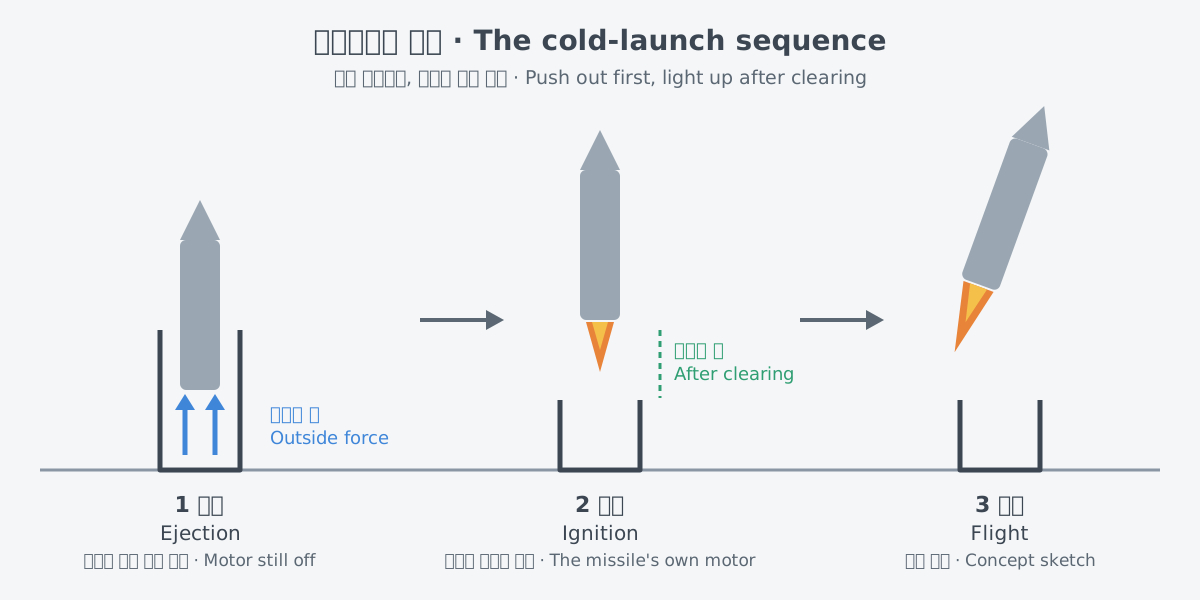
The order is the same, but the wording differs a little from source to source. L&T MBDA calls the Soft Vertical Launch (SVL) of its Sea Ceptor "a form of cold launch." Even for Polaris, the pushing force has two names: Lockheed Martin says compressed air streams, and the Royal Air Force Museum says gas and steam.
| Source | Pushing force | When the motor is lit |
|---|---|---|
| L&T MBDA, Sea Ceptor (ship) | Gas charge | After safe clearance from the ship |
| Lockheed Martin, Polaris (submarine) | Compressed air streams | At a safe distance from the submarine |
| Royal Air Force Museum, Polaris (submarine) | Gas and steam | After clearing the water |
The museum compares the scene to a cork popping out of a toy popgun. In both, the push of a gas sends the object out of a tube. The real thing differs in one way. A cork just falls after it pops out, but the missile lights its own motor once it is out and flies on.
Public examples: submarines, ships and land-based silos
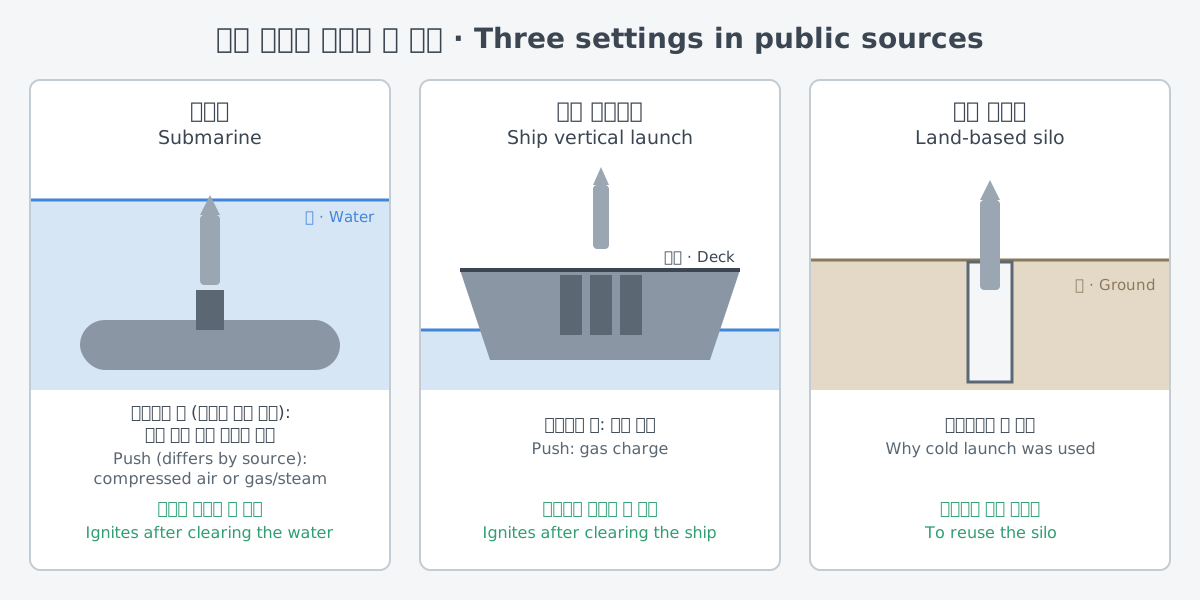
Submarines come first. Lockheed Martin's history points out that launching from under water called for very different technology than launching from land.
The result came in 1960. On July 20, 1960, a UGM-27 Polaris Fleet Ballistic Missile was launched successfully for the first time from the U.S. Navy submarine USS George Washington. In November of that year, the submarine set out on the first Fleet Ballistic Missile patrol.
Polaris A1 was the first to bring the ability to launch from under water, according to Lockheed Martin's 2025 anniversary feature. The Royal Navy later obtained the upgraded Polaris A3 as well.
On ships, vertical launch systems are the example. The SVL of Sea Ceptor, described above, is a form of cold launch, and Roketsan's MİDLAS takes both methods in one system.
Cold launch has also been used in land-based silos. Peacekeeper was the missile intended to replace the Minuteman. According to Northrop Grumman's history of the intercontinental ballistic missile (ICBM), it used a cold launch system so that its silos could be reused.
Why sources use it, and what to keep in mind
Why push the missile out first at all? The reasons in public sources depend on the setting. The submarine source places the moment the first-stage engine is lit after the missile reaches "a safe distance" from the sub. In land-based silos, the reason was to reuse the silo.
For the naval system, the manufacturer lists more advantages. L&T MBDA credits SVL with a minimal launch signature and reduced deck stress, a smaller system footprint, and simpler installation. The claim that it offers better performance and safety than the conventional hot vertical launch is also the company's own.
These advantages come from a manufacturer describing its own product. They are not an assessment by a government or military body comparing the two methods, so they do not mean that cold launch is always the better choice.
The launch method is also just one of many technologies that make up a missile. Even in the sentence that introduces Peacekeeper, the cold launch system is one item listed alongside other technologies such as an advanced guidance system. The launch method alone does not tell you everything about a missile.