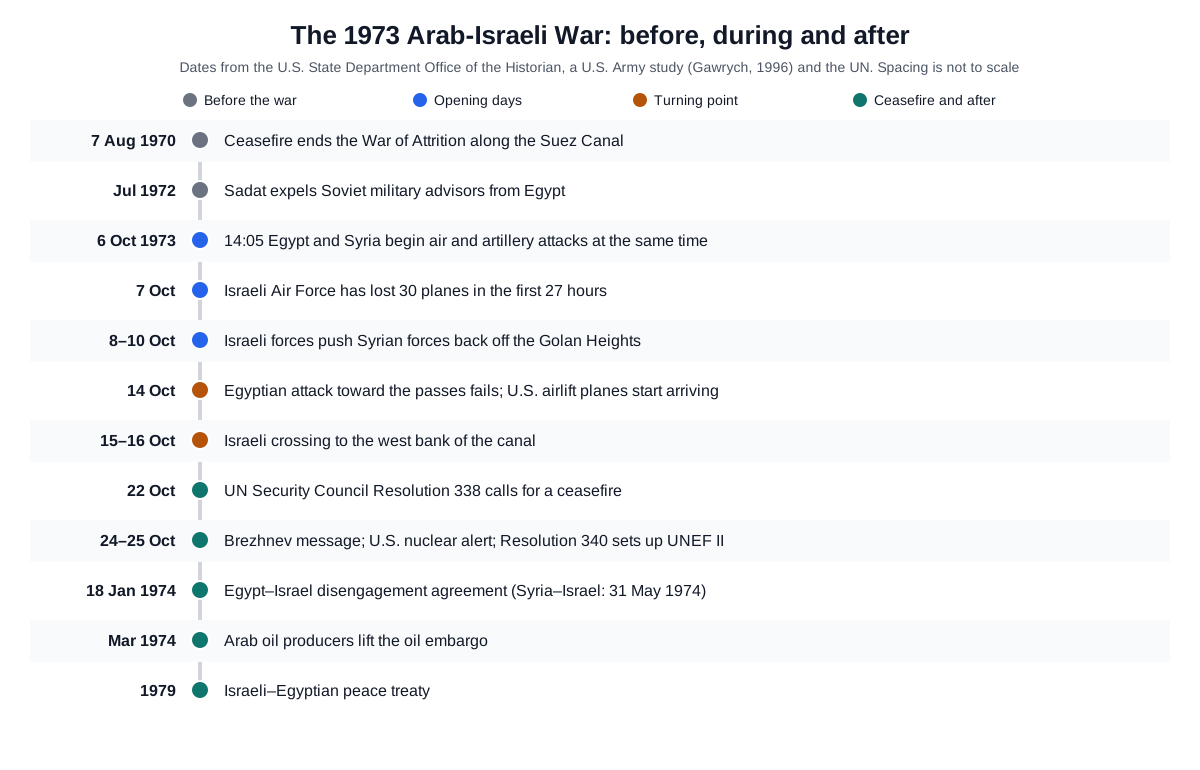
On 6 October 1973 it was Yom Kippur, the Day of Atonement and the most solemn day in Judaism. In Egypt and Syria it was Ramadan, the Muslim month of fasting. At 14:05 that day the two countries began air and artillery attacks at the same time.
Six years earlier the Israeli army had won a sweeping victory. Now, in the first two days, it lost tank after tank in front of the Suez Canal and plane after plane in the sky over the battlefield. Behind those losses was an Egyptian plan that tied together infantry with antitank missiles and missiles fired from the ground at aircraft. Yet when the fighting stopped three weeks later, Israeli forces were west of the canal, surrounding Egypt's Third Army, and the crisis had ended with a U.S. nuclear alert.
Did missiles really end the age of the tank and the warplane? And why is the side that was pushed back on the battlefield often described as the one that got what it wanted at the negotiating table? This article follows those two questions through the overview by the U.S. State Department Office of the Historian, a 1996 study by George W. Gawrych published by the U.S. Army Combat Studies Institute, and United Nations peacekeeping records.
After 1967: talks that went nowhere
After the 1967 war, Israeli forces stayed in the Sinai Peninsula east of the Suez Canal and on the Golan Heights. The State Department Office of the Historian sees the 1973 war as a lesson for the Nixon administration. Arab anger that Israel would not give up the land it had taken in 1967 could hurt American interests in serious, strategic ways.
Talks stalled again and again. By December 1969, the U.S. "Rogers Plan" had been turned down by Egypt, Israel and the Soviet Union alike. The "War of Attrition" across the canal did not stop until 7 August 1970.
In February 1971, Egyptian President Anwar Sadat offered to reopen the Suez Canal if Israeli forces pulled back from its east bank. In July 1972, he sent Soviet military advisors out of Egypt. Still nothing moved. Looking at the balance of forces, Nixon and Kissinger expected no Egyptian or Syrian attack on Israel, and much of the American intelligence community thought the same.
6 October: crossing the canal
Sadat was not aiming for all of Sinai. According to Gawrych's study, the Egyptian armed forces went to war for "limited objectives" that matched their abilities. Sadat told them to focus on causing Israel heavy losses rather than seizing strategic ground or destroying the Israeli army. In his view, only American pressure could make Israel give the land back.
War was a way to shake up the negotiations.
Israel received firm warning shortly after 04:30 on 6 October. The warning gave the attack time as 18:00, but the real plan was for 14:00. The attack hit just as Israeli reservists were starting to mobilize.
The chief of staff recommended a preemptive air strike against Syria. Defense Minister Moshe Dayan opposed it, citing the American and international reaction and the risk of Israel being branded the aggressor, and Prime Minister Golda Meir sided with Dayan.
The barrage that opened at 14:05 used 2,000 artillery pieces. For 53 minutes it fell on the strongpoints of the Bar-Lev Line, the Israeli fortifications on the east bank of the canal. At 14:20 the first wave, 8,000 men in 1,000 rubber rafts, crossed the canal.
Next came the sand embankments of the Bar-Lev Line. Seventy engineer groups, working from wooden boats, cut through them with jets of water from hoses on pumps. By the next day all ten heavy bridges were in use.
The assault force had more than 100,000 combat troops and 1,020 tanks. Over four days it built bridgeheads 12–15 km deep on the east side of the canal. By dawn on 7 October, some 50,000 Egyptian troops and 400 tanks were already on the east bank. In Gawrych's count, which draws on the memoirs of Egyptian generals, Egypt's losses on the first day were 280 men killed, 15 planes and 20 tanks.
Antitank missiles in the hands of infantry
The Israeli army was built around the tank. Egypt answered with two Soviet antitank weapons.
One was the Sagger, an anti-tank guided missile (ATGM). The other was the RPG-7, an unguided antitank weapon. Both were infantry weapons carried by soldiers.
The Sagger's formal name is the 9K11 Malyutka. Introduced in 1963, it was the first Soviet man-portable antitank guided weapon, and it used the first-generation method. The gunner watches the target and steers the missile by hand, often with a joystick, and the commands usually travel along a wire attached to the rear of the missile. Unlike the RPG-7, whose path is fixed when it is fired, it can change course in flight.
What mattered in the Egyptian plan was not one weapon but how the pieces fit together. Infantry with these weapons, backed by artillery and tanks, had the main job of stopping Israeli tank counterattacks.
Israeli armored units, for their part, lacked the infantry, mortars and artillery needed to suppress such infantry. Gawrych writes that without air support and short of artillery and infantry, Israeli tank crews in Sinai were left vulnerable. He traces this to a doctrine that had become too heavy on armor.
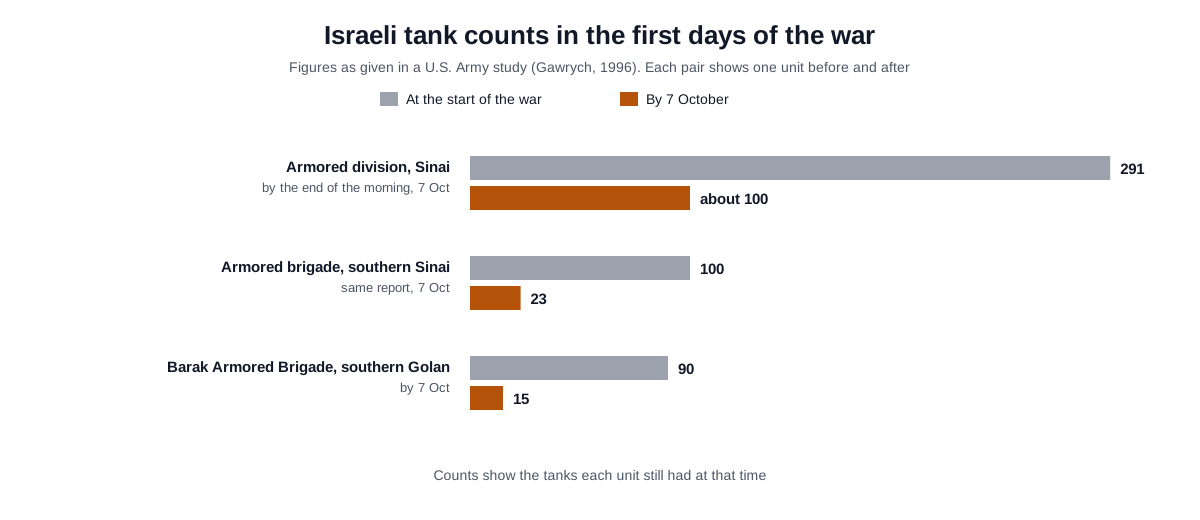
The results showed in the numbers. By the end of the morning of 7 October, one Israeli armored division in Sinai was down to about 100 tanks from 291 at the start of the war. One armored brigade in the south fell from 100 tanks to 23. In Gawrych's assessment, a major offensive built on air defense and infantry carrying antitank missiles was an innovation in modern warfare, and it caught the Israeli army off guard.
How antitank guided missiles changed from one generation to the next is covered in more detail in Anti-tank guided missiles: rockets versus guided missiles.
An umbrella of surface-to-air missiles
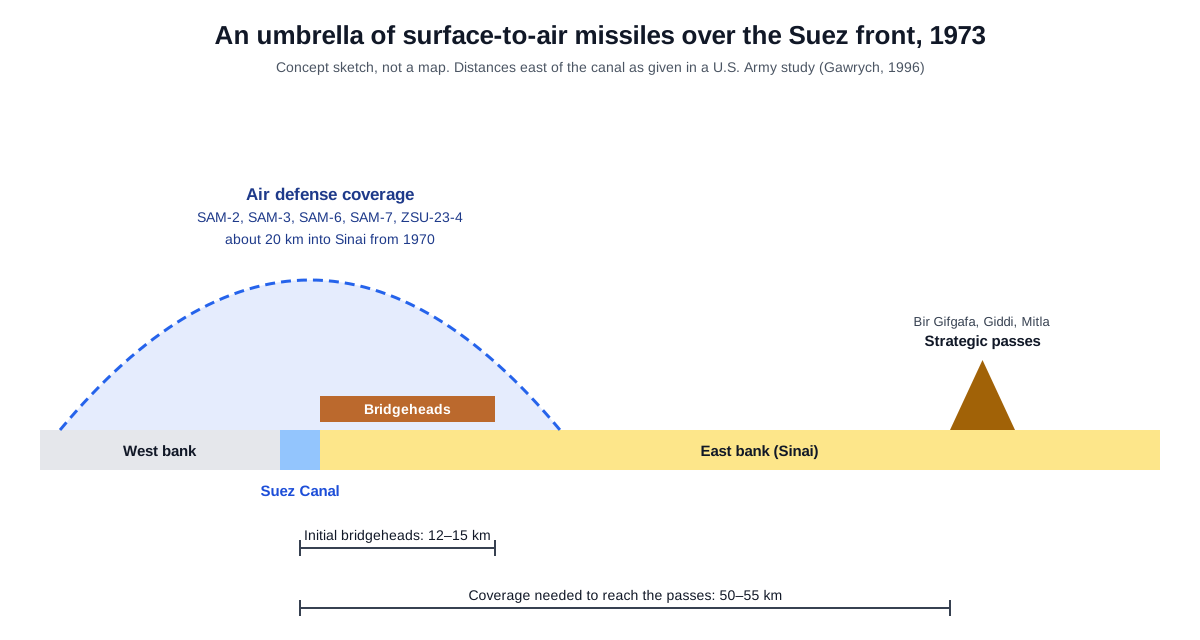
The Egyptian air force was weaker than Israel's. Missiles fired from the ground filled the gap. Egypt and Syria built an integrated air defense system from SAM-2, SAM-3, SAM-6 and SAM-7 surface-to-air missiles and ZSU-23-4 antiaircraft guns. The SAM-6 and ZSU-23-4 rode on vehicles and could keep up with armored units, while the SAM-7 was an infantry weapon carried by one soldier.
This umbrella had an edge. Missiles moved close to the canal near the end of the War of Attrition pushed air defense coverage about 20 km into Sinai. But covering the three strategic passes deeper in Sinai, Bir Gifgafa, Giddi and Mitla, would have taken 50–55 km. So the Egyptian army kept its first bridgeheads 12–15 km east of the canal, under the umbrella.
The idea was to reach parity in the sky over the battlefield with ground-based missiles. The air force, meanwhile, would avoid a head-on fight with the Israeli Air Force for control of the air.
At 16:00 on 7 October, the Israeli chief of staff, Elazar, learned that the air force had lost 30 planes in the first 27 hours of the war.
Egyptian air defenses had largely shut the Israeli Air Force out of the sky over the battlefield. Most Israeli air power went to the more threatened Golan front instead. The mobile SAM-6, new to that front, caused particular trouble. Even so, Gawrych concludes that the heavy damage came from the sheer density of fire as a whole.
How ground-launched missiles are built from radars, engagement control and launchers continues in Surface-to-air missiles: ground systems that guard the sky.
Ten days that turned the war
The first two days on the Golan Heights in the north were also perilous. In the southern Golan, Syrian forces cut Israel's Barak Armored Brigade from 90 tanks to 15. From 8 October Israeli forces began pushing Syrian forces back toward the prewar line, and by 10 October they had driven them off the Golan Heights. Later they pushed 20 km into Syria, to within 40 km of Damascus.
The superpowers moved too. The Soviet Union began resupplying Egypt and Syria with weapons, and by 9 October Israel had asked the United States to do the same. Nixon agreed, and the first American aircraft loaded with weapons reached Israel on 14 October. Supplying and moving weapons and materiel to forces while they fight is what is called logistics.
On that same 14 October, the tide turned in Sinai. After a plea from Syria, Sadat ordered an offensive out of the bridgeheads toward the passes, meant to draw Israeli attention away from the Golan front. By early afternoon the Egyptian forces had fallen back to their bridgeheads, leaving behind some 250 destroyed tanks. Israeli intelligence put the figure at 280.
This time Israel had a new missile as well: the TOW, a tube-launched, optically tracked, wire-guided antitank missile just arrived from the United States. The first TOW entered U.S. Army service in 1970, and on 11 October the Israeli army set up a course to train TOW instructors quickly. Antitank missiles were not one side's weapon alone.
Then Israeli forces crossed the canal in the other direction. The State Department Office of the Historian dates the crossing to 16 October. Gawrych writes that the operation began at 17:00 on 15 October and that the first tank crossed on a raft at 06:43 on 16 October. Once west of the canal, Israeli forces eventually surrounded 30,000–40,000 troops and 300 tanks of Egypt's Third Army.
Ceasefire and a nuclear alert
On 22 October the UN Security Council adopted Resolution 338, put forward jointly by the United States and the Soviet Union. It called for a ceasefire and for work to begin on carrying out Resolution 242 of 1967, and Resolution 339 confirmed it the next day. The fighting went on anyway. When Sadat asked the United States and the Soviet Union directly to send troops to enforce the ceasefire, the United States refused and the Soviet Union agreed.
On 24 October, Soviet General Secretary Leonid Brezhnev used the hotline to propose to Nixon that the two countries send troops to Egypt together. He added that if the United States declined, the Soviet Union would have to consider acting on its own. The Soviet Union put seven airborne divisions on alert, and on 25 October the United States placed its nuclear forces on alert around the world. The State Department Office of the Historian calls it the closest the United States had come to a nuclear clash with the Soviet Union since the Cuban missile crisis.
The United Nations defused the crisis. On 25 October, Resolution 340 demanded an immediate ceasefire and a return to the positions of 22 October. It also set up the Second United Nations Emergency Force (UNEF II), drawn from member states other than the permanent members of the Security Council. UN records state that setting up and sending this peacekeeping force effectively ended the crisis.
The encirclement of the Third Army was lifted in February 1974.
The war spread to the oil market as well. Arab members of the Organization of Petroleum Exporting Countries (OPEC) placed an oil embargo on the United States in response to its resupply of the Israeli military. The price of oil first doubled, then quadrupled, and the embargo was not lifted until March 1974.
The cost and what it left behind
In Israel, a country of just over three million people, more than 2,800 people were killed, at least 7,500 were wounded and some 500 became prisoners of war. For the first time, the Israeli army saw large numbers of soldiers struck down by combat stress.
Among nonfatal casualties, the share of psychiatric cases ranged from 12.3% to 23.1% depending on the source. After the war the army created a new doctrine that placed psychiatric teams in division medical battalions. Some reserve units stayed mobilized until as late as April 1974, and some reservists who served that long faced economic hardship.
Who won depends on where you stand. In the State Department Office of the Historian's account, Israel won the war, but the United States paid a heavy price. Gawrych notes that many Western observers saw a military victory for Israel, while Israeli society mostly judged the war more harshly. He also stresses that the weaker side made a stronger opponent and two superpowers change their attitude.
The door to talks did open. Israel signed disengagement agreements with Egypt on 18 January 1974 and with Syria on 31 May 1974. The war paved the way for Kissinger's "shuttle diplomacy" and for the 1979 Israeli-Egyptian peace treaty. Through that diplomacy, Sadat won back all of Sinai without another major war.
Armies changed too. By 1982 the Israeli government had doubled the size of its standing army. Arab tactical successes with antitank and surface-to-air missiles had exposed flaws in Israeli doctrine.
In response, the number of self-propelled artillery pieces grew sharply. The air force paid more attention to the air defense threat, buying airborne warning and control system (AWACS) equipment and building drone aircraft. Tanks still stayed at the center of the Israeli army.
Across the ocean, the American army studied this war closely. Douglas V. Johnson II of the Strategic Studies Institute at the Army War College sees the 1973 war as a turning point in the Army's thinking. It was tied directly to the defense of NATO Europe, and it was a sign that Soviet military technology had caught up with the West.
The field manual FM 100-5, published three years later, reflected General Donn A. Starry's analysis of the war.
What to read next
- How the Sagger and TOW of 1973 led to third-generation "fire-and-forget" missiles: Anti-tank guided missiles: rockets versus guided missiles
- What one surface-to-air missile battery is made of: Surface-to-air missiles: ground systems that guard the sky
- What the idea of tying many missiles and guns together looks like today: Integrated air defense and sensor fusion
- How the main battle tank (MBT), still central after 1973, is judged today: Main battle tanks: is it all about the gun?
- How airlift and supply hold up a war: Military logistics: performance must be sustainable
- Where lasers fit beside missiles and guns in air defense today: Lasers, interceptor missiles and guns: how they share the work