April 3, 1982, was a Saturday. The House of Commons met that day. Prime Minister Margaret Thatcher told it that, for the first time in many years, a foreign power had invaded British sovereign territory. The day before, Argentine forces had landed on the Falkland Islands in the South Atlantic and taken military control of them.
About 1,800 people lived on the islands, some 8,000 miles (about 12,900 km) from Britain. Why did two countries fight for 74 days over such distant islands? This article follows the parliamentary record of those days, UN resolutions and US diplomatic papers. It traces the roots of the dispute, what happened at sea and on land, and the questions the war left for navies.
Islands with two names
Britain calls the islands the Falklands. Argentina calls them the Malvinas. UN resolutions put both names together, writing "Falkland Islands (Islas Malvinas)" in their text.
Who first found the islands is still disputed. The first recorded settlement was founded by French settlers in 1764, who named the islands "Iles Malouines" after their home port of St. Malo. Malvinas is the Spanish form of that name.
Britain claimed the islands in 1765, and that began the sovereignty dispute. Two years later France sold them to Spain, and Argentina bases its claim on Spain's possession and occupation of the islands.
After Spain left, a newly independent Argentina claimed them as its own. In 1833 a small Argentine delegation at the harbor of Stanley was driven out by British seamen. Britain then brought in colonists and sheep and has run the islands since. On the British side, Thatcher argued in 1982 that the 1,800 islanders were "of British tradition and stock."
The islands had one industry: raising sheep for wool. Even so, the sovereignty question weighed heavily, counted among the oldest problems in Argentine foreign policy. From the mid-1960s, Argentina raised the issue again and again on the world stage.
On December 16, 1965, the UN General Assembly noted in Resolution 2065 that the two governments disputed sovereignty over the islands. It asked them to negotiate without delay to find a peaceful solution. On March 26, 1982, a daily intelligence report from the US Central Intelligence Agency (CIA) said the two countries had been negotiating for 15 years. It added that Buenos Aires had grown impatient for progress and had begun to threaten an end to the negotiations.
April 2, 1982
The first spark came on South Georgia, an island to the southeast. An Argentine navy cargo ship landed about 60 Argentines at Leith harbor. They set up camp and raised the Argentine flag.
They were there under a commercial deal to clear scrap from an old whaling station, but the British side said landing without permission was not allowed. On March 22 the ship and about 50 of them left, but about 10 stayed behind.
Early in 1982 the military government of Argentina, headed by Leopoldo Galtieri, walked away from years of talks and chose to invade. A history article in The Gazette, the UK's official public record, sees the decision as chiefly political. Facing criticism over a failing economy and human rights abuses, the junta expected that taking back the islands would bring the nation together in a wave of patriotism.
The invasion began on Friday, April 2, when Argentine forces entered the capital, Port Stanley, early in the morning. Facing more troops and heavier weapons, the small Royal Marines garrison fought briefly before Governor Sir Rex Hunt told it to lay down its arms. The Marines defending Government House suffered no casualties, and as far as the governor knew, no civilians were hurt. South Georgia was soon taken as well.
The UN Security Council adopted Resolution 502 on April 3. It found "a breach of the peace" in the region of the islands and demanded an immediate end to hostilities and for every Argentine soldier to leave at once. It also called on both governments to seek a diplomatic solution. Ten members voted for it and Panama against, while China, Poland, Spain and the Soviet Union abstained.
A task force sails to the far South Atlantic
On the day of the resolution, Thatcher told the Commons that a large task force would sail. HMS Invincible would lead it and leave port on Monday. The official British name for the operation was Operation Corporate, and overall command went to Admiral Sir John Fieldhouse, Commander-in-Chief Fleet.
Preparations moved fast. In July 1982, US Secretary of Defense Weinberger wrote to President Reagan about the war. Britain had little or no contingency planning for such an operation, he wrote, but did very well with plans made on the spot.
The first ships sailed within five days. By the end of May, Britain had loaded supplies onto 58 civilian ships, taken over, chartered or refitted for the job.
It took 3 weeks for the task force, with 28,000 troops on 100 ships, to get to the islands. Waiting there were 12,000 Argentine soldiers, mostly conscripts.
Diplomacy went on in the meantime. US Secretary of State Alexander Haig traveled between London and Buenos Aires to mediate. When no settlement came, the United States publicly sided with Britain on April 30 and placed sanctions on Argentina.
The first fighting came at South Georgia, in an operation that began at first light on April 25. When the Argentine submarine Santa Fe appeared near British warships preparing to land troops, helicopters attacked and disabled it. British troops landed just after 4 p.m. London time, and at about 6 p.m. the Argentine commander at Grytviken surrendered.
About 180 prisoners were taken. The British government said the operation was an act of self-defense under Article 51 of the UN Charter.
The sea in May: Belgrano and Sheffield
The task force arrived around the islands on April 30. After giving the Argentine government two days' warning, Britain enforced a 200-mile total exclusion zone around the islands. Entering it meant a risk of attack.
Early on May 1, Vulcan bombers and Sea Harriers attacked the airfield at Port Stanley. Craters in the runway left it unusable for transport aircraft flying in from the mainland. The same day, Sea Harriers drove off Argentine Mirages and Canberras that came from the mainland to attack.
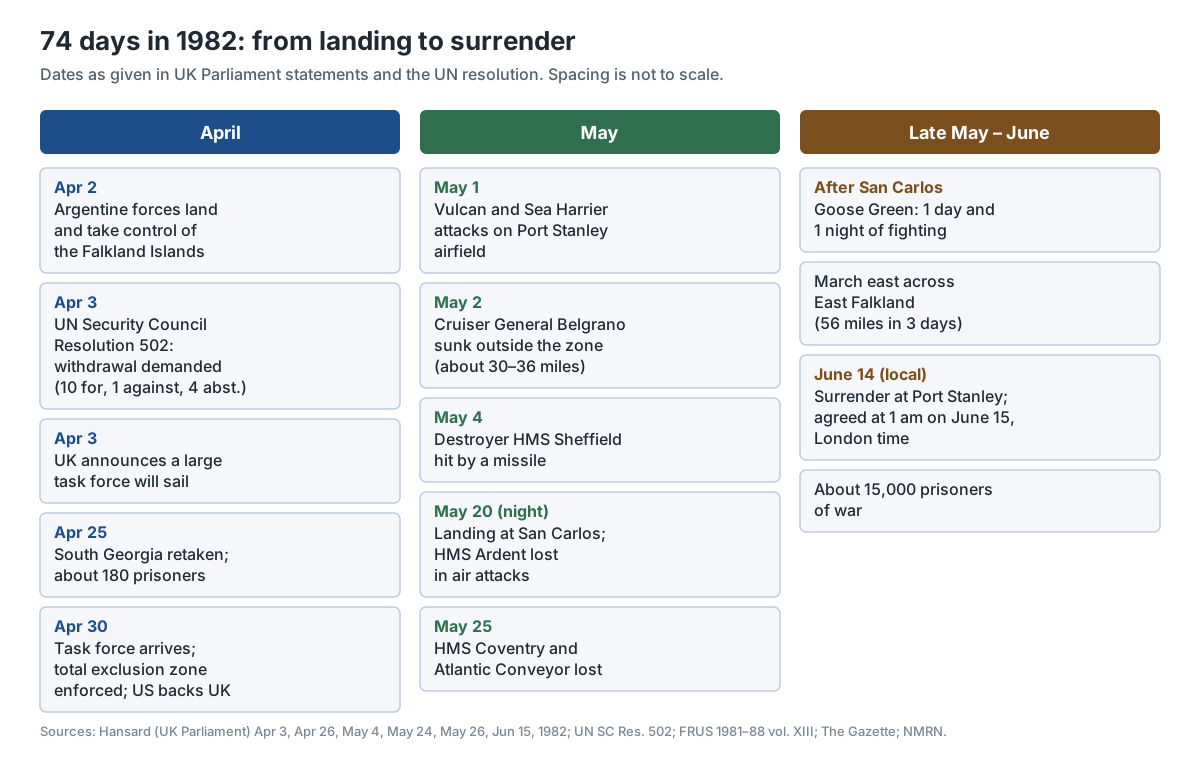
At 8 p.m. London time on May 2, a British submarine found the Argentine cruiser General Belgrano, escorted by two destroyers. Defence Secretary John Nott said the group was near the exclusion zone and closing on part of the task force, only hours away.
Britain believed the escorts were armed with Exocet anti-ship missiles that could reach beyond 20 miles. In the government's account, the threat was too great for the task force commander to ignore, and the Belgrano was sunk.
Where it was sunk was disputed from the start. In the Commons that same day, Nott first said it was just outside the zone, about 35 miles, and later said it was about 30 miles south of it. A questioning member said he understood it was 36 miles outside and warned that the loss of life was worrying allies.
The National Museum of the Royal Navy calls the decision still highly controversial, since the ship lay outside the zone. Depending on the source, 323 to 368 of the crew died (323 according to the Presidency of Argentina, 368 in The Gazette). Argentina remembers the day as the greatest naval tragedy in its history.
Two days later, late in the afternoon of May 4, an Argentine missile struck HMS Sheffield, a British Type 42 destroyer. The fire grew beyond control, the crew was ordered off the ship, and nearby ships picked up the crew. In the Commons that day, Nott first reported 12 men missing, then corrected himself to say the deaths might reach 30. The final figure given by The Gazette is 20.
From San Carlos to Stanley
On the night of Thursday, May 20, British forces landed at San Carlos on East Falkland. The task force slipped into Falkland Sound under cover of darkness, and destroyers and frigates lined the sound to protect the landing. Argentine air attacks came again and again over the ships.
Argentine aircraft that got through the air defense screen damaged five British ships. The Type 21 frigate HMS Ardent sank on the Friday night, with 22 of her crew killed and 17 injured. Britain fought back with missiles from ships, Rapier batteries ashore and Sea Harriers overhead, but the frigate HMS Antelope was also badly damaged.
The destroyer HMS Coventry was posted north of the entrance to Falkland Sound to give early warning of air attacks. At about 7:30 London time on May 25, Skyhawks hit Coventry with several bombs, and she capsized; first figures put the dead at 20. At about 8:30, the merchant ship Atlantic Conveyor, carrying supplies, was hit by Exocet missiles fired by two Super Etendard aircraft and set on fire. Four people on board were killed.
First, fighting at Goose Green lasted one day and one night. Combined losses on both sides were 64 dead and 209 wounded. After winning this battle, British forces broke out of San Carlos and began the long march east toward Stanley.
Atlantic Conveyor had carried three Chinook helicopters for heavy lifting. With them gone, the Royal Marines had to cross the islands on foot, covering 56 miles in three days.
The final attack aimed at the last Argentine line of defense, on the high ground around Stanley. Argentine forces surrendered on June 14, local date, and the surrender was agreed at 1 a.m. on June 15, London time. It was 74 days after the invasion. British General Moore took the surrender of every Argentine unit on East and West Falkland from Argentine General Menendez.
There were far more prisoners than expected. About 11,000 men surrendered at Port Stanley and about 2,000 on West Falkland. With 1,800 taken earlier, the total came to some 15,000.
With help from the International Red Cross, the British government said it would protect them under its responsibilities in the Geneva Convention. It hoped to move them off the islands as soon as possible.
Weapons and lessons
Exocet anti-ship missiles, Sea Harriers flying from small carriers, submarines under the sea and Rapier batteries on shore all appeared in this one war. When it ended, the US and British governments each began to sort out its lessons. But deciding what the lessons were was not something to rush.
Weinberger's July memo named the first conclusion as the danger of drawing conclusions too quickly. After Sheffield sank, a claim spread that her aluminum superstructure was a weakness, but Sheffield had no aluminum superstructure. With the caveat that data were scarce, the memo judged that a fire the missile may have started spread beyond what the ship's firefighters could control.
The same memo said the war reconfirmed how important it is to gain and hold air superiority in operations at sea and in landings. Britain's small carriers could carry only a few Sea Harriers. In the memo's view, missing long-range warning of air attack, and missing strike aircraft, made it a close-run thing.
In a House of Lords debate that December, Lord Mayhew, questioning the government, said that the Harriers had done well but fighter cover needed more size, range and endurance. The government replied that upgrades to increase the Harrier's range and payload were under way, and that bringing back big carriers would take too large a shift in resources.
On December 14, 1982, the British government published the White Paper The Falklands Campaign: The Lessons. Its Part II set out the main lessons from the campaign. The government said it would give each carrier its own airborne early warning, built around the Searchwater radar. It also planned modern point defense weapons for its carriers, assault ships and Type 42 destroyers.
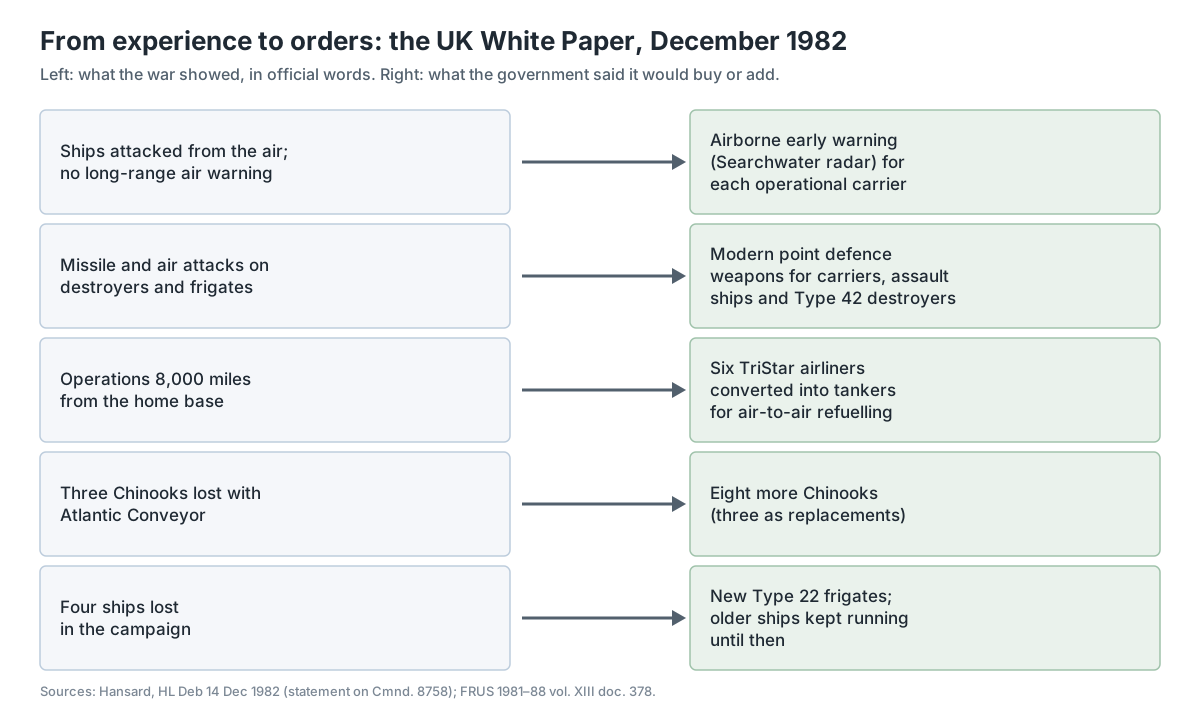
Fighting 8,000 miles from home led to aerial refueling as well. The White Paper statement called air-to-air refueling vitally important in the campaign and said Britain would buy six TriStar airliners from British Airways and convert them into tankers. It would buy eight more Chinooks, three of them to replace losses, and seven more Sea Harriers.
Britain would cover the four ships it lost for now by keeping older ships in service, then replaced by new Type 22 anti-submarine frigates. The list of new weapons bought during the conflict also included Harpoon missiles and laser-guided munitions. Laser-guided munitions usually work by semi-active laser guidance: a laser lights up the target, and the weapon follows the reflected light.
What the war left behind
On June 15, as news of the surrender arrived, Thatcher spoke to the Commons. The final details would take a few more days, she said, but about 250 British servicemen and civilians were dead. The National Museum of the Royal Navy gives final figures of 255 British personnel killed and 777 wounded. Argentine military deaths are 649 in the museum's figures and 655 in The Gazette, and three Falkland Islanders also died.
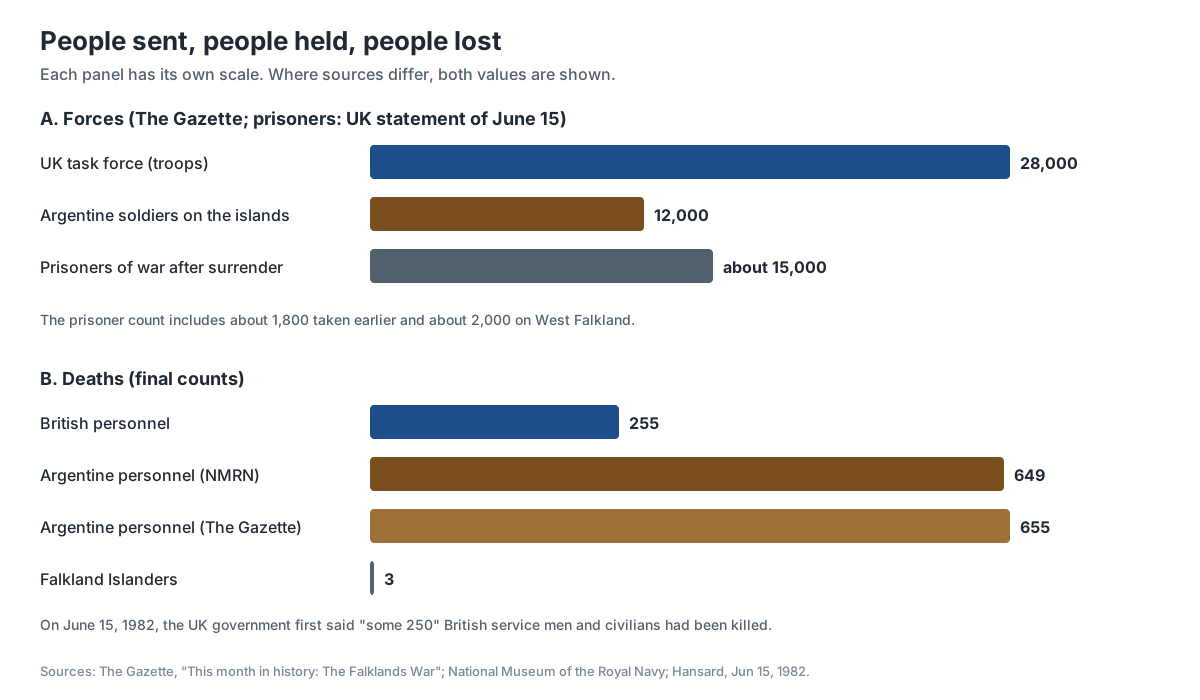
That December, the Ministry of Defence told Parliament that a little under 1% of the troops sent to the islands died in action. A small share in percentage terms still meant families whose people did not come home. In the same answer, the ministry said it was planning a more permanent resting place for many of the temporarily buried Argentine dead. It would consult the International Committee of the Red Cross and the Brazilian embassy.
The war changed Argentine politics. Galtieri lost power three days after Port Stanley fell, which ended junta rule and opened the way back to democracy. Civilian government returned to Argentina in December 1983.
The United States had its own problems to manage. The State Department's FRUS volume on the conflict says the war damaged US relations with Latin America, and that the sovereignty dispute, still unresolved, shaped US-Argentine relations after the war. The islands remain a British dependent territory today.
What to read next
- Anti-ship missiles: dealing with moving targets at sea: how the kind of weapon that hit Sheffield and Atlantic Conveyor finds a ship.
- Close-in weapon systems: a warship's last layer: what the point defense weapons promised for every British carrier and Type 42 destroyer are.
- Airborne early warning and control: a control tower in the sky: how the eye in the sky that the fleet lacked spots distant aircraft.
- Aerial refueling: sharing fuel in the air: why tankers are needed to send aircraft to a battlefield 8,000 miles away.
- A laser weapon is more than a laser: the system at a glance: unlike the laser-guided munitions of 1982, today's systems try to act on a target with the laser light itself.