Gyeonnaeryang, in Geoje, is a narrow strait full of rocks. On the evening of the 7th day of the 7th month of 1592, word reached the Korean navy that more than 70 Japanese warships were anchored there. The battle fought the next day off Hansando Island is now remembered together with a name: the crane-wing formation, or hagikjin.
How much do the records actually say about a formation shaped like a crane spreading its wings? This article follows the battle through several entries of the Encyclopedia of Korean Culture, published by the Academy of Korean Studies. It sets them next to two old records, the Gukjo Bogam and the Nanjung Japnok, in the Korean translations of the Institute for the Translation of Korean Classics. The encyclopedia entries are written by modern scholars who read the old sources, and each one carries a note that it gives the author's scholarly view.
Summer 1592: why the sea mattered
The Imjin War began on the 13th day of the 4th month of 1592, when Japan invaded Korea. The Japanese army came with a plan to advance by land and sea together, and its navy aimed to move along the south and west coasts. The sea route was one of the two legs of that plan.
Korea's navy started the war in poor shape. Joseon is estimated to have had about 250 panokseon before the war, yet once fighting began, the fleet of Won Gyun, Right Naval Commander of Gyeongsang, was nearly wiped out. The ships under the two naval commanders of Jeolla became the core of the navy, and Yi Sun-sin took command. After Yi became Left Naval Commander of Jeolla in 1591, he had built warships and added to his stores of arms.
The first sortie came between the 4th and 8th days of the 5th month. At Okpo, Happo and Jeokjinpo the fleet burned or broke 37 enemy ships, and Okpo is recorded as Yi's first sea battle. The second sortie, from the 29th day of the 5th month to the 10th day of the 6th month, sank 72 Japanese ships at Sacheon, Dangpo, Danghangpo and Yulpo.
During that sortie Yi Eok-gi, Right Naval Commander of Jeolla, joined with his fleet and brought the allied fleet to 51 ships. The turtle ship was used from the battle of Sacheon on.
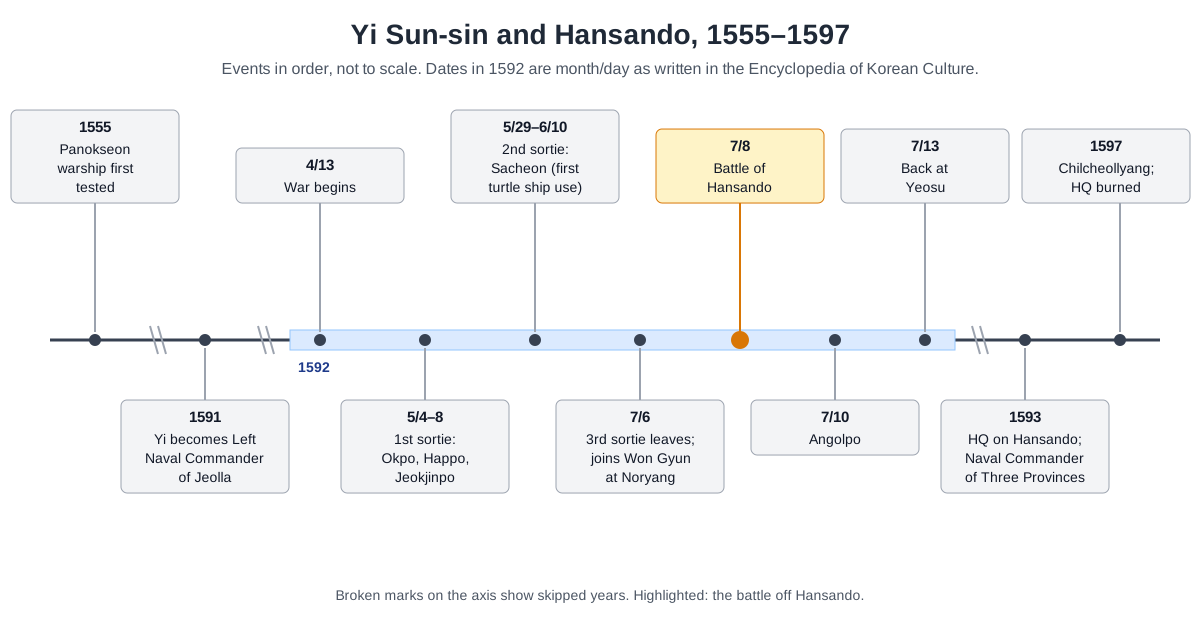
The Japanese navy did not stand still. After these defeats, Wakisaka (脇坂安治) added troops and led 73 ships toward Geoje Island, and Kuki (九鬼嘉隆) followed with 42 ships. The battle of Hansando was fought against this regrouped Japanese navy.
From the 6th to the 8th day of the 7th month
On the 5th day of the 7th month, Yi and Yi Eok-gi gathered 48 warships of the two Jeolla fleets off the home base at Yeosu and drilled together. The next day they left the base and reached Noryang, where Won Gyun joined with 7 ships, making 55 warships from the three provinces. The Imjin War entry says instead that the two commanders left that day with more than 90 ships. What kinds of boats went into either count is not spelled out.
On the evening of the 7th, the fleet reached the waters off Dangpo. There a herdsman named Kim Cheon-son told them that more than 70 Japanese warships were anchored at Gyeonnaeryang. On the 8th, from the waters off Hansando, they confirmed it: 36 large, 24 medium and 13 small ships, 73 in all, under Wakisaka.
From a narrow strait to open water
Yi judged that the area around Gyeonnaeryang was too narrow and rocky for his panokseon warships to move freely. He decided to draw the enemy out to the waters off Hansando and fight there. Five or six panokseon attacked the Japanese fleet first, and when it struck back, they pulled away toward Hansando and let it follow.
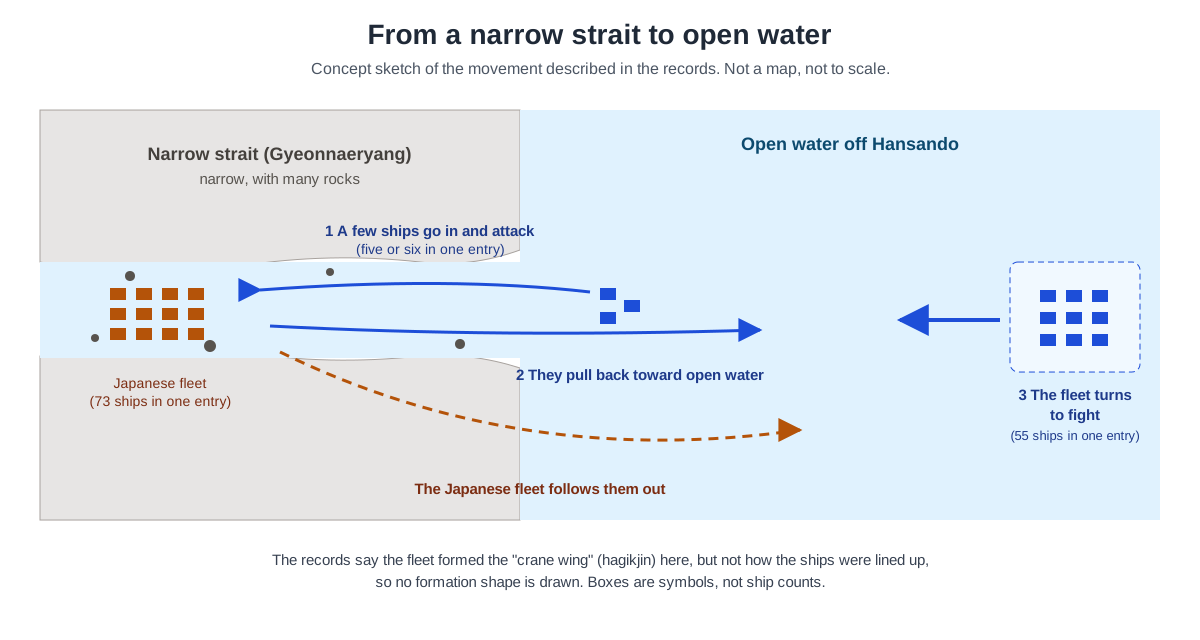
The old records tell the same basic story. In the Gukjo Bogam entry for the 25th year of King Seonjo, Won Gyun, confident after the earlier victories, wants to fight at once. Yi answers that the harbor is too narrow and shallow to fight in, so the enemy must be lured out to open sea. The commanders pretend to lose and fall back, the enemy chases them, and off Hansando the Korean ships turn and fight.
The Nanjung Japnok tells it a little differently: here the Korean ships meet 10 large and more than 70 medium and small Japanese ships at Gyeonnaeryang. A second volley shows no sign of breaking the enemy, so they fall back to the open sea off Hansando. There they go in together with the ships of all three provinces, beating the drums, and destroy nearly all of them. A note at the end of the passage says it was taken from another record, the Gyeongsang Sunyeongnok.
So two accounts survive side by side: one in which the enemy was lured out by plan, and one in which the fleet fought, pulled back and went in again. In both, the fleet left the narrow strait and won in open water.
The crane-wing formation: what the records say
Hagikjin (鶴翼陣) is explained as a formation set out like a crane spreading its wings, handy for surrounding an enemy. A note in the translation of the Nanjung Japnok also calls it one of the standard battle formations, laid out in the shape of a crane opening its wings.
All three encyclopedia entries say the formation was used at Hansando. In the Battle of Hansando entry, every warship attacks in the crane wing on Yi's order, and his men charge in firing guns such as the jija and hyeonja cannon. In the Imjin War entry, the fleet spreads into the crane wing and fires, breaking two or three ships first. When the enemy tries to flee, the whole fleet rushes in at once.
None of the three entries says how many lines the ships formed or what curve they made. The Hansando passages of the Gukjo Bogam and the Nanjung Japnok do not use the word at all; they describe only the pullback and the turn to fight. The sources read for this article do not show how the ships were arranged, so the diagram above does not draw it either.
The name was not used only at Hansando. The Nanjung Japnok says that in the 9th month of the same year, at a land battle near Seongju, Japanese reinforcements formed the crane wing and surrounded the Korean troops. It was a formation name used in accounts of land fighting as well.
The panokseon and its guns
The heart of the Korean fleet at Hansando was the panokseon. It was first tested in 1555, the 10th year of King Myeongjong, and the Imjin War came 37 years later. At that time, apart from a few turtle ships, the panokseon was the navy's only fighting ship; the rest were very small boats that served the warships or scouted.
The panokseon was a fighting ship with two decks, one above the other. The rowers worked between the lower and upper decks, out of the enemy's sight, while the fighting men stood on the wide, high upper deck. It weighed 140.3 tons and measured 8.74 m wide, 5.56 m high and 32.16 m long.
By the Imjin War the panokseon already carried more than 125 men. That was far beyond the old large maengseon, which held at most 80, or Japanese warships. Its height made it hard for enemies to climb aboard, and its guns sat high, where they had a better position to fire from. The panokseon became the base for the turtle ship and stayed the main warship into the late Joseon period.
The guns fired at Hansando survive in the record by name, such as the jija and hyeonja cannon. The Imjin War entry lists, after Yi's command, the sturdier build and stronger firepower of Korean warships compared with Japanese ones as a reason for the navy's string of wins. The ship's height and strength and the guns mounted on it worked as a pair.
Reading Hansando in numbers
The numbers for Hansando differ from source to source. The Korean fleet is 55 ships in the Battle of Hansando entry and in the entry on the Hansando historic site, but more than 90 in the Imjin War entry. The Japanese fleet is 73 ships in the Battle of Hansando entry and more than 70 in Kim Cheon-son's report. The Nanjung Japnok gives 10 large plus more than 70 medium and small ships.
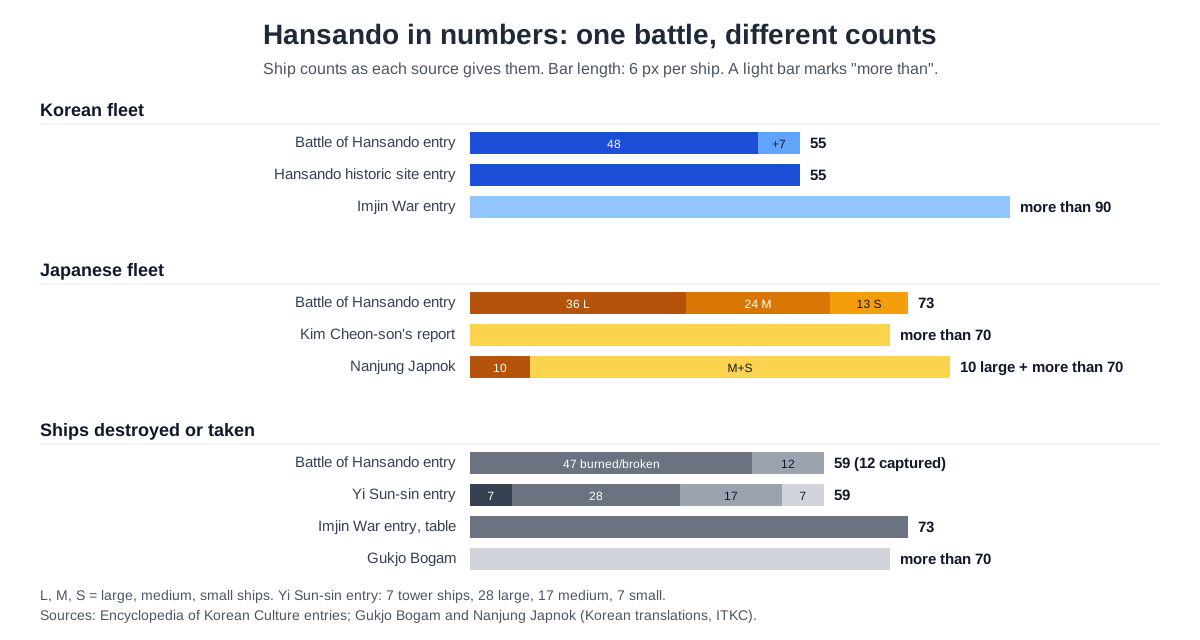
The results are not even counted the same way. The Battle of Hansando entry has 47 burned or broken and 12 captured; the Yi Sun-sin entry lists 7 tower ships, 28 large, 17 medium and 7 small ones destroyed. The categories differ, but both add up to 59 ships. The battle table in the Imjin War entry says "73 Japanese ships destroyed," and the Gukjo Bogam says "more than 70 enemy ships destroyed without exception."
The ships that got away are more than 10 in the Imjin War entry and 10 in the Nanjung Japnok. More than 400 survivors left their ships and fled to nearby land. The Korean navy had dead and wounded but lost no warships. The Gukjo Bogam adds, as word passed on from the Japanese camp, that 9,000 Japanese soldiers died at Hansando; this is a rumor the writer heard and wrote down.
Angolpo, and what remained on Hansando
After the battle the fleet stayed at Gyeonnaeryang and set out again on the 9th. At Angolpo lay the fleets of Kuki and Kato (加藤嘉明), who had planned to work with Wakisaka. In the Imjin War entry, the fleet destroys every enemy ship at Angolpo from the 10th until dawn the next day.
In the Yi Sun-sin entry, the water is too shallow and the enemy will not come out to be lured. The commanders take turns attacking all day and burn nearly all the large ships. The Nanjung Japnok says more than 100 Korean ships fought more than 70 enemy ships there but could not destroy them all.
The fleet returned to Yeosu on the 13th. On this third sortie it destroyed or captured about 100 enemy ships, but Korean losses were not small either. The Imjin War entry holds that the battles of Hansando and Angolpo gave Korea control of the sea and blocked a Japanese advance into the west coast. The Battle of Hansando entry likewise judges that the battle nearly destroyed the main Japanese naval force and defeated the plan to advance by land and sea together.
The battle is counted, with the battles of Jinju Fortress and Haengju, as one of the three great victories of the Imjin War. For Hansando and Angolpo, Yi was raised to Jeongheon daebu, a senior second rank, and Yi Eok-gi and Won Gyun to Gaui daebu, a junior second rank. The Battle of Hansando entry places Angolpo "one day after" Hansando, which does not match the 10th given in other sources.
Hansando then became the navy's base. In the 7th month of 1593, Yi set up his headquarters there, and in the 8th month he became Naval Commander of the Three Provinces. For 3 years and 8 months he ran the camp from the island, farming garrison fields and making weapons and warships.
In 1597, during the second invasion, Bae Seol, Right Naval Commander of Gyeongsang, set fire to the headquarters and left it in ruins. That same year, at the battle of Chilcheollyang, Yi Eok-gi was killed along with Won Gyun, Choe Ho, the naval commander of Chungcheong, and others.
Today Hansando holds the Jeseungdang hall, the Chungmusa shrine, the Hansanjeong pavilion and a watchtower, among other buildings. In 1740 the naval commander Jo Gyeong set up a memorial stone on the old site, and the present Jeseungdang was rebuilt in 1932 by local leaders of Tongyeong. According to the Korea Heritage Service, the site was designated a Historic Site on January 21, 1963 and covers 528,027 ㎡.
What to read next
- "The Imjin War at a Glance: Seven Years from 1592": where Hansando sits in the seven-year war.
- "The Battle of Myeongnyang: Thirteen Ships and the Uldolmok Strait": Yi's later battle as commander again, read the same way.
- "The Turtle Ship: What the Records Confirm and What We Don't Know": the ship built on the panokseon, seen through the records.
- Destroyers and frigates: why warships have different names: how warship names and types came about.