In September 1940, a British mission crossed the Atlantic to the United States. In its baggage was one of Britain's most closely guarded technical secrets: a 10 cm cavity magnetron, a kind of vacuum tube. Descendants of this device, a solid copper block with a few holes drilled into it, still run inside kitchen microwave ovens today.
Why was a drilled block of copper so precious? On the eve of World War II, radar meant huge fixed stations hung from masts more than 100 m tall. This article follows the public record on what held that radar back and how the cavity magnetron got past the barrier. It also looks at how different institutions handle the claim that "radar won the war."
The fear of bombers and the return of radar
Through the 1920s, aircraft kept getting bigger, faster and able to fly farther, and it was plain they would matter greatly in any future war. Bombing was the main worry. A line spoken in 1932 by British Prime Minister Stanley Baldwin was widely known: "the bomber will always get through."
That fear revived an old, neglected idea. A radar sends out a pulse of radio waves and listens for the echo from a distant object. Radio waves travel at the speed of light, so the time between sending the pulse and hearing the echo gives the distance. The principle is covered in more detail in Radar: measuring distance and motion with radio waves.
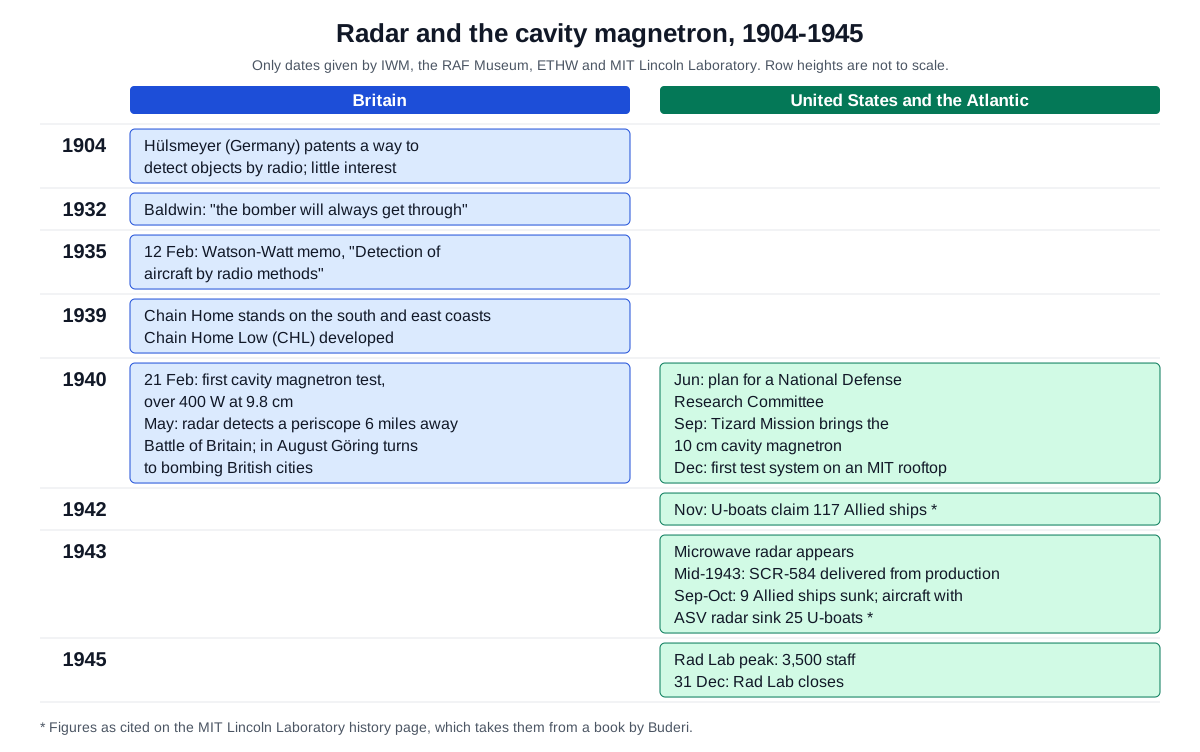
The idea itself was old. A German inventor, Christian Hülsmeyer, received a patent for such a device in 1904, yet hardly anyone paid attention. In the late 1930s, as the threat of air attack grew, teams in no fewer than eight nations built radar on their own. The list ran from France, Germany, Italy and Japan to the Netherlands, the USSR, Britain and the U.S.
In Britain, a memo by Robert Watson-Watt went out on 12 February 1935 under the title "Detection of aircraft by radio methods." Hanbury Brown later called it "the birth certificate of radar." Imperial War Museums (IWM) credits British scientists and engineers of the 1930s with first making radar practical, though radar had actually been invented in Germany.
Chain Home: long waves and tall masts
When war broke out in September 1939, a line of early warning radar stations already stood along Britain's south and east coasts. This was Chain Home (CH). Britain needed it fastest of all, so the system was built to run at 25 MHz, and its antennas looked much like those of a shortwave broadcaster.
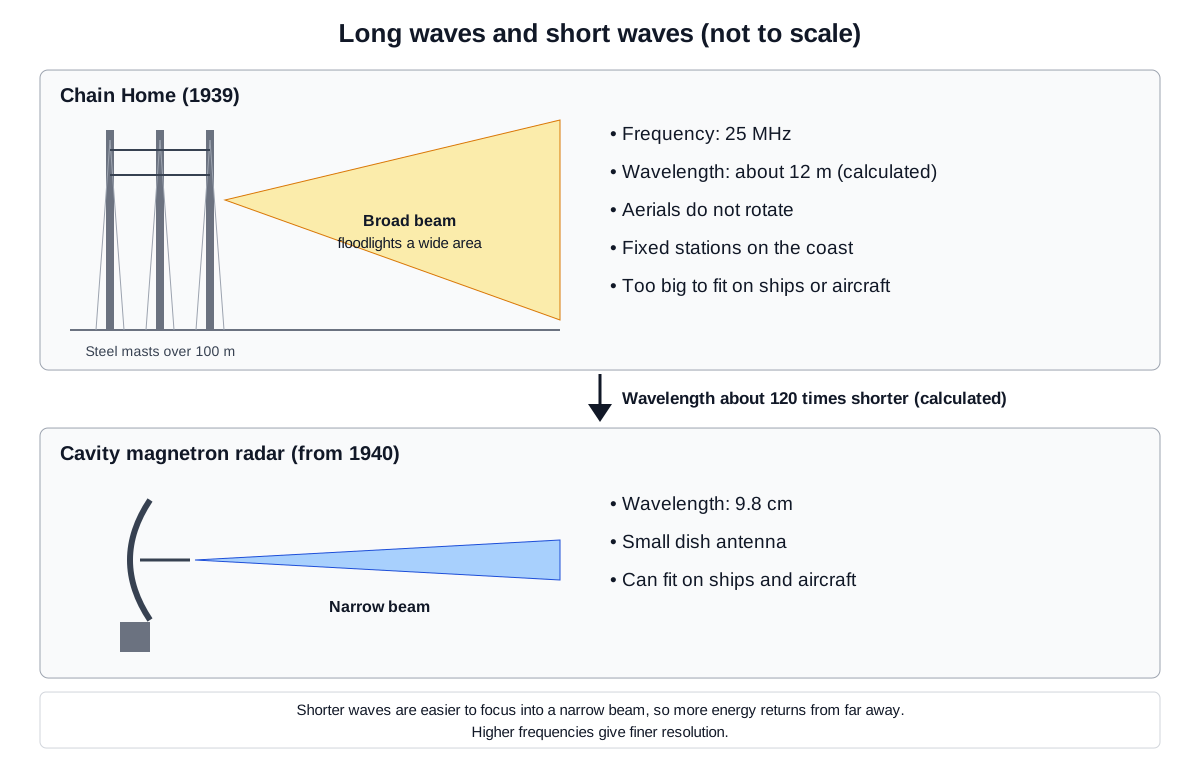
Dividing the speed of light by a frequency of 25 MHz gives a wavelength of about 12 m. Waves that long needed big antennas. Chain Home stations were huge fixed sites with steel transmitter masts more than 100 m tall. The station at Poling in Sussex had three 110 m steel transmitter towers and four 73 m wooden receiver towers.
Unlike modern radars, the Chain Home aerials did not rotate; they sent out radio pulses in a broad beam that lit up a wide area all at once. Sources give different detection ranges. IWM says the stations could pick up incoming aircraft at 80 miles. The RAF Museum says that sites on cliffs and high ground could reach as far as 320 km (200 miles).
Aircraft flying low could slip under Chain Home, so a low-level version, Chain Home Low (CHL), followed in 1939. CHL swept a narrow beam with a turning aerial. It gave no height reading, yet it could spot aircraft flying at 152 m out to 177 km. By 1940, with CHL stations added, the chain was complete.
Radar did not fight alone. The Dowding System, named for Fighter Command's Commander-in-Chief Hugh Dowding, joined technology, ground defenses and fighters into one network. Radar let operators estimate the range, bearing, strength and height of incoming raids, and that information passed through Fighter Command headquarters to the whole network.
The limits were real. Radar was not always accurate and did not give a complete picture, so the Observer Corps, who watched the skies by eye, added more information. Results depended heavily on the skill and judgment of the operators reading the signals. Chain Home faced out to sea, so bombers that had crossed the coastline dropped out of radar view.
Even so, radar meant fighters no longer had to patrol the sky nonstop, which gave exhausted aircrews room to breathe. Germany attacked some stations, but only Ventnor on the Isle of Wight was out of action for any significant time, and Germany never concentrated on destroying radar sites. In August 1940, Hermann Göring judged those attacks ineffective and decided to focus on bombing British cities.
Holes drilled in a copper block
Chain Home did its job reasonably well, but its long waves tied it to towers on the coast. A radar small enough to fit on a ship or an aircraft needed much shorter waves: microwaves. Yet as of 1939, nobody had a way to produce the strong microwaves that a long-range radar would need.
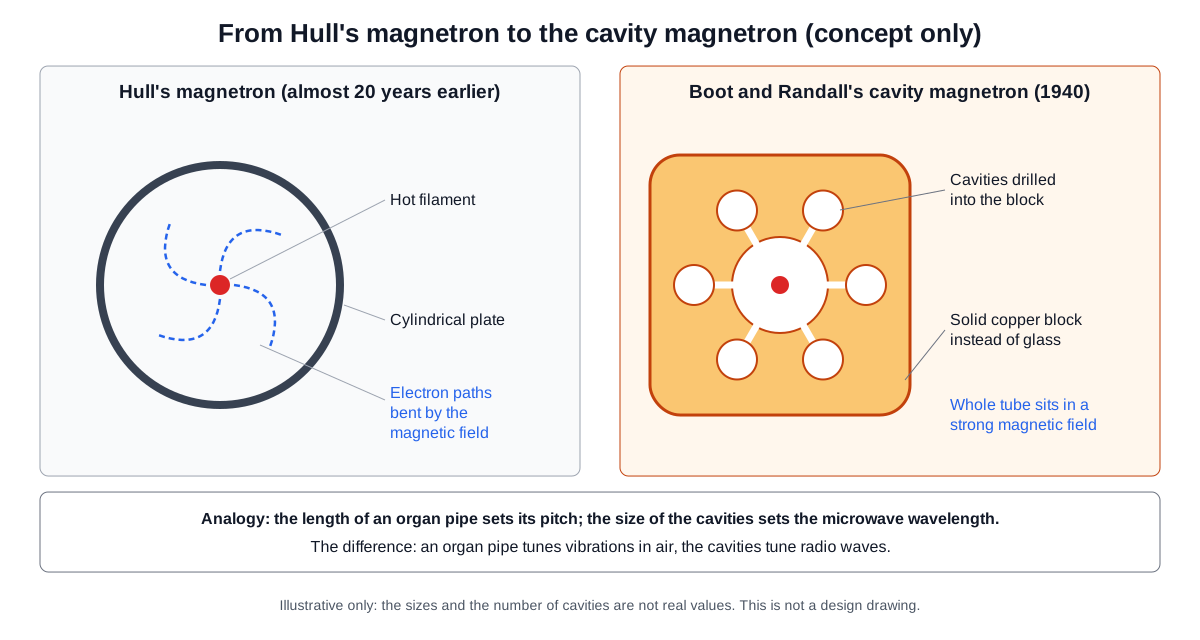
The starting point was a tube called the magnetron, which the American A. W. Hull had come up with close to two decades before. His tube had a hot filament and a cylindrical plate around it.
Hull applied a magnetic field that bent the paths of the electrons, and he could control the current reaching the plate by changing the field strength. Still, the tube found little real use.
At the University of Birmingham in England, Harry Boot and John Randall took up the problem under the direction of the Australian physicist Mark Oliphant. They drew together ideas from researchers in the United States, Denmark, France and Japan. They wanted a magnetron that could take high power and turn out microwaves efficiently.
Most tubes of the time were sealed in glass. Boot and Randall instead made the body of their tube from one solid piece of copper, a metal that carries heat away well, and drilled holes called cavities into it. Then they placed the whole tube in a strong magnetic field.
An organ pipe's length decides the note it plays, and in the same way the size of the cavities sets the wavelength of the microwaves. The difference is that an organ pipe tunes vibrations in air, while the magnetron's cavities tune the wavelength of radio waves.
On 21 February 1940, the two men switched on their first working cavity magnetron. It gave more than 400 W at a wavelength of just 9.8 cm. No one had ever reached close to that much power at such a short wavelength; it was almost a hundredfold jump.
At 9.8 cm, the wave was roughly 120 times shorter than Chain Home's 12 m. By May, other researchers had built the magnetron into a radar able to pick out a submarine periscope 6 miles away.
A secret across the Atlantic and the MIT Rad Lab
The United States was moving too. In June 1940, Vannevar Bush, MIT President Karl Compton and Harvard President James Conant proposed to President Roosevelt that a national committee for defense research be set up. The work on detecting aircraft and ships was quickly narrowed to microwaves and handed to a committee led by Alfred Loomis.
What the committee found was discouraging. Microwaves looked useful in theory, but no microwave source in the desired frequency range was powerful enough.
In September 1940, Britain sent a mission led by Henry Tizard across the ocean. It carried the 10 cm cavity magnetron, one of Britain's most prized technical secrets, and persuaded the United States to begin large-scale development. Over three weeks, the Loomis committee and the British team sketched out the main shape of a radar program.
The laboratory was set up at MIT. Lee DuBridge, who had worked in nuclear physics at Rochester, became director, and Isidor I. Rabi became associate director.
It was named the Radiation Laboratory, or Rad Lab. The name was chosen on purpose to make outsiders think it worked on nuclear physics. By December 1940, a simple test system was already running on the roof of Building 6 at MIT.
The lab grew fast. At its 1945 peak it had 3,500 staff and spent nearly $4 million each month. The MIT Lincoln Laboratory history page says the Rad Lab developed more than 100 radar systems and that industry built $1.5 billion worth of radar from its designs.
Its output ranged from bombing radars for aircraft and search radars for ships to coastal and harbor radars and gun-aiming radars. It also produced landing guidance radars, identification friend-or-foe beacons and the LORAN navigation system.
What microwave radar changed
What made short waves better? Shorter waves are easier to focus into a narrow beam, so more energy comes back from a distant object. More important, higher frequencies give finer resolution. Aiming anti-aircraft guns and long-range naval guns by radar alone, or drawing the ground below an aircraft on a screen, required microwaves.
Getting from the lab to the battlefield took time. It took a year to go from the British laboratory magnetron of mid-1940 to the Rad Lab's first 10 cm experimental tracker. A further year produced the XT-1 field test model, and by the middle of 1943 production SCR-584 sets were reaching users. Microwave radar appeared in 1943, after the magnetron became a high-power device that could be mass-produced.
Most of the war's air and sea fighting still relied on radar working at UHF or lower frequencies. Early U.S. sets ran at 200 MHz, and when the United States joined the war it had the 105 MHz SCR-270 and the 205 MHz SCR-268. An SCR-270 picked up the aircraft heading for Pearl Harbor, but the command and control system around it failed; both facts belong to the story of the period.
During the war, radar found dozens of uses. It first aimed searchlights, then anti-aircraft guns.
On ships it helped with navigation at night and in fog, with finding enemy ships and aircraft, and with directing gunfire. In aircraft it found hostile planes and ships, helped navigation and located bombing targets. Military weather forecasters even followed storms with it.
The MIT Lincoln Laboratory history page names two of the Rad Lab's most critical contributions. One was microwave early-warning (MEW) radar, which it says all but cancelled the danger the V-1 posed to London. The other was air-to-surface vessel (ASV) radar, which it says turned the tide against the U-boat threat.
The page also cites figures from a book by Buderi. In November 1942, U-boats sank 117 Allied ships. In September and October 1943, the toll fell to 9 Allied ships, while aircraft carrying ASV radar sank 25 U-boats.
Radar was also made very small during the war. The proximity fuze put a tiny radar set in each artillery shell so that it would burst near its target. Roughly 22 million were made before the fighting ended. The principle is in Proximity fuzes: working without a direct hit.
The other side was not idle either. German engineers also developed radars, and perhaps the most important, the Würzburg type, used a dish antenna 8 m wide as part of a system to detect incoming aircraft.
"Radar won the war"?
The phrase comes up often. The MIT Lincoln Laboratory history page notes a common saying: the atomic bomb brought the war to a close, but radar won it. Compton himself called the Rad Lab "the greatest cooperative research establishment in the history of the world." There is also the view, held by many historians, that the magnetron's advantage made a real difference across many stages of the war.
Others take a step back. The World War II radar page of the IEEE's Engineering and Technology History Wiki (ETHW) calls it an overstatement to say radar handed the Allies their victory. It adds that radar did have a huge impact on how both sides fought.
The emphasis also differs for the Battle of Britain. According to ETHW's radar page, Chain Home's warnings bought time for Britain's limited air defenses, and the view that radar turned the tide is widely accepted.
IWM says what really gave Britain the edge was Germany's failure to recognize how vital radar was. The RAF Museum leaves it as a question: was it radar, or Göring's failure to see its importance, that brought the British victory?
Placed side by side, these accounts share one thing. Talk of radar's role covers not only the equipment but also the people who read the signals and the judgment of the other side.
After the war: from kitchens to lasers
The Rad Lab closed on 31 December 1945, and most of its staff went back to universities. The magnetron stayed. Since the war, most of the magnetrons that matter for making microwave power, the ones in kitchen ovens among them, have been cavity magnetrons.
Wartime radar research also led toward the laser. Charles H. Townes was on the staff of Bell Labs between 1933 and 1947 and spent much of World War II designing radar bombing systems. After the war he took the microwave methods developed for wartime radar and applied them to spectroscopy.
Townes conceived the maser in 1951, and in early 1954 his group became the first to amplify and produce electromagnetic waves using stimulated emission.
In 1958, working with Schawlow, he showed in theory that masers could work in the optical and infrared range, the step that opened the road to the laser. What is a laser? How it differs from a light bulb explains what a laser is.
What to read next
- Radar: measuring distance and motion with radio waves: how round-trip time and the Doppler effect give distance and speed.
- Phased arrays and AESA radar: steering without moving: the radar that came after masts and dishes.
- Proximity fuzes: working without a direct hit: a closer look at the tiny radar inside a shell.
- Turning points in military technology: the big forks in weapons technology that followed radar.
- Lasers and high-power microwaves: two kinds of directed energy: how microwaves and lasers meet again in today's weapons technology.
- The Battle of Britain: An Air Defense Built on Radar and Control: how Chain Home and the Dowding System worked in real combat.
- The Battle of the Atlantic: The Long Fight Between U-Boats and Convoys: the sea war where ASV radar took part.