The Imperial War Museums (IWM) in London keep an old walking stick. It belonged to Morgan Jones, who had kept the accounts at Rangoon Zoo. In 1942 he leaned on it for 600 miles, walking from Rangoon to Imphal in India over mountains and rivers.
Hundreds of thousands of refugees left Burma that year. Hunger, exhaustion and disease killed a terrible number of them in the monsoon rain. Yet two years later, at that same Imphal, a major Japanese offensive broke. The surrounded troops held on with supplies that came down from the sky, not along the cut roads.
IWM dates the Burma Campaign from 1941 to 1945 and calls it the longest land campaign Britain fought in the Second World War. In jungle and mountains with almost no roads, how did feeding and moving an army shape the outcome? This article follows the retreat, the rebuilding, air supply, the sieges of Imphal and Kohima, and the reconquest of 1945.
Why Burma?
Burma is today's Myanmar. Once part of British India, it became a British crown colony in 1937. A wide plain lies at its center, but high, jungle-covered mountains wall its borders.
Britain valued Burma as a source of raw materials. Japan and China went to war in the 1930s. After that, roads and railways running from the capital, Rangoon, carried US military aid to the Nationalist Chinese army in Yunnan, in southwest China. The Burma Road, Britain's single overland supply link with China, crossed the country too.
Japan saw the same route from the other side. Taking Burma could cut China off from outside help. According to the National Army Museum (NAM) timeline, Japan's Fifteenth Army moved in to guard the flank of its earlier conquests and to sever the US supply line to China.
The land and the weather took part in this war too. Troops on both sides faced harsh jungle, steep ground, monsoon rain and disease. Burma's monsoon starts in May and runs to October.
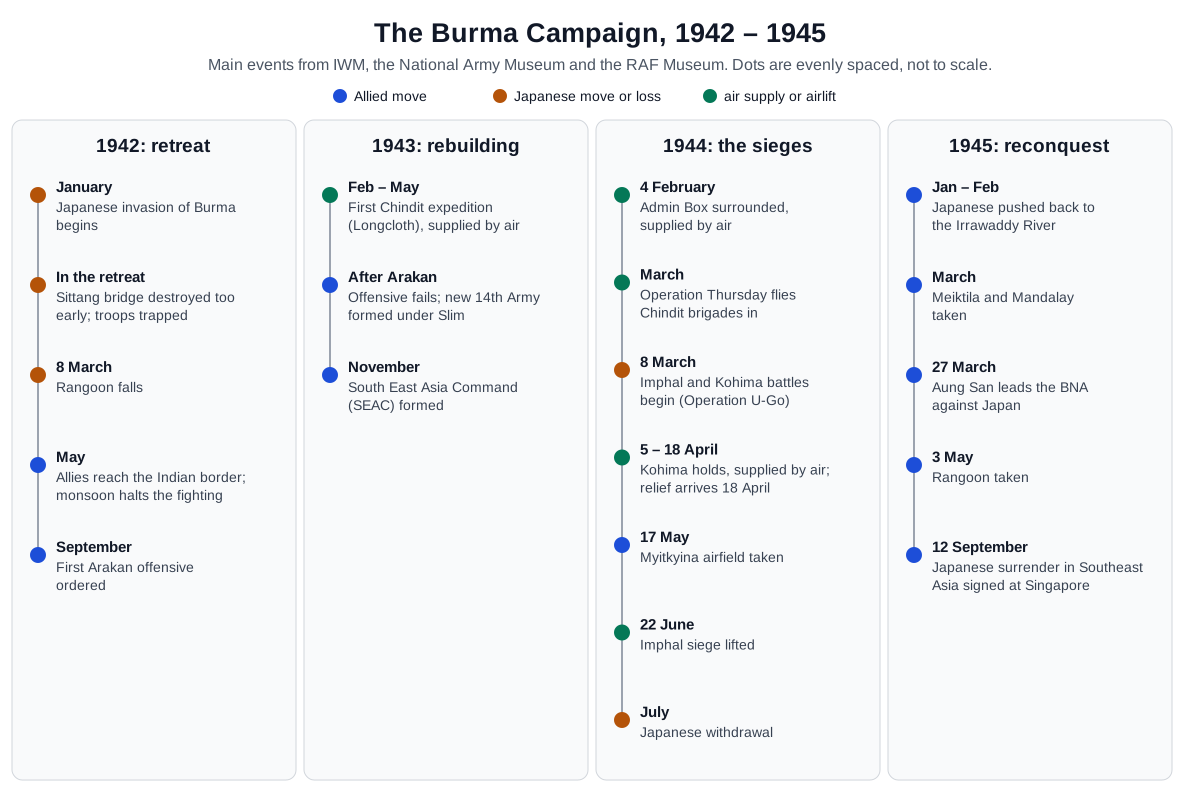
1942: the long retreat to India
Japan invaded Burma in January 1942. Britain had only two divisions there, both below full strength. During the confused withdrawal, the bridge over the Sittang River was blown too soon, and thousands of Indian soldiers were left stranded on the wrong bank. Rangoon, the capital, fell on 8 March.
The Allies pulled north, hoping to hold central Burma. Chinese Fifth and Sixth Armies joined them and took the eastern end of the line. In the end, though, the Allies fell back toward India, along with hundreds of thousands of civilians.
It was a five-month fighting retreat over 1,000 miles (1,600 km) of hard country. NAM calls it the longest retreat Britain's army has ever made. In May 1942 the Allies crossed into India, and the monsoon soon stopped the fighting.
India had its own crisis. Famine was starting to spread in Bengal, and in the end it took 2 to 3 million lives.
1943: failure and rebuilding
The first counterattack came on the coast. In September 1942, General Archibald Wavell, then commanding in India, sent troops into the coastal Arakan to seize the Japanese airfields on Akyab Island. There, British and Indian troops ran into Japanese bunkers for the first time and found no way to deal with them. The bunkers were so tough that British officers mistook them for concrete.
IWM treats the Arakan failure as the alarm bell the Allies had to hear. The forces were reorganized into a new 14th Army under General William Slim. Rebuilding morale went hand in hand with strict new rules against disease and fresh methods in logistics. In November 1943, Admiral Louis Mountbatten's South East Asia Command (SEAC) took charge of operations.
That February also brought a very different experiment. Brigadier Orde Wingate took the Chindits into Burma for the first time, in Operation Longcloth. The goal was to upset Japanese supply lines and to try out long-range raids deep behind the front.
Seven columns walked in behind the Japanese. They wrecked bridges and railways and stirred up the rear until they pulled out in May, with all their supplies coming by air. IWM judges that the raids did little militarily but mattered a great deal for morale. They showed that soldiers supplied from the air could survive in the jungle and still fight.
The price was high. Many Chindits were killed or wounded, and many fell sick.
Supply by air
Group Captain Deryck Groocock flew Dakota transports in Burma. At a 1995 symposium of the RAF Historical Society, he called himself "a very reluctant Dakota pilot." In his account, once the Allies controlled the air, they could keep ground troops supplied almost entirely by aircraft. In a land with hardly any railways, roads or rivers fit for boats, that was vital.
Supplies reached the troops in two ways. In air landing, the aircraft touched down and unloaded; in air dropping, the load fell from a plane in flight. Planes landed at existing airfields when they could, and sometimes on strips the troops had cleared themselves. Groocock said none of it could have been done without a plane like the Dakota, and he gave credit to ground crews who worked long hours in a punishing climate.
Views of the monsoon changed too. Before 1944, fighting through the rainy months from May to October was usually thought impractical. In 1944 that view changed.
So did the policy. In the past, British troops withdrew when the Japanese cut their supply lines, and fighting nearly stopped in the rains. Now troops were to stay put when cut off, live on air supply, and keep fighting in the worst conditions. Slim had his units form defensive "boxes," so that a surrounded force could be fed from the air.
The Arakan fighting of February 1944 is one example. Japan attacked on 4 February. Counting on captured supplies, Japanese troops surrounded British forces at Sinzweya, a position that became known as the "Admin Box." The British dug in instead of pulling back and were supplied from the air.
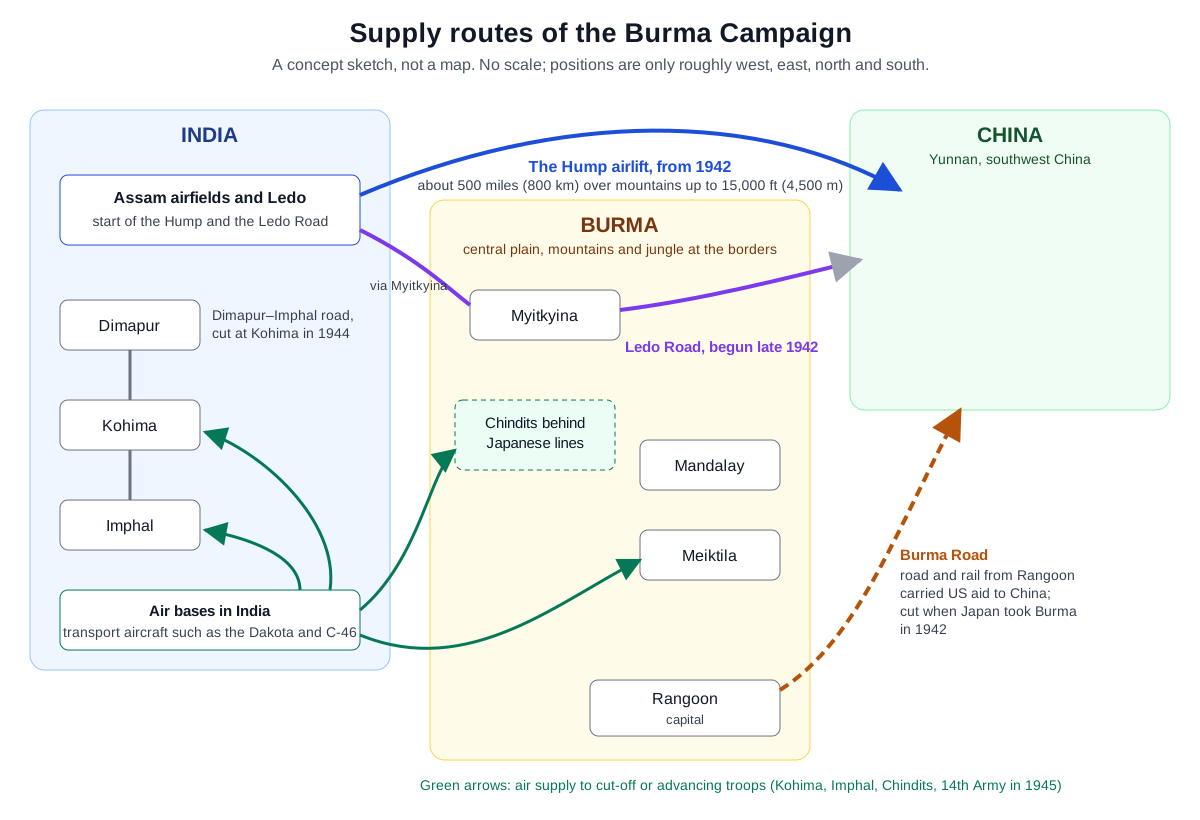
Once the Burma Road was lost, the way to China lay in the air, on a route from Assam over Yunnan's rugged mountains known as "the Hump." An RAF Museum exhibition gives the distance as only 500 miles (800 km). But the flight crossed the 15,000 ft (4,500 m) Santsung Range, near the ceiling of a fully loaded transport. A researcher's article from the same museum names the range as the Patkai mountains.
The route was dangerous. Storm clouds could shake an aircraft hard enough to break it, and a crew that came down in the remote jungle had little chance of being found.
Even so, the cargo grew fast. The US Air Transport Command delivered just 85 tonnes in July 1942, but in July 1945 alone, 71,000 tonnes reached China by air. Over the whole airlift, American transports carried 650,000 tonnes of fuel, ammunition and other goods.
A land route was built as well. From late 1942, the United States pushed a road out from Ledo in Assam, and it grew into a 1,079-mile highway. According to The National WWII Museum, about 250,000 troops served in the China-Burma-India (CBI) theater; 15,000 of them worked on the Ledo Road, and 60% of those were African Americans. The museum adds that the Hump airlift helped but could not meet the need over time.
In March 1944 the Chindits went back in. Their second operation, Operation Thursday, was six times the size of the first, with around 23,000 men. This time British and American transports carried the lead units of two brigades behind Japanese lines.
Groocock recalled that the first lift was timed for the night of 5/6 March, with three landing sites planned. A final check showed one site blocked, so all landings went to a single site, and many gliders were lost. Still, an airstrip was made, and Dakotas were soon flying in men, mules and supplies on a steady schedule.
The US First Air Commando Group, set up in March 1944, gave the Chindits air cover, strike power and transport. It even had a few Sikorsky R-4 helicopters. Wingate was killed when his plane crashed on 24 March, and afterward the Chindits were pulled into grinding infantry battles they had not been equipped or trained to fight.
In the north, American infantry also marched through the jungle: the 5307th Composite Unit (Provisional) became "Merrill's Marauders," after Brigadier General Frank Merrill, who led it. It first saw action in February 1944 and took Myitkyina airfield on 17 May. It helped capture the town on 3 August and was disbanded within days, in early August. The jungle had hurt it as badly as the enemy.
Myitkyina fell to the X Force, led by the American general Stilwell, working with the Y Force, Chinese divisions that had come south from China. That opened the way to reopening the Burma Road.
1944: Imphal and Kohima
Operation U-Go began in March 1944, when Japan's Fifteenth Army struck at India's northeast frontier. Japan wanted to get ahead of an expected British push into Burma. The plan was to take the British supply depots on the plain around Imphal and to sever the Dimapur–Imphal road at Kohima. Holding Imphal would also let Japan threaten the air supply to China.
The plan came from Lieutenant-General Renya Mutaguchi, who commanded three Japanese divisions and one division of the Indian National Army. The battles lasted from 8 March to 18 July 1944.
The defenders brought in troops by air. The whole 5th Indian Division, with its equipment, flew from the Arakan to Imphal within two days. The RAF Museum timeline counts 748 sorties for this lift, while Groocock gives 758.
At Kohima the fighting took place on a small ridge. IWM puts the defenders at only 1,500, a hastily gathered force facing 15,000 Japanese troops. NAM says Colonel Hugh Richards hastily put together a fighting force from a garrison of 2,500, many of whom were not combat troops. It kept a tight ring around Garrison Hill.
From 5 April to 18 April, the fighting at Kohima was among the fiercest close combat of the war. At one point the two sides were only a tennis court's width apart. When the British 2nd Division broke through with relief on 18 April, the defenders held an area just 350 meters square.
Cut off in early April, the garrison had to live on what aircraft dropped to it. An IWM photograph of FSD Hill shows trees draped with torn supply parachutes.
Imphal had been surrounded since 5 April. Four Indian divisions (5th, 17th, 20th, 23rd) held on, and on 22 June the relief force reached IV Corps there and ended the siege. According to NAM, the RAF carried in close to 19,000 tons of stores and more than 12,000 troops during the battle, and flew about 13,000 casualties out.
A Japanese voice survives too. In 1945, Major-General Ichida of the Japanese Army said that Allied air supply let ground forces in Burma hold their positions without retreating. That, he said, made Japanese infiltration and encircling tactics useless.
The Japanese plan depended on seizing Allied stores fast. When that failed, the soldiers starved in the hills. IWM puts Japanese losses by the July 1944 withdrawal at upwards of 50,000 casualties, most from hunger and disease. NAM says that of the Fifteenth Army's 85,000 men, 53,000 were killed or went missing.
British casualties came to 12,500 at Imphal and another 4,000 at Kohima.
1945: across the Irrawaddy to Rangoon
In January and February 1945, Slim's 14th Army drove the Japanese back to the Irrawaddy River. XXXIII Corps headed for Mandalay, while IV Corps raced for Meiktila behind Japanese lines. IV Corps fought its way out of its river bridgehead and captured Meiktila, a key Japanese supply base. IWM calls this the longest river crossing made against opposition in the Second World War.
When Mandalay fell in mid-March, most of the Japanese army in Burma had already been broken. The Allies then hurried south. In early May, with IV Corps only 30 miles (48 km) away, Rangoon was taken by forces arriving from the air and the sea. The date was 3 May, just before the monsoon.
IWM curator Ian Kikuchi explains that in this phase Slim joined air power to his armor, artillery and infantry operations. Aircraft gave close support, carried supplies, and put troops wherever they were needed. Deception hid his intentions.
Air supply carried on through the advance. In Groocock's account, daily deliveries peaked at 1,800 tons, over twice what had been planned. Between 2 January and the fall of Rangoon on 1 May, 14th Army got 210,000 tons by air. Over the same months, road convoys brought just 5,500 tons and boats on the Chindwin River 38,700 tons.
Burmese loyalties shifted as well. In 1942 Japan trained and armed the Burma Defence Army, led by Aung San. In August 1943 it was reorganized under a new name, the Burma National Army (BNA). On 27 March 1945, after secret contacts with the Allies, Aung San turned the BNA against Japan in a revolt across the country.
The revolt came just as the Allies pushed into central Burma, and it marked a turning point in which side Burma stood on. On 12 September 1945, in Singapore, Mountbatten accepted Japan's surrender of its forces across Southeast Asia.
The numbers and the memory
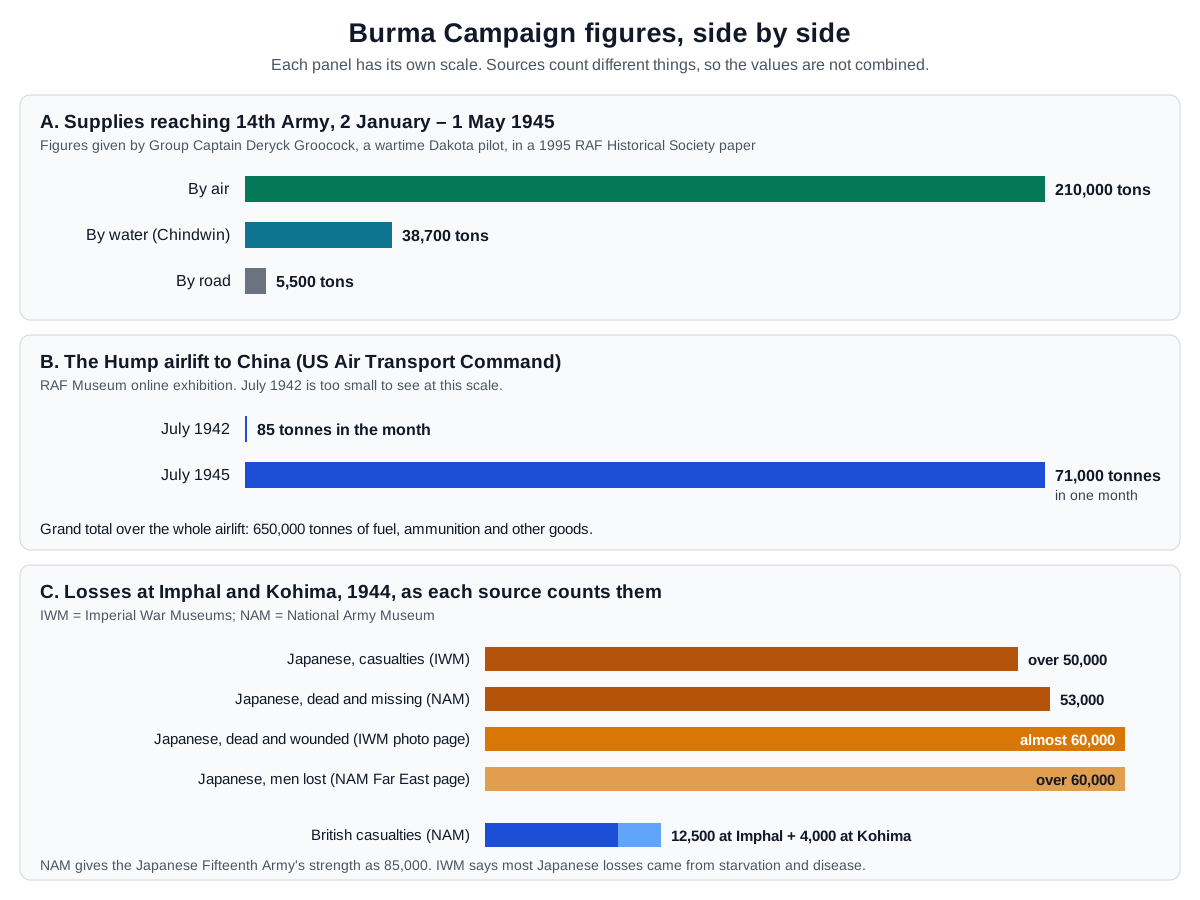
Numbers from this campaign need careful reading. For Japanese losses at Imphal and Kohima alone, an IWM photo page gives "almost 60,000 dead and wounded," and the NAM Far East page says "over 60,000 men." Set beside the "upwards of 50,000 casualties" and "53,000 dead and missing" above, the totals change with what was counted.
The campaign became known as the "Forgotten War," and its soldiers as the "Forgotten Army." NAM explains that it was far from what most people at home lived through and was often pushed aside in the newspapers of the time. Kikuchi notes that London lies more than 5,000 miles from Rangoon and that few people in Britain were touched by events in India and Burma.
Most of 14th Army's fighting men were Indian or African. Kikuchi says their part has often been overlooked in Britain since the empire ended. Remembering Burma, he adds, means remembering that Britain fought not only to free Europe but also to keep, and win back, its Asian empire.
More than 1,400 men of the Commonwealth forces now lie in Kohima War Cemetery. Over 900 Hindu and Sikh soldiers, cremated as their faith required, are named on the Kohima Cremation Memorial inside the grounds. The outline of that tennis court can still be seen in the earth.
The 2nd Division Memorial carries these words: "When you go home, tell them of us and say, for your tomorrow, we gave our today." Beyond the numbers lie other stories as well, of civilians who fell on the refugee road and of Japanese soldiers who starved in the hills.
Burma became independent on 4 January 1948. Earlier, on 19 July 1947, Aung San and several fellow Executive Council members were killed in an assassination organized by his political rival U Saw. In October 1947, a treaty between Britain and Burma settled the handover of power and the conditions of independence.
What to read next
- Military logistics: performance must be sustainable: sets the work that air supply did in Burma, supply, movement and maintenance, in today's terms.
- Turning points in military technology: a timeline of moments that changed military technology, from radar and the proximity fuze to drones, ending with where laser weapons fit.
- World War II Logistics: The Red Ball Express and Supply: how truck convoys kept supplies moving on the European front.